The Fox And The Horse
A farmer had a horse that had been an excellent faithful servant for many years. At length the horse grew old and worthless, and the farmer wanted to get rid of him without giving anything.
The Fox and the Horse (German: Der Fuchs und das Pferd) is one of the quieter and more morally pungent of the household tales gathered by Jacob and Wilhelm Grimm. Catalogued as KHM 132 in the Kinder- und Hausmärchen, it entered the canon in the second edition of 1819, supplied to the brothers from a Mecklenburg dialect source preserved in the so-called Mecklenburger Märchen tradition. Folklorists classify it under Aarne–Thompson–Uther type ATU 47B (The Horse Kicks Wolf in the Teeth), with strong structural ties to ATU 103 (the cunning trickster who promises a feast and orchestrates the predator’s defeat). The standard English text is the rendering by Margaret Hunt (1884) in Grimm’s Household Tales; an earlier and freer version appears in Edgar Taylor’s German Popular Stories (1823), the volume that brought Grimm to the Anglophone nursery shelf.
Origins, Sources, and the Long Memory of an Old Trick
The tale belongs to one of the most widely diffused narrative families in European oral tradition: the cycle of stories in which a small clever animal — fox, hare, jackal, weasel — engineers the destruction of a much larger predator on behalf of an aged or beleaguered domestic animal. Beneath its short, almost epigrammatic surface, KHM 132 contains an entire moral economy. The Grimms’ immediate source was a North German dialect text from the Mecklenburg–Schwerin region, transmitted to them, according to their own notes (the Anmerkungen appended to the 1856 third volume of the Kinder- und Hausmärchen), through a chain of informants that included the von Haxthausen family of Bökendorf in Westphalia. The Haxthausens, a Catholic landed family on the Weser, supplied the brothers with many of the tales added between the first edition of 1812 and the second of 1819, and the Mecklenburg coloring of Der Fuchs und das Pferd survived their editorial smoothing only in the rough rhythm of its sentences and the brusqueness of its farmer.
The deeper genealogy of the tale runs much further back. The closely related fable The Old Hound (Perry 175) — in which an aged hunting-dog, beaten by his master for letting prey escape, defends himself by appealing to the dignity of past service — appears in nearly every collection of Aesopic material from antiquity onward, including those of Phaedrus (1st c. CE), Babrius (2nd c. CE), and the medieval Latin recensions later codified by Léopold Hervieux in his monumental Les fabulistes latins (Paris, 1893–99). The same moral pattern — the loyal servant cast off when no longer useful, only to triumph by stealth or by the kindness of a smaller ally — runs through the Sanskrit Pancatantra (Book III, “On Crows and Owls”), through the medieval beast-epic Roman de Renart, and into the eighteenth-century French verse fables of Jean de La Fontaine, whose Le vieux chien (Book VIII, fable 22) preserves almost exactly the Grimm tale’s pivot from despair to vindication. The pattern is so persistent that the great Finnish folklorist Antti Aarne singled it out in his 1910 catalogue as a foundational European narrative core, later refined by Stith Thompson and Hans-Jörg Uther in the modern ATU index.
For Jacob Grimm — already laying, in these same years, the philological foundations of what would become Grimm’s Law of consonant shifts in Germanic languages — a tale like Der Fuchs und das Pferd was not a piece of nursery décor but an artifact of cultural geology. Its survival across so many languages and centuries proved, to him, that the deep structure of folktale was as patterned and recoverable as the deep structure of speech itself.
The Cruel Word at the Gate
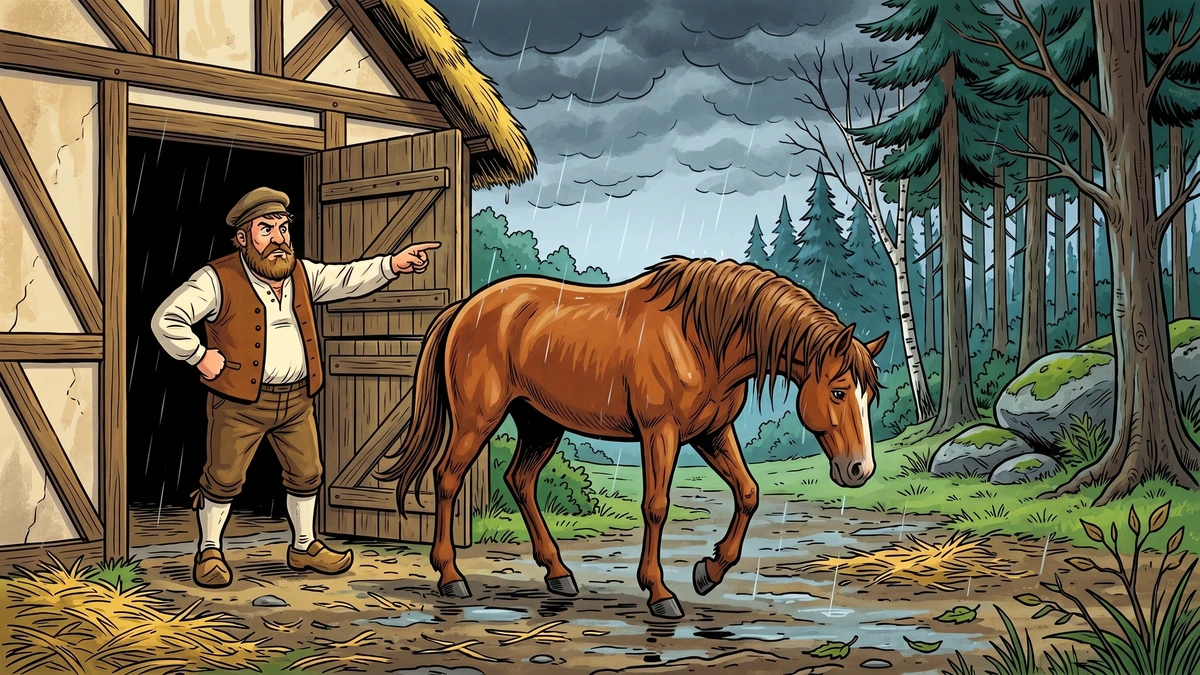
The story opens with one of the most economical injustices in the entire household-tales corpus. A farmer, the tale tells us, had a horse that had been an excellent and faithful servant for many years, but the animal was now grown too old to work. So the farmer — and here the German is unsentimentally direct — would give him nothing more to eat, and dismissed him with a sentence whose cruelty is sharpened by its mathematical precision: I want you no longer; take yourself off out of my stable. I shall not take you back again until you are stronger than a lion. He opened the door, and turned the horse adrift.
The injustice is double. First, the farmer denies the horse the bare maintenance owed to a long-serving animal in pre-industrial European agriculture, where the unwritten covenant between draught beast and small farmer was understood as mutual until death. Second, he wraps the dismissal in a condition designed to be impossible: only by becoming stronger than a lion will the horse be welcome in the stable again. It is the formula of the fairy-tale impossible task — the same formula that runs through Rumpelstiltskin‘s straw-into-gold, through The Goose-Girl‘s twelve servants, through The Six Swans‘ six shirts of starwort — but here it is given a peculiarly cynical turn: it is uttered not by a king or a giant or a witch but by the horse’s own master, the very figure to whom medieval moral theology and rural custom alike assigned the duty of care. The Grimms’ sentence is a small social document. It records, in the voice of a single farmer, the moment at which the old covenant between human and working animal — the covenant that had been the moral spine of European farm life since the early Middle Ages — began to fray under the harder calculations of nineteenth-century rural capitalism.
The horse himself, in the German, is not given to philosophy. He goes melancholy into the wood. He looks for shelter from cold and rain. He hangs his head. The Grimms’ narrative camera, unusually for them, lingers on the animal’s gait — a small touch of affective realism that moralists from Wilhelm Grimm in his 1856 notes onward have read as the tale’s emotional center of gravity. We are, the tale insists before any moral is drawn, to feel the horse’s exile in the body before we feel it in the argument.
The Fox in the Wood, and the Trick by Which Strength Is Borrowed
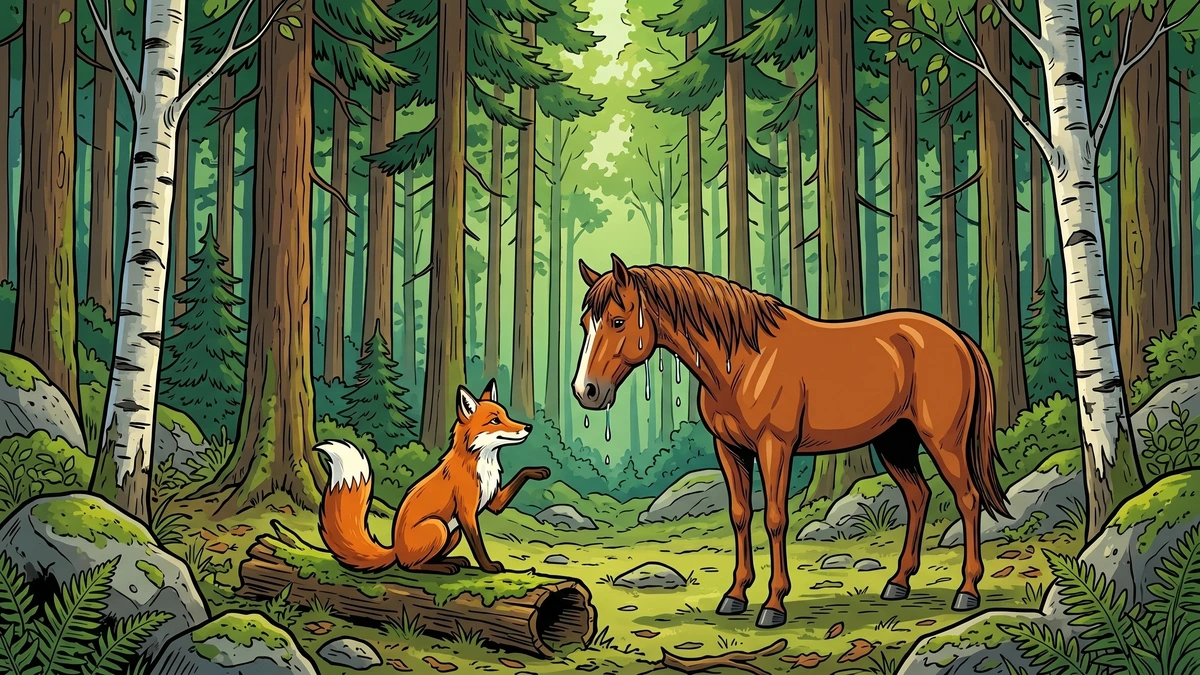
It is at this point that the tale’s true protagonist arrives. The fox — der Fuchs, the great trickster of the European bestiary, brother in cunning to Reynard, jackal-cousin of the Pancatantra‘s Damanaka — meets the horse in the wood and asks the question that opens every great fable of vindication: What is the matter, my friend? Why do you hang down your head and look so lonely and woe-begone? The horse explains. The fox listens. And the fox replies with the sentence that turns the entire tale: I will help you. Lie down there, stretch yourself out quite stiff, and pretend to be dead.
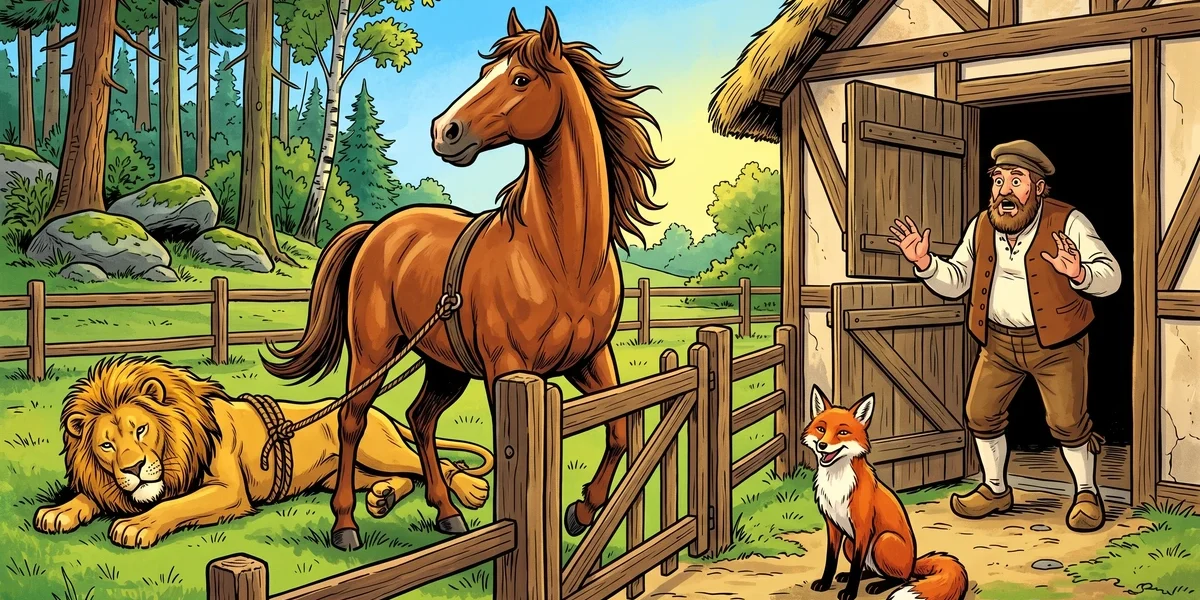
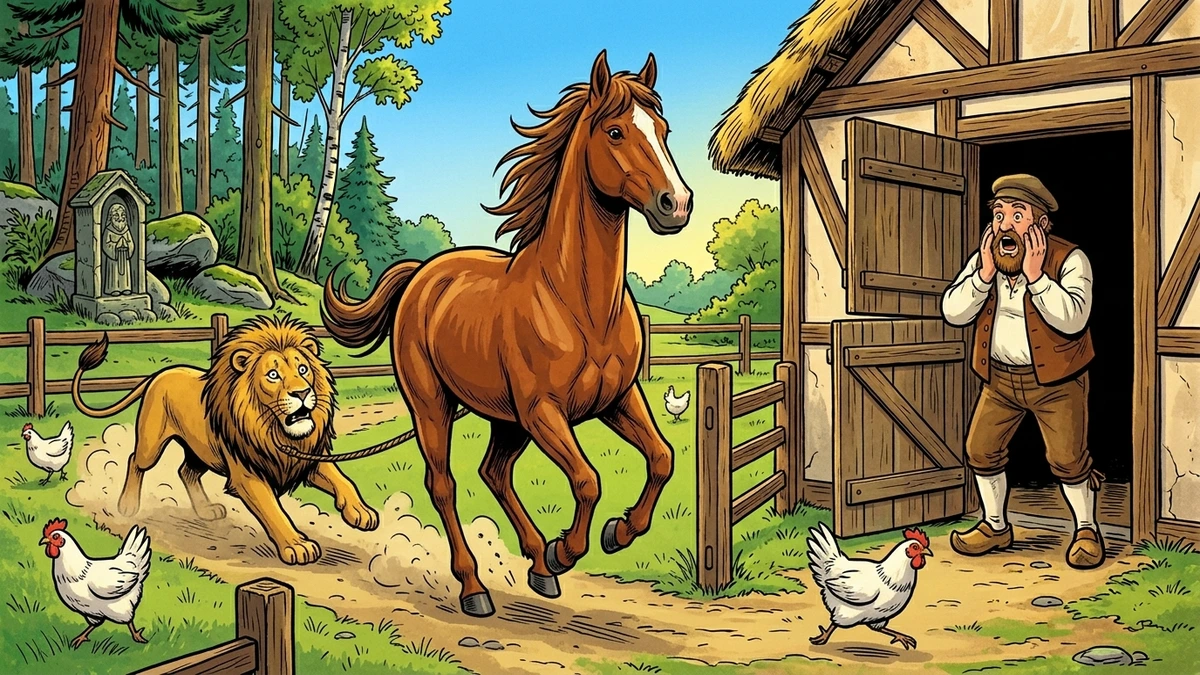
What follows is one of the cleanest pieces of trickster choreography in the Grimm corpus. The fox proceeds to the lion’s den nearby and, with the deferential courtesy that all good intermediaries adopt before great predators, informs the lion that a dead horse lies a little way off, a magnificent meal there for the taking. The lion, pleased, agrees. The fox suggests, however, that to eat in comfort the lion would do well to let himself be tied to the carcase by the tail, the better to drag the meal home at his leisure to the cave. The lion, in the immemorial credulous mode of large predators in folktale, consents. The fox knots him in tight. And then the horse — who has been lying perfectly still, listening — leaps to his feet and gallops home, dragging the trussed lion behind him through the brambles and the stones of the wood.
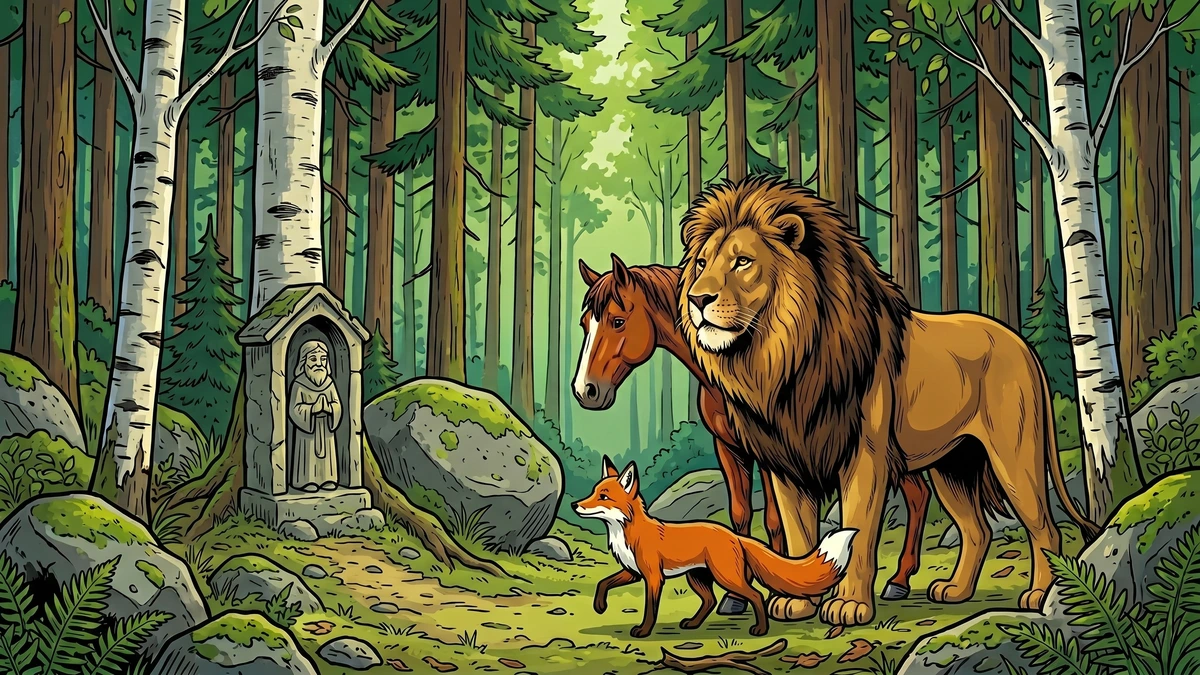
This is the structural masterpiece of the tale. The horse has not, in fact, become stronger than a lion — no animal in the wood has the strength to overpower a lion in single combat, and the tale is not a fantasy of physical metamorphosis. The horse has instead acquired a lion. He has, by the fox’s stratagem, made the lion’s strength his own — has converted the predator from antagonist into appendage. The German of the original makes the inversion almost visible: the lion, dragged at the tail of a horse, ceases to be a lion and becomes mere weight, mere meat, mere demonstration of an obligation owed and now exacted. The fox, whose only instrument was his voice, has changed the moral arithmetic of the wood without lifting a paw.
The Farmer at the Door, and the Settling of the Old Account
The horse arrives at the farmer’s gate, the lion still tied behind him, and lays the carcase on the threshold. The farmer, when he comes out, sees what has happened — and in the tale’s beautifully economical closing scene, his attitude reverses with the speed of a door swinging back. He restores the horse to the stable, gives him good food, and looks after him until he dies of natural old age, many years later, in the warmth of a place he had been told he could never re-enter except by a miracle. The farmer, the Grimms say in a single closing sentence whose bareness carries the moral, treated him well from that day forward.
The conversion is not described in psychological terms. The farmer does not weep, does not apologize, does not undergo a Christian repentance. The Grimms, who in their philological scholarship were always more interested in pattern than in piety, simply allow the act of restoration to stand for itself. The horse has met the impossible condition; the farmer therefore must keep his word; the old covenant has been re-imposed not by sentiment but by the horse’s having bent the world into a shape in which the farmer’s own boast must be honored. There is a deep medieval legalism in this ending — the same legalism that runs through The Twelve Brothers, through The Goose-Girl at the Spring, through Faithful John — in which words spoken at the gate, even cruel and rhetorical ones, retain their binding force when the listener turns out to have been more resourceful than the speaker imagined.
The Moral, in the Original German
The Grimms, as a rule, did not append explicit morals to their tales — they were folklorists of the post-Aesopic kind, content to let pattern do the work that earlier fabulists had done with epigram. But the closing sentences of Der Fuchs und das Pferd carry an unmistakable moral weight, one that the popular nineteenth-century German chapbook tradition rendered, in various forms, in something like the following couplet often reproduced in the Volksbücher of the period:
“Was du dem alten Diener nahmst, das gibt dir der schlaue Freund zurück;
denn Treue bleibt, auch wenn die Kraft vergeht.”
(“What you took from the old servant, the cunning friend gives back to you;
for faithfulness endures, even when strength has gone.”)— Paraphrastic moral in the spirit of Der Fuchs und das Pferd, KHM 132
This is the heart of the tale’s enduring appeal: the rejection of the strong-and-young arithmetic by which the farmer first calculated the horse’s worth, and its replacement with a longer, more durable arithmetic in which loyalty earned across many years cannot be cancelled by a single morning’s bad mood. The fox does not deliver a sermon; the lion does not learn a lesson; the farmer does not give a speech. The story simply re-arranges the wood until the obligation that had been forgotten is again standing at the door, with a lion tied to its tail.
Why the Tale Has Lasted Two Hundred Years
It would be easy to read Der Fuchs und das Pferd as a slight piece — a few pages in the household tales, a small fable of cunning and cooperation, the kind of story a grandmother might tell over a pan of Rote Grütze on a winter evening in Mecklenburg. But the tale has lasted, in print and in oral retelling, for the better part of two centuries because its slightness is deceptive. Beneath the surface lies a serious moral question, one that the Grimms preserve in its sharpest possible form: what is owed to the worker who has outlived the work? The horse has done a lifetime of plowing, hauling, and carting, and the farmer’s response — at the very moment the horse most needs the stable — is to turn him out into the wood with a contemptuous condition. The tale does not soften this; it dramatises it.
Modern readers, especially in cultures that have lived through the industrial transformation of agriculture, the rise and fall of the welfare state, and the contemporary debates over pensions and elder care, recognize the tale’s moral architecture instantly. It is the architecture of intergenerational obligation — the same architecture that runs through the Confucian doctrine of xiao (filial piety), through the Mosaic injunction not to muzzle the ox that treads the corn (Deuteronomy 25:4), through Aristotle’s account in the Nicomachean Ethics of justice as the proportional return of benefit for benefit. The Grimms’ tale offers a folkloric, narrative version of this same insight: the old horse’s claim on the stable does not vanish because his back is no longer strong; it persists because the years of labor are themselves a kind of capital, deposited in the moral economy of the farm and not to be withdrawn at the master’s whim.
The fox, meanwhile, is the agent of an even older folkloric truth: that strength can almost always be overcome by intelligence, and that intelligence, in the long view of the wood, is more reliably allied with the weak than with the strong. The lion in this tale, dragged home by his own tail, is a figure of every great power that mistakes its own size for invulnerability. The fox is the perennial small advisor, the figure who knows the geography of the wood better than the lion who patrols it. Together, fox and horse make a small republic of the dispossessed — the cunning marginal and the loyal exhausted — and the farmer, when he opens the door at the end of the tale, is forced to acknowledge that the wood has voted against him.
Reading the Tale Today: Loyalty as a Long-Term Asset
One of the quieter pleasures of returning to Der Fuchs und das Pferd as an adult is noticing how carefully the Grimms preserved the tale’s three-cornered moral geometry. The fox is not the horse’s friend in the way a dog might be a horse’s friend; he is the horse’s strategic ally, the figure who appears when sentimental remedies have already failed. The lion is not the villain of the tale in the way a dragon or a witch would be villains; he is merely a powerful animal who is hungry and gullible and who, in the way of all great predators in folktale, has been taught nothing by his own size. The villain, properly speaking, is the farmer — and the tale’s deep wisdom lies in its refusal to make even the farmer simply wicked. He is, instead, ordinary: a working man at the end of a hard year, calculating the cost of feed against the value of labor, and arriving at a wrong answer. The tale does not punish him; it instructs him.
This refusal to demonise the farmer is what saves the tale from the easy moralism of so much nineteenth-century children’s literature. The Grimms — Wilhelm in particular, in the editorial work he did between the first and seventh editions of the Kinder- und Hausmärchen — were always more interested in re-arranging the moral world than in condemning its inhabitants. The farmer in this tale is corrected, not damned. He keeps his horse, in the end, not because he becomes a better man but because the world has been re-arranged around him until his own boast must be honored. This is one of the great gifts of the Grimm corpus to the moral imagination of the modern reader: the conviction that ordinary cruelty is, in most cases, susceptible to correction by an ordinary cunning, and that even the bleakest opening of a fairy tale — a horse turned out into the cold rain — can be answered, two pages later, by a horse asleep again on warm straw.
For a modern reader, especially a young one, the tale’s most surprising element may be the fox’s lack of reward. He receives no banquet, no kingdom, no magical coat. He simply walks back into the wood. This is the Grimms’ great signature: the trickster who acts well does not need to be paid, and the tale does not tell us whether the fox ever heard, much later, that the horse was sleeping warm again in the farmer’s stable. We are left to assume that the fox, who knew the geography of the wood, also knew the geography of his own satisfaction, and that the act of having put the lion at the end of a rope was, in itself, the only payment a fox of his quality required.
To read it well today is to read it as a small, sturdy meditation on the durability of obligation: on the impossibility of cancelling a covenant of long service by a single dismissive sentence; on the dignity of the loyal worker whose body has outlived his usefulness; on the cunning of the small advisor who knows that the strong can almost always be defeated by the careful application of their own pride; and on the moment between two animals in the wood — one despairing, one watching — at which the moral arithmetic of the world is quietly, decisively, re-balanced.
You May Also Like
 Grimm's Fairy Tales
Ages 9-12
Grimm's Fairy Tales
Ages 9-12
The Twelve Huntsmen
The Twelve Huntsmen: There was once a king’s son who had a bride whom he loved very much. And when he was sitting beside her and very happy, news came that his
 Grimm's Fairy Tales
Ages 9-12
Grimm's Fairy Tales
Ages 9-12
The Fisherman And His Wife
The Fisherman And His Wife: There was once a fisherman who lived with his wife in a pigsty, close by the seaside. The fisherman used to go out all day long
 Grimm's Fairy Tales
Ages 9-12
Grimm's Fairy Tales
Ages 9-12
Fundevogel
Fundevogel: There was once a forester who went into the forest to hunt, and as he entered it he heard a sound of screaming as if a little child were there.