The Straw, The Coal, And The Bean
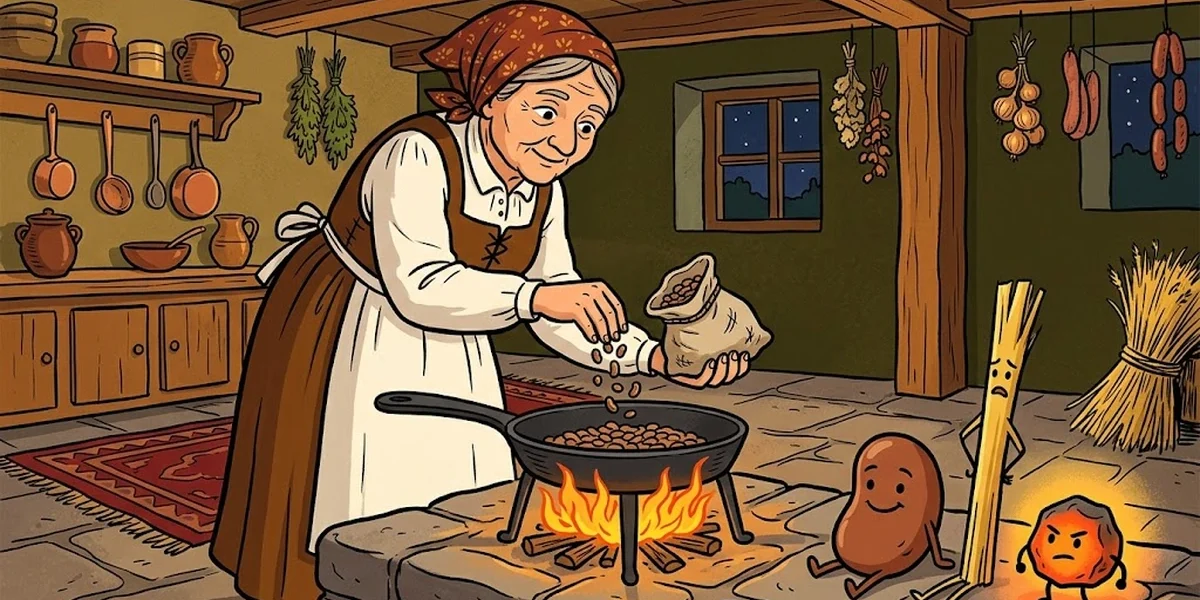
The Straw, The Coal, And The Bean: In a village dwelt a poor old woman, who had gathered together a dish of beans and wanted to cook them. So she made a fire
The Straw, the Coal, and the Bean — Strohhalm, Kohle und Bohne in the Brothers Grimm’s original German — is a quietly perfect miniature: a hearth, a runaway flame, a panicking trio, a brook, a tailor with a needle, and one black seam that lasts forever. Only a few hundred words long in its 1812 form, it has nevertheless been retold for two centuries because it answers a child’s question with a story: Why is there a dark line down a bean? The Grimms placed it eighteenth in Kinder- und Hausmärchen, and folklorists today catalogue it as ATU 295 — a tiny aetiological tale type whose laughter, like the bean’s, splits cleanly in two: half slapstick, half origin myth.
Origin And Canonical Attribution
The tale entered print on 20 December 1812 in the first volume of Kinder- und Hausmärchen, gesammelt durch die Brüder Grimm, published in Berlin by the Realschulbuchhandlung as KHM 18. Wilhelm Grimm collected it from the Wild family of Cassel — the household of the apothecary Rudolf Wild, whose Sonnenapotheke (“Sun Pharmacy”) stood directly across the street from the Grimms in Hesse. Heinz Rölleke’s annotated editions identify Dorothea Catharina Wild (1752–1813), the matriarch of the household, as the most likely informant; her daughters Gretchen, Lisette, Dortchen, and Mie all contributed other tales, and Wilhelm later married Dortchen in 1825. The Wild family’s repertoire favored short, oral, household-flavored narratives — tales told beside cooking pots, exactly the sort of setting in which Strohhalm, Kohle und Bohne opens.
The Aarne–Thompson–Uther index, edited by Hans-Jörg Uther in 2004, classifies this story as ATU 295: The Bean (the Straw and the Coal). ATU 295 belongs to the small, distinctive family of animal and object tales (ATU 200–299) and shares structural DNA with formulaic chain-tales such as The Louse and the Flea (KHM 30, ATU 2022). Its defining markers are three: a personified household trio, a fatal river-crossing, and an aetiological closing flourish that fixes a permanent feature of the natural world. Variants are documented across German-, Slavic-, and Yiddish-speaking Europe, sometimes featuring a pea instead of a bean.
English readers met the tale first in Edgar Taylor‘s German Popular Stories (London, 1823), the watershed selection illustrated by George Cruikshank. Taylor smoothed and softened — a Victorian translator’s habit — but he kept the seam. Lucy Crane‘s 1882 Household Stories, with engravings by her brother Walter Crane, gave the tale its most quoted Anglophone phrasing. Margaret Hunt‘s philologically faithful 1884 two-volume edition, later revised by Andrew Lang, restored some of the dryness of the original German close. All three translators preserve the central fact: a tailor’s stitch fixes the bean — and explains the bean.
| KHM number | 18 |
| ATU type | 295 — The Bean (the Straw and the Coal) |
| German title | Strohhalm, Kohle und Bohne (1812) |
| English title (Taylor 1823) | The Straw, the Coal, and the Bean |
| Brothers Grimm year | 1812 (first edition, vol. 1) |
| Publisher (first edition) | Realschulbuchhandlung, Berlin |
| Informant | Wild family of Cassel (Hesse) — per Rölleke, Dorothea Catharina Wild |
| Major English translators | Edgar Taylor 1823; Lucy Crane 1882; Margaret Hunt 1884 |
| Folktale function | Aetiological — explains the black seam on a bean |
| Reading time | 10 minutes |
Beat 1: The Three Survivors Of The Hearth
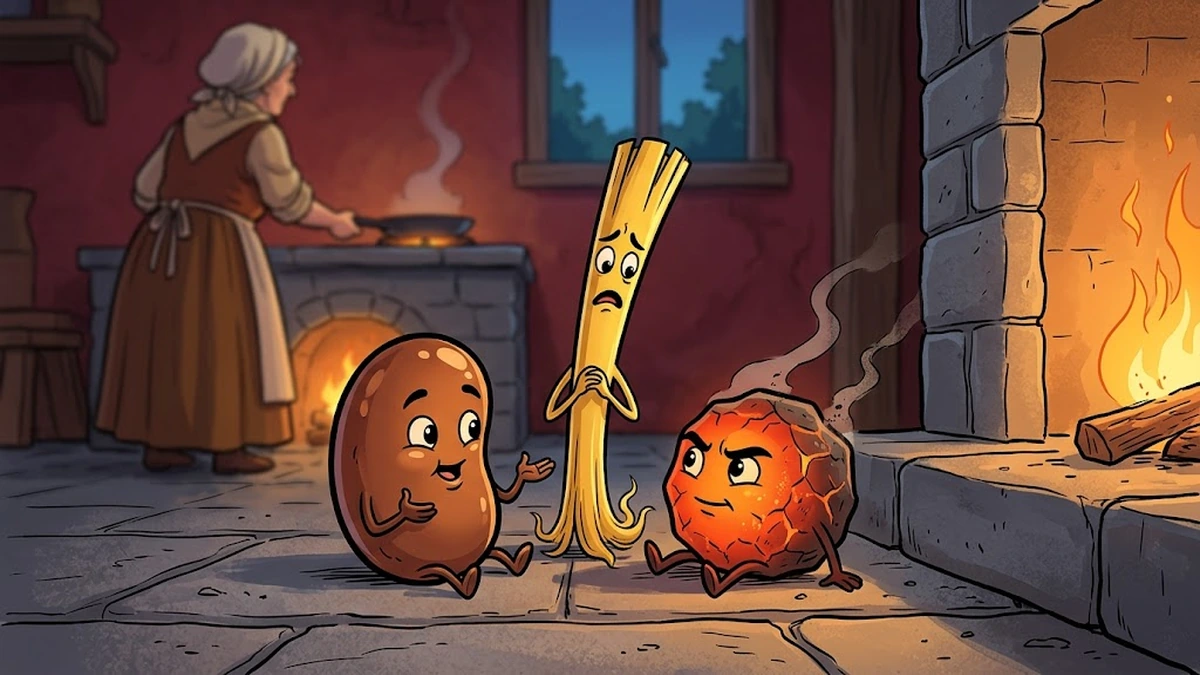
An old woman in a Hessian village wants beans for supper. She lights her hearth with a fistful of straw, scoops her beans into a pan above it, and turns to her work. The hearth fire snaps, the pan rattles, and the kitchen does what kitchens have always done: it loses things. Three small fugitives slip away unnoticed. A single bean rolls out of the pan and lands on the floor. A wisp of straw escapes the bundle she fed to the fire. A glowing coal jumps free of the flame, lands beside the other two, and cools on the flagstones. The narrator does not explain how each escaped — only that, by accident or providence, they did.
The Wild-family voice surfaces here: a household setting, a kitchen we can smell, a domestic catastrophe miniaturised. Wilhelm Grimm’s editorial hand smooths the prose between editions but leaves the trio’s introductions in their original child-friendly rhythm. The personifications are immediate. The straw speaks first — an unceremonious “Dear friends, where do you come from?” The coal answers with the bluster of a near-burned thing: it leapt from the fire by sheer force, or it would have been ashes. The bean answers with bourgeois primness: it would have been broth, like its comrades, “without any mercy.” The straw is the most theatrical mourner of all; the old woman has destroyed sixty of its brothers in fire and smoke, and the straw has only just slipped through her fingers.
Already, before any plot has begun, the story has done two important pieces of work. First, it has personified a vegetable, a stalk of grass, and a piece of carbon, granting each one a voice without explanation; the Grimms trust their listener to accept the conceit instantly. Second, it has named an enemy — the cooking pot — whose threat is not malice but ordinary appetite. The kitchen is the place where things go to be transformed, and these three have refused transformation. They have chosen to remain themselves. That refusal is what propels the rest of the tale.
Beat 2: A Plan, A Brook, A Bridge Of Straw
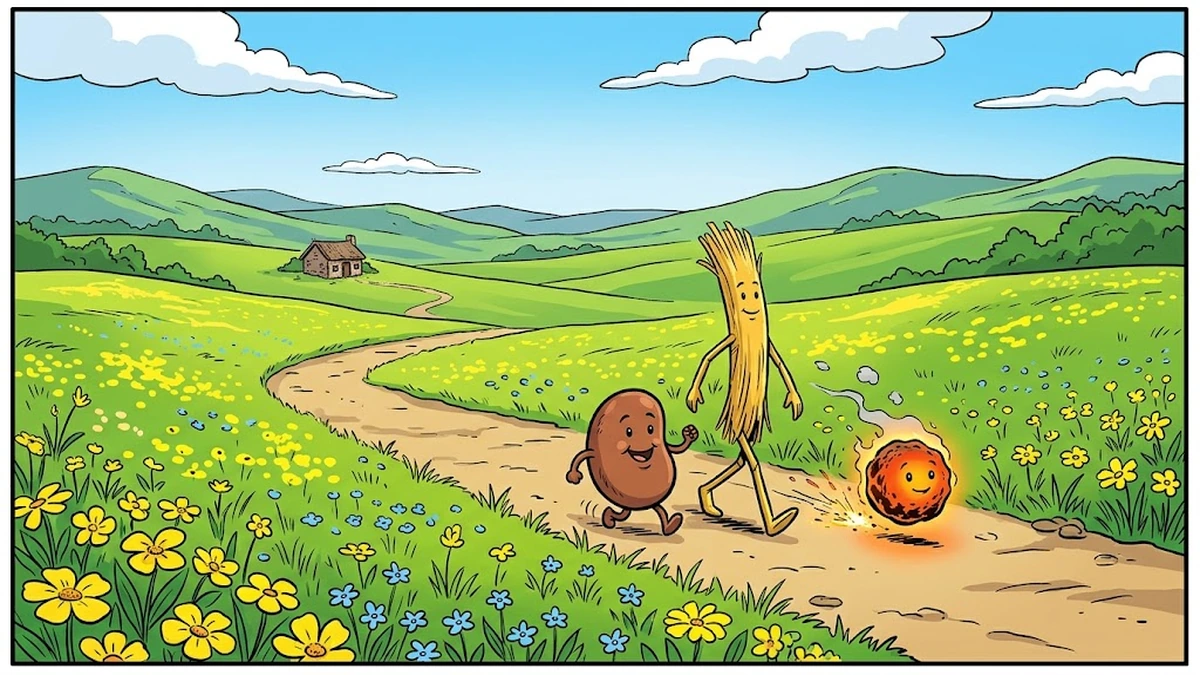
The bean — the most middle-class of the three, with views about mercy and a clear sense of self-preservation — proposes a plan. They have all narrowly escaped death. They should keep together “like good companions,” leave the dangerous country of the kitchen, and emigrate. The straw and the coal agree, and the three set out. The Grimms do not specify a destination, only a direction: fort, fort in ein fremdes Land — away, away, into a foreign country.
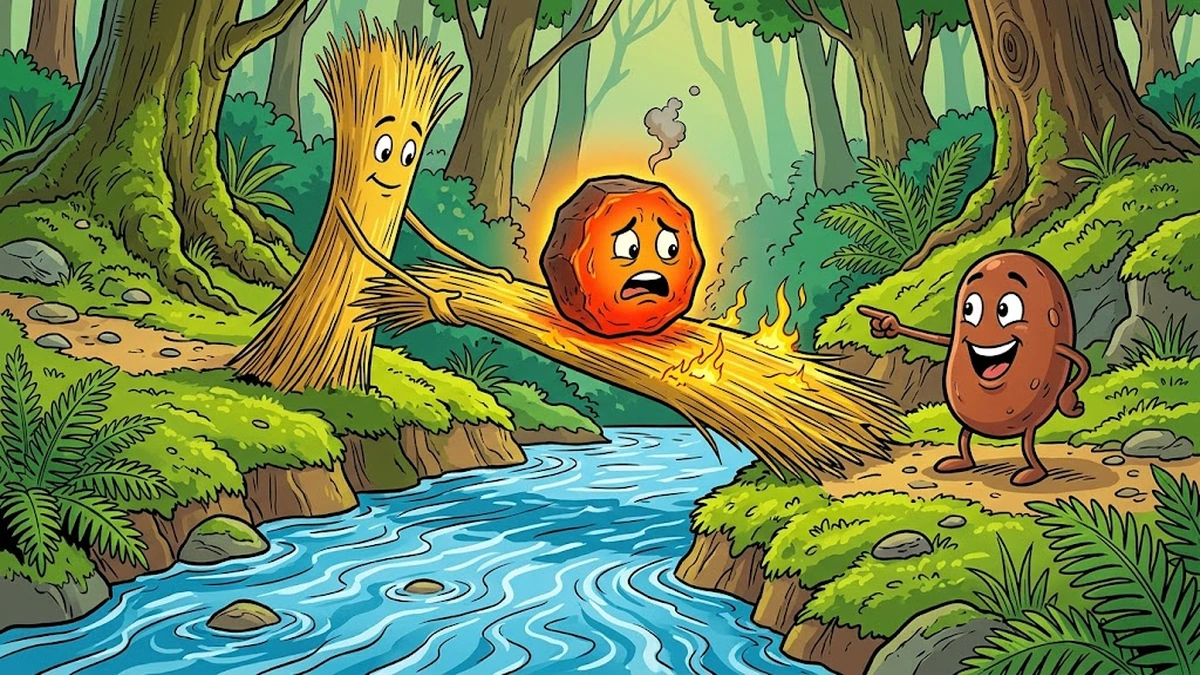
The trouble appears in the second sentence of the journey. They reach a brook. There is no bridge, no plank, no ferryman, no convenient stone. Three travellers smaller than a thumb cannot ford running water. The straw, gallantly or rashly, volunteers a solution: it will lay itself across the brook, and the coal and bean can walk over its body. The plan is brave; it is also lethal. Straw — especially the dry, fire-touched straw of a kitchen — cannot bear weight, and it cannot stand contact with anything hot.
The coal, which is impulsive and warm-blooded, charges out first. Halfway across, it pauses. Some translations say it grew afraid of the rushing water; some say it was simply too heavy. Whichever the reason, the coal stops. It rests its red-hot belly on the straw. The straw catches fire. The straw burns through. The coal hisses into the brook and dies in a wreath of steam. Two of the three companions are gone in a single sentence. The bean, watching from the bank, is left alone — and begins to laugh.
Beat 3: The Bean Bursts — And The Tailor Arrives
The bean’s laugh is the moral and physical hinge of the tale. The Brothers Grimm linger on it because it is the moment a domestic comedy turns into an aetiological myth. The bean laughs so hard at its companions’ undignified end — the coal extinguished, the straw blazing into ash — that it splits apart. The tale states this matter-of-factly: sie barst, “it burst.” This is the second death of the journey, and it is the bean’s own. It does not complain; it does not warn its friends; it dies of its own laughter at the failure of their plan.
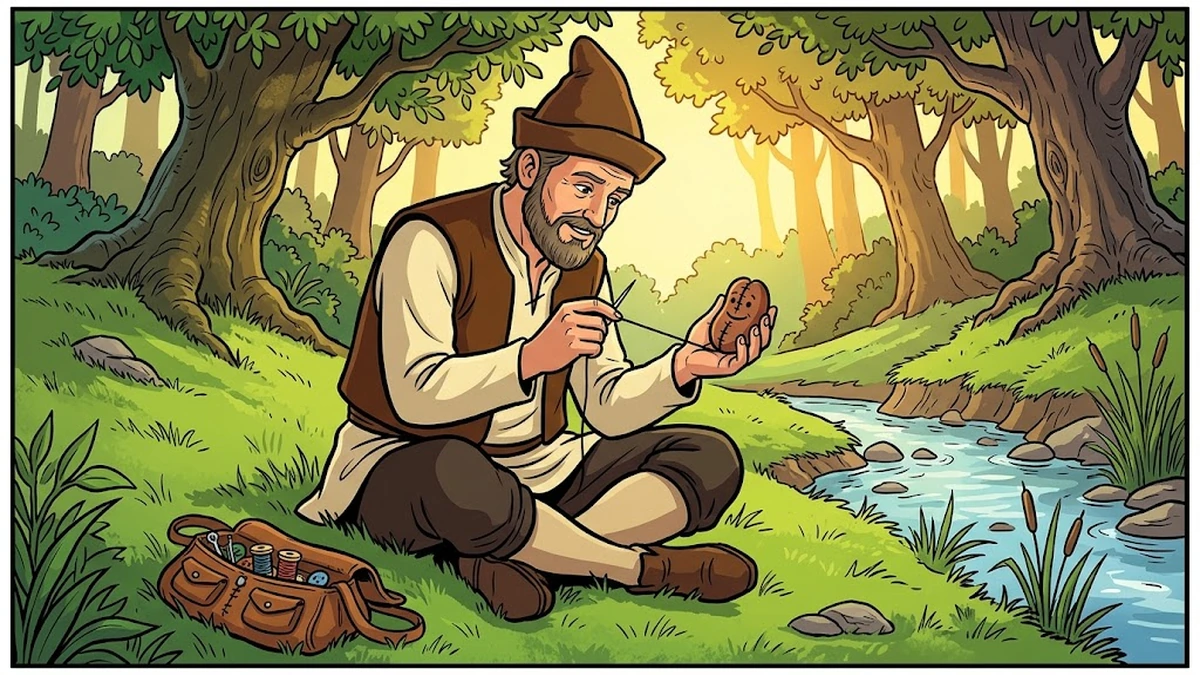
Hessian folktales rarely waste a death, however, and the Grimm tellers had a third character ready in the bushes: a wandering tailor. He has come down to the brook to rest. He sees the burst bean, takes pity (the German word is erbarmen, “to feel mercy,” echoing the bean’s own earlier word for what the cooking pot would not have shown), and produces from his bag the only tool a tailor brings on every road: needle and thread. He stitches the two halves of the bean back together. The tale then notes, almost in an aside, what colour his thread happened to be.
It was black. Tailors in early-modern Germany commonly carried plain dark thread for repairs to working clothes — the colour least likely to show on a worn coat. And so the bean is sewn up with black thread. The narrator pauses at the seam.
«Daher kommt es, dass alle Bohnen einen schwarzen Naht haben.»
— Brüder Grimm, KHM 18 (closing line, 1812 / final 1857 edition)
Translated: That is why all beans have a black seam. The line is the door through which the household tale steps out of slapstick and into mythology. Every reader who has ever shelled a bean and noticed the dark stripe along its hilum has, the Grimms claim, been shown the tailor’s stitch.
Beat 4: Why The Bean Has A Black Seam
The closing aetiology is what makes Strohhalm, Kohle und Bohne a pourquoi tale rather than a fable. Fables conclude with a moral: a sentence that tells the listener how to live. Pourquoi tales conclude with a fact: a sentence that tells the listener how the world came to look the way it does. The Grimms knew the difference; their notes for KHM 18 explicitly classify it among tales of explanation alongside KHM 38 (The Wedding of Mrs Fox) and KHM 173 (The Heron and the Hoopoe).
The aetiology depends on close domestic observation. A dry bean — Phaseolus vulgaris, the haricot the old woman of Cassel was about to cook — really does carry a dark line along the hilum, the small scar where the seed once attached to the pod. Hessian children, who had shelled beans for supper as long as anyone could remember, would have known this dark line by sight. The tale answered their question. It also did something subtler: it dignified the line. The seam is no longer a botanical accident. It is a tailor’s mercy — the visible record of a stranger’s small kindness on a riverbank.
Rölleke’s 1980 critical edition notes that the Wild family version was unusually complete: many regional variants of ATU 295 omit the tailor and let the bean simply die laughing, leaving no aetiology. The Grimms preferred the version with the stitch. Their preference was not accidental. Throughout Kinder- und Hausmärchen, the brothers favoured tellings whose endings repaired the world rather than simply ended it. The tailor’s needle, here as elsewhere in the collection, is a quiet emblem of that editorial taste.
Moral — The Stitch That Holds
The tale carries no Sittenspruch in the manner of Aesop — no italicised closing line that tells the reader what to think. Its moral is structural rather than stated, embedded in the ratio of laughter to mercy. The bean laughs at misfortune and is undone by its laughter. The tailor offers mercy and is rewarded with a story that has outlived him by two hundred years. Between those two postures lies the small ethical heart of Strohhalm, Kohle und Bohne: be careful what you laugh at, and be willing to mend what you find broken at the side of a road.
For young listeners, the tale also carries a sub-moral about plans. The companions agree on a journey but hold no real council about how to cross the brook. The straw improvises. The coal hesitates. The bean spectates. None of them stops to consider the obvious physics — that fire burns straw, that water cools coal, that seeds split when they laugh. The Grimms do not lecture; they simply set their three travellers in motion and let the world’s ordinary properties pass judgement.
Read at adult height, the moral is sterner still. The story is a tiny meditation on how brittle small alliances are, and on the role of strangers — the tailor — in repairing what families and friendships break. The tailor has no name, no destination, no backstory. He is simply a passer-by with the right tool. He is the figure most likely, in any small Hessian village, to be the answer when something needs mending. The Grimms gave him a permanent monument in the seam of every bean.
Why The Story Has Lasted
Few tales in Kinder- und Hausmärchen are shorter than Strohhalm, Kohle und Bohne, and few have travelled further. It is taught in German primary schools as one of the standard “easy Grimm” tales for early reading, partly because of its length, partly because its three protagonists are vegetable, mineral, and pure carbon — non-threatening, non-anthropomorphic, and easy to draw. It has been illustrated by Walter Crane, Otto Ubbelohde, Wanda Gág, Maurice Sendak, and dozens of mid-twentieth-century picture-book artists, each of whom found the trio’s silhouettes irresistible.
The aetiological close ensures the tale’s hooks attach to ordinary life. A child who has heard Strohhalm, Kohle und Bohne once cannot easily look at a bean again without seeing the tailor’s thread. That is the same trick the Grimms played with Hansel and Gretel (which makes every gingerbread house faintly suspect) and The Bremen Town Musicians (which colours every trio of barnyard animals heroic). It is one of the brothers’ deepest contributions to the storyteller’s art — the habit of stitching a story onto a thing the reader will see again the next morning.
For two centuries, then, this little tale has done what folklore does best. It has explained nothing scientifically and everything narratively. The hilum line on a haricot has nothing to do with tailors; the stitch was always there, biologically speaking. But the Grimms understood that children are not satisfied by botany. They want a story for the seam. Strohhalm, Kohle und Bohne obliges. It hands them a hearth, a brook, a tailor, and a permanent black thread that runs through every kitchen in the world.
And so when you next split a bean in half — in Cassel, in Calcutta, in Cape Town, in California — the seam you see is a quiet inheritance from a Wild family kitchen in 1808, from a tailor on a Hessian riverbank, and from two brothers who thought such things deserved to be written down.
You May Also Like
 Grimm's Fairy Tales
Ages 9-12
Grimm's Fairy Tales
Ages 9-12
The Golden Goose
The Golden Goose: There was a man who had three sons, the youngest of whom was called Dummling,[*] and was despised, mocked, and sneered at on every occasion.
 Grimm's Fairy Tales
Ages 9-12
Grimm's Fairy Tales
Ages 9-12
The White Snake
The White Snake: A long time ago there lived a king who was famed for his wisdom through all the land. Nothing was hidden from him, and it seemed as if news of
 Grimm's Fairy Tales
Ages 9-12
Grimm's Fairy Tales
Ages 9-12
Sleeping Beauty (Briar Rose)
Sleeping Beauty (Briar Rose): On the morning that the princess was christened, the entire kingdom gathered in the grand cathedral of the castle to celebrate