The Four Clever Brothers
The Four Clever Brothers: Dear children,’ said a poor man to his four sons, ‘I have nothing to give you; you must go out into the wide world and try your luck.
The Four Clever Brothers (German: Die vier kunstreichen Brüder) is one of the more philosophically inquisitive of all the household tales gathered by Jacob and Wilhelm Grimm. Catalogued as KHM 129 in the Kinder- und Hausmärchen, it first appeared in the second edition of 1819, having been supplied to the brothers by the von Haxthausen family of Westphalia — the same Catholic landed circle in the Bökendorf region that gave them many of the tales added between the first and second editions. The Grimms classified it among their stories of cleverness and craft; modern folklorists place it under Aarne–Thompson–Uther type ATU 653 (The Four Skillful Brothers), with type 653A reserved for its closely related rival, The Rarest Thing in the World. The English text most readers know is the translation by Margaret Hunt (1884), with an earlier and freer rendering by Edgar Taylor (1823, German Popular Stories), the very volume that introduced Grimm to the Anglophone nursery.
Origins, Sources, and the Long Memory of a Riddle
The tale belongs to one of the oldest and most widely diffused riddle-narratives in the world. The folklorist Stith Thompson, in his classic study The Folktale (1946), proposed that Kathāsaritsāgara — Somadeva’s twelfth-century Sanskrit “Ocean of the Streams of Story” — preserves “the probable original” of the European version, and the comparison is illuminating. In the Indian source, four Brahmins regenerate a dead lion from a single hair, a tooth, a claw, and a bone, demonstrating a learning so absolute that it ceases to be wisdom. The European reflex tames that scholastic fable into a fairy tale: four brothers, four lower trades, one princess to be rescued, and one perfectly impossible question to be settled at the end. The pivot from “who has the highest learning?” to “whose skill saved the princess?” is one of the great folkloric translations of pure intellect into civic virtue.
The Grimms’ immediate source, the Familie von Haxthausen, supplied a number of the tales added in the 1819 edition — among them several composite hero-tales whose internal structure bears the same pattern as The Four Clever Brothers: a quest divided among siblings, each contributing a single specialised act, and a king’s verdict at the close. A nineteenth-century Sicilian variant collected by Giuseppe Pitrè and re-anthologised by Jack Zipes in The Collected Sicilian Folk and Fairy Tales of Giuseppe Pitrè (Routledge, 2009/2013) confirms that the structure travelled freely along the Mediterranean trade routes; the French conte de fées tradition has its own seventeenth-century cousin in Henriette-Julie de Castelnau’s “A Trip to the Country” (modernised in Gethner and Stedman’s 2011 Wayne State edition). The Slavonic line is equally robust: Albert Henry Wratislaw‘s Sixty Folk-Tales from Exclusively Slavonic Sources (1889) prints two close variants from Czech and Bulgarian sources. What unites all of them, across more than a thousand years and three sub-continents, is the architectural insight that no single skill is sufficient — and that the cleverness of cooperation is itself a craft.
For Jacob Grimm, who in his philological works was already laying the groundwork for what would become Grimm’s Law of consonant shifts in Germanic languages, the appeal of such a tale was not its quaintness but its portability: here was a story-bone that had survived translation into a dozen languages and a hundred dialects. Its survival proved, to him, that the deep grammar of folktale was as patterned and recoverable as the deep grammar of speech.
The Crossroads at the Centre of the Tale
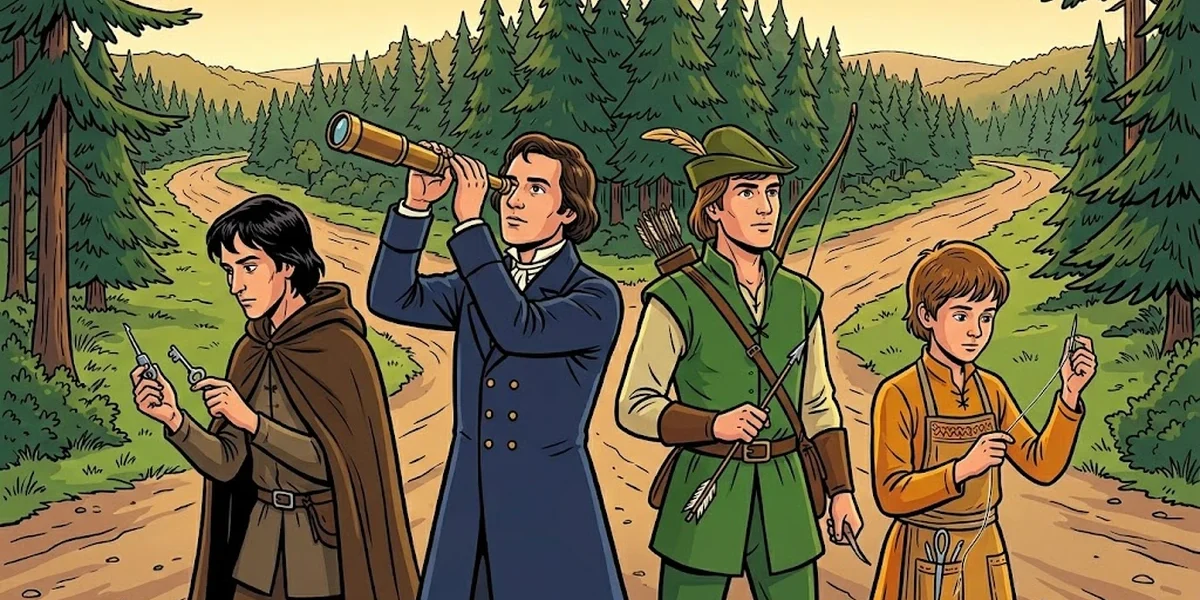
The story opens with a poor father who can give his four sons nothing but their walking-sticks and a parting blessing. They go out at the gate together, walk for a while, and arrive at a place where four roads divide. The eldest pronounces the formula that gives the tale its shape: here we must part; but this day four years we will come back to this spot. The crossroads is the great architectural device of European folktale — the geometrical opposite of the family hearth — and the Grimms’ version uses it with unusual rigour. The four roads do not just send the brothers in four directions; they send them into four different relationships with knowledge.
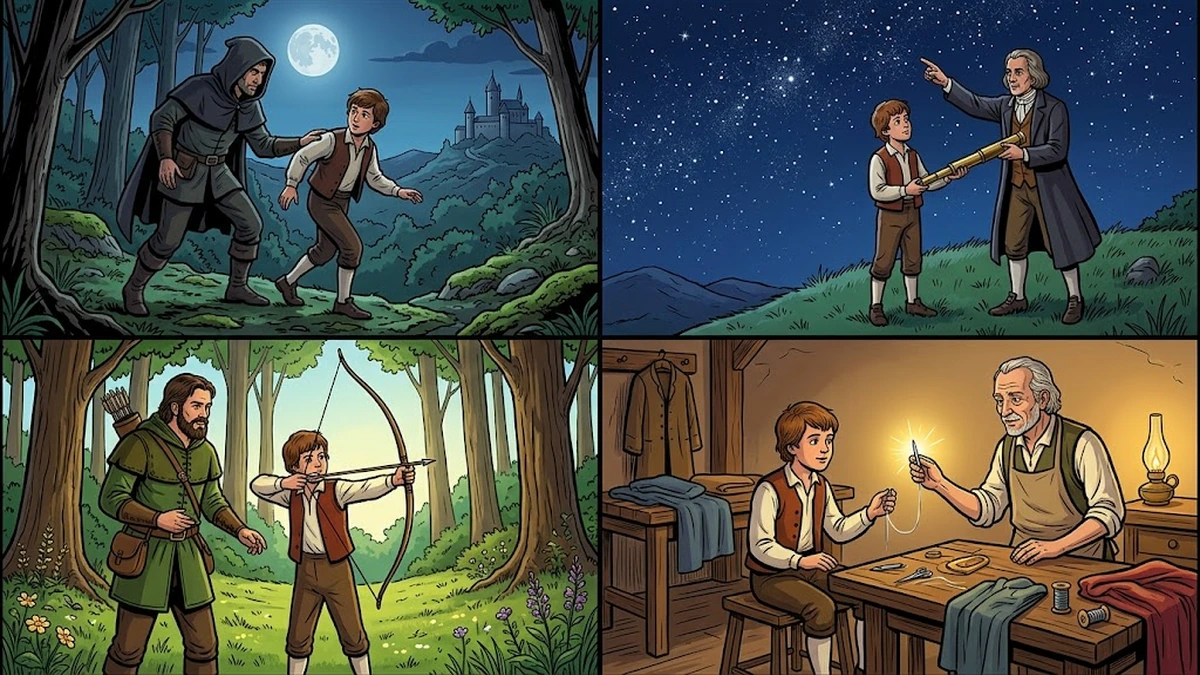
The eldest is met by a stranger who promises to teach him to be the cunningest thief in the world. The boy, scrupulous in the way Grimm heroes often are, refuses on principle: it is not an honest calling, and there is the gallows at the end of it. The stranger answers with a moral hair-splitting that the tale never quite resolves — he will only teach him to steal “what will be fair game,” what no one else can get and what no one will miss. It is the morality of poaching converted into the morality of the impossible task: thievery as art rather than crime, the kind of skill that will, four years later, lift a princess off a dragon’s rock.
The second is offered the trade of star-gazer, and the German word in the original — Sterngucker — is wonderfully comic, a mock-academic title for a peasant boy whose tutor will give him a glass through which “all that is passing in the sky and on earth” is visible. The third becomes a huntsman and is sent off with a bow whose arrow cannot miss. The youngest, after refusing the cross-legged drudgery of conventional tailoring, is recruited into the magical sort, and is given a needle that will sew anything — egg-soft or steel-hard — and leave no seam. Four boys; four crafts; four magical instruments. The numerology is exact, the symmetry is total, and the tale is now wound like a clock.
The Reunion, the Bird’s Egg, and the Princess on the Rock
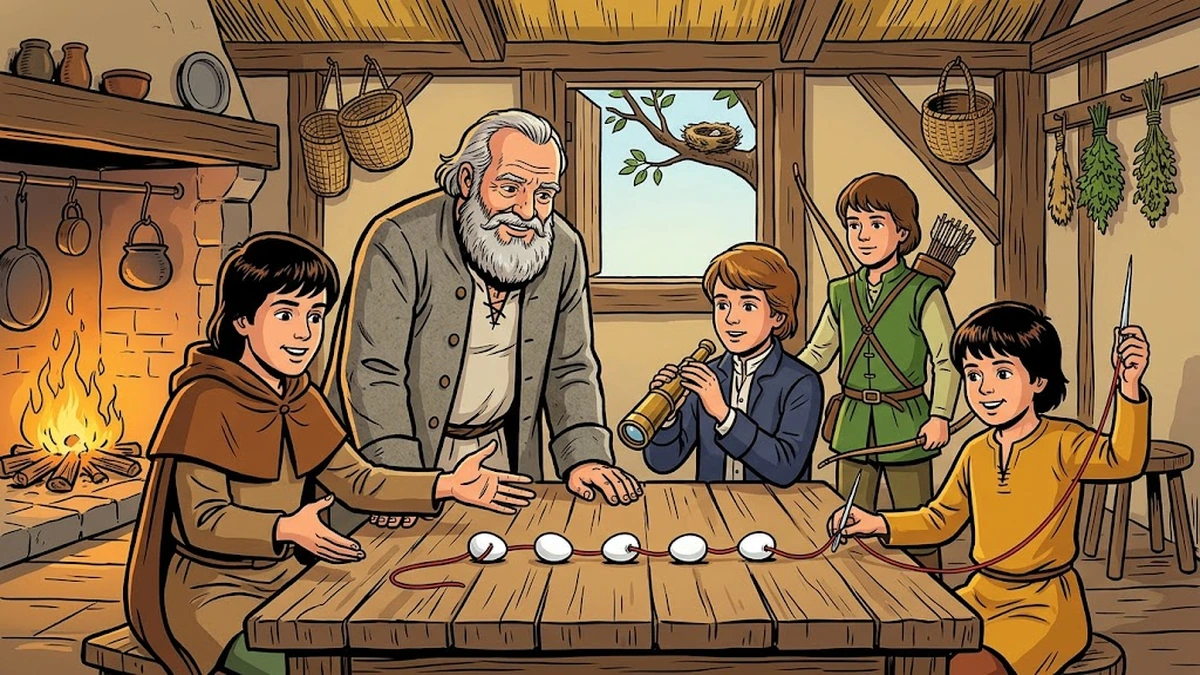
Four years pass. The brothers return to the crossroads — note how the tale honours the appointment, how its world is one in which promises made at parting are kept — and present their crafts to their delighted father. He proposes a test. There is a bird’s nest in a high tree; what is in it? The star-gazer reports five eggs. The thief, without disturbing the nest, brings the eggs down and lays them on the table; one for each brother and one for the father. The huntsman, with a single arrow, shoots through all five at once. The tailor, with his needle, sews the eggs back together so neatly that no seam can be seen. The eggs are returned to the nest, the chicks hatch, and each comes into the world with a small thread of red around its neck — a delicate detail, almost a cinematic close-up, that establishes the brothers’ joint craftsmanship without anyone saying a word.
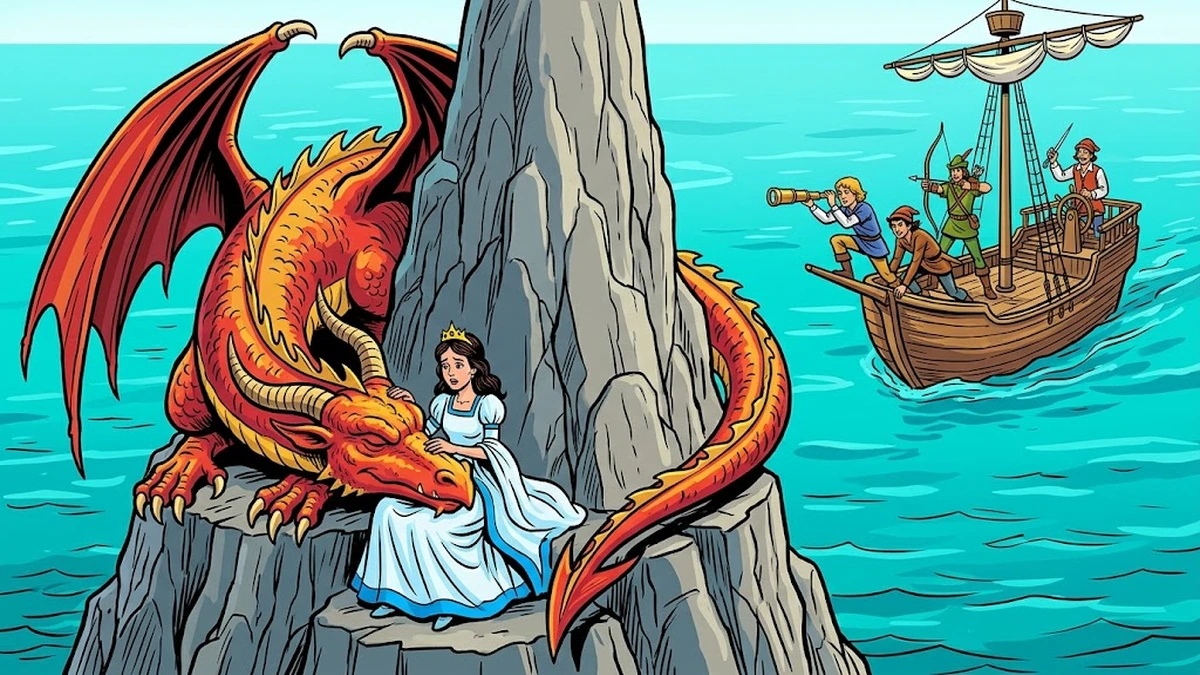
It is at this point that the great public crisis arrives, in the form of a public proclamation. The king’s daughter has been carried off by a dragon, and whoever brings her back shall have her in marriage. The brothers ride to court, and the rescue divides into a perfect four-part counterpoint of crafts. The star-gazer trains his glass and locates the princess on a remote rock in the sea, with the dragon coiled and sleeping with his head in her lap. The thief, ferried out in a ship, removes her so quietly from beneath the monster that the dragon does not stir. The huntsman, when the dragon at last awakens and gives chase across the water, shoots him cleanly through the heart with a single arrow. The dragon falls, but in his collapse he shatters the ship into a hundred pieces, and the brothers and the princess are about to drown — until the tailor, drawing out his needle, stitches the ship back together with seams as fast as new caulking, and they sail home with the princess safe.
The King’s Verdict and the Quiet Question Beneath the Tale
The court receives them with delight, and the king prepares to fulfil his proclamation. But now the brothers, who have hitherto co-operated as one craftsman with four hands, fall to quarrelling. Each claims the princess. The thief points out that without his stealth she would still be on the rock; the star-gazer, that without his glass she would never have been found; the huntsman, that without his arrow the dragon would have devoured them; the tailor, that without his needle they would all be at the bottom of the sea. The princess, sensibly, says nothing — she is a Grimm princess, and her speech in such tales is reserved for moments of consent or refusal, not arbitration.
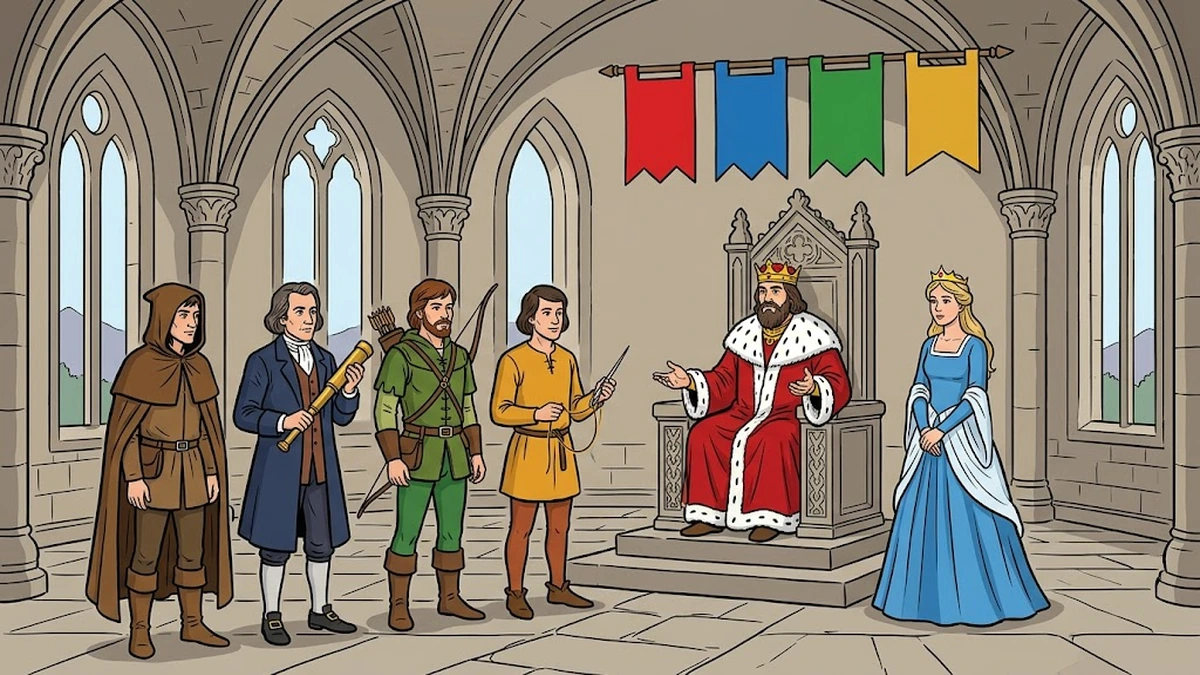
The king, faced with what may be the cleanest dilemma in the entire household tales corpus, gives a verdict whose elegance has impressed every commentator from Wilhelm Grimm in his 1856 notes to Jack Zipes in his recent translations. He cannot give the princess to all four; he will not give her to one. So he gives each brother a kingdom — four kingdoms in his realm, each prosperous, each independent — and the princess he keeps at his own court, where (the variants split here) she either chooses for herself in time or remains unmarried as a princess in her own right. It is the rarest of fairy-tale endings: a refusal of the love-prize as the just resolution of a service rendered. The tale, which began with a father unable to give his sons anything, ends with a king who can give them everything except the one thing they thought they had earned.
The Moral, in the Original German
The Grimms did not append explicit morals to most of the tales — they were folklorists, not Aesopians — but the closing sentence of KHM 129 in the German text carries the weight of one. The brothers, having received their kingdoms, are said to live with their father and the princess “in great happiness,” each having his own art and each respecting the others. The implicit moral is the one any reader of the tale will draw:
“Vier Künste, ein Werk; vier Hände, ein Sinn — und keine ohne die andere ist ganz.”
(“Four arts, one work; four hands, one mind — and none of them, without the others, is whole.”)— Paraphrastic moral in the spirit of Die vier kunstreichen Brüder, KHM 129
This is the heart of the tale’s enduring appeal: the rejection of the soloist in favour of the ensemble. The princess is not the prize; the cooperation is the prize. Each brother’s craft is, in isolation, a curiosity — a thief without a target, a star-gazer without a question, a huntsman without quarry, a tailor without a tear to mend. Brought together, they constitute something the tale takes great care never to name: a polity, a small republic of skills, of which the king’s four-kingdoms verdict is the political diagram.
Why the Tale Has Lasted Two Hundred Years
It would be easy to read The Four Clever Brothers as a charming exercise in symmetry — four boys, four crafts, four kingdoms, four roads — and leave it at that. But the tale has lasted, in print and in oral retelling, for the better part of two centuries because its symmetry conceals a serious moral question: what is the proper reward for a co-operation that cannot be unbundled into individual contributions? The thief alone could not have brought the princess down; the star-gazer alone could not have approached the rock; the huntsman alone could not have shot the dragon while the brothers were on dry land; the tailor alone had nothing to mend. The rescue is irreducibly collective. The king’s verdict — kingdoms for all, princess for none — is one of the few mature treatments of collective reward in the entire fairy-tale tradition. It is the answer Aristotle gives, in a different vocabulary, in Nicomachean Ethics V: that distributive justice consists in giving to each according to what they have contributed — and that when contributions are inseparable, the reward must itself become inseparable, that is, shared in equal kingdoms.
Modern parents and teachers read the tale, often without knowing it, as a parable of teamwork; modern folklorists read it as a particularly pure example of ATU 653; modern philosophers read it, when they read it at all, as a small, vivid demonstration of the ethics of joint action. All three readings are correct, and all three are present in the German text the Haxthausens dictated to the Grimms in the second decade of the nineteenth century. Few stories of fewer than two thousand words have done as much intellectual work for as many generations of readers, in as many languages, as this one.
Reading the Tale Today: Cooperation as a Craft
One of the quieter pleasures of returning to Die vier kunstreichen Brüder as an adult is noticing how carefully the Grimms preserved the asymmetry of the four crafts themselves. Three of them — star-gazing, hunting, tailoring — are honest trades that any family might apprentice a son to; the fourth, thievery, sits uneasily on the same line, and the tale does not pretend otherwise. The eldest’s hesitation at the gallows is, in narrative terms, the moral fee the tale pays for putting a thief in the rescue party. It is also a small piece of social history. In the Bökendorf Westphalia of the early nineteenth century, where the Haxthausens lived, the line between a poacher and a thief was an active one — the same line that runs through the great forest tales of Hessen and Westfalen. The story preserves the medieval intuition that there are forms of stealth which, in the right cause and against the right adversary (a dragon, say), are not crimes but crafts.
The four magical instruments — glass, bow, needle, and the thief’s own dexterous hands — also reward close reading. They are the four classes of tool that pre-industrial Europe knew best: the lens (perception extended), the bow (force directed), the needle (matter rejoined), and the trained hand (object displaced without disturbance). The story is, in this sense, a small encyclopaedia of human capability, presented to the child reader in fairy-tale form. The princess is the occasion for the rescue, not its argument; the argument is the four-fold instrument-kit and the four-fold mode of attention each tool requires.
For a modern reader, especially a young one, the tale’s most surprising element is the king’s refusal to give the princess to a single hero. Compare this with The Brave Little Tailor (KHM 20), The Golden Bird (KHM 57), or Iron John (KHM 136), in each of which the princess is the conventional reward for the singular hero’s singular trial. The Four Clever Brothers simply will not do this. It is one of the few Grimm tales in which the structural logic of the rescue dictates a structural revision of the reward — and this, more than any of its surface charms, is why it has retained the attention of folklorists, ethicists, and educators for two centuries.
To read it well today is to read it as a small, sturdy meditation on the ethics of co-operation: on the impossibility of unbundling a joint feat, on the dignity of refusing to crown a single victor when the victory was four-handed, on the wisdom of a father who had nothing to give and a king who had everything to give, and on the moment between these two men when four sons walked through a gate, four roads, four trades, and four years, and came back with a craft that was, in the end, a single thing, indivisible.
You May Also Like
 Grimm's Fairy Tales
Ages 9-12
Grimm's Fairy Tales
Ages 9-12
The Pink
The Pink: There was once upon a time a queen to whom God had given no children. Every morning she went into the garden and prayed to God in heaven to bestow on
 Grimm's Fairy Tales
Ages 9-12
Grimm's Fairy Tales
Ages 9-12
The Six Swans
The Six Swans: In a kingdom bordered by enchanted forests and ancient mountains, a King mourned his first wife, a woman of wisdom and grace. Years passed in
 Grimm's Fairy Tales
Ages 9-12
Grimm's Fairy Tales
Ages 9-12
3. How Partlet Died And Was Buried, And How Chanticleer Died Of Grief
From that day Chanticleer would eat and drink no more, and pined away until he died of grief.