Snow White and the Seven Dwarfs
Snow White and the Seven Dwarfs: In a kingdom where mountains touched the clouds and forests stretched endlessly, there lived a king and queen who ruled with
Few European folktales are as instantly recognisable as the story the Brothers Grimm set down in 1812 under the Hessian title Sneewittchen—Snow White. A queen pricks her finger over an ebony window-frame, wishes for a daughter as white as snow, as red as blood and as black as ebony, dies in childbirth, and is replaced by a beautiful but ferociously vain new wife who keeps a truth-telling mirror. When the mirror at last names the child as “the fairest of them all,” the queen orders the girl killed. The girl flees into the forest, takes refuge with seven dwarfs in their mountain cottage, survives three murder attempts disguised as gifts, falls into a death-like sleep after biting a poisoned apple, and is restored to life when a prince’s servants jolt the glass coffin and dislodge the apple-piece from her throat. The vain queen is then made to dance to her death in red-hot iron shoes at the wedding.
This is a story about beauty as a weapon, about the moment when a mother becomes a rival, and about the small kindly creatures—the dwarfs of the Erzgebirge mining country—who shelter what the world tries to destroy. Walt Disney’s 1937 animated feature smoothed many of the Grimms’ sharper edges, but the older tale, in its proper Hessian form, is sterner and more strange.
The Mirror and the Wish (KHM 53, opening)
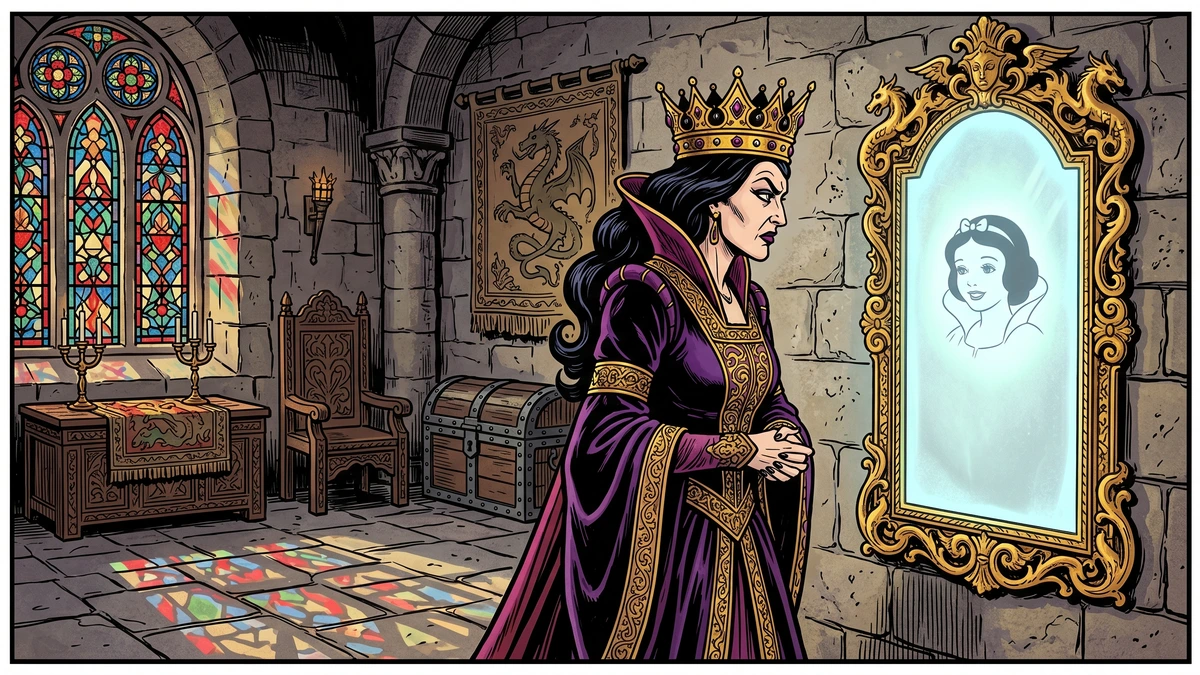
The Grimms open the tale in mid-winter, with snowflakes falling like feathers from heaven. A queen sits sewing at an ebony-framed window, looking out at the snow; she pricks her finger, three drops of blood fall onto the snow, and she frames the famous wish: a daughter weiss wie Schnee, roth wie Blut und schwarzwie das Holz an dem Rahmen—white as snow, red as blood, black as the wood of the window-frame. The child is born; the mother dies; a year passes; the king marries again. The new queen is beautiful but proud, and she owns a mirror that will not lie.
The dialogue with the mirror, repeated four times across the tale, is one of the most quoted couplets in German literature: “Spieglein, Spieglein, an der Wand, wer ist die Schönste im ganzen Land?”—“Little mirror, little mirror, on the wall, who is the fairest in all the land?” While Snow White is small the mirror flatters the queen; on the day Snow White turns seven the mirror answers that the child is now tausendmal schöner, a thousand times more beautiful. The queen turns yellow and green with envy and summons a huntsman.
The folklorist Heinz Rölleke, editor of the standard critical edition of the Kinder- und Hausmärchen, has shown that this opening derives from oral tellings the Grimms collected in the Hassenpflug household in Kassel. Marie Hassenpflug (1788–1856) is the principal source for the 1812 text; her sister Jeanette and the Treysa schoolmaster Ferdinand Siebert added variant details that the Grimms blended into the 1819 and later editions. The motif of the wished-for child and the magical mirror is older still: a printed precedent appears in Johann Karl August Musäus’ Volksmährchen der Deutschen (1782), in the tale “Richilde,” which the Hassenpflugs almost certainly knew.
The Huntsman, the Forest, and the Cottage of Seven
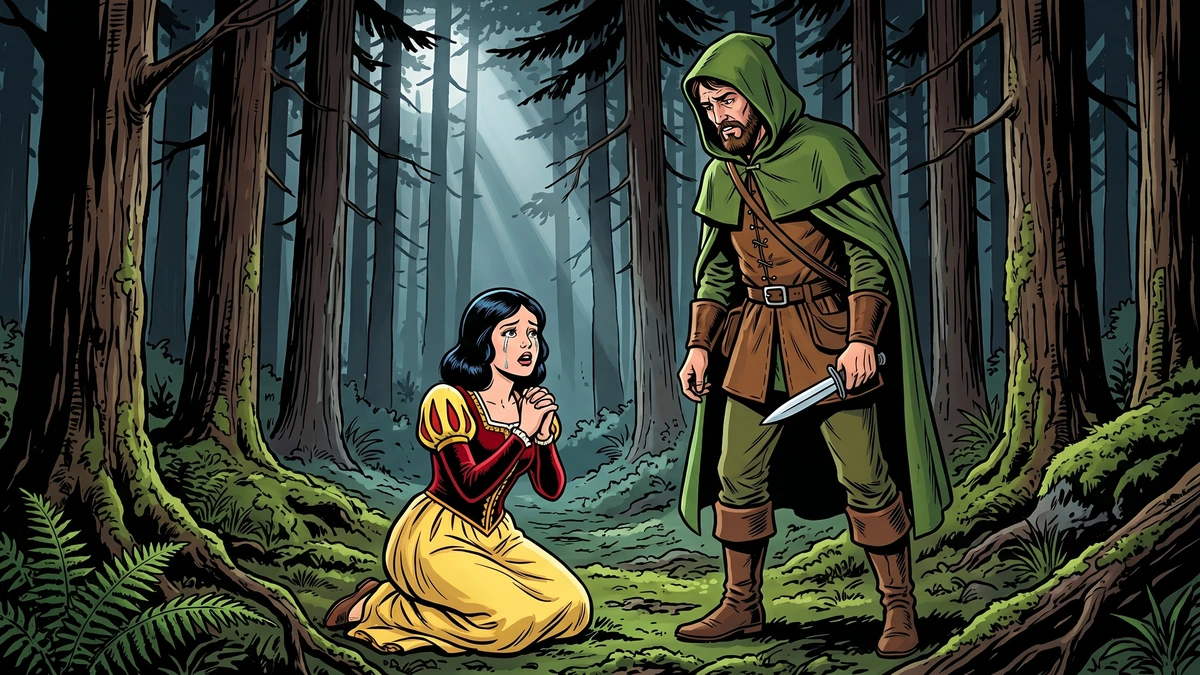
The queen orders the huntsman to take Snow White into the forest, kill her, and bring back her lung and liver as proof. He cannot do it. Snow White’s tears and her plea—“Ach, lieber Jäger, lass mir mein Leben”—disarm him; he kills a young boar instead, brings the queen its organs, and the queen, believing she has eaten her stepdaughter’s flesh, is satisfied. The motif of the cannibal queen is one of several elements that Wilhelm Grimm softened only partially through successive editions; it persists in the 1857 final text.
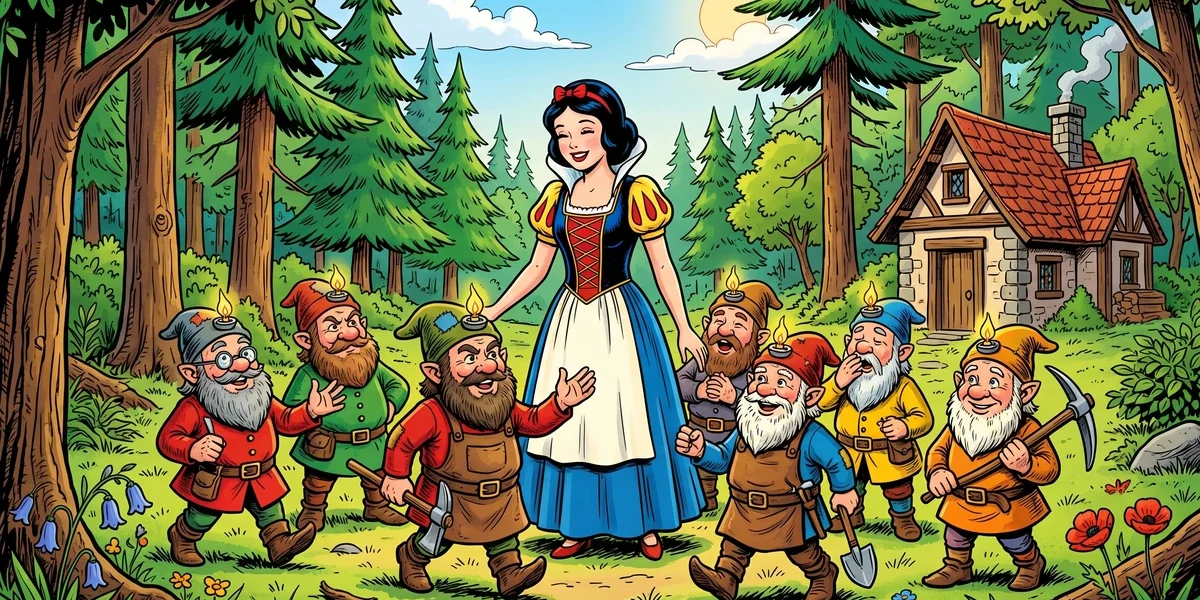
Snow White wanders alone through the great German forest. She comes at evening to a small cottage where everything is in sevens: seven little plates on a white-clothed table, seven little spoons, seven little knives and forks, seven little cups, and against the wall seven little beds with snow-white sheets. She eats a little vegetable and a little bread from each plate, drinks a drop of wine from each cup, tries the beds, and falls asleep in the seventh, which fits her exactly. The dwarfs return from their day in the mountains—sie suchten Erz und gruben in den Bergen, “they sought ore and dug in the mountains.”
This single line places the tale geographically. The seven dwarfs are Bergleute, miners of the kind who worked the silver, copper and tin lodes of the Erzgebirge (Ore Mountains) on the Saxon–Bohemian border from the late mediaeval period. The German folklorist Eckhard Sander argued, controversially, that the historical model for Snow White was Margarete von Waldeck (1533–1554), whose family owned copper mines worked by stunted, child-aged labourers in the Hessian region of Bad Wildungen. Whether or not the connexion is real, the dwarfs of the cottage are recognisably industrial figures—skilled craftsmen who come home tired, light their seven candles, and find a stranger in their orderly house.
The dwarfs strike a bargain with Snow White: she will keep house for them—cook, clean, sew, knit—and in return they will protect her. They warn her, knowing the queen will discover she still lives, to nimm dich in Acht vor deiner Stiefmutter: take care of her stepmother, and let no one in.
The Three Murder Attempts: Lace, Comb, Apple
The mirror, consulted again, betrays the huntsman’s mercy: Snow White still lives, beyond the seven mountains, in the cottage of the seven dwarfs, and is fairer than the queen by a thousandfold. The queen now devises three attempts on the child’s life, each disguised as a peddler’s gift, each turning on Snow White’s own appetite for what is pretty.
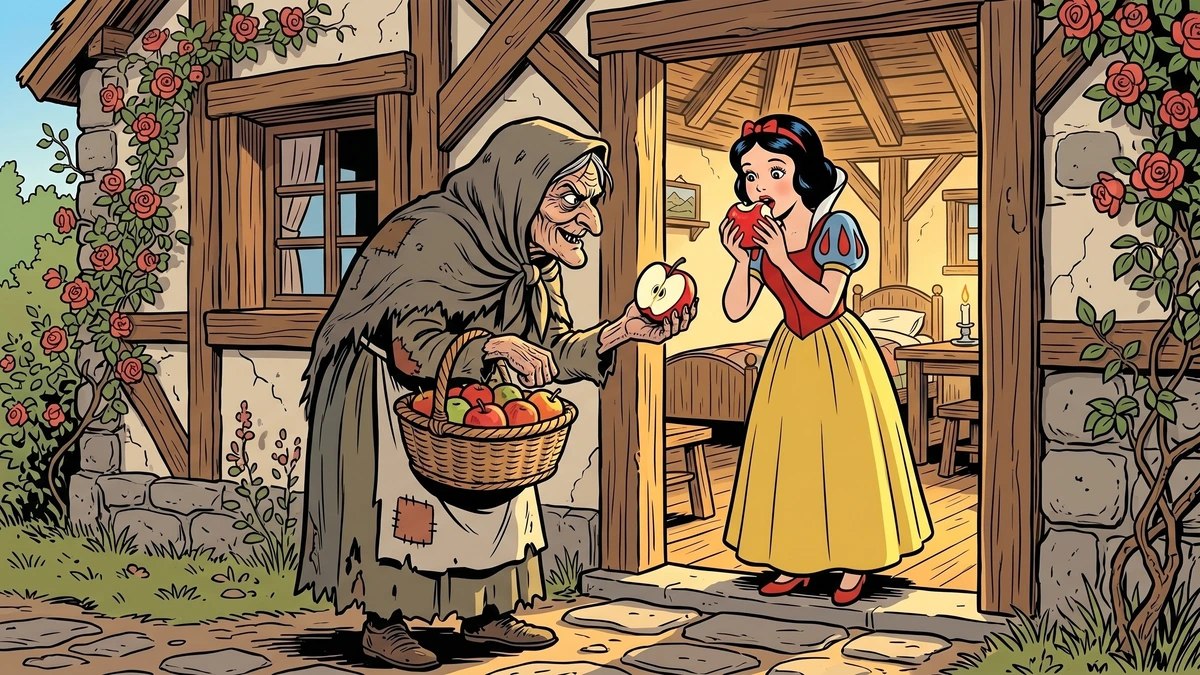
The first attempt is a brightly coloured silk bodice-lace. The disguised queen offers to lace it for her; she pulls the strings so tight that Snow White falls down as if dead. The dwarfs cut the lace and revive her. The second attempt is a poisoned comb: thrust into Snow White’s hair it stuns her, and again the dwarfs save her by pulling the comb out. The third attempt is the apple. The queen, in her secret chamber, prepares an apple half-white and half-red, poisoning only the red half. Disguised as a peasant woman she offers it; Snow White, suspicious, refuses; the queen cuts the apple in two, eats the white half herself, and gives Snow White the red half. Snow White bites; the poisoned piece lodges in her throat; she falls down dead. This time the dwarfs cannot save her. They lay her in a glass coffin on the mountain so that the world may continue to see her, and they write her name on it in golden letters and add that she is the daughter of a king. The animals come to mourn: first an owl, then a raven, last a dove—a small triad in keeping with the threefold structure of the temptation.
The Aarne–Thompson–Uther catalogue indexes this tale-type as ATU 709 “Snow White,” with the iconic motif sequence: jealous queen, magic mirror, attempted murder by hireling, dwarfish helpers, three murder attempts by disguised antagonist, glass coffin, apparent death, revival, punishment of antagonist. The same type appears in over four hundred recorded variants across Europe, North Africa and Asia Minor, including the Italian La Bella Venezia (Calvino’s Fiabe italiane 1956, no. 13), the Greek Myrsina (Hahn 1864), and the Albanian Fatija.
The Glass Coffin, the Prince, and the Iron Shoes
A prince, riding through the forest, comes on the dwarfs’ mountain and the glass coffin. He is overcome by Snow White’s beauty and begs the dwarfs to give the coffin to him; they refuse to sell, but at last give it to him as a gift. As his servants carry the coffin down the mountain, one of them stumbles over a tree root, the jolt dislodges the bit of poisoned apple from Snow White’s throat, she sits up, and the prince takes her home to his father’s castle to be his bride.
The Grimms’ ending is famously severe. The wicked queen, consulting her mirror on the morning of a great wedding, learns that the new young queen is a thousand times more beautiful than she. Driven by jealousy she goes to the wedding, recognises Snow White, and stands rooted with terror. Iron slippers have already been put into a fire of glowing coals. They are brought out with tongs, set before her, and she is forced to step into them and dance until she falls down dead.
The punishment in red-hot iron shoes is a folkloric judicial echo of the medieval Gottesurteil, the trial by ordeal: the wicked are made to walk on heated iron and the truth of their guilt is announced by the verdict of the body. The Grimms preserved this stern conclusion through every edition from 1812 to 1857. Wilhelm Grimm did, however, undertake one notable revision: in the 1812 edition the antagonist is Snow White’s biological mother, whose envy of her own child is the engine of the plot. By the second edition of 1819 the figure had become a stepmother, distancing the cruelty from the mother–daughter bond and making the tale acceptable to the bourgeois German nursery for which the brothers were now consciously editing.
The Moral
“Spieglein, Spieglein, an der Wand, wer ist die Schönste im ganzen Land?”
“Little mirror, little mirror, on the wall, who is the fairest in all the land?”
— KHM 53, refrain repeated four times in the 1857 text
The moral of Sneewittchen is harder than the cinema versions allow. The vanity that destroys the queen is not a comic flaw but a sustained spiritual sickness; she is willing to murder a child rather than accept that she is no longer the most beautiful woman in the kingdom. The Grimms set the lesson in the form of a punishment that fits the crime: the woman who could not bear another’s beauty is forced to perform her own death as a public spectacle. Goodness, in this tale, is not assertive—Snow White does not defeat her stepmother by cunning or strength; she survives because others, the huntsman, the dwarfs, the prince, recognise her worth and intervene. The story values the small, dependable goodness of the mining household—the seven candles, the seven beds, the table set for seven—against the spectacular, predatory beauty of the court.
Why the Tale Has Lasted
Two centuries after the 1812 first edition and seven centuries after its Hessian and Italian antecedents, the Snow White story is more famous than it has ever been. Walt Disney’s Snow White and the Seven Dwarfs (1937) was the first feature-length animated film in cinema history, and it fixed the tale’s visual vocabulary—the apple, the mirror, the glass coffin, the named dwarfs Doc, Grumpy, Happy, Sleepy, Bashful, Sneezy and Dopey—in the imagination of the twentieth century. Anne Sexton retold it in verse in Transformations (1971); Donald Barthelme made a postmodern novel of it in 1967; the Brothers Grimm’s own birthplaces of Hanau and Steinau are now stops on the German Fairy Tale Road.
The deeper reason for the tale’s endurance is that it dramatises a fear that does not date: the fear that the very person whose love a child needs most—the mother or the woman in the mother’s place—can become her enemy. The Grimms’ original 1812 instinct, that the murderous queen is the biological mother, may be the truer telling; later editors muffled it into a stepmother, but the unease remains. Sneewittchen is a story about female envy across generations, about the courage of small steady kindness, and about a glass coffin in which beauty waits, neither alive nor dead, until the world chooses to lift the lid.
Comparative Variants Across Europe
The Grimms’ Sneewittchen is one bright node in a network of cognate tales reaching from Sicily to Karelia. The Italian variants—Calvino’s La Bella Venezia from Tuscany, Pitrè’s Sicilian Maruzzedda, and the Maria, Marietta told in Friulan—keep the magic mirror but replace the seven dwarfs with seven robbers, twelve robbers, or in one Calabrian telling a single old hermit. The Greek Myrsina, recorded by J. G. von Hahn in Griechische und albanesische Märchen (Leipzig 1864), gives twelve months of the year as protectors instead of dwarfs, who shelter the heroine in their mountain palace. The Albanian Fatija turns the dwarfs into forty dragons. The Russian Skazka o myortvoy tsarevne i o semi bogatyryakh—Pushkin’s 1833 verse “Tale of the Dead Princess and the Seven Knights,” itself founded on a folk version—substitutes seven warrior-knights for the dwarfs and a winding-sheet for the glass coffin. In each retelling the underlying ATU 709 skeleton is preserved: a beautiful young woman, an envious older woman, a mirror or its functional equivalent, a flight to the wilderness, kindly hosts of an unusual number, attempted murder by gift, apparent death, restoration. Scholars from Antti Aarne to Hans-Jörg Uther have catalogued more than four hundred recorded variants, suggesting either a single very old Indo-European prototype or a tale-pattern that recurs spontaneously wherever a court-and-forest geography meets the dynamics of step-family rivalry.
What is distinctive about the Grimm version is the precise, almost domestic exactness of its sevens—the seven plates, seven cups, seven candles, seven beds—and the industrial specificity of the dwarfs as Bergleute, miners. These are not the woodland sprites of Celtic tradition or the dragons of the Balkan tellings; they are recognisable members of a known German trade community, complete with the discipline of a working household. That domestic precision is what makes the Grimm telling feel, two centuries later, less like a fable and more like a remembered place.
Historical Reception and Modern Afterlives
The first English translation of Sneewittchen appeared in Edgar Taylor’s German Popular Stories (London 1823), illustrated by George Cruikshank and read aloud by Charles Dickens to his children. Andrew Lang reprinted a translation in The Red Fairy Book (1890). Margaret Hunt’s 1884 complete English translation, revised by James Stern in 1944, remains the standard scholarly version in English. The Disney studio acquired the story in 1934 and released the animated feature in 1937; the visual design of the dwarfs drew on Heinrich Lefler’s 1905 Viennese illustrations. The 1937 film made “Mirror, mirror, on the wall”—a slight mistranslation of Spieglein, Spieglein—the canonical English form of the refrain.
Twentieth-century writers returned to the tale repeatedly. Anne Sexton’s confessional poem “Snow White and the Seven Dwarfs” in Transformations (1971) reads the queen as the heroine’s future self—“the dancing dolls / who tap their feet in the iron shoes”—and indicts the cycle of female competition the tale stages. Donald Barthelme’s Snow White (1967) reimagines the heroine as a disenchanted young woman in a Manhattan apartment shared with seven men. Angela Carter included a brief, savage reworking, “The Snow Child,” in The Bloody Chamber (1979). Neil Gaiman’s short story “Snow, Glass, Apples” (1994) inverts the moral universe by giving the narration to the queen and revealing Snow White as a vampiric child. Each retelling tests a different pressure point of the original: the cost of beauty, the politics of female generations, the meaning of the glass coffin’s pause.
Frequently Asked Questions
What is the moral of Snow White and the Seven Dwarfs?
Who wrote Snow White and the Seven Dwarfs?
What is the story of Snow White?
Why are there seven dwarfs in Snow White?
What are the differences between Grimm's Snow White and Disney's Snow White?
You May Also Like
 Grimm's Fairy Tales
Ages 9-12
Grimm's Fairy Tales
Ages 9-12
Hans In Luck
Hans In Luck: Some men are born to good luck: all they do or try to do comes right all that falls to them is so much gain all their geese are swans all their
 Grimm's Fairy Tales
Ages 9-12
Grimm's Fairy Tales
Ages 9-12
Jorinda And Jorindel
Jorinda And Jorindel: There was once an old castle, that stood in the middle of a deep gloomy wood, and in the castle lived an old fairy. Now this fairy could
 Grimm's Fairy Tales
Ages 9-12
Grimm's Fairy Tales
Ages 9-12
The Wolf and the Seven Young Goats
The Wolf and the Seven Young Goats: In the days when animals spoke and understood the human tongue, there lived a mother goat with seven children born under a