Hans In Luck
Hans In Luck: Some men are born to good luck: all they do or try to do comes right all that falls to them is so much gain all their geese are swans all their
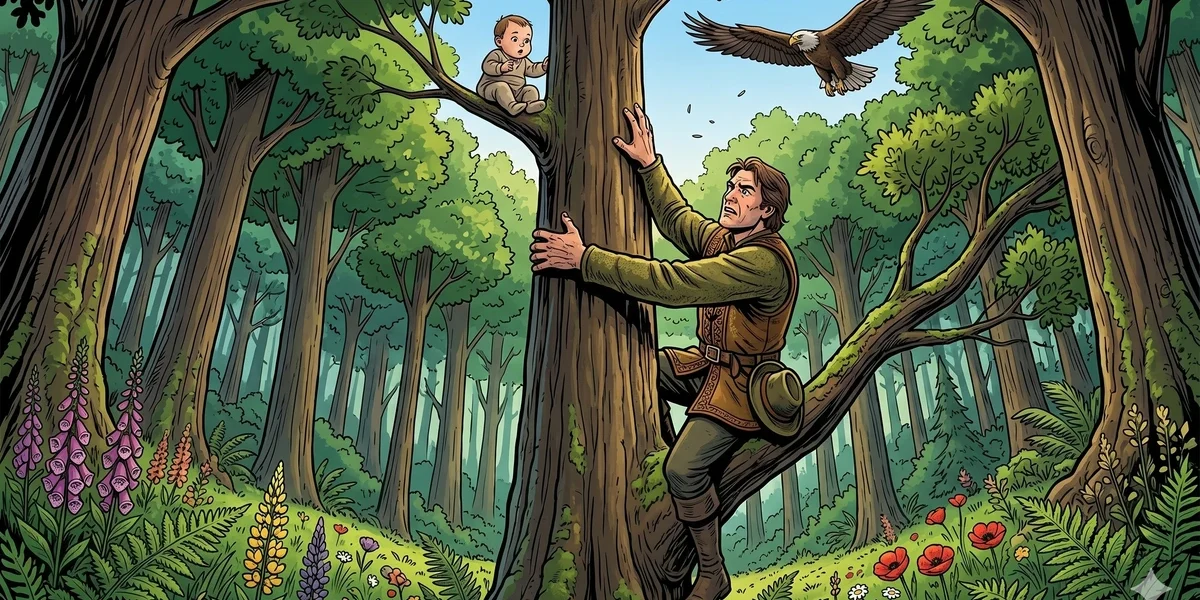
Hans in Luck is the Grimm treasury’s most subversive masterpiece — a tale that systematically dismantles the logic of accumulation and replaces it with something the Sanskrit tradition calls santoṣa: contentment as the supreme wealth. Hans trades his gold ingot downward through a sequence of exchanges — horse, cow, pig, goose, grindstone — ending with nothing but joyful lightness. Where conventional wisdom sees catastrophic loss, Hans experiences progressive liberation. The tale enacts the Vedāntic teaching that parigraha (grasping, hoarding) is itself the burden, and that the person who holds nothing is, paradoxically, the freest.
The Tradition: Santoṣa and the Upward Poverty
The archetype of the person who exchanges wealth for simplicity and finds happiness appears across world wisdom traditions. In Indian philosophy, santoṣa — contentment — is listed in Patañjali’s Yoga Sūtras as the second of the five niyamas (personal disciplines), described as productive of “supreme happiness” (paramam sukham). The Bhagavad Gītā distinguishes between sukha derived from objects (ultimately unstable) and the ānanda of the Self (inherently stable). Hans, through his cheerful divestiture, moves from the former toward the latter — not through philosophical study but through temperamental alignment.
The Jain concept of aparigraha (non-possessiveness) is perhaps the closest doctrinal parallel: one of the five great vows of Jain monasticism, aparigraha holds that every possession creates a corresponding anxiety of loss. Hans’s joy increases with each exchange not despite but because of his diminishing possessions — a perfect illustration of the Jain observation that freedom and ownership exist in inverse proportion.
Plot and Philosophical Analysis: Vairāgya Without Renunciation
Hans works seven years for his master and receives a gold ingot as wages — a just reward for sustained labor. His journey home involves five exchanges, each apparently a bad bargain: gold for a horse (heavy metal for lively transport), horse for a cow (speed for milk), cow for a pig (milk for pork), pig for a goose (food for feathers), goose for a grindstone (flight for weight). The grindstone he accidentally drops into a well, and Hans rejoices: “I am the luckiest man alive.”
The Vedānta concept of vairāgya — dispassion toward objects — is typically associated with renunciation through disciplined practice. Hans achieves it through temperamental ease, which the tradition calls sahaja-vairāgya — natural, spontaneous dispassion. He is not a renunciant; he simply does not cling. Each trader who persuades him is, in effect, offering him a philosophy lesson: that any object can be exchanged for another, that no object has intrinsic, non-negotiable value. By the tale’s end Hans has internalized the Upaniṣadic teaching that ātman alone is truly one’s own — everything else is anātman, belonging to the realm of impermanent exchange.
The Aṣṭāvakra Gītā is the text Hans most resembles in spirit: its protagonist Janaka, after a single satsang with the sage Aṣṭāvakra, instantaneously releases all attachment without external pressure. Both Hans and Janaka demonstrate that liberation (mokṣa) is not the product of accumulation — of virtue, merit, knowledge — but of recognition. Hans recognizes at each exchange that the new arrangement feels lighter, and he chooses lightness. This is viveka (discrimination) expressed not as intellectual analysis but as gut-level preference for freedom over burden.
Scholarly Synthesis: The Economics of Contentment
Modern economics is built on the axiom of revealed preference: what people choose reflects what they value. Hans’s revealed preferences are systematically anti-accumulative — he consistently chooses the arrangement that creates less worry, less weight, less responsibility. The Arthaśāstra would classify him as a poor economic agent; the Yoga Sūtras would classify him as a spiritual prodigy. The tale’s genius is that it refuses to adjudicate between these frameworks — it simply shows Hans arriving home empty-handed and light-hearted, and invites the audience to decide which standard to apply.
The Mahābhārata‘s Śānti Parva contains extended dialogues on the nature of wealth (dhana), consistently distinguishing between external and internal wealth. The sage Vidura counsels: “Contentment is the highest gain; non-desire, the best of virtues.” Hans embodies this teaching without having received it — which is precisely the point. Wisdom traditions across cultures have produced their Hanses, their Fools who turn out to be the wisest characters in the story, because genuine santoṣa is recognizable across philosophical languages.
“The man who arrives home with nothing in his hands but joy in his heart has made the most profitable journey of all — for he has traded the heaviest metal on earth for the one thing that cannot be stolen, taxed, or dropped in a well.”
Why This Story Lasted
Hans in Luck endures because it offers a genuine counter-narrative to the acquisitive logic that governs most folk tales. In a genre where protagonists strive for gold, kingdoms, and beautiful spouses, Hans goes the other way — and arrives happier than any of them. The story survives because it names something real: that past a certain point, more possessions produce more anxiety rather than more security, and that the person who has learned not to mind losing things has discovered a form of invulnerability that no thief can breach. Every generation rediscovers this and needs a Hans to embody it.
Frequently Asked Questions
What is the moral lesson of Hans in Luck?
The tale teaches santoṣa — contentment as the highest form of wealth. Hans’s happiness increases as his possessions decrease, demonstrating that freedom from attachment produces greater joy than the accumulation of goods. Rather than a cautionary tale about foolishness, it celebrates the spiritual intelligence of non-grasping.
Is Hans actually foolish or wise in the Grimm tale?
Hans enacts what Indian philosophy calls sahaja-vairāgya — spontaneous, natural dispassion — without formal training. He is not intellectually foolish but temperamentally liberated: he does not cling, and therefore cannot truly lose. The Grimm tradition presents him as the “Fool” archetype who achieves what the wise strive for without trying.
What Indian philosophical concept best matches Hans in Luck?
The Jain concept of aparigraha (non-possessiveness) is the closest parallel: every possession creates a corresponding anxiety of loss. Hans’s joy grows with each divestiture, perfectly illustrating the Jain observation that freedom and ownership exist in inverse proportion. Patañjali’s santoṣa as “supreme happiness” also directly applies.
Are there Indian folktale parallels to Hans in Luck?
Yes — the Jātaka tales include several stories of monks or lay practitioners who cheerfully give away successive possessions and arrive at liberation through divestiture. The Mahābhārata‘s Śānti Parva dialogues explicitly teach that contentment is the highest gain. The “lucky fool” archetype appears in Tamil, Bengali, and Rajasthani folk traditions as well.
Why does Hans feel lucky after losing everything?
Because each loss removes a burden he did not know he was carrying. The grindstone’s splash into the well is Hans’s moment of complete vairāgya — dispassion — leaving him with no possessions to protect and no losses to mourn. In Vedāntic terms, he has recognized that ātman (self) alone is truly one’s own; everything else was always borrowed from the impermanent world.
You May Also Like
 Grimm's Fairy Tales
Ages 9-12
Grimm's Fairy Tales
Ages 9-12
3. How Partlet Died And Was Buried, And How Chanticleer Died Of Grief
From that day Chanticleer would eat and drink no more, and pined away until he died of grief.
 Grimm's Fairy Tales
Ages 9-12
Grimm's Fairy Tales
Ages 9-12
Clever Gretel
There was once a cook named Gretel, who wore shoes with red heels, and when she went out she cut capers with them.
 Grimm's Fairy Tales
Ages 9-12
Grimm's Fairy Tales
Ages 9-12
Rumpelstiltskin
Rumpelstiltskin: By the side of a wood, in a country a long way off, ran a fine stream of water; and upon the stream there stood a mill. The miller’s house was