Hansel and Gretel: A Short Retelling for Kids
Hansel and Gretel: A Short Retelling for Kids: In a small cottage at the edge of a great forest lived a woodcutter and his wife with two children - Hansel and
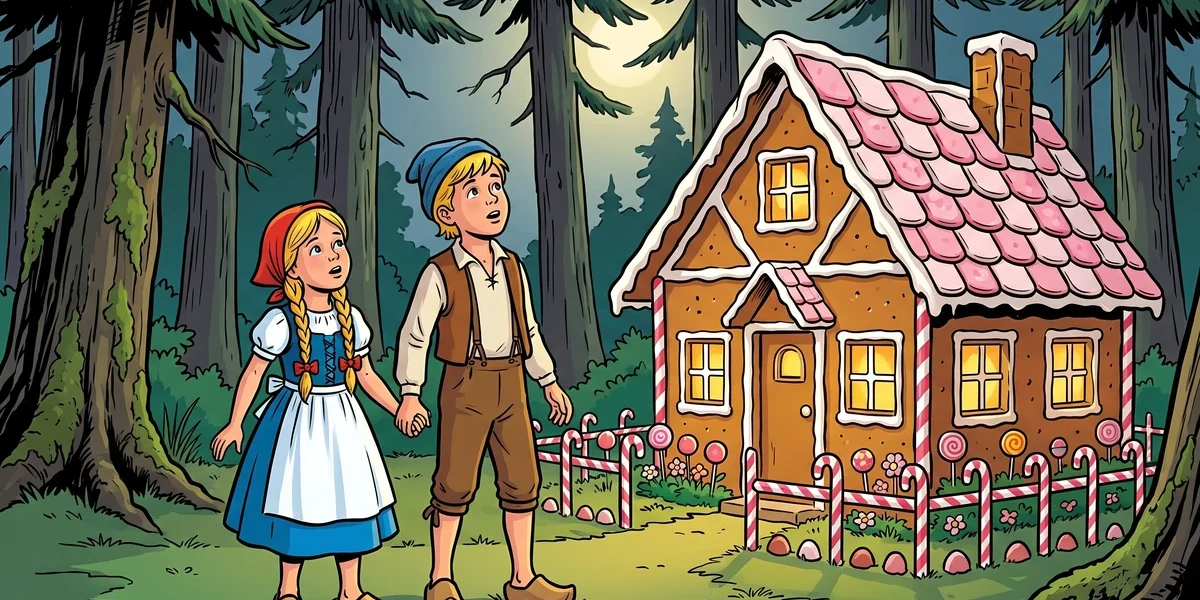
Origin: German folktale, Kinder- und Hausmärchen (Children’s and Household Tales), Brothers Grimm, 1812 · KHM 15 · ATU 327A — “Hansel and Gretel” / “The Children and the Ogre” · Original German title: Hänsel und Gretel.
Few stories in the European folk canon strike as deep a chord as that of two small children abandoned in a forest, lured by a candy-encrusted cottage, and held captive by a cannibal witch. Recorded in 1812 by Jacob and Wilhelm Grimm in the first volume of Kinder- und Hausmärchen, the tale of Hänsel und Gretel appears as KHM 15 and is classified as Aarne-Thompson-Uther type 327A, the international tale-type known as “The Children and the Ogre,” cousin to AT 327B “The Dwarf and the Giant” and AT 328 “The Boy Steals the Ogre’s Treasure” (Jack and the Beanstalk’s family). Behind its sugary surface lies a hard, lean story shaped by famine, infant mortality, and the mountains and forests of central Europe — a story whose younger sister Gretel ultimately seizes her own rescue.
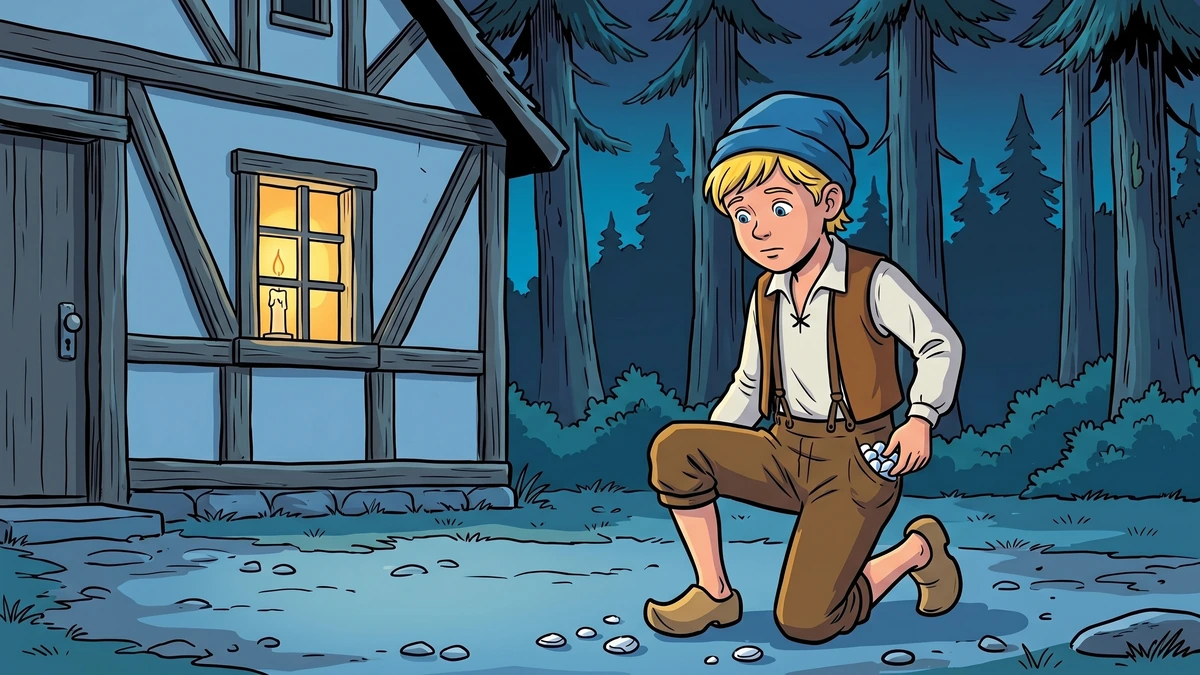
The Pebbles That Glittered Like Silver Coins
At the edge of a great German forest, in a low timbered cottage with a thatched roof and a single iron pot, lived a poor woodcutter, his second wife, and his two children from a former marriage — Hansel and his little sister Gretel. The Grimms set the tale in a vague but unmistakably medieval-Germanic world: pine forests, ovens of stone, bread baked from rye flour, and the constant near-presence of hunger. When famine struck the land, even the bread on the woodcutter’s table grew scarce.
One night, as the embers cooled and the children pretended to sleep, the stepmother spoke the unspeakable. The forest was vast; the children were small; if the family went on as they were, all four would starve. Tomorrow, she said, they would lead Hansel and Gretel into the deepest thicket and leave them there. The woodcutter wept, but he had no other plan.
Hansel, however, lay awake listening. As soon as the cottage fell silent, he slipped out into the moonlit yard and filled both pockets with small white pebbles, each one glittering like a freshly minted silver pfennig. When dawn came and the family set off into the forest with a single crust of bread between the children, Hansel walked behind, dropping pebbles one by one along the path. By nightfall the parents had vanished and the fire they had lit in the clearing burned out. But the moon rose high, the pebbles shone, and Hansel led Gretel home along a glowing thread of stone.
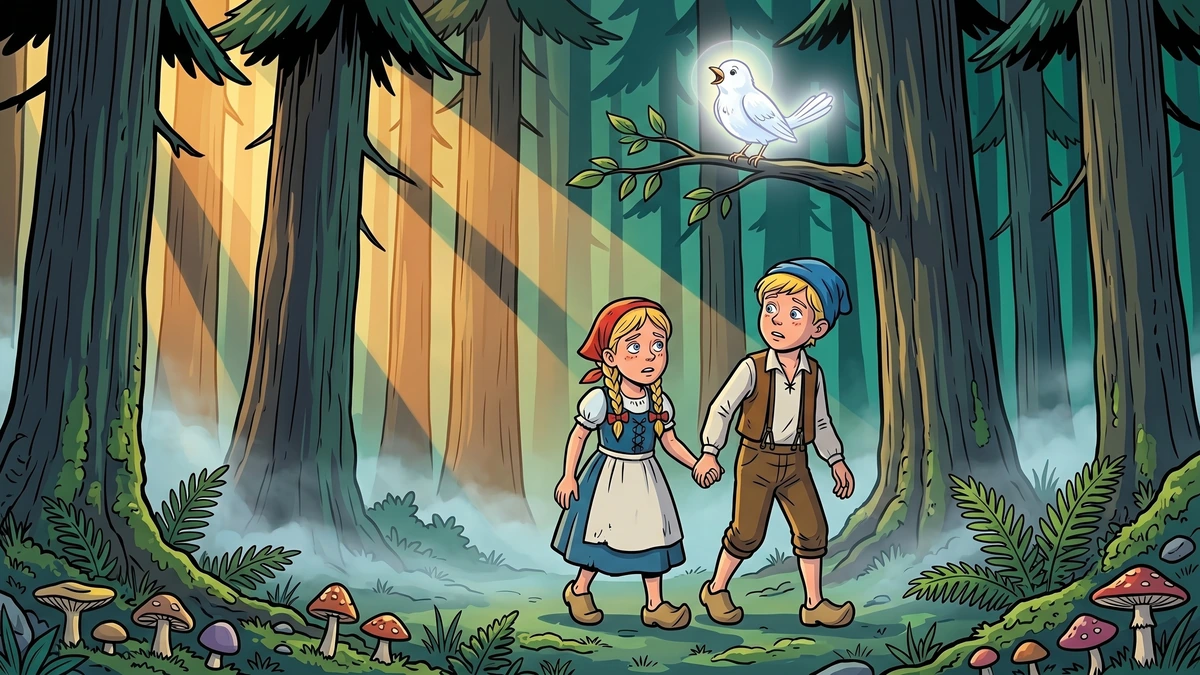
The Trail of Bread and the House of Sweet Bread
The reprieve was brief. Within weeks the famine deepened. This time the stepmother bolted the cottage door, and Hansel could not gather pebbles. When morning came, he could only crumble his small ration of bread into his pocket and let it fall as breadcrumbs along the forest floor. By the time the parents abandoned the children deep among the firs, the birds had eaten every crumb. There was no road home.
For three days and nights Hansel and Gretel wandered. They drank from cold streams, slept curled together against the roots of an oak, and grew light-headed with hunger. On the third morning, a snow-white bird with a song sweeter than any thrush perched on a branch above them and led them deeper into the wood — until at last the trees parted and they saw a strange, glowing little house in a clearing. Its walls were baked of gingerbread, its roof was tiled with sugar cake, and its windows shone with panes of clear-spun barley sugar.
Half-mad with hunger, the children fell upon the house. Hansel snapped a piece from the roof; Gretel pressed a windowpane to her tongue. From inside a thin, cracked voice called out:
“Knusper, knusper, knäuschen,
Wer knuspert an meinem Häuschen?”
“Nibble, nibble, little mouse, who is nibbling at my house?”
— Hänsel und Gretel, KHM 15, Brüder Grimm, 1812
The door creaked open and out came a very old woman, leaning on a crutch. She smiled, stroked the children’s cheeks, and led them inside to a table laid with milk, pancakes, sugared apples, and nuts. She gave them small white beds with snow-white linen. The children, who had not slept under a roof in days, fell into a sleep so deep that they did not see the witch’s red eyes glittering in the firelight.
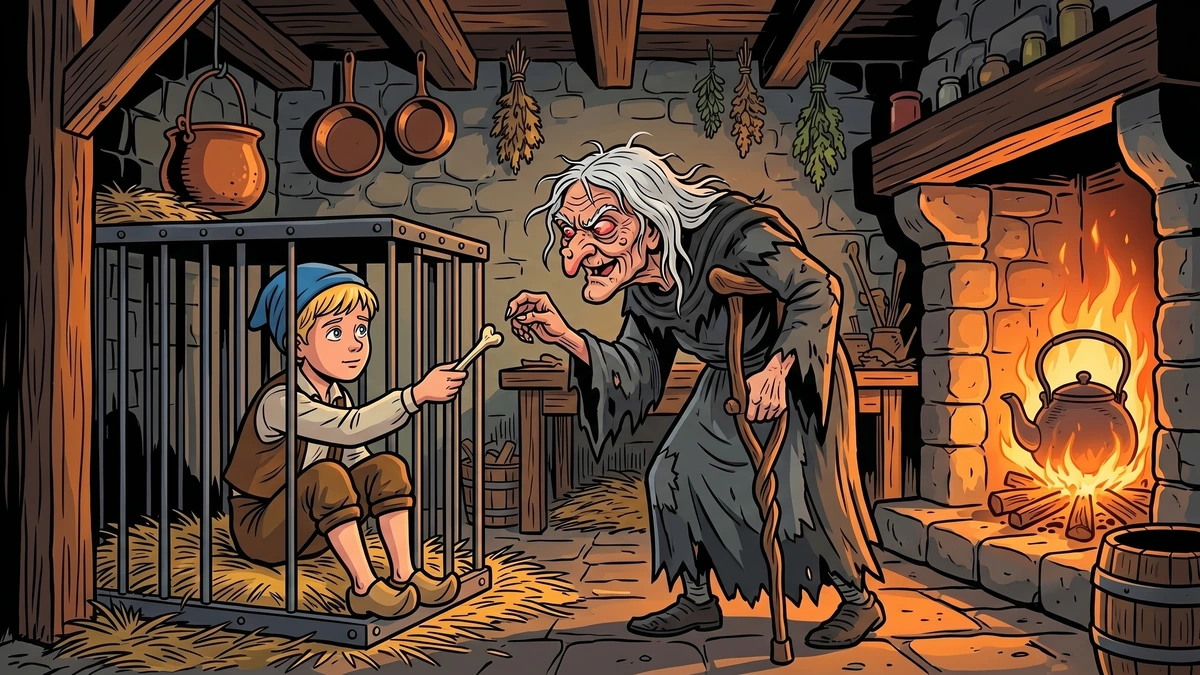
The Cage, the Bone, and the Slow-Heating Oven
For the woman was a witch — one of the old Germanic Hexen who, in the Grimms’ words, had built her gingerbread house “to lure little children, whom she then killed, cooked, and ate.” Her eyesight was poor, but her sense of smell was as keen as a beast’s; she could smell a human child miles away. At dawn she dragged Hansel by his hair into a small stable behind the house and locked him into an iron cage. Gretel she shook awake with a cry: “Get up, lazybones! Fetch water and cook something good for your brother. He is in the stable, and he is to be fattened up. When he is fat enough, I shall eat him.”
Each morning the witch hobbled to the stable and called: “Hansel, stretch out your finger so I may feel whether you will soon be fat.” But Hansel, clever even in captivity, held out a thin chicken bone he had found in the cage straw. The half-blind witch felt the bone, grumbled that the boy refused to grow plump, and ordered Gretel to cook ever larger pots of stew. Four weeks passed in this way. The witch’s patience wore through.
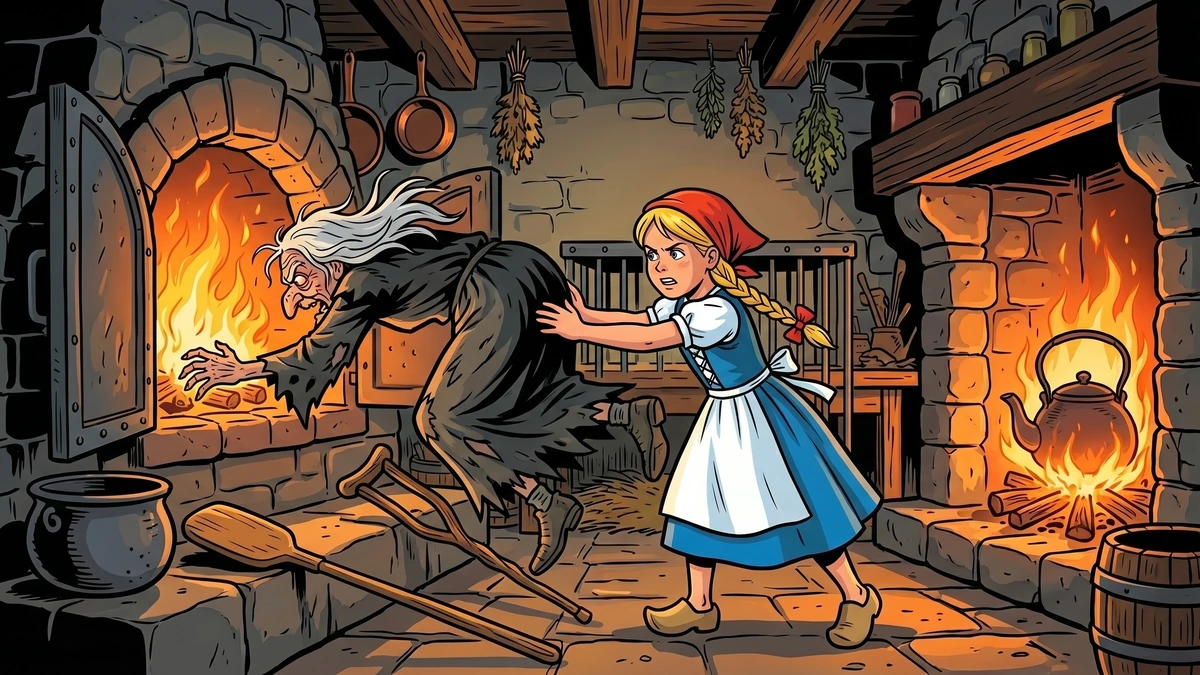
“Fat or thin,” she snapped one morning, “Hansel shall be cooked tomorrow.” She lit the brick oven and made Gretel knead bread dough, then said: “Crawl in and see if it is hot enough; we’ll bake the bread first.” But the witch’s true plan was to shut the iron oven door behind Gretel and roast her too. The little girl, who had wept herself thin with terror for weeks, looked at the oven, then at the witch, and saw what was meant. Slowly, almost shyly, she said: “I do not know how. Show me first.”
Two Swans, a Pearl Necklace, and the Way Home
The witch, hissing with annoyance, climbed onto the oven’s stone lip and stuck her head inside to demonstrate. In one motion Gretel braced her small palms against the witch’s back and shoved with all the strength a starving child can summon. The witch tumbled headfirst into the flames. Gretel slammed the iron door, and the wicked old Hexe burned to her end as she had meant to burn the children.
Gretel ran straight to the stable and unlocked the cage. Hansel sprang into her arms “like a bird whose cage is opened,” the Grimms write, and the two of them ran through the witch’s house, laughing now where they had trembled before. In every corner they found chests of pearls and precious stones — the treasure the witch had stolen from earlier victims. Hansel filled his pockets, Gretel filled her apron, and they fled into the forest.
At last they came to a wide stretch of dark water with no bridge across. A great white swan glided up to them, and Gretel sang, “Little swan, little swan, here stand Hansel and Gretel; no bridge or ferry can be found, take us across on your back so white and round.” The swan ferried them over one at a time. On the far bank the forest grew familiar. The two children began to run, faster and faster, until at last they burst into their father’s cottage. The woodcutter wept; the stepmother — the Grimms tell us — had died while the children were lost. Hansel shook out his pockets and Gretel shook out her apron, and pearls and precious stones rolled across the floor like a small storm. From that day forward the family wanted for nothing, and lived together in great joy.
The Moral — Cleverness, Courage, and the Younger Sister Who Saved Them Both
Mein Märchen ist aus, dort lauft eine Maus, wer sie fängt, darf sich eine große, große Pelzkappe daraus machen.
“My tale is done; there runs a mouse — whoever catches it may make a great, great fur cap of it.”
— closing formula, KHM 15
The moral that schoolmasters in nineteenth-century Hesse pinned to the tale was simple: presence of mind and quiet courage are stronger than greed and cruelty. But the more careful moral, the one the Grimms themselves saw, is gendered and quiet. Hansel saves them once with his pebbles, but it is Gretel — the smaller, the younger, the dismissed — who saves them both when it counts. The witch is undone not by a knight’s sword or a prince’s spell but by a starving girl who finds, in the worst hour of her life, the wit to ask the right question: “Show me first.”
Why the Tale Has Lasted Two Centuries
Folklorists have long noted that “Hansel and Gretel” sits at the cross-road of two ancient worries: the famine that periodically swept medieval and early-modern Germany, and the universal childhood terror of being abandoned by one’s parents. Hans Traxler’s 1963 satire Die Wahrheit über Hänsel und Gretel placed the witch’s house in the Spessart forest near Engelhardsberg; serious folklorists smiled, but the very fact that readers wanted to believe the cottage was real shows how completely the tale has fused with the German landscape. Engelbert Humperdinck’s 1893 opera turned the children into a holiday institution; the tale has been retold by Anne Sexton, Robert Coover, Gregory Maguire, and a thousand picture-book illustrators from Arthur Rackham to Lisbeth Zwerger. Across two hundred years the story keeps its hold for one reason: in the darkest part of the forest, with the door of the oven open, a small child finds her courage — and that is a candle every generation needs to keep lit.
Variants Across Europe — From Charles Perrault’s “Le Petit Poucet” to the Russian “Baba Yaga”
“Hansel and Gretel” is not a single story but a node in a vast comparative web. Antti Aarne, Stith Thompson, and Hans-Jörg Uther’s index (the standard reference of folklore studies, last revised by Uther in 2004 as The Types of International Folktales) groups the tale as ATU 327A, “The Children and the Ogre” — a sub-type within the larger ATU 327 cycle. Charles Perrault’s 1697 French tale Le Petit Poucet (“Little Thumbling”), in which seven brothers are abandoned by destitute parents and the youngest tricks an ogre into murdering his own daughters, is the classic French cousin to the German story. The Russian tradition gives us “Baba Yaga and the Little Children,” in which the iron-toothed forest witch keeps a hut on chicken legs and a sister rescues her brother from the oven. Italian, Romanian, Hungarian, Estonian, and Lithuanian variants exist; Stith Thompson identified more than nine hundred recorded versions of ATU 327 across Europe, the Americas, and Asia. The candy house is a German contribution — in many other versions the witch’s lair is simply a hut, a cave, or an ogre’s castle — but the abandoning parents, the captured boy, the lonely sister, the oven, and the forest are remarkably stable across two millennia of telling.
How the Brothers Grimm Recorded the Story
Jacob and Wilhelm Grimm collected the tale around 1810 from Henriette Dorothea (“Dortchen”) Wild and her family in Kassel, Hesse, where the brothers were then librarians at the court of King Jérôme Bonaparte. The first edition of Kinder- und Hausmärchen, published 20 December 1812 by the Realschulbuchhandlung in Berlin, contains a noticeably starker text than later versions. In the 1812 telling it is the children’s natural mother, not a stepmother, who urges abandonment; only in the 1819 second edition did Wilhelm Grimm soften this to the now-canonical “wicked stepmother.” The same edition added the closing formula about the mouse and the fur cap, sharpened the witch’s rhyme at the gingerbread house, and refined the swan’s ferry on the homeward journey. Scholars led by Heinz Rölleke (whose 1980 critical edition of the manuscript Grimm tales remains the standard) have shown how Wilhelm Grimm’s hand smoothed and Christianised the tales across seven editions between 1812 and 1857, but the bones of “Hansel and Gretel” — abandonment, edible house, oven, escape — were already present in the very first manuscript Dortchen recited in the Wild family kitchen.
Famine, Forest, and the Real Hunger Behind the Sugar
Historians of pre-modern Germany have long pointed out that the opening pages of “Hansel and Gretel” describe a real and recurring catastrophe. The “Great Famine” of 1315–1317, the cooler decades of the seventeenth century known as the Little Ice Age, and the famines that followed the Thirty Years’ War (1618–1648) all left rural German families with the unbearable arithmetic the woodcutter faces in the tale’s first scene. Contemporary chronicles record cases of child abandonment in the great forests of Hesse, Thuringia, and Bavaria. The detail of a child crumbling bread to mark a path is older than the Grimms; it appears in classical Greek and Latin sources and in medieval saint-tales. Even the gingerbread house, often dismissed as pure invention, has roots in real culture: Lebkuchen, the spiced honey-cake of Nuremberg and Bavaria, was baked into elaborate house shapes for Christmas markets as far back as the 1500s. The cottage in the clearing is a children’s fantasy of plenty grown directly out of the medieval kitchen.
Symbolism — Pebbles, Breadcrumbs, the Oven, and the Swan
Bruno Bettelheim’s controversial but influential The Uses of Enchantment (1976) read “Hansel and Gretel” as a story of children learning to overcome the “oral fixation” of helpless infancy — the candy house representing the regressive longing to be fed, the witch the devouring mother, the burning oven the child’s own anger turned outward and finally mastered. Marie-Louise von Franz, working in the Jungian tradition, saw Gretel’s shove as the moment the youthful psyche integrates and outgrows its terror of the Great Mother. Folklorists less committed to depth psychology — Maria Tatar, Jack Zipes, Ruth Bottigheimer — emphasise the practical lessons: cooperation between siblings, the difference between the trick that fails (breadcrumbs) and the trick that works (the chicken bone), and the moral economy in which the witch’s stolen pearls become a legitimate inheritance once the witch is destroyed. Whatever lens one chooses, the symbols are remarkably tight: white pebbles (the moon, hope, the way back); breadcrumbs (the false plan, eaten by birds); the oven (the witch’s own weapon turned against her); and the swan (transformation, deliverance, the river of return).
From the Forest to the Opera House — A Two-Hundred-Year Afterlife
Englebert Humperdinck’s children’s opera Hänsel und Gretel, premiered in Weimar on 23 December 1893 under the baton of Richard Strauss, recast the tale for the Wagnerian stage and made it a German Christmas tradition that continues to this day. The libretto, written by Humperdinck’s sister Adelheid Wette, soft-pedalled the abandonment (the parents are simply absent rather than cruel) but kept the witch and the oven intact. In the twentieth century, Anne Sexton’s 1971 poem “Hansel and Gretel” stripped the tale back to its hungry core; Robert Coover’s 1969 short story “The Gingerbread House” zoomed in on the moment before the witch appears; Neil Gaiman’s 2014 novella Hansel and Gretel, illustrated by Lorenzo Mattotti, returned the story to the famine where it began. Picture-book illustrators from Arthur Rackham (1909) to Anthony Browne (1981) to Lisbeth Zwerger (1979) and Susan Jeffers (1980) have made the gingerbread house one of the most-drawn images in Western children’s literature. The story has been filmed at least twenty times since 1909 and adapted as ballet, puppet show, video game, and pantomime. Two centuries after Dortchen Wild told it in a Hessian kitchen, “Hansel and Gretel” remains the central European fairy tale that never lets go.
Frequently Asked Questions
What is the moral of Hansel and Gretel?
Who wrote Hansel and Gretel?
What is the story of Hansel and Gretel?
What is the dark history behind Hansel and Gretel?
What age is Hansel and Gretel appropriate for?
You May Also Like
 Grimm's Fairy Tales
Ages 9-12
Grimm's Fairy Tales
Ages 9-12
The Little Peasant
The Little Peasant: There was a certain village wherein no one lived but really rich peasants, and just one poor one, whom they called the little peasant. The
 Grimm's Fairy Tales
Ages 9-12
Grimm's Fairy Tales
Ages 9-12
Clever Gretel
There was once a cook named Gretel, who wore shoes with red heels, and when she went out she cut capers with them.
 Grimm's Fairy Tales
Ages 9-12
Grimm's Fairy Tales
Ages 9-12
Frederick And Catherine
Frederick And Catherine: There was once a man called Frederick: he had a wife whose name was Catherine, and they had not long been married. One day Frederick