The Goose-Girl
The Goose-Girl: The king of a great land died, and left his queen to take care of their only child. This child was a daughter, who was very beautiful; and her
The Goose-Girl — in the original German Die Gänsemagd — is tale number 89 in the Brothers Grimm Kinder- und Hausmärchen, the celebrated Children’s and Household Tales. It first appeared in the second volume of the inaugural edition (Berlin, 1815) and was then carried, with successive philological refinements, through every one of the seven editions Jacob and Wilhelm Grimm prepared between 1812 and the definitive Ausgabe letzter Hand of 1857. In the international Aarne–Thompson–Uther index of folk-tale types the story is classified as ATU 533 — “The Speaking Horsehead,” a tale type whose central, almost shocking image is the severed head of a faithful magical horse nailed under a city gate, speaking out the truth of a stolen identity to a princess who, dispossessed and forced into servitude, dares not utter the truth herself. The Grimms’ principal informant for the tale was the great Hessian story-teller Dorothea Viehmann — die Märchenfrau aus Niederzwehren — whose unusually pure oral diction and extraordinary memory the brothers praised in the prefaces to their second and later volumes; she gave them not only The Goose-Girl but a substantial proportion of the second-volume material. English readers met the tale first in Edgar Taylor’s celebrated German Popular Stories (London, 1823, with George Cruikshank’s iron-line engravings), and then more fully and accurately in Margaret Hunt’s 1884 translation for George Bell & Sons, which remains the standard English text. In the Stith Thompson Motif-Index of Folk-Literature the tale gathers an extraordinary cluster of motifs: B133.3 (speaking horse’s head), B211.1.3 (speaking horse), K1911 (false bride/imposture by waiting-maid), K1934 (imposter forces heroine to change places), D1318.2 (severed head reveals truth), H13.2.1 (recognition by tale told to stove or oven), and the savage Q414.0.1 (punishment in a barrel of nails). It is one of the most artistically integrated of all the tales in the collection, and its small number of unforgettable images — the lock of three blood-drops, the talking horse, the head nailed under the dark gate, the silver-gold hair combed in the meadow, the iron stove into which the truth is whispered — have made it for two centuries one of the great touchstones of European folk imagination.
I. The Three Drops of Blood, the Speaking Horse, and the Road
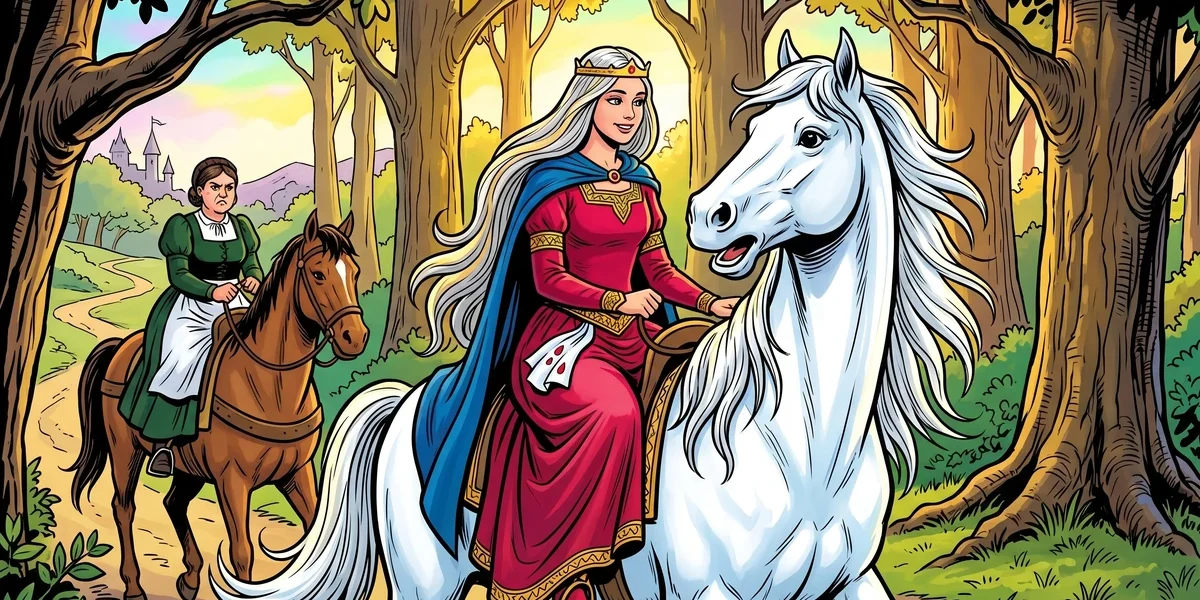
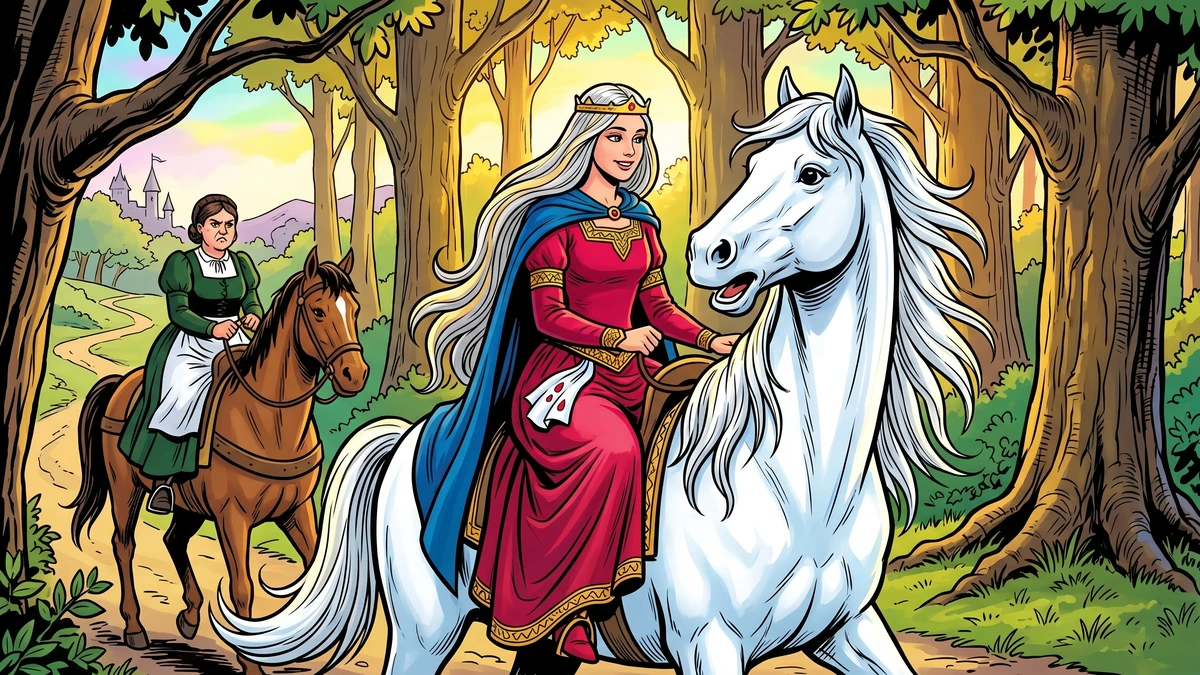
The story opens in a German princely court of the kind the Grimm brothers loved to set their tales in: a stone palace with a great Romanesque hall, smoke-blackened beams, banners of arms hanging from rafters, and a widowed queen who has never recovered from the death of her husband and who pours her whole life into the upbringing of her one daughter, a princess of exceptional beauty and the more exceptional gentleness that, in the Grimm corpus, is always the first signature of a true heroine. The princess has been promised, since she was a child, to a prince in a country far across the German lands, and at last the day comes for her to be sent to the bridegroom. The queen-mother fills heavy oak chests with the gold and silver and jewelled girdles and embroidered linen of a royal trousseau; she gives her daughter a single waiting-maid; and she gives her, for the journey, the most precious of her wedding-gifts — the magical horse Falada (German Fallada), who in the folk-tradition belongs to the great family of the speaking, faithful, sometimes prophetic horses of Indo-European myth that runs from the Vedic Aśvins through Tacitus’s white horses of the Germanic groves to Sleipnir of the Norse Eddas. Falada has been the queen’s gift to the princess; he can speak; and his loyalty to the bride is, the tale will quietly insist, the deeper of the two protections the queen gives her child.
The deeper, but not the only one. As the princess takes her leave, the queen-mother goes into her chamber, takes a small knife, and cuts her own finger, letting three drops of blood fall onto a piece of fine white linen. She gives the linen to her daughter and says, “Take care of this, dear child; it will help you on the road.” The motif is among the most haunting in all of European folk-magic — a mother’s blood as a portable amulet, a small charm of the protective dead, a literal gift of self carried in the bosom against the day when the traveller will be powerless and alone. Then the princess and her waiting-maid set off, the princess on Falada and the maid on a lesser horse, and the queen-mother stands at her tower window and watches them ride away through the linden-shaded gate of the court.
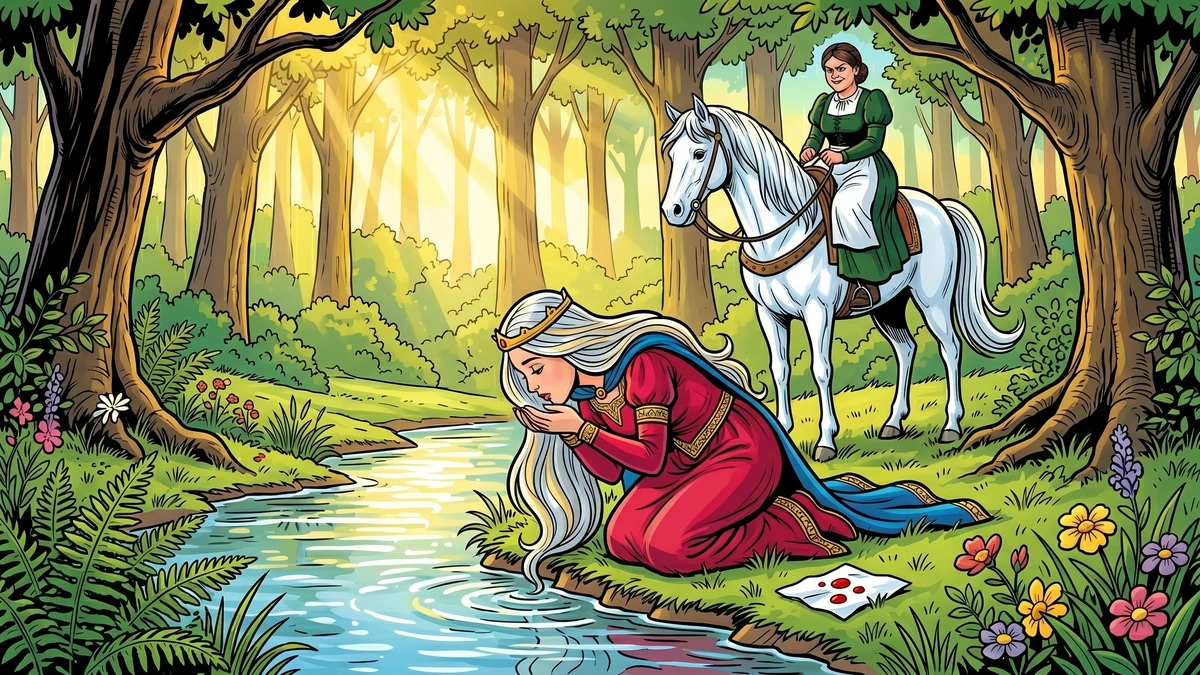
The road is long, the day grows hot, and at last the princess is overcome by thirst. She asks her maid politely to dismount and to fetch her water in her golden cup from a brook running beside the road. The maid, in one of the most quietly chilling speeches in the tale, refuses: “If you are thirsty, get off and stoop and drink from the brook; I am not your servant any longer.” The princess, gentle by temperament and far too well-bred to argue, dismounts, kneels at the water, and drinks; and as she drinks the three drops of blood on the linen in her bosom speak to her in a small grieving voice: “Wenn das deine Mutter wüsste, das Herz im Leibe tät’ ihr zerspringen” — “If your mother knew this, her heart would break in her body.” The same scene happens twice more, by a deeper river; the princess dismounts again, drinks again, the three drops grieve again. And on the third descent, as she leans down to the running water, the linen with the drops of blood slips from her bosom and floats away unseen down the stream — and the princess, drinking, does not notice. The maid, watching from the bank, sees, and knows precisely what it means. The talisman is gone. The girl is now alone.
II. The Stolen Identity, the Death of Falada, and the Dark Gate
The maid acts at once. She tells the princess to dismount from Falada, gives her her own poor horse, makes her change clothes — the rich royal silks for the maid’s coarse stuff — and, as the road approaches the bridegroom’s kingdom, makes the princess swear under heaven not to tell a single living soul what has been done to her, on pain of being killed where she stands. The princess, gentle, terrified, possessed of nothing now but her oath and her own dignity, swears it. Falada, however, sees everything. The folk-magical principle here is precise — the horse, magically articulate, is the surviving witness; and the maid, knowing the danger of any witness, will move to silence him as swiftly as she can.
They arrive at the bridegroom’s court. The young king rides out to meet them, lifts the maid from Falada with a courtly gesture, mistakes her for the bride, and leads her into the palace and up to the bridal chamber. The true princess is left standing in the courtyard. The old king, the bridegroom’s father, looking down from his kitchen window in idleness, sees the strange beautiful girl in the maid’s clothes standing alone below, and asks the false bride who she is. “I brought her with me for company on the road,” says the maid lightly. “Pray give her some work to do, that she may not be idle.” The old king, after a moment’s thought, says, “I have a lad named Curdken [German Conrad or Kürdchen] who keeps the geese in the meadow; let her help him.” And so the princess, the betrothed bride of the kingdom, becomes its goose-girl.
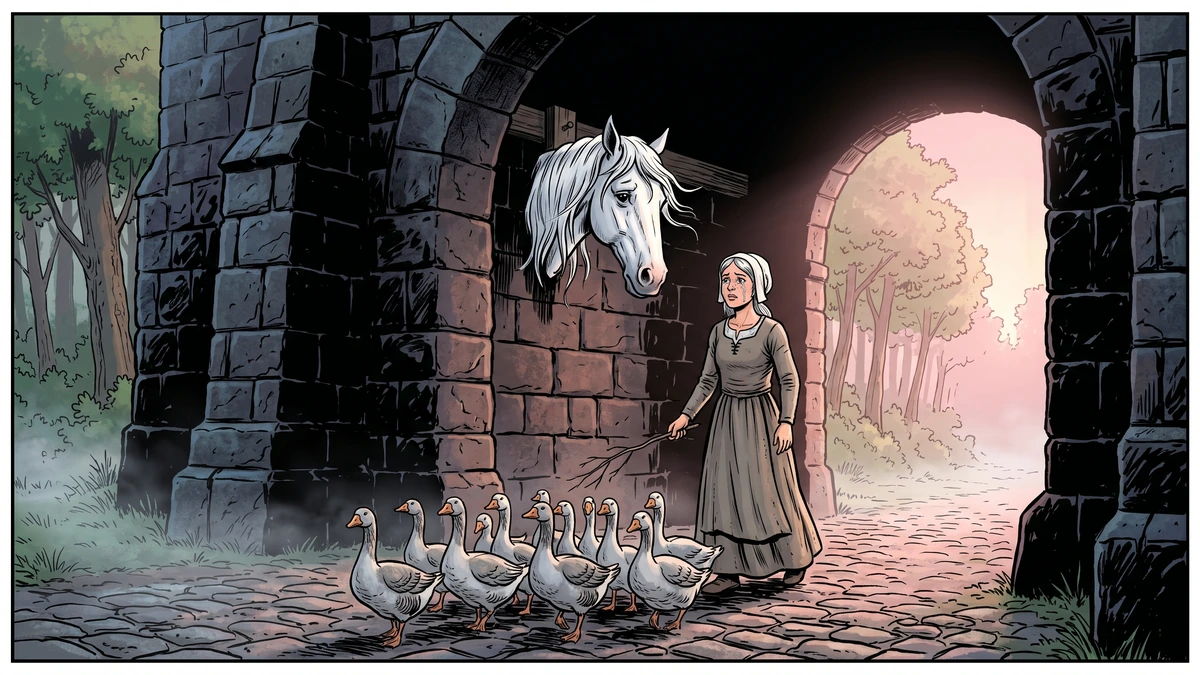
But the maid is not yet safe. Falada is still in the stable, and Falada knows. The false bride goes to the young king with a weeping, charming, perfectly fluent request: would her husband do her one small kindness, and order the slaughterer to cut off the head of the unruly horse she rode on the road, who plagued her cruelly? The young king, doting on what he thinks is his bride, gives the order; and the magnificent talking horse is led to the block. The true princess, hearing the news, weeps in secret and goes to the slaughterer. She offers him a coin and begs that, when the deed is done, Falada’s head be nailed up under the great dark gate of the city through which she has to drive the geese to pasture every morning and home again every evening, so that she may at least see him pass each day. The slaughterer, more out of pity than out of any payment, agrees; and so begins one of the most extraordinary tableaux in the entire Kinder- und Hausmärchen: the dark Romanesque archway of a German city gate, the faithful horse’s head nailed against the stone, and the daughter of a queen, dressed in coarse linen, driving her flock of grey geese under it twice a day.
Each morning, going out, she greets the head: “O Falada, da du hangest!” — “O Falada, hanging there!” And each morning the head answers, in a voice the wind seems to carry: “O Jüngferlein, Jüngferlein, da du gangest! Wenn das deine Mutter wüsste, das Herz im Leibe tät’ ihr zerspringen” — “O young maiden, going on your way! If your mother knew it, her heart would break in her body.” The faithful horse, even in death, speaks a truth the living princess cannot. The motif (Stith Thompson D1318.2, severed head reveals truth) belongs to a deep folk current that runs through the Welsh Mabinogion‘s Brân the Blessed, the singing skull of certain Russian skazki, and the prophesying severed head of the saintly Cephalophore in Christian hagiography; but nowhere in the European tradition is its emotional power more concentrated than here.
III. The Meadow, the Silver-Gold Hair, and the Wind That Blows the Hat
Out beyond the gate, in the long meadow where the geese graze, the goose-boy Curdken — rough, freckled, perhaps twelve years old, a Bauernbub of the kind the Grimm brothers knew well from their Hessian villages — watches the new helper unwillingly. Each day in the meadow, when the geese settle to feed, the princess sits on a hummock, takes off her coarse linen cap, and lets fall her hair, which the tale describes with a marvellous Grimm-period adjective compound: it is silberweiss und goldglänzend, silver-white and shining with gold — the kind of hair that in folk-tradition signals royal blood as plainly as any crown. Curdken, dazzled, runs over to pluck a few of the shining locks for himself, but the princess, knowing what he is about to do, says quickly:
“Weh’, weh’, Wändchen,
nimm Kurdchen sein Hütchen,
und laß’ ihn sich mit jagen,
bis ich mich geflochten und geschnatzt,
und wieder aufgesatzt!”
— “Blow, blow, little wind, take Curdken’s little hat, and make him chase it until I have braided and bound and set my hair up again!” Instantly a wind springs up, snatches the boy’s hat, and rolls it across the meadow and over the hill; Curdken pelts after it, the princess combs and braids and pins her shining hair back beneath the cap, and by the time the breathless and angry boy returns, all is again as it was. Day after day the same thing happens. The motif — magical mastery of the wind, command over an animate element by a heroine forbidden to use her tongue — is one of the most striking of all the tale’s small magic; the princess, prevented by her oath from speaking the truth even to save herself, is yet permitted to speak with the wind.
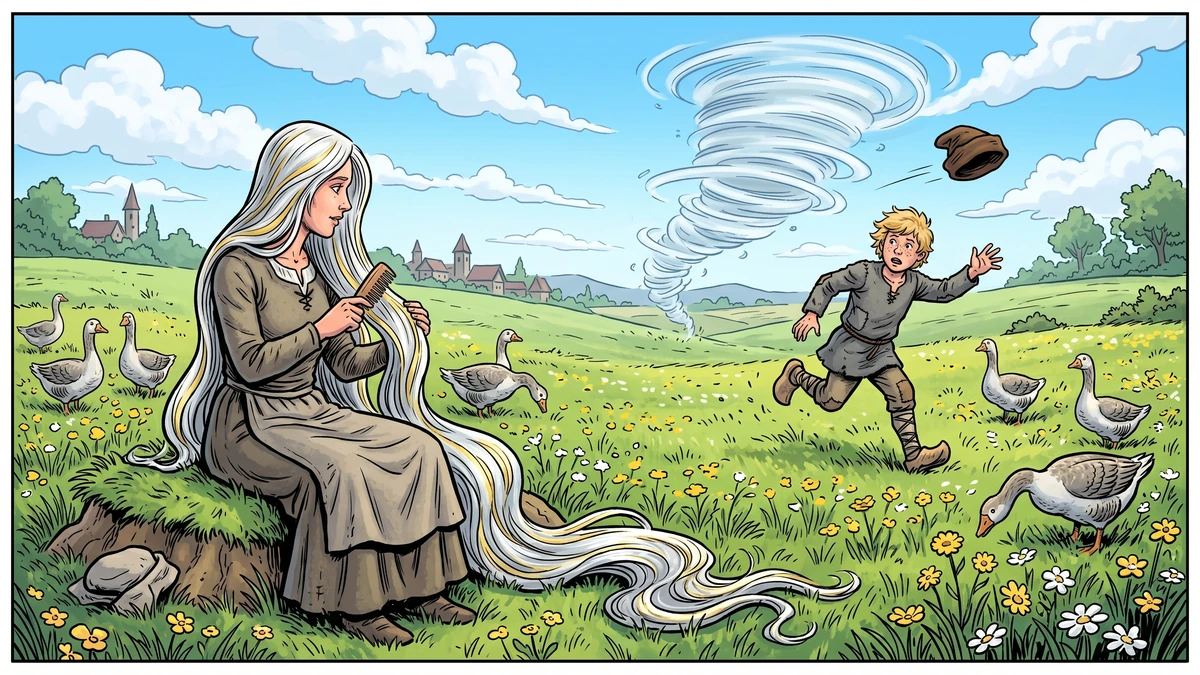
At last Curdken, sulking, complains to the old king. “I will not keep the geese any longer with that strange girl,” he says. “She talks to a horse’s head under the gate every morning, and the head answers her; and out in the meadow she lets down her hair, which is silver-and-gold, and she calls up a wind to blow my hat away.” The old king, listening with the slow attention of a folk-tale king, suspects. The next morning he hides behind the dark gate, and hears the princess greet Falada, and hears Falada’s grieving answer; he hides in a clump of bushes by the meadow, and sees the silver-gold hair come out of its coarse cap, and the wind spring obediently up at the maiden’s small command. He goes home thoughtful and says nothing. In the evening, when the goose-girl returns, he calls her aside and asks her plainly to tell him who she is. She bursts into tears. “I dare not tell you,” she sobs, “or any human being — I have sworn under heaven, and I shall lose my life if I tell.” The folk-tale rule of an oath made to one’s enemy is iron; she cannot break it.
IV. The Iron Stove and the Recognition
But the old king is wise in the way that folk-tale kings are wise. He has seen the head, the hair, and the wind; he knows already; he needs only a door through which the truth, sworn to no human being, can be permitted to pass. He leads the goose-girl to a great iron stove — a heavy German Eisenofen of the kind that warmed the halls of Hessian palaces — opens its black iron door, tells her to creep inside, and shut herself up alone with the iron walls and her grief. “Tell to the stove,” he says, “what no human being may know.” Then he goes outside, lays his ear against the chimney-pipe of the stove on the upper floor, and listens.
The princess, in the dark of the iron belly, weeping bitterly, tells the stove the whole story: the queen-mother, the three drops of blood, the lock that floated away, the maid’s threat, the false bride at her own wedding-feast, Falada killed and his head nailed to the dark gate, the meadow and the wind. The motif is one of the most beautiful in the entire Grimm corpus — Stith Thompson H13.2.1, recognition by tale told to stove (or oven, or hearth) — and it has a precise folk-logic to it: the oath was sworn against no human ear hearing, and an iron stove is not a human ear. The truth is told without the oath being broken; and the listening king at the chimney hears every word.
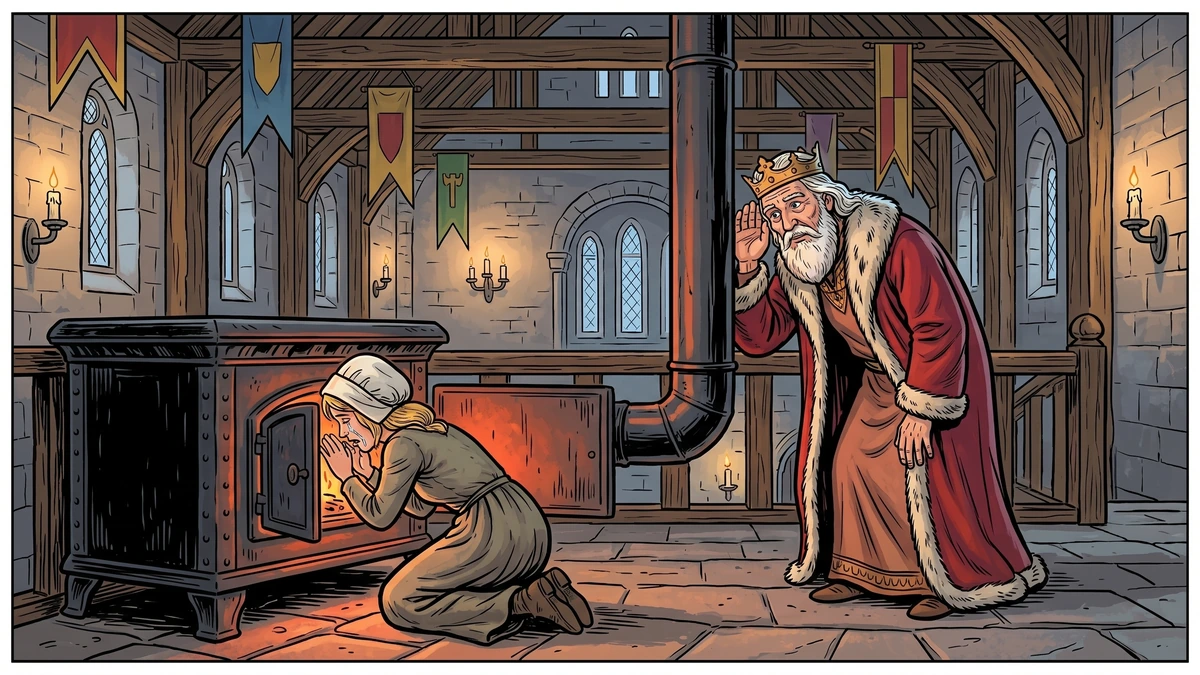
He goes back to the goose-girl, draws her out of the stove with great gentleness, and orders his women to dress her in royal robes again. She is so beautiful in them that the entire court is struck silent at the sight. The young king, summoned, recognises her as his true bride, and rejoices in her beauty and in her patience and in the long kindness she has shown to a faithful horse and to a freckled goose-boy. The old king commands a great feast. The young king sits at the head of the table, the false bride still on one side of him — perfectly unaware that she has been discovered — and the true princess on the other, restored to her rank, in clothes that even her old waiting-maid does not at first recognise. The young king, after the feast has gone on a while, asks the false bride, as if proposing a courtly riddle, what punishment such-and-such a person would deserve who had done such-and-such a thing — and lays out the maid’s own crime, in detail, as a hypothetical. The false bride, never imagining she is judging herself, answers loudly and with the relish of a wicked queen pronouncing on a stranger: she would deserve to be stripped naked and shut into a barrel studded inside with nails, and the barrel dragged behind two white horses through every street of the town until she was dead. “Thou art she,” says the old king, “and thou hast pronounced thine own sentence.” The Grimms preserve the savage punishment exactly as their oral source gave it (Stith Thompson Q414.0.1); the young king is married at last to his true wife; and the kingdom, in the matter-of-fact closing line of the original German, lives on in peace and gentleness for many years.
V. Falada Restored and the Tale’s Closing Image
In some versions preserved by the Grimms, and in many of the most beloved later adaptations, the closing image of the tale is the appearance of the queen-mother’s good fairy, who returns to the kingdom at the wedding and, in a small kindness that seems almost an afterthought, restores faithful Falada to life. The horse, who saw and could not save, who spoke from a nailed head and could not be silenced, is given back his body; the princess, who suffered everything in silence, is restored to her speech; and the iron stove into which the truth was poured stands forever after, in the iconography of the tale, as the small dark vessel into which a good story can be made to confess what no human being is permitted to be told.
Moral — Die Moral der Geschichte
“Die Wahrheit kann man begraben, an ein Tor nägeln, in einen Eisenofen einsperren — und doch wird sie sprechen; denn ein treues Pferd, ein redlicher König und der Wind selbst sind ihre Zeugen.”
The German moral — “The truth may be buried, nailed to a gate, or shut up in an iron stove, and yet it will speak; for a faithful horse, an honest king, and the wind itself are its witnesses” — gathers the entire moral architecture of the tale into a single epigram. The princess, oath-bound and powerless, never speaks the wrong done to her in any human ear; and yet the wrong is spoken — by the three drops of blood on the linen, by Falada from a head nailed in stone, by the wind in a meadow, by the iron stove and a king at a chimney-pipe. The story’s deepest claim is not that virtue is always rewarded — though here it is — but that truth itself, when it is held in by force, finds its way out through other voices than the one that bore it. The moral is also, in its small Grimm-Hessian way, a moral about gentleness as a form of strength: the princess never raises her voice, never breaks her oath, never accuses her enemy, and never ceases to be kind to a faithful horse and to a difficult boy in a meadow — and the kingdom, in the end, recognises her precisely because of that long unfailing gentleness.
Why The Goose-Girl Has Lasted Two Hundred Years
Of the more than two hundred tales in Kinder- und Hausmärchen, only a relative handful have crossed every linguistic boundary to become genuinely global property — Cinderella, Snow White, Hansel and Gretel, Rapunzel, Little Red-Cap, Rumpelstiltskin, the Bremen Town Musicians, the Frog King, and The Goose-Girl among them. Die Gänsemagd‘s endurance has many sources. Its central images — the mother’s three drops of blood, the talking horse, the severed head nailed under a Romanesque arch, the silver-gold hair in the meadow, the iron stove into which the truth is whispered — are among the most cinematically and visually translatable images in the entire European folk-stock, and have been illustrated by every major artist who ever turned to the Grimms, from George Cruikshank in 1823 through Walter Crane (1882), Arthur Rackham, Wanda Gág, Jiří Trnka, and the picture-book traditions of the twentieth and twenty-first centuries. Its moral architecture is unusually clean: a journey, an oath of silence sworn under coercion, a long ordeal in a humble office, three witnesses (horse, hair, wind), an iron-stove confession, and a self-pronounced punishment of the antagonist by her own mouth — one of the most artistically perfect symmetries in all of folk-narrative.
Its psychological reach is equally remarkable. Bruno Bettelheim, in The Uses of Enchantment (1976), reads the tale as a parable of the long apprenticeship through which an inner truth, silenced by the demands of others, eventually finds its way back to articulate authority; Marie-Louise von Franz, in her Jungian commentaries, saw in Falada the figure of the animal soul whose voice the heroine cannot afford to lose even after his apparent death; and Maria Tatar, in The Hard Facts of the Grimms’ Fairy Tales (1987), placed the iron-stove confession scene in a long European tradition of secret-telling rituals that allow the powerless to speak. The tale has been adapted in opera (Engelbert Humperdinck’s Königskinder, 1910, draws on closely related material), in early German silent film, in the Lotte Reiniger silhouette tradition, in Philip Pullman’s modern retelling (Grimm Tales for Young and Old, 2012), in Shannon Hale’s prize-winning novel The Goose Girl (2003), and in the modern Indian classroom anthology where it sits beside the Panchatantra and the Jataka tales as a perennial example of the universal grammar of the folk-tale.
Its heroine remains, in her stubborn meekness, one of the most unusual moral figures in the European tradition: a princess whose only weapon is her own absolute reluctance to speak a wrong word, and whose vindication arrives not because she fights but because the world — horse and wind and stove and king — refuses to let the truth she carries be smothered. The tale ends, almost uniquely in the Grimm corpus, in a courtroom scene the falsifier herself unwittingly conducts; and that closing image — the imposter, asked to pronounce a sentence she does not know is her own, sentencing herself with relish — is one of the most enduring images of folk-justice in any European literature. What is buried by force speaks through other mouths; what is taken by violence is given back through patience. Two hundred years on, Die Gänsemagd remains exactly as it stood in Dorothea Viehmann’s Hessian voice in 1815: one of the great parables of the European imagination of how a truth, however deeply silenced, finds its road back into the daylight.
Frequently Asked Questions about The Goose-Girl
Q1. Who wrote The Goose-Girl, and when was it first published?
The Goose-Girl (German Die Gänsemagd) was collected, edited, and published by the brothers Jacob and Wilhelm Grimm as tale number 89 (KHM 89) in the second volume of Kinder- und Hausmärchen (Children’s and Household Tales), first issued in Berlin in 1815 by the Realschulbuchhandlung. The Grimms did not “write” the tale in the modern authorial sense; they recorded an oral German folk story whose principal informant was the great Hessian story-teller Dorothea Viehmann of Niederzwehren near Cassel — die Märchenfrau — whose unusually pure oral diction the brothers praised in their preface. The tale was revised across all seven editions of Kinder- und Hausmärchen between 1815 and the definitive Ausgabe letzter Hand of 1857, with the brothers polishing the diction and rhymes in each successive edition. Edgar Taylor introduced it to English in German Popular Stories (1823) and Margaret Hunt issued the standard accurate English translation in 1884.
Q2. What is the ATU classification of The Goose-Girl?
In the international Aarne–Thompson–Uther index of folk-tale types, The Goose-Girl is classified as ATU 533 — “The Speaking Horsehead.” The defining features of this tale type are: a princess sent to be married to a distant prince; a treacherous waiting-maid or false bride who substitutes herself for the heroine on the road; a faithful magical horse who knows the truth and is killed by the imposter to silence him; a severed head that continues to speak the truth from a wall or city gate; and a final recognition scene in which the imposter unwittingly pronounces her own sentence. Cognate ATU 533 tales appear all across Europe and into Slavic and Caucasian folklore. The Stith Thompson motif-index pinpoints the operative magical mechanisms as B133.3 (speaking horse’s head), K1911 (false bride), D1318.2 (severed head reveals truth), H13.2.1 (recognition by tale told to stove), and Q414.0.1 (punishment in a barrel of nails).
Q3. Why is the horse called Falada, and what does Falada represent in the tale?
Falada (also spelled Fallada in some Grimm editions) is the name of the talking magical horse the queen-mother gives her daughter as a wedding-gift. The name itself appears to be of Old High German poetic origin and is famously borrowed by the twentieth-century German novelist Rudolf Ditzen as his pen-name Hans Fallada. Within the tale, Falada belongs to the great family of speaking, faithful, sometimes prophetic horses of Indo-European folklore that runs from the Vedic Aśvins through Tacitus’s white horses of the Germanic groves to Sleipnir of the Norse Eddas. He is the surviving witness to the maid’s treachery; his death is the maid’s attempt to silence the truth; and his nailed head — speaking out of stone, twice a day, to a princess walking under the dark gate — is one of the most haunting images in the entire Grimm corpus. Stith Thompson catalogues the magical mechanism as motif B133.3 (speaking horse’s head) and D1318.2 (severed head reveals truth).
Q4. What is the significance of the iron stove (Eisenofen) into which the princess speaks?
The iron stove is the folk-magical key to the tale’s moral resolution. The princess has sworn under heaven that she will not tell any human being what has been done to her, on pain of being killed; the oath is iron, and even the old king who suspects the truth cannot release her from it by direct questioning. The old king’s solution is exactly the kind of folk-magical loophole the European tale-tradition specialises in: he leads her to a great German Eisenofen, asks her to creep inside and tell her grief to the iron walls (which are not a human ear), and goes outside to listen at the chimney-pipe. The motif is Stith Thompson H13.2.1, “recognition by tale told to stove (or oven, or hearth),” and it appears in a small but precious cluster of European tales in which a heroine bound by oath, taboo, or fear is permitted to speak the truth into an inanimate vessel and so be saved. It is one of the most beautiful pieces of folk-juridical imagination in the corpus.
Q5. Why does the false bride pronounce her own punishment, and what does the ending mean?
The closing scene is one of the most artistically perfect moments of self-incrimination in any European folk-narrative. The young king, having heard the princess’s whispered confession through the chimney-pipe, knows the truth; but rather than confront the imposter directly, he stages a riddle at the wedding-feast. He asks the false bride, as if posing a hypothetical case for her judgment, what punishment such-and-such a person would deserve who had done such-and-such things — laying out, in disguised form, her own crimes. The false bride, never imagining that she is judging herself, pronounces with relish the savage punishment of the cask of nails (Stith Thompson motif Q414.0.1) — and the old king answers, “Thou art she; and thou hast pronounced thine own sentence.” The ending is a piece of folk-justice as old as Solomon: the wicked, given enough rope, condemn themselves out of their own mouths. It is also, in the deeper symbolic reading favoured by Bruno Bettelheim and Maria Tatar, the moment in which the truth that the heroine could not speak finally finds the one mouth in the kingdom most committed to denying it — and forces even that mouth to speak it plain.
You May Also Like
 Grimm's Fairy Tales
Ages 9-12
Grimm's Fairy Tales
Ages 9-12
The King Of The Golden Mountain
The King Of The Golden Mountain: There was once a merchant who had only one child, a son, that was very young, and barely able to run alone. He had two richly
 Grimm's Fairy Tales
Ages 9-12
Grimm's Fairy Tales
Ages 9-12
The Twelve Huntsmen
The Twelve Huntsmen: There was once a king’s son who had a bride whom he loved very much. And when he was sitting beside her and very happy, news came that his
 Grimm's Fairy Tales
Ages 9-12
Grimm's Fairy Tales
Ages 9-12
The Wolf And The Seven Little Kids
The Wolf And The Seven Little Kids: There was once upon a time an old goat who had seven little kids, and loved them with all the love of a mother for her