Clever Elsie
Clever Elsie: There was once a man who had a daughter who was called Clever Elsie. And when she had grown up her father said: ‘We will get her married.’ ‘Yes,’

Clever Elsie: The Tragedy of Future-Forecasting Gone Wrong
Among the Brothers Grimm’s tales of human foolishness, Clever Elsie stands as perhaps the most psychologically acute: a young woman sent to the cellar to fetch beer becomes transfixed by a pickaxe hanging on the wall, imagines a sequence of future catastrophes — she will marry, have a child, the child will come to this cellar, the pickaxe will fall and kill it — and dissolves into inconsolable weeping over this purely hypothetical disaster. Her family members come one by one to discover why she has not returned; each of them has the same reaction, and each joins her in weeping. The story is simultaneously a comedy of anxious over-imagination and a remarkably precise account of how catastrophic thinking propagates through a social group.
The Sanskrit philosophical tradition has a name for this cognitive pattern: asambhava-chinta — anxious concern with improbable future events, a form of mental activity that produces suffering without producing any information useful for navigating actual reality. The Yoga Sutras of Patanjali identify this as a variant of abhinivesha (clinging to existence, the fear of non-being): the mind projects into the future, manufactures catastrophe, and then responds to the manufactured catastrophe as if it were present reality. Elsie weeps for a child who does not exist, killed by an accident that has not happened, in a future that may never arrive — while the beer she was fetching waits untouched.
The Pickaxe as Catastrophe-Seed: Object as Anxiety Trigger
The pickaxe that triggers Elsie’s catastrophizing is, in ordinary reality, simply a tool hanging on a wall. But Elsie’s anxious imagination transforms it into a catastrophe-seed: an object that contains within itself the potential for future disaster, if an improbable chain of events unfolds in exactly the worst-possible-case sequence. This transformation — from neutral object to disaster-potential — is what cognitive psychology calls “catastrophic appraisal”: the tendency to evaluate ambiguous situations according to their worst possible outcome rather than their most probable one.
Indian narrative has its own versions of this motif. The tale of the Brahmin who counts his chickens before they hatch (and daydreams his way through a sequence of escalating prosperity until he kicks his leg at an imagined rival and spills the pot of rice from which the entire fantasy was supposed to emerge) operates on the same cognitive pattern as Elsie’s catastrophizing — but in the opposite direction: optimistic fantasy rather than pessimistic catastrophe. Both tales are critiques of the same cognitive error: substituting imagined future scenarios for present-moment engagement, whether the imagination runs toward disaster (Elsie) or toward triumph (the Brahmin).
Contagious Weeping: The Social Epidemiology of Anxiety
The tale’s most acute observation is what happens after Elsie’s initial catastrophizing: each family member who comes to find her hears her imaginary disaster, visualizes it, and joins her in weeping. The weeping spreads through the family exactly as grief or panic spreads through any social group — through the mechanism of empathic resonance and social modeling. Nobody stops to examine whether the disaster is real; they simply find themselves feeling the emotions appropriate to a catastrophe that has been vividly described.
This social contagion of anxiety — which the tale treats as comedy — has serious implications that Indian narrative theory recognizes through the concept of manah-samkranti (mental transmission): the documented capacity of emotional and cognitive states to transfer between individuals through shared attention and social proximity. The family weeping in the cellar is a miniature demonstration of how anxiety epidemics propagate: one vivid imaginer produces a sufficiently compelling picture that others experience it as if it were real, and their emotional responses amplify the original imaginer’s distress while adding nothing useful to any practical response.
Hans’s Response: The Stranger’s Pragmatism as Comic Counter
When Hans — Elsie’s suitor — finally comes to the cellar and discovers the entire family weeping over an imaginary future disaster, his reaction is the tale’s comic counter-weight: he declares that if Elsie is indeed as “clever” as they say — clever enough to anticipate disasters this thoroughly — he will marry her. The irony is complete: the family’s praise of Elsie’s “cleverness” (shrewdness, foresight) is meant sincerely, but Hans (and the audience) recognizes that the quality on display is catastrophic anxiety, not practical wisdom. The joke turns on the gap between the family’s label for Elsie’s behavior and the behavior’s actual nature.
Indian epistemology distinguishes between prajna (genuine wisdom arising from correct perception and reasoning) and mithya-jnana (false knowledge arising from incorrect perception or reasoning). Elsie’s “cleverness” is mithya-jnana: she has reasoned from a real object (the pickaxe) to an impossible conclusion (her unborn child’s death) through a chain of increasingly improbable steps, and has treated the conclusion with the emotional force appropriate to genuine knowledge. The tale diagnoses this as foolishness while maintaining genuine sympathy — Elsie is not malicious, merely unable to distinguish vivid imagination from actual foresight.
“She saw the pickaxe and saw the child and saw the catastrophe — all of it perfectly clearly, all of it entirely in her head. When the family arrived, she shared the view so vividly that they all began to weep for the child who had not yet been born to die.”
Why This Story Lasted
Clever Elsie endures because catastrophic thinking is not a medieval German peculiarity but a timeless feature of anxious minds in every culture. The tale makes this thinking visible through comic exaggeration — Elsie’s catastrophe is so remote and improbable that its absurdity is immediately apparent — while preserving enough empathy for the anxiety itself that the comedy is not cruel. Every person who has ever lain awake manufacturing elaborate future disasters from ambiguous present evidence has a little of Elsie in them. The tale offers the gentle medicine of laughter at this tendency without dismissing the genuine suffering that the anxiety (however misapplied) produces in the anxious imaginer.
Frequently Asked Questions
What is asambhava-chinta and how does it describe Elsie’s condition?
Asambhava-chinta (anxious concern with improbable future events) is the Sanskrit name for Elsie’s cognitive pattern. The Yoga Sutras identify this as a variant of abhinivesha (clinging to existence, fear of non-being): the mind projects into the future, manufactures catastrophe, and responds to the manufactured catastrophe as if it were present reality. Elsie weeps for a child who doesn’t exist, killed by an accident that hasn’t happened, in a future that may never arrive.
How does the Indian Brahmin counting-chickens tale compare to Clever Elsie?
Both tales critique the same cognitive error — substituting imagined future scenarios for present-moment engagement — but in opposite directions: the Brahmin’s catastrophe is optimistic fantasy (imagining escalating prosperity until he spills his rice pot), while Elsie’s is pessimistic catastrophe (imagining escalating disasters from a neutral pickaxe). Both demonstrate mithya-jnana: treating vivid imagination as genuine foresight with the emotional force of real knowledge.
Why does the family join Elsie’s weeping instead of reassuring her?
Through manah-samkranti (mental transmission) — the documented capacity of emotional states to transfer between individuals through shared attention. Each family member hears Elsie’s vivid catastrophe-description, visualizes it, and finds themselves feeling emotions appropriate to a real disaster. Nobody pauses to examine whether the catastrophe is actually probable. The social epidemiology of anxiety is precisely depicted: empathic resonance amplifies the original distress while adding nothing practical.
Is Hans’s decision to marry Elsie satirical?
Yes — Hans’s declaration that if Elsie is “clever” enough to foresee disasters so thoroughly he will marry her is ironic. The family’s genuine praise of Elsie’s “cleverness” (foresight, shrewdness) is entirely sincere; Hans and the audience recognize that what is on display is catastrophic anxiety, not practical wisdom. The joke turns on the gap between the folk label “clever” and the actual cognitive pattern being labeled.
What happens to Elsie after the story — does her catastrophizing continue?
The tale has a second act in which Hans tests whether Elsie is truly “at home in herself” — eventually she becomes so confused about her identity that she genuinely doesn’t know if she is herself. This extension suggests that catastrophic thinking unaddressed has progressive consequences: the person who cannot distinguish vivid imagination from reality eventually loses their grip on their own identity. The comic tone masks a genuine warning about anxiety left untreated.
You May Also Like
 Grimm's Fairy Tales
Ages 9-12
Grimm's Fairy Tales
Ages 9-12
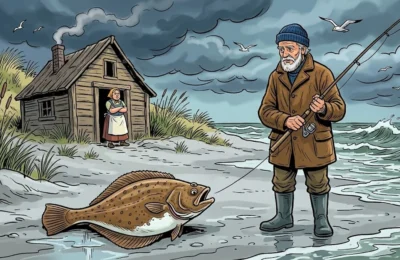
The Fisherman and His Wife: A Brothers Grimm Tale
The Fisherman and His Wife: A Brothers Grimm Tale: In a small cottage on the edge of a vast sea lived a fisherman named Heinrich and his wife Margaretta. The
 Grimm's Fairy Tales
Ages 9-12
Grimm's Fairy Tales
Ages 9-12
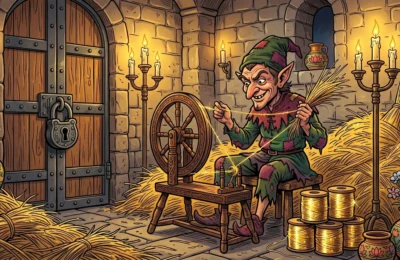
Rumpelstiltskin
Rumpelstiltskin: By the side of a wood, in a country a long way off, ran a fine stream of water; and upon the stream there stood a mill. The miller’s house was
 Grimm's Fairy Tales
Ages 9-12
Grimm's Fairy Tales
Ages 9-12
Sleeping Beauty (Briar Rose)
Sleeping Beauty (Briar Rose): On the morning that the princess was christened, the entire kingdom gathered in the grand cathedral of the castle to celebrate