The Mouse, The Bird, And The Sausage
The Mouse, The Bird, And The Sausage: Once upon a time, a mouse, a bird, and a sausage, entered into partnership and set up house together. For a long time all
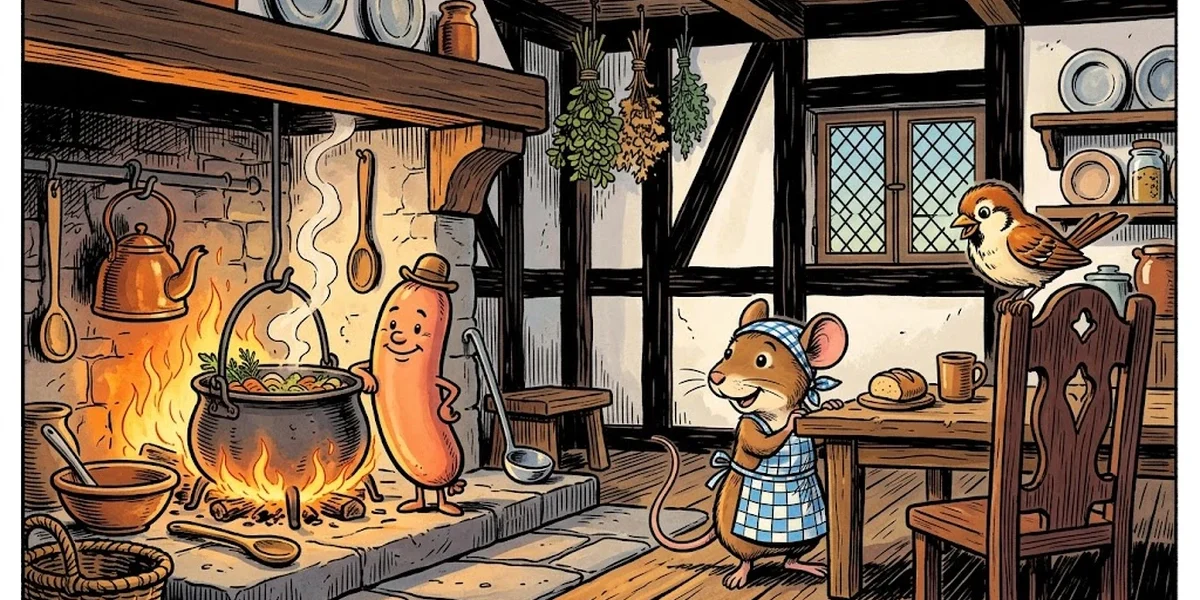
Once upon a time, in a snug timber cottage at the edge of a German forest, a little mouse, a little bird, and a plump bratwurst entered into partnership and set up house together. For a long while all went well. The bird flew out each dawn to gather kindling from the spruce-wood; the mouse drew water from the stone well, swept the hearth, and laid the linen; and the bratwurst, fragrant with marjoram and pepper, did the cooking. They prospered so steadily that they were able to put aside something for winter, and at evening their three voices rose together in contentment over a buttered pot of vegetables.
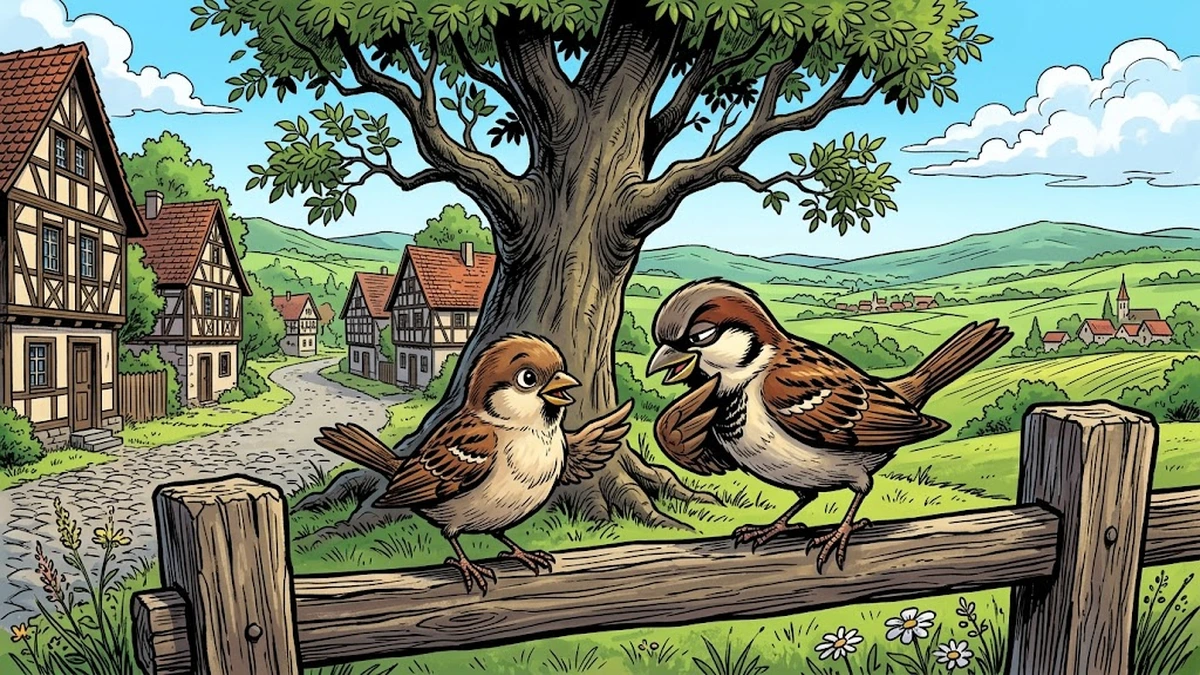
But when people are too well off, they always begin to long for something new. So it came to pass that the bird, while out one fine morning, fell in with a fellow of his own kind perched on a roadside ash. To this stranger he expounded the excellence of his household. The other bird only sneered, calling him a poor simpleton who did all the hard labour while the others lived at ease at home. For, said the stranger, when the mouse had kindled the fire and fetched the water, she retired to her little chamber to rest until it was time to set the table. The sausage had only to watch the pot, and when dinner-time drew near he would simply throw himself into the broth or roll three or four times among the cabbages and turnips, and at once they were buttered and salted and ready to serve. Then the bird returned and laid aside his burden, and they sat down together. After supper they slept their fill until morning. Was that, asked the stranger pointedly, a fair division of toil?
The poison did its work. Next morning the bird refused to bring in the wood, declaring that he had been their servant long enough, and had been a fool into the bargain, and that it was now time to make a change. The mouse and the sausage begged and prayed, but the bird remained master of the situation. So they drew lots: it fell to the sausage to bring in the wood, to the mouse to cook, and to the bird to fetch the water from the well.
The First Calamity: A Sausage Meets a Dog
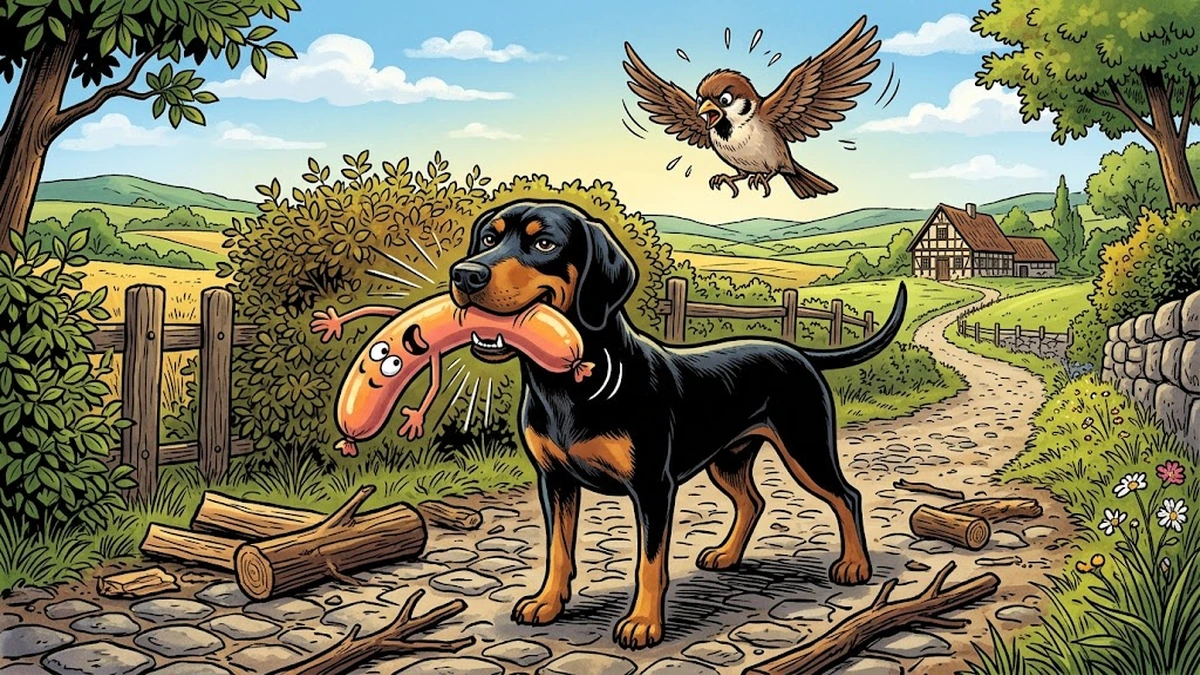
And now what happened? The sausage waddled out into the road in search of fuel, the bird kindled a small fire, and the mouse put on the pot. The two waited and waited; but the sausage did not return. At last, with growing unease, the bird flew out to meet him. He had not flown far when he came upon a great farm-dog by a hedge. The dog had met the sausage, regarded him as legitimate booty, seized him, and swallowed him whole. The bird protested loudly at this bare-faced robbery, but nothing he said was of any avail, for the dog answered with a smug shrug that he had found false credentials on the sausage, and that for that reason the sausage’s life had been forfeit. The bird, sick at heart, picked up what wood he could find, and flew sadly home.
The Second Calamity: A Mouse Boils Like a Bratwurst
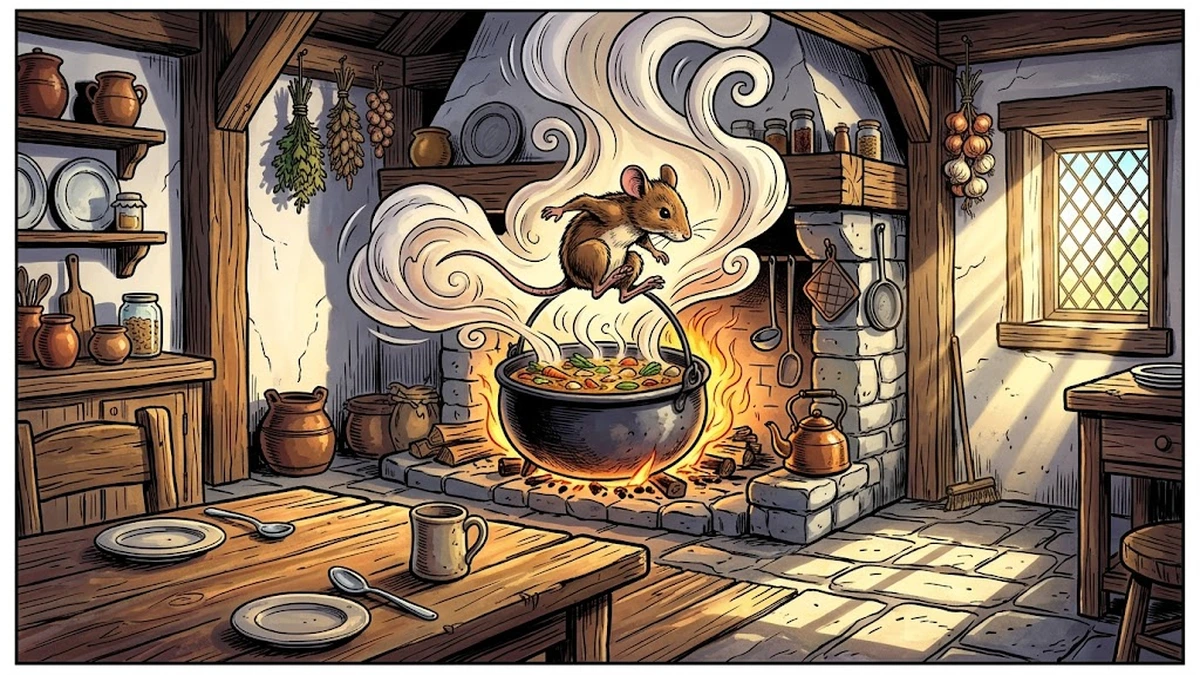
The mouse listened with horror to the bird’s account. They wept together, but agreed at last to make the best of things and to remain with one another, only two now in the cottage that had once held three. The bird laid the table; the mouse went to the pot to mind the supper. Wishing to prepare it in the same way as the sausage had done, by rolling in and out among the vegetables to butter and salt them, she leapt up to the rim and jumped in. But she stopped short long before she reached the bottom of the broth, having already parted not only with her skin and hair, but also with her life. The pot bubbled on, indifferent.
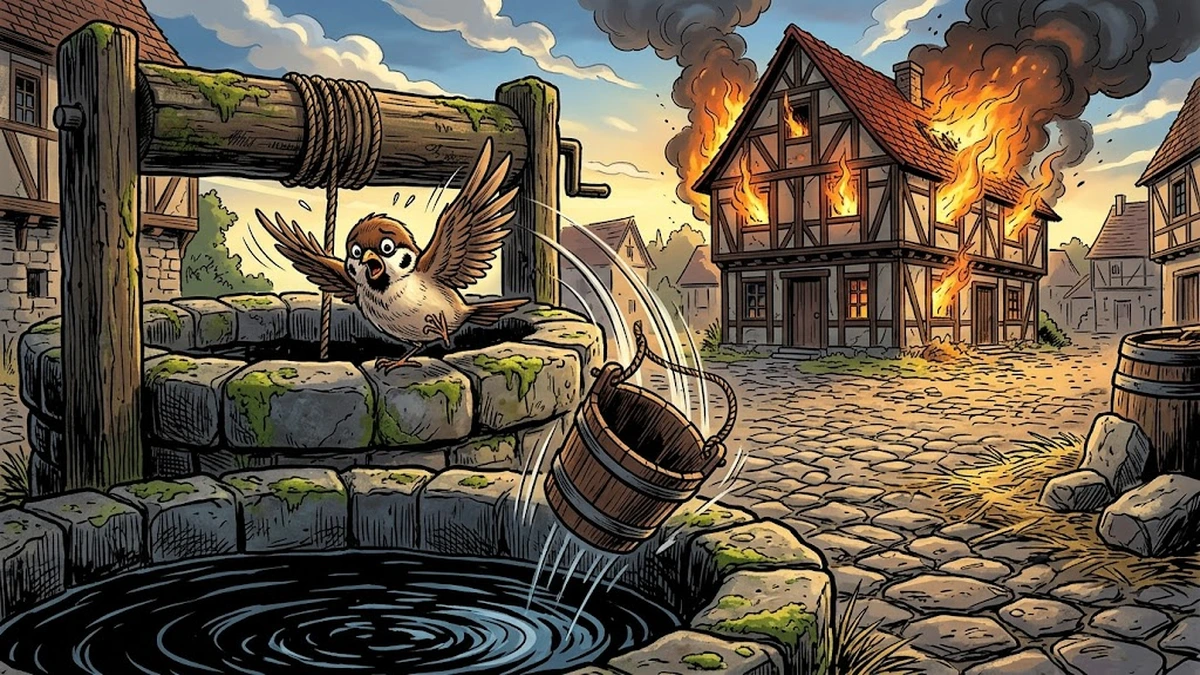
Presently the bird came in to serve up the dinner, but he could nowhere see his cook. In his alarm and flurry, he flung the firewood about the floor, calling and searching everywhere. But no cook was to be found. Some of the wood that had been carelessly thrown caught the embers, and a small flame began to climb the leg of the table. The bird, panicking, snatched up the well-pail and flew to the well to fetch water; but the pail was heavy, and as he leaned over the curb the pail tipped and fell into the dark water below. He plunged after it, unable to right himself, and was drowned. So the cottage burned to a black heap, and of the three companions not one was left.
Moral
“Hochmut kommt vor dem Fall.” — German proverb embedded in the tale’s reception. Pride goes before a fall. Each housemate abandoned the role for which he was fitted because pride whispered that another’s task looked easier; and once the order of the cottage was broken, each in turn was destroyed by a duty he was never made to bear.
The deeper teaching is not merely that vanity is dangerous, but that cooperation is itself a form of skill. The bird could fly but not cook; the mouse could carry water but not waddle into a hot pot; the sausage could season broth but could not survive on a country road. Their partnership was a small economy in which each weakness was answered by another’s strength. When the bird, listening to a stranger, weighed labour by visible effort instead of by aptitude, the whole web of trust collapsed in a single afternoon. The Grimms preserved this old fable as a warning to households, guilds and small communities of their own age — and ours.
Origin & Canonical Attribution
“The Mouse, the Bird, and the Sausage” stands as tale 23 (KHM 23) in the Brothers Grimm Kinder- und Hausmärchen, first published by the Realschulbuchhandlung in Berlin in 1812 and revised through seven editions to its definitive form in 1857. The original German title is Von dem Mäuschen, Vögelchen und der Bratwurst — literally “Of the Little Mouse, the Little Bird, and the Bratwurst.” It carries the international classification ATU 85 in the Aarne-Thompson-Uther index, where it is registered as the eponymous tale type “The Mouse, the Bird, and the Sausage.”
Unlike most tales in the Grimms’ collection, KHM 23 is not drawn directly from oral peasant tradition. The brothers’ own scholarly notes (the Anmerkungen) credit the seventeenth-century satirist Johann Michael Moscherosch (1601–1669), who included a short fable titled Geschicht / Mäusslein / Vögelein vnd Bratwürstlein in his moralistic compendium Wunderliche und wahrhafftige Gesichte Philanders von Sittewald (Strasbourg, 1640–1650). Moscherosch’s prose, with its gently archaic Alemannic flavour, supplied the bones of the plot and the unforgettable image of a bratwurst trotting out for firewood. The Grimms smoothed the language for nineteenth-century readers but preserved Moscherosch’s tripartite household and the inevitability of its undoing.
Translators & Anglophone Reception
English-speaking children met the tale first in Edgar Taylor’s landmark German Popular Stories (London: C. Baldwyn, 1823), illustrated by George Cruikshank, which introduced the Grimms to Britain. Taylor renders the trio as “the mouse, the bird, and the sausage” and softens the catastrophe slightly for nursery readers. Lucy Crane’s elegant 1882 translation, illustrated by her brother Walter Crane, gave the story a Victorian arts-and-crafts shimmer. The most faithful and complete English version remains Margaret Hunt’s two-volume Grimm’s Household Tales (London: George Bell & Sons, 1884), with introduction by Andrew Lang, which preserves the dog’s mordant claim of “false credentials” against the sausage. In the twentieth century, Ralph Manheim’s Grimms’ Tales for Young and Old (1977) and Jack Zipes’s Complete Fairy Tales (1987, revised 2003) carry the story to modern readers in the rhythms of the original Hessian German.
The ATU 85 Family of Tales
Type ATU 85 is small but distinct. It belongs to the wider family of animal-and-object companion fables in which inanimate, vegetable or kitchen objects are personified and made household-mates with creatures. Cousins in the type include The Straw, the Coal and the Bean (KHM 18, ATU 295), where another tripartite party meets ruin on a journey, and the older Aesopic The Belly and the Members, in which a body’s organs revolt against the stomach and learn that division of labour cannot be re-allocated by jealousy. KHM 23’s particular contribution to the type is the choice of a bratwurst — a humble, immediately legible German foodstuff — as one of the housemates, lending the tale its distinctive Hessian-Swabian colour and its grim, almost slapstick black humour.
Reading the Symbolism: Cottage as Microcosm
Folklorists from Vladimir Propp to Maria Tatar have read KHM 23 as a parable of the Hausgemeinschaft — the small, interdependent household that was the basic economic unit of pre-industrial Europe. Each member personifies a labour: the bird stands for outside-work (gathering, foraging, exchange with the wider world); the mouse stands for inside-work and water-bearing (the running of the hearth); the bratwurst stands for the cooked meal itself — the literal product of domestic union. When the bird, restless after a chance conversation with a “fellow bird” (a stranger introducing fashionable resentment), insists that lots be redrawn, the household ceases to function as an organism and becomes three solitary roles wrongly cast. The dog who eats the sausage and the well that swallows the bird are not random misfortunes but structural consequences: the sausage cannot defend itself outdoors; the bird cannot lift a heavy pail. Each is killed by a task to which it was never suited.
Why the Story Lasted
Two centuries after the Grimms first set it in print, KHM 23 still circulates in school readers, picture-books, and folklore anthologies in dozens of languages. Its stamina rests on three things. First, it is memorable: a sentient sausage trotting down a country lane is an image children do not forget. Second, it is compact: under a thousand words in the German, the tale delivers a complete moral arc with three reversals and three deaths, no padding. Third — and most importantly — it speaks to a perennial human anxiety: the suspicion, planted easily by a stranger or a passing comparison, that one’s own role in a shared life is the worst-paid and least respected. The Grimms knew that suspicion well. They had seen households break, guilds dissolve, and old village economies fall apart in the convulsions of the Napoleonic wars. KHM 23 stands as their warning: do not redraw the lots simply because someone outside the cottage has whispered that you should.
The German Original: A Glimpse of the 1812 Text
For readers curious about the texture of the Grimms’ German, the opening of the 1812 first edition runs:
“Ein Mäuschen, ein Vögelchen und eine Bratwurst kamen einst zusammen und beschlossen, einen gemeinsamen Haushalt zu führen. Eine Zeitlang ging alles gut: das Vöglein flog jeden Tag in den Wald und holte Brennholz; das Mäuschen trug Wasser, machte Feuer und deckte den Tisch; die Bratwurst aber kochte das Essen.”
The diminutives -chen and -lein (Mäuschen, Vögelchen, Würstlein) carry the gentle nursery cadence which Edgar Taylor translated as “little mouse” and “little bird.” The opening verb kamen…zusammen (“came together”) is the same vocabulary the Grimms used elsewhere for the founding of households and guilds — a quiet hint that this is a fable about civic association, not just kitchen comedy.
A Note on the Bratwurst
That the third partner is specifically a bratwurst — and not, say, a knackwurst, a leberwurst, or the more cosmopolitan “sausage” of English translation — anchors the tale firmly in the meat-eating culinary culture of Hesse, Thuringia and Franconia, the regions from which the Grimms drew most of their oral and printed sources. The bratwurst of 1812 was a coarsely chopped pork sausage, finger-thick, seasoned with marjoram, caraway and pepper, and cooked over an open hearth: precisely the foodstuff a cottage trio would have produced and shared. By making this most German of foods walk, talk, and finally die at the jaws of a country dog, the Grimms folded a flash of grotesque domestic comedy into what is otherwise a stern moral fable.
Reflection & Discussion
- What does each character’s discontent reveal about the seductiveness of comparison? How does the tale suggest that pride is planted from outside, not born within?
- The bratwurst, smallest in stature but central to the household’s pleasure, is the first to die. Why is it significant that the most “indispensable” partner is also the most vulnerable when removed from its proper place?
- The dog claims to have found “false credentials” on the sausage. What does this strange phrase suggest about the way roles confer or withhold legitimacy in a community?
- How does the destruction of the cottage by fire and the bird’s drowning in the well echo older European folk-images of elemental punishment — fire for arrogance, water for foolishness?
- If you were to rewrite KHM 23 for a modern workplace or shared apartment, which roles would the mouse, the bird and the bratwurst now occupy — and which “stranger bird” would whisper the discontent?
Further Reading
- Brüder Grimm, Kinder- und Hausmärchen, 1st ed. (Berlin: Realschulbuchhandlung, 1812), tale no. 23.
- Edgar Taylor (trans.), German Popular Stories, 2 vols. (London: C. Baldwyn, 1823–1826), illus. George Cruikshank.
- Lucy Crane (trans.), Household Stories from the Collection of the Brothers Grimm (London: Macmillan, 1882), illus. Walter Crane.
- Margaret Hunt (trans.), Grimm’s Household Tales, 2 vols. (London: George Bell & Sons, 1884), with introduction by Andrew Lang.
- Hans-Jörg Uther, Handbuch zu den Kinder- und Hausmärchen der Brüder Grimm (Berlin: De Gruyter, 2008).
- Maria Tatar, The Annotated Brothers Grimm (New York: W. W. Norton, 2004).
- Jack Zipes, The Complete Fairy Tales of the Brothers Grimm, 3rd ed. (New York: Bantam, 2003).
You May Also Like
 Grimm's Fairy Tales
Ages 9-12
Grimm's Fairy Tales
Ages 9-12
Ashputtel
Ashputtel: The wife of a rich man fell sick; and when she felt that her end drew nigh, she called her only daughter to her bed-side, and said, ‘Always be a
 Grimm's Fairy Tales
Ages 9-12
Grimm's Fairy Tales
Ages 9-12
1. How They Went To The Mountains To Eat Nuts
1. How They Went To The Mountains To Eat Nuts: The nuts are quite ripe now,’ said Chanticleer to his wife Partlet, ‘suppose we go together to the mountains
 Grimm's Fairy Tales
Ages 9-12
Grimm's Fairy Tales
Ages 9-12
The Queen Bee
The Queen Bee: Two kings’ sons once upon a time went into the world to seek their fortunes; but they soon fell into a wasteful foolish way of living, so that