The Lion and the Mouse: Friendship Across Worlds
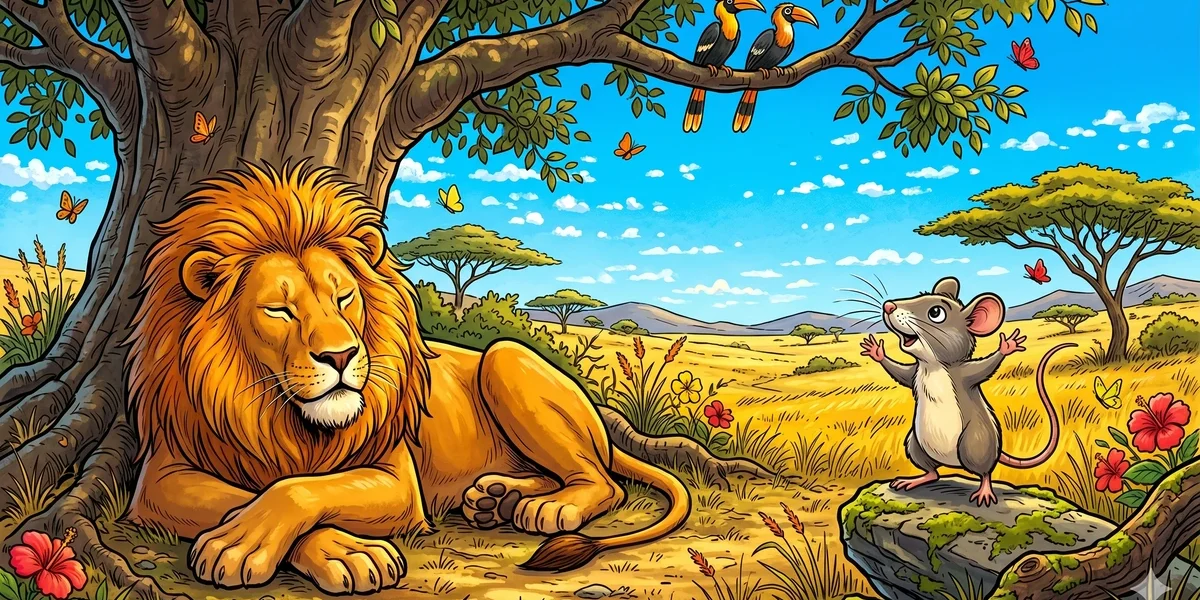
The Lion and the Mouse: Friendship Across Worlds: The savanna stretched endlessly beneath the African sun, a landscape of golden grasses and scattered acacia
Where the Tale Comes From
“The Lion and the Mouse” is one of the most universally beloved fables ever told. In the Western tradition it is attributed to Aesop, the Greek storyteller of the sixth century before the common era, and it carries the number Perry 150 in the standard scholarly index of the Aesopic corpus. From the Greek it travelled into Latin through the medieval Romulus collections, into the Old French and Anglo-Norman verse Aesops, and into English with William Caxton’s first printed edition of 1484. Jean de La Fontaine made it the eleventh fable of his second book in 1668, where it acquired its most quoted moral line — On a souvent besoin d’un plus petit que soi, “we often need someone smaller than ourselves.” Samuel Croxall, Thomas Bewick, Joseph Jacobs, and a hundred Victorian schoolbook editors carried it into modern English; it is one of the first stories most children in the English-speaking world ever hear.
But the tale is older than Aesop. The same plot — a small creature accidentally angers a great one, is forgiven, and one day repays the great one in a moment of helpless need — appears in two of the great Sanskrit storybooks of ancient India: the Pañcatantra, traditionally attributed to Vishnu Sharma around the third century before the common era, and the Hitopadesha compiled by Nārāyaṇa around the twelfth century of the common era. There the great creature is not a lion but an elephant — Chaturdanta, the four-tusked king of the herd — and the small creature is Mūṣikarāja, the king of mice. The Indian version is part of an older, larger philosophical work on the doctrine of mitralābha, the winning of friends, and it is one of the oldest written witnesses to this storyline anywhere in the world. The tale of The Elephants and the King of Mice is told in detail elsewhere on this site; here we tell the more familiar Greek form.
What is striking is that whether the great creature is a lion under a fig tree on the African savanna, or an elephant by a ruined city in Bharatavarsha, the lesson is the same. The wise make friends everywhere, even with those who seem too small to matter. The Indian text carries the older, deeper philosophical version of the teaching; the Greek text carries the briskest, plainest, most child-friendly version. Both are true. Both are needed. We tell the Greek tale here in full, with quiet acknowledgement of its older Indian sister.
The Lion Asleep Beneath the Fig Tree
It was the hottest hour of the day. The sun stood directly overhead and turned the high savanna grasses to a sea of pale gold. Birds had gone silent in the branches; even the cicadas had stopped their thin metal song. The whole land seemed to be holding its breath.
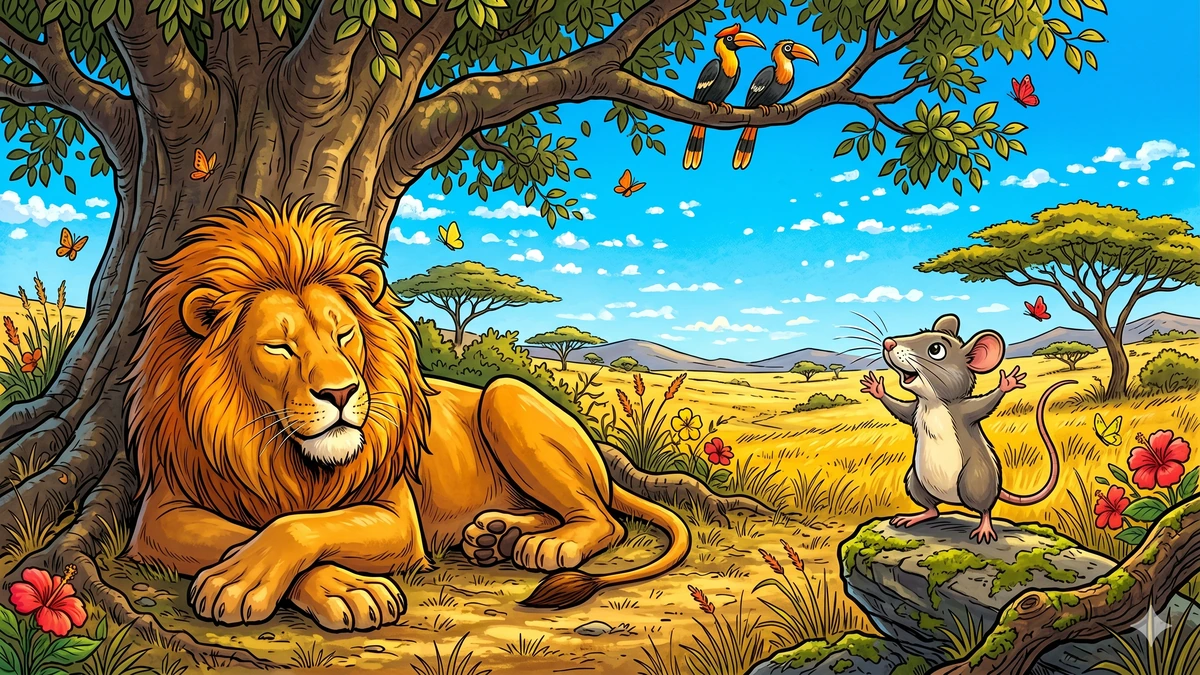
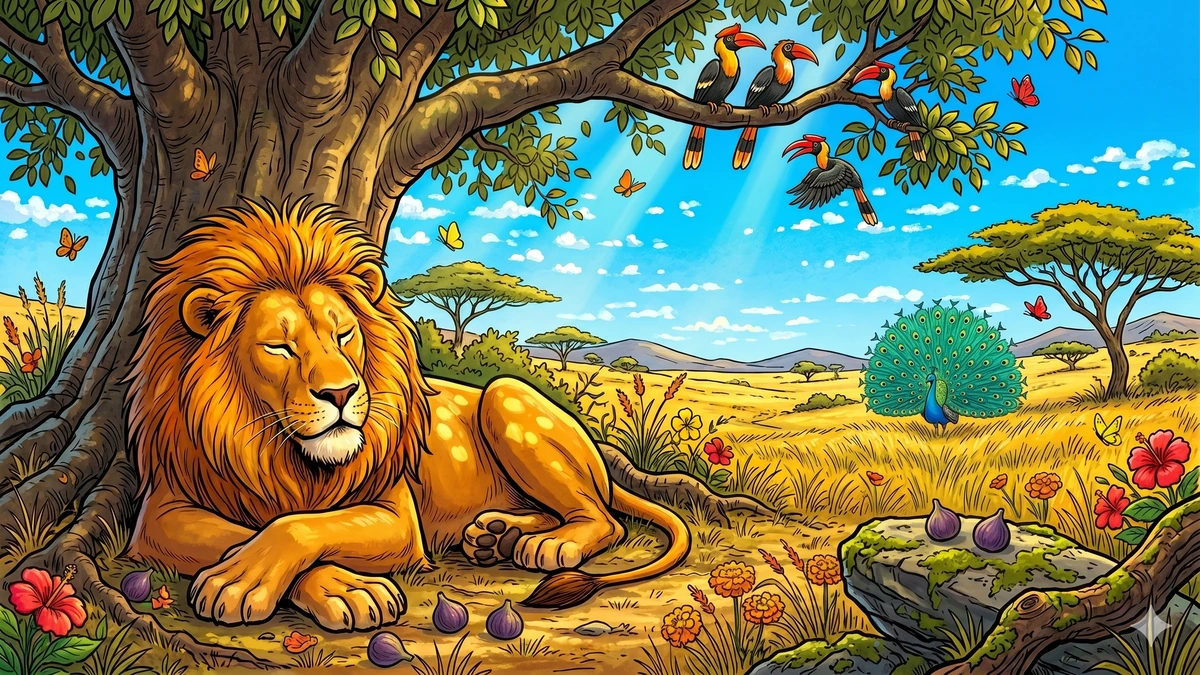
Beneath an enormous old fig tree, in a circle of shade so deep that it was almost cool, the lion lay sleeping. He was the king of beasts and looked it. His mane was thick and dark gold, almost the colour of honey, spilling around his head like a great dark crown. His chest was deep, his shoulders heavy with muscle, his paws the size of dinner plates with claws now sheathed inside soft pads. He slept stretched on his side, one paw flung out over the tree-roots, his enormous tail curled lazily across the moss. The slow rise and fall of his breathing was the only movement for a hundred paces in any direction.
He had hunted at dawn and eaten well. He had drunk at the river. He had patrolled the southern border of his territory and warned a wandering male away with a single low growl. Now, in the deep heat, the king of beasts had earned his rest. No creature on the plain would have dared to disturb him; even the vultures circled high and well clear.
The fig tree above him was old. Its trunk was as wide as four men with their arms outstretched, and its great limbs reached out across the clearing like the rafters of a green-roofed cathedral. The leaves were broad and waxy, and through them the sunlight fell in golden coins onto the lion’s pale gold flank. A single ripe fig dropped silently onto the moss. A pair of yellow butterflies swayed past on a breath of warm air. Far away, on the very edge of hearing, the wind moved through the dry grass like the whisper of a long-forgotten secret.
A Mouse Who Did Not Look Where He Was Going
Now in this very forest there lived a young brown mouse, no bigger than a man’s thumb. He had bright dark eyes and silver whiskers and a small white belly, and he was, on this particular afternoon, very pleased with himself. He had found a hidden pile of fig-seeds at the foot of the old tree and was busily picking out the best ones to take home to his mother.
The mouse was not, in honesty, a careful young man. His mother had told him a hundred times to keep his eyes open and his ears up when he travelled in the open. The hawk, she had said, sees everything from the sky; the snake hears everything from the grass; the lion is the king of the day. The mouse had nodded each time he was told these things, and then had run out into the world without giving them another thought.
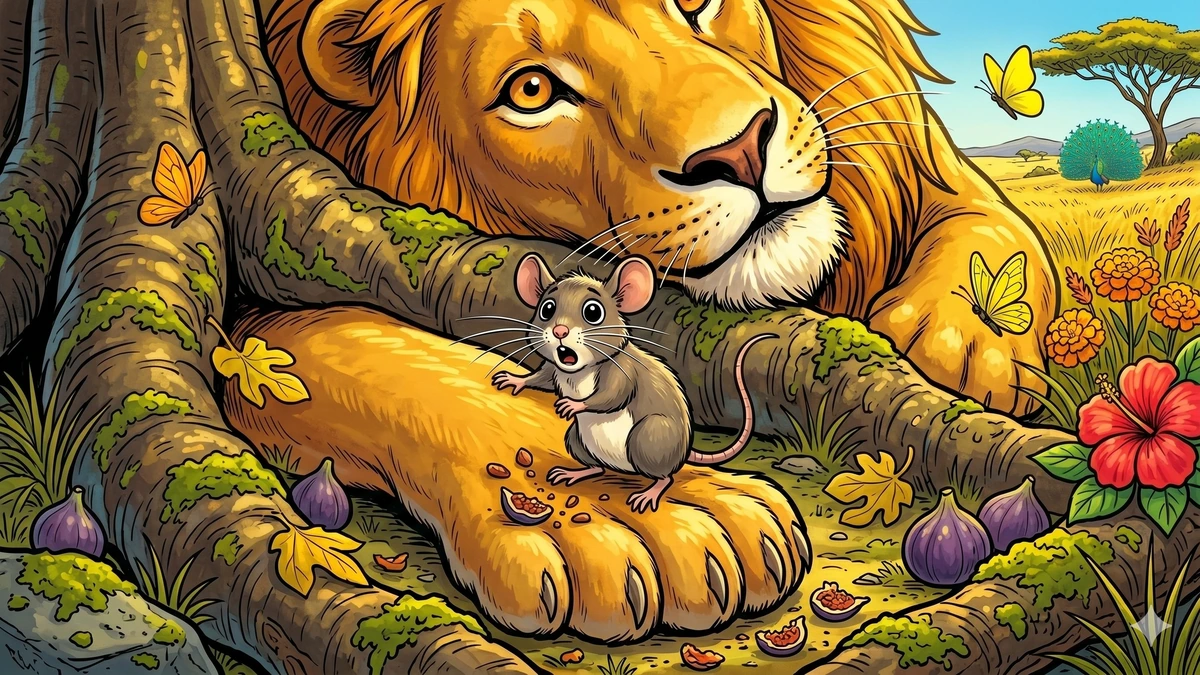
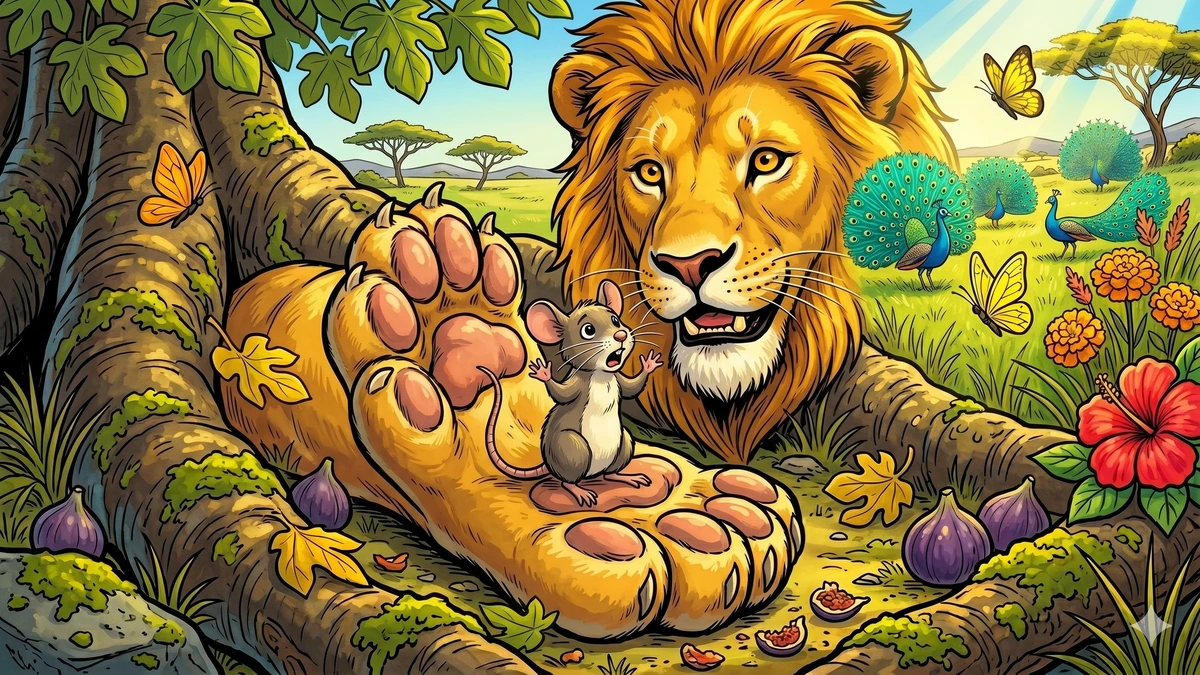
So it was that, with his cheeks stuffed full of fig-seeds and his mind on the song he was making up about the seeds, the young mouse came scampering at full speed around the curve of the fig tree’s trunk and ran straight up the slope of the lion’s outflung paw.
For one long heartbeat, the mouse did not understand what he had done. The slope under his small feet was warm and soft; it smelled faintly of dust and grass and something rich and animal. He had climbed three steps up before he realised that the warm soft slope was breathing.
The lion’s amber eye opened, slow and enormous, and looked straight at him.
The mouse stood on the lion’s paw, frozen, every fig-seed forgotten. The eye was bigger than his whole body. In its golden depth he saw himself reflected: a small frightened creature on a very, very large king.
The lion’s other paw came down, gentle as a settling shadow, and closed around the mouse without crushing him. Slowly, deliberately, the lion lifted his head and brought the small trembling creature up to the level of his face.
“Well,” said the lion in a voice like distant thunder rolling across stone, “what have we here?”
The Mouse’s Plea
The mouse had read all his life about lions. He had heard the older mice tell stories of how the king of beasts could break the neck of an antelope with a single blow, how his roar could be heard from one end of the plain to the other, how no creature with sense walked openly across his shadow. The mouse, who had walked openly across the lion himself, knew now that he was about to die.
And yet the lion was not eating him. The lion was holding him in the great gentle cup of his paw, and looking at him with what seemed almost like mild curiosity.
The mouse cleared his small throat. His voice came out as a thin squeak at first, but he steadied it as he went on.
“Great king,” he said, “I am the most foolish mouse in all this forest. I ran across your paw without looking, and I deserve any punishment you wish to give me. But I beg you to think before you give it.”
The lion’s whiskers twitched, very slightly, in something that might have been amusement. The mouse pressed on.
“I am too small to make even one mouthful for a king. My fur is no use to you. My bones would catch in your teeth. If you eat me, you will gain nothing, and you will have crushed a creature smaller than your own claw. But if you let me go — if you spare me, here, today, in this great kindness — then perhaps one day, in some moment that neither of us can foresee, I shall be able to repay you. The wise teachers of the mouse-people say that no one knows whose moment of need will come. Even the smallest of us can sometimes help the greatest. Spare me, and I shall not forget.”
The lion was silent for a long moment. The mouse could hear the slow steady drum of the lion’s enormous heart beneath the paw.
And then the lion did a thing that no one would have expected. The lion laughed.
It was a great rolling rumble of a laugh, the laugh of a king at a small joke that has pleased him. “You?” he said. “You, little brown thread of a creature, are going to repay me one day? You, whose whole body fits inside one of my claws? Oh, little one. The world is wide, but it is not so wide as that.”
The mouse felt his heart sink. He had been sure that his speech would fail; now he was sure of it.
But then the lion’s great paw opened, and the lion lowered him gently to the moss at the base of the fig tree.
“Go, little friend,” the lion said, still smiling. “Go and tell your children that you walked across the lion-king and lived. Your speech amused me. Your courage was real. Even a king of beasts can spare a mouse. Run home now, before I change my mind.”
The mouse did not need to be told twice. He bowed once, very deeply, in the formal manner of his people, and then he ran for the tall grass and was gone.
For a long time afterwards the lion lay where he was, smiling to himself in the dappled shade. He thought about the small bright voice of the mouse, and he thought how strange it was that bravery should come in such a tiny package. Then he stretched, yawned a yawn that showed every one of his great white teeth, and went back to sleep.
The Long Days Between
The seasons turned. The dry season came and the rains came after it; the savanna burned brown, then greened, then burned brown again. The lion patrolled his lands. The mouse ate his seeds and grew older, and told the story to his small grey children, and they told it to theirs, until in the underground passages of the mouse-people the tale of the brave young mouse who had spoken to the lion was a half-forgotten family legend.
The lion did not think of the mouse at all.
And then, on a cool morning at the end of the second dry season, hunters came.
The Net of Ropes
They came from the village beyond the river. They were three of them, with bows and spears and a great heavy bundle of rope-net coiled on the back of the eldest. They had heard that the king of beasts had taken three calves from the village herd that month. They had decided, between them, to settle the matter for good.
They knew the lion’s paths. They knew the watering-place at the bend of the river where he drank at dusk. They knew the trail of bent grass that led from the watering-place to the cool stand of fig trees where he liked to lie in the heat. And so on a moonless night they hung their great net high in the branches between two fig trees, with the cunning ropes that would drop the net the moment any heavy creature stepped through the gap below.
At dawn the lion came down the trail. He was thinking of nothing in particular — the cool of the river behind him, the warm flat stones ahead, a long quiet day waiting under the trees. He stepped through the gap between the fig trees.
The net fell.
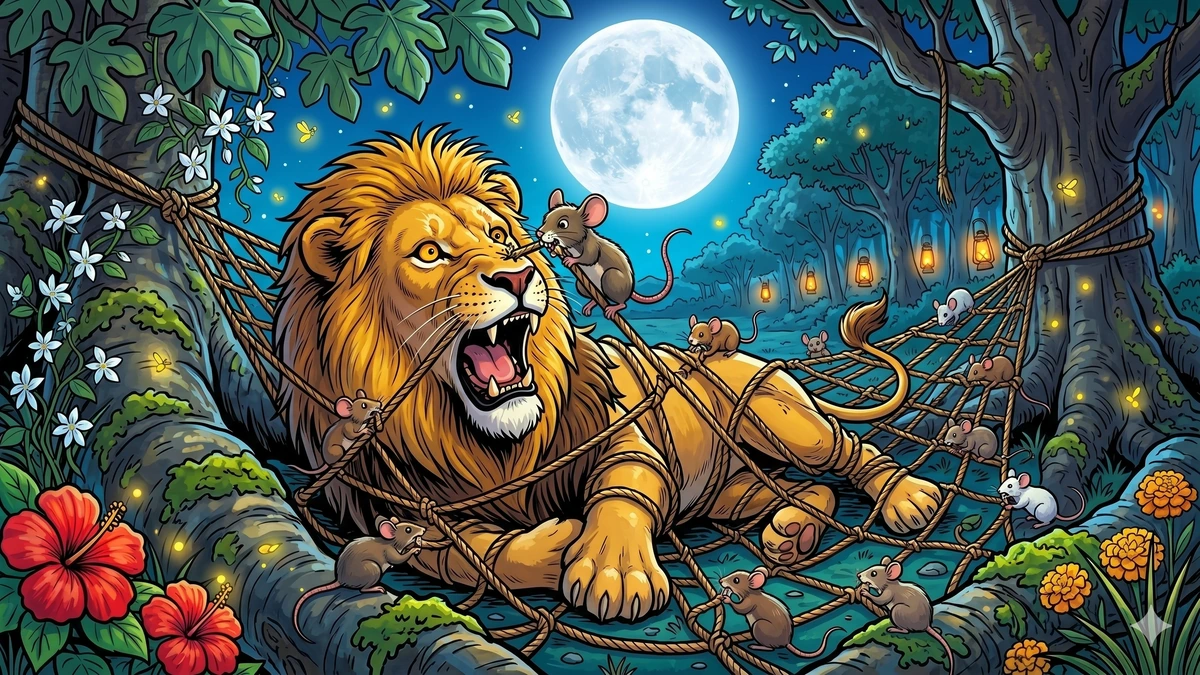
It was a heavy net of thick rope, soaked in tallow to make the cords slip-tight when they tightened, and made of a weave too dense to break with claw or tooth. The lion thrashed; he tore great mouthfuls of cord with his teeth; he raked the net with claws that could split a log. None of it was enough. The hunters had built well. By the time the sun was fully up he was bound from neck to tail-tip and hung in the lower branches of the fig tree like a great golden fly in a giant spider’s web.
The hunters saw their work was done and went back to the village to fetch the long pole and the four extra men they would need to carry the king of beasts home.
And the lion, alone in the morning light, lifted his great head as well as the cords would let him, and he roared.
The Mouse Hears and Comes
The roar of a desperate lion is unlike any other sound in the savanna. It is not the long warning-roar of a king marking his border, and it is not the short hunting-roar of a king at the kill. It is something else: a deep, grief-shaken, tearing sound, the cry of a great creature who knows he is helpless. It carried out across the plain like a wave; it bent the grasses; it sent every smaller creature on the savanna scurrying for shelter.
And in his deep burrow under the roots of a wild aloe, the old grey mouse — for he was old now — lifted his head from his afternoon doze and listened.
He had heard a thousand lion-roars in his life. He had heard the warning-roar and the hunting-roar and the courting-roar and the hunger-roar. He had never heard anything like this. He sat very still in the dark of his burrow, and his old whiskers trembled, and a memory came up out of the long-buried bottom of his mind: a fig tree, a paw, a great gentle voice saying go, little friend, run home before I change my mind.
He did not stop to think. He climbed up out of his burrow and into the sunlight, and he called every mouse and rat in the great network of tunnels — his sons and daughters, his sons’ sons, his nieces and nephews and second cousins to the third remove. They came running, hundreds of them, a small brown river of mice; they came because the old mouse was their grandfather many times over, and because the old mouse, when he commanded, was the king of mice.
“Follow me,” he said. And without explanation he led them at a flat run across the savanna, towards the place where the great rolling cry was still echoing.
They came to the fig trees and saw the lion bound in the net. The mice did not waste a moment in speeches. The old grey mouse — who was no longer young, but whose teeth were still sharp — climbed up the trunk and onto the netted lion’s mane, and from there to the great worried face. The lion looked down with his huge amber eye, surprised, even in his grief, at the small grey visitor.
“Lord,” said the mouse, “long ago you let me go when I had run across your paw. I told you on that day that I might one day repay your kindness, and you laughed. Lie still, lord. Today is the day.”
And then the mouse-king bent his head and set his small sharp teeth to the rope across the lion’s jaw, and he gnawed; and beside him on the net, hundreds of his cousins set their teeth to other ropes; and the gnawing of so many tiny teeth in the morning silence sounded like a soft strange rain falling on the leaves above.
One rope parted. Another. The net began to sag, then to loosen, then to slide. A great cord across the lion’s chest snapped; a knot at his shoulder gave; a thick rope at his haunch parted with a soft whispering sound. The lion felt the binding ease. He did not rush. He held himself still while the small army worked, because he knew that one wrong twitch could trap a tiny life beneath him.
And at last the last rope went, and the net fell away, and the lion stood up.
He stood very still for a moment, drawing the first deep breath of his recovered freedom. Then, carefully, he lay down on his belly with his great paws crossed in front of him, so that the small grey mouse on his nose was at his eye-level.
“Little friend,” said the lion, “I was a fool, that day in the shade, to laugh at your promise. You have given me back my life. I shall not forget. From this day until the end of my days, no mouse in all this forest shall ever fear a lion.”
The old mouse bowed, in the formal manner of his people, exactly as he had bowed long ago at the foot of the same fig tree. “Lord,” he said, “the wise teachers of my people have always said that no one knows whose moment of need will come. The wise, therefore, make friends everywhere.”
And then the king of beasts and the king of mice walked away together, side by side, through the long gold grass, towards the river — and the hunters, returning that afternoon with their pole, found only an empty net, and a strange clean-cut tracery of rope, and a small drift of grey fur on the moss at the foot of the fig tree.
The Moral of the Tale
Aesop’s moral, in the plain Greek form preserved in Babrius, is μικροὶ μεγάλους ὠφελοῦσι — “small creatures can help great ones.” La Fontaine, two thousand years later, gave it the form by which it is best known in Europe: On a souvent besoin d’un plus petit que soi — “we often need someone smaller than ourselves.”
The Indian source-tale, in the older Sanskrit of the Pañcatantra and Hitopadesha, gives the same teaching in a deeper, more philosophical key. There the moral is part of the great doctrine of mitralābha, the winning of friends, and is given in formal verse:
na kaścid api jānāti kasya kālo bhaviṣyati /
yasmād akāraṇaṁ mitraṁ kuryāt sarvatra paṇḍitaḥ //
“No one knows whose moment of need will come. Therefore the wise make friends everywhere, even without cause.”
The Greek says it briskly. The French says it elegantly. The Sanskrit says it as a piece of timeless philosophical instruction. All three are saying the same thing. The world is uncertain. We do not know which day will bring our hour of helplessness, and we do not know which creature, however small, will turn out to be the one with the sharp teeth at the right rope. The wise person — the wise lion, the wise mouse, the wise human being — does not despise the small. The wise person makes friends everywhere.
Why This Story Has Lasted
“The Lion and the Mouse” has lasted, across more than two and a half thousand years and across at least four major civilisations, because it gives a child a perfectly clear picture of a perfectly true thing. Every child has been small in a world of large beings. Every child has, at some point, been afraid of someone larger and stronger. The story tells that child: largeness is not everything; smallness is not nothing; a kindness given to a small creature is never wasted; the world is the kind of place in which the small creature can sometimes save the great one.
Adults, too, recognise the truth of it at once. We have all been the lion in the net at some point in our lives, and we have all been saved, when we were saved at all, by some quiet, often unnoticed friend whose small steady gnawing finally cut the rope that held us. The story is, in this sense, simultaneously a children’s fable and a grown-up parable about gratitude, friendship, and the unpredictability of need.
Above all, it is a story about the moral of being kind when one does not need to be. The lion lets the mouse go when the lion is at the height of his power. He has nothing to gain. The mouse can do nothing for him. And precisely because the lion is generous in that moment, when generosity costs nothing, he is saved later, when the cost of cruelty would have been everything. Akāraṇaṁ mitraṁ kuryāt — “make friends without cause.” It is, perhaps, the deepest single line in all the world’s fable literature, and we have it in the same form from a Greek slave on the island of Samos and from a Brahmin teacher on the plains of Bharatavarsha. The two civilisations, separated by half a continent and three thousand miles, came independently to the same conclusion. We may take that as a hint that the conclusion is right.
Frequently Asked Questions
What is the moral of The Lion and the Mouse?
Who wrote The Lion and the Mouse?
What happens in the story of The Lion and the Mouse?
Why is The Lion and the Mouse important for kids?
Is The Lion and the Mouse a true story?
You May Also Like
 Aesop's Fables
Ages 3-5
Aesop's Fables
Ages 3-5
Tiger Brahmin Jackal
Tiger Brahmin Jackal: Once a Brahmin was passing through a forest when he came across a tiger caught in a trap. Please let me out of this cage”, called the
 Aesop's Fables
Ages 3-5
Aesop's Fables
Ages 3-5
The Girl Who Married A Snake
The Girl Who Married A Snake: Long ago, a Brahmin lived with his wife, in a village. Both of them led a very simple and happy life. Their only concern was that
 Aesop's Fables
Ages 3-5
Aesop's Fables
Ages 3-5
Timid Hare Flight Beasts
Timid Hare Flight Beasts: Once upon a time when Brahmadatta reigned in Benares, the Bodhisatta came to life as a young lion. And when fully grown he lived in a