Jackal Barber Brahmin
Jackal Barber Brahmin: A Barber and a Jackal once struck up a great friendship, which might have continued to this day, had not the Jackal been so clever that
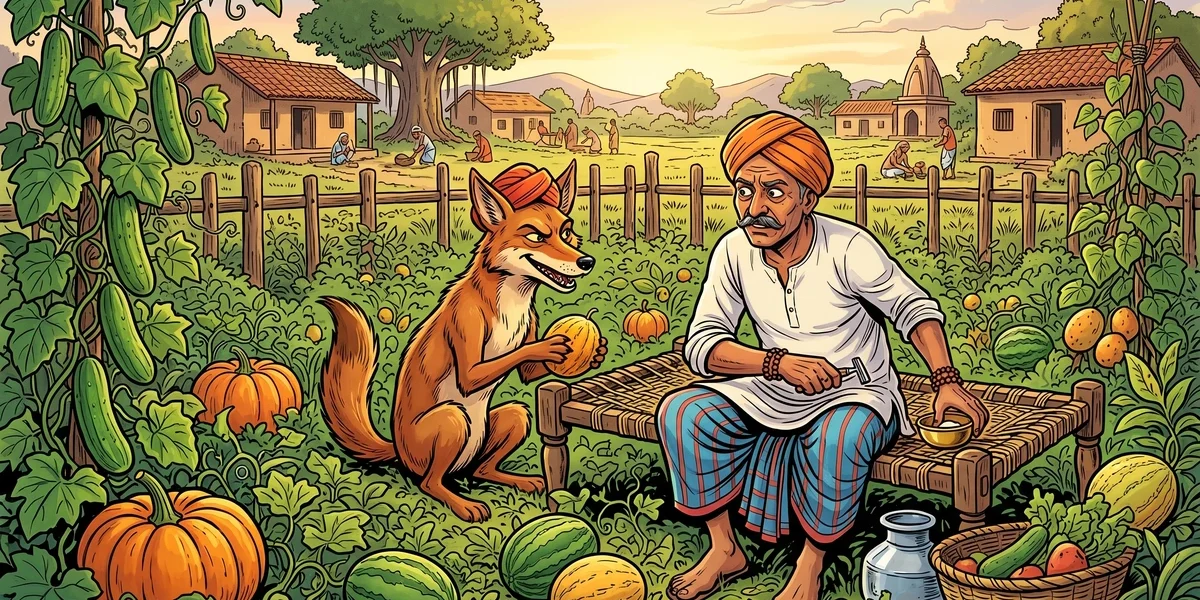
Jackal, Barber, Brahmin: Wit, Service, and the Comedy of Social Pretension
The triangular encounter between the jackal, the barber, and the brahmin belongs to the great tradition of Indian trickster comedy — tales in which the sharp-witted animal or low-status human outmanoeuvres the socially prestigious through a combination of quick thinking, impersonation, and the exploitation of the powerful’s own assumptions about their superiority. The jackal is India’s classic trickster — cunning, flexible, willing to play any role required by the moment — and the brahmin is the classic target of such comedy: learned in scripture but vulnerable to the specific kind of flattery and manipulation that exploits the pride of the learned.
The barber in this tale occupies the interesting middle position: a craftsman whose service is intimate (he touches the face, the head, the body) but whose social status is lower than the brahmin he serves. The barber knows things about his clients that their priests do not know — the quality of their scalp, the texture of their beard, the way their hands shake when they are anxious. This intimate knowledge of high-status bodies is a form of power that the tale explores: the barber who knows too much, and the jackal who uses this knowledge to confound a brahmin who trusts his own dignity more than his common sense. The governing concept is bandhav-kila—the social comedy of position—in which the assumptions embedded in social hierarchy are exploited by those who understand the hierarchy better than those it benefits.
“The brahmin was certain the jackal could not be as clever as it appeared. This certainty was the jackal’s primary tool.”
Beat I — The Jackal’s Entrance and Its Disguise
The jackal enters the tale through some form of disguise or misdirection — presenting itself in a role that gives it access to the brahmin’s world. The animal trickster’s power in Indian folk narrative derives from this flexibility of presentation: it can be humble when humility is advantageous, deferential when deference opens doors, assertive when assertiveness is required. The brahmin, who presents himself consistently (as a man of learning and social authority), has no equivalent flexibility and is therefore consistently vulnerable to whoever reads his consistency and uses it against him.
Beat II — The Barber’s Knowledge and Its Uses
The barber’s role in the triangle is to provide the intimate service that creates the opening for the jackal’s mischief. The barber knows the brahmin’s bodily vulnerabilities; the jackal knows the brahmin’s social vulnerabilities. Together — whether in alliance or separately, depending on the version — this combined knowledge is sufficient to confound someone who has invested in the belief that his learning and status protect him from the indignities that lesser people suffer. The comedy of the encounter depends on this investment: the brahmin’s pride is the trap he sets for himself.
Beat III — The Comic Resolution
The resolution varies by version but consistently involves the brahmin’s discomfiture and the jackal’s escape — the trickster achieving its goal and departing before the consequences can catch up with it. The barber may or may not benefit; the brahmin is left with his dignity diminished and a story that will follow him. The folk tradition’s comedy here is not cruel — it does not destroy the brahmin, merely punctures him — but it is clear-eyed about the vulnerability that social pretension creates. The man who cannot imagine being outmanoeuvred by a jackal is precisely the man who will be outmanoeuvred by one.
Trickster archetype: The jackal as Indian trickster — cunning, flexible, socially subversive
Related traditions: The jackal trickster appears across Panchatantra, Hitopadesha, Jataka tales, and numerous regional oral traditions
Themes: Bandhav-kila (the social comedy of position), trickster cunning vs. social pretension, intimate service as knowledge, the pride that creates vulnerability
Beat IV — What the Trickster Teaches
The jackal trickster in Indian folk narrative is not simply a comic figure — it is a social instrument. The trickster tale functions as a form of social commentary that can be told without the consequences of direct criticism: the jackal can say through its antics what the barber cannot say aloud, can expose the brahmin’s pretensions in a way that would be dangerous if a human of lower status attempted it directly. The comedy is the protection; the laughter is the critique. The jackal’s freedom to puncture social pretension comes precisely from its animal status, which puts it outside the social hierarchy it is criticising.
Why This Story Lasted
The jackal-barber-brahmin triangle has lasted because it names a social dynamic that is not historically specific: the powerful person who is protected by their status from most challenges but vulnerable to the specific challenge that comes from someone who reads the power’s assumptions better than the powerful person does. The trickster tale teaches its audience to see these vulnerabilities — to notice that social authority depends on the consent of those it is exercised over, and that a sufficiently clever person who withholds that consent has an unexpectedly effective tool. The comedy is entertaining; the lesson is genuinely subversive.
Frequently Asked Questions
Why is the jackal the primary trickster in Indian folk narrative?
The jackal occupies an interesting ecological and social position in the Indian world: it is a scavenger that lives at the edges of human settlement, clever enough to survive despite being neither predator nor prey in the straightforward sense. Its intelligence is the intelligence of adaptation and opportunism rather than strength. In folk narrative, this makes it the perfect vehicle for trickster stories: it thrives not through power but through reading the situation more accurately than anyone else and acting on that reading with speed and decisiveness.
What does the barber represent in the social hierarchy?
The barber (nai) occupies a specific position in the traditional Indian social structure: a craftsman whose service is intimate but whose status is lower than those he serves. This creates a structurally interesting position — the barber knows things about high-status people that those people prefer not to acknowledge, and must maintain discretion about what he knows while performing a service that makes him necessary. The barber’s position in this tale exploits that structural intimacy.
How does the brahmin’s pride create vulnerability?
The brahmin’s confidence in his own learning and status creates a specific blind spot: he cannot imagine being outmanoeuvred by someone he perceives as inferior — a jackal, a barber — and this inability to imagine it means he does not guard against it. Pride in one’s position is, in trickster narratives, systematically translated into the failure to attend to the actual situation, which allows the trickster to exploit the gap between the proud person’s self-image and the reality they are too confident to examine.
Is there a moral in this tale or is it purely comic?
The two are not exclusive. The moral — that social pretension creates specific vulnerabilities that those without social status can exploit — is embedded in the comedy. The laughter is the signal that something true has been said. Folk tale comedy, in the Aesopic and Indian traditions, is rarely purely comic; the entertainment is the vehicle for the observation, and the observation has genuine social content.
How does this tale relate to the Panchatantra?
The jackal is a central character in the Panchatantra, where it appears in multiple roles: as the wily minister Damanaka, as various trickster figures, and as an animal whose cunning is both celebrated and cautioned against. The Panchatantra’s jackal tales established a template for the animal trickster in Sanskrit narrative tradition that has influenced Indian folk tale traditions across the subcontinent. The Jackal-Barber-Brahmin tale participates in this long tradition of jackal as social critic.
Frequently Asked Questions
**Q: Why is this story important?**
You May Also Like
 Aesop's Fables
Ages 9-12
Aesop's Fables
Ages 9-12
The North Wind and the Sun
The North Wind and the Sun: In the time when the gods still walked among mortals and the forces of nature were personified as powerful beings with their own
 Aesop's Fables
Ages 3-5
Aesop's Fables
Ages 3-5
The Fate of the Turtle
A Panchatantra tale where a talkative turtle breaks his promise to stay silent and pays with his life.
 Aesop's Fables
Ages 9-12
Aesop's Fables
Ages 9-12
The Wolf in Sheep’s Clothing
The Wolf in Sheep's Clothing: In the rolling hills of ancient Macedonia, where olive groves stretched across sun-baked valleys and shepherds tended their