The Story of Bhasmasura
A proud demon asks Lord Shiva for a terrible boon, and only a clever dance can stop him.
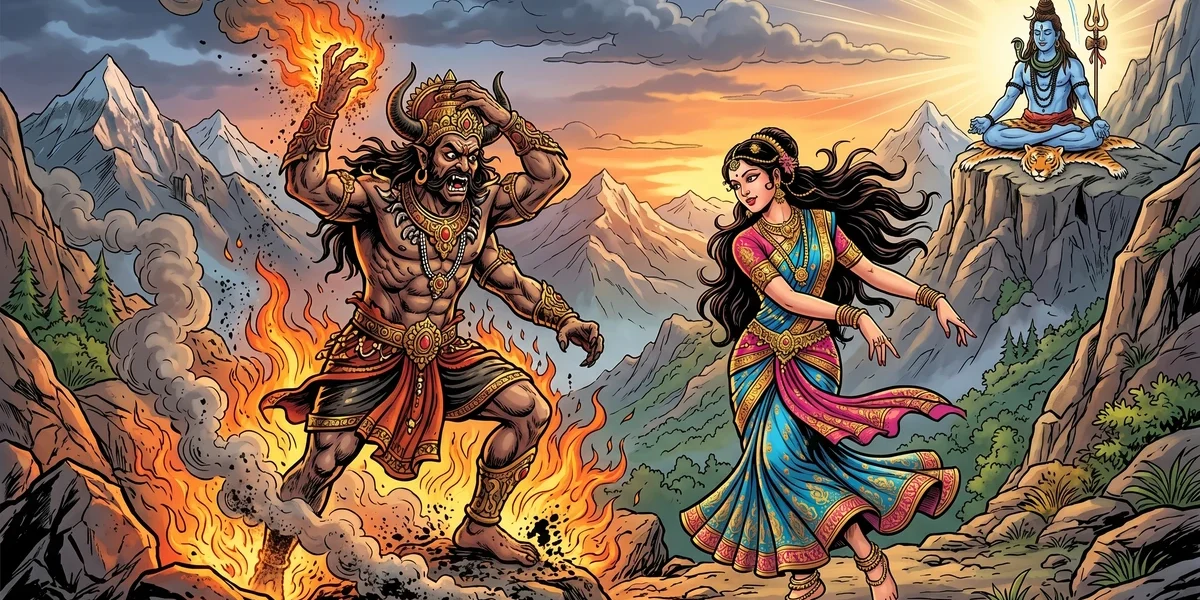
Bhasmasura: The Curse of the Boon and the Wisdom of Limits
The Asura Who Earned Too Much: Bhasmasura’s Tapas
The story of Bhasmasura belongs to a specific narrative type that recurs throughout Hindu Puranic mythology: the asura (demon) who performs extraordinary austerities (tapas), earns a powerful boon from a god — typically Shiva, whose generosity toward devoted ascetics is legendary — and then immediately attempts to use the boon against the very god who granted it, or against the cosmic order itself. The name Bhasmasura means “ash-demon,” derived from bhasma (ash) — which foreshadows the nature of his boon.
Bhasmasura is a demon of some ambition and considerable spiritual discipline. He performs intense tapas — austerities involving fasting, exposure to the elements, physical hardship — directed at Shiva. The purpose of tapas in Hindu tradition is precisely this: to accumulate spiritual heat (tapas also means heat) that creates an obligation on the divine to respond. Shiva, characteristically, is pleased with the devotion and appears to grant a boon.
What Bhasmasura asks for is remarkable in its specificity: the power to reduce to ashes anything he touches with his hand. Whatever his palm came to rest upon would immediately turn to ash. Shiva, in his aspect as Bholenath — the innocent, easily pleased god — grants the boon without hesitation or qualification. The moment the boon is granted, Bhasmasura tests it — by reaching for Shiva’s own head.
This is the structural core of the vara-viparyaya (reversal of the boon): the recipient immediately turns the gift against the giver. Shiva has made himself vulnerable through his own generosity. A power without limits becomes a threat to everyone, including its grantor. Shiva, the destroyer of the universe, must now flee from a demon who received his own generosity.
Shiva’s Predicament: When Divine Generosity Creates Danger
Shiva’s flight from Bhasmasura is one of the more humorous and theologically complex episodes in Puranic literature. Here is the greatest of the destroyer-gods, the ascetic whose matted hair holds the Ganges, the deity who swallowed the cosmic poison to save the world — running from an asura. The incongruity is deliberate. The story uses it to make a point about the difference between power and wisdom, between the ability to give and the discernment to give well.
The Puranas do not present Shiva’s predicament as a failure of his divinity but as a consequence of his particular divine character. Shiva is specifically celebrated as Ashutosh — “one who is easily satisfied,” “one who is pleased quickly.” This is among his most beloved attributes: unlike Vishnu, who is often depicted as more calculating and strategic, Shiva responds to genuine devotion with immediate, unconditional generosity. He does not negotiate; he does not add conditions; he does not question the devotee’s worthiness or the wisdom of the request. This quality makes him supremely approachable as a deity — and, in this narrative, supremely exploitable.
The story is thus structured as a complementary portrait of two divine temperaments: Shiva’s generosity without discernment, and Vishnu’s discernment without excessive sentimentality. Both are necessary; neither alone is sufficient. Shiva’s Bholenath quality makes him beloved but also vulnerable; Vishnu’s strategic intelligence can remedy what Shiva’s open-handedness creates. The gods, in Puranic mythology, form an ecosystem — each with their strengths and limitations, each depending on the others to maintain cosmic balance.
“The power without wisdom is a weapon without aim. The boon without limits is a curse in disguise. This is the lesson the demon earned and could not learn — and that Shiva, even as a god, had to be taught.”
Mohini’s Dance: Vishnu’s Strategy and the Self-Undoing of Pride
Shiva, unable to destroy Bhasmasura (whose touch would reduce even Shiva to ash), approaches Vishnu for help. Vishnu agrees and employs a tactic characteristic of his avatar-role as the cosmic preserver: not force, but maya — divine illusion, strategic transformation. He takes the form of Mohini, a supernaturally beautiful woman, and appears before Bhasmasura.
Bhasmasura is immediately smitten. He abandons his pursuit of Shiva and declares his desire to marry Mohini. Mohini agrees — conditionally. She is, she says, a dancer, and she will only marry a man who can match her in dance. Bhasmasura agrees eagerly. The dance begins, and Bhasmasura mirrors Mohini’s every gesture, every mudra, every pose. Mohini leads him through an increasingly elaborate sequence of movements. And then, in the sequence of gestures, she places her hand on her own head.
Bhasmasura, faithfully mirroring her, places his own hand on his own head — and is immediately reduced to ash. The boon, which granted the power to destroy anything he touched, destroyed only him in the end. The weapon turned against its wielder; the power he earned became his undoing.
The elegance of Vishnu’s solution is its economy: no battle, no direct confrontation, no demonstration of superior force. The demon is destroyed by his own boon, through his own desire, by following his own actions to their logical conclusion. Mohini did not trick Bhasmasura into doing something he would not otherwise do — she arranged the conditions under which he freely did what he was inclined to do (desire, imitation, pride in his own power) and allowed those inclinations to resolve themselves. This is upaya — skillful means — the solution that allows the problem to solve itself.
The Moral Architecture: Power, Discernment, and the Limits of Generosity
The story of Bhasmasura carries several interlocking moral arguments that have made it a durable tale for both entertainment and instruction across millennia. The first concerns the nature of power without wisdom: Bhasmasura’s boon is not inherently evil. The power to reduce things to ash could theoretically be a tool for many purposes. What makes it catastrophic is that it is given to a being who immediately uses it for destructive and self-aggrandising ends — to threaten the god who gave it, and to pursue unlimited personal power. Power without the wisdom to use it is the most dangerous gift.
The second argument concerns the conditions on generosity. Shiva’s granting of the boon, while an expression of his divine love for the devotee, is presented by the narrative as an error — not a moral error, but a practical one. Unconditional generosity, directed without discernment toward those who will misuse what they receive, creates harm. The story does not resolve this tension neatly — Shiva’s open-handedness is also his most beloved quality — but it insists that even divine generosity requires some wisdom about the character of the recipient.
The third argument, perhaps the most philosophically interesting, concerns the self-undoing nature of unchecked desire. Bhasmasura is ultimately destroyed not by any external force but by his own desire (for Mohini) and his own pride (in his ability to mirror her perfectly). His downfall is the direct consequence of his own inclinations, amplified and arranged by Vishnu’s strategic intelligence. The tradition reads this as a statement about the self-defeating character of ungoverned ambition: those who live entirely by desire and power tend, eventually, to be consumed by the very forces they have cultivated.
For children, the story delivers a clear and accessible message: do not be greedy; power without wisdom hurts the one who holds it; cleverness can defeat brute force. But the adult reading reveals a more complex theological argument about the complementarity of divine temperaments, the limits of generosity, and the way that attachment to one’s own power — however extraordinary — ultimately becomes a trap.
Why This Story Lasted
The Bhasmasura myth has endured because it captures with narrative precision one of the oldest human anxieties about power: that a tool or capacity obtained through great effort can become the very thing that destroys its possessor. This is the theme of Frankenstein, of the Sorcerer’s Apprentice, of countless cautionary tales across cultures about the danger of capabilities without the wisdom to use them. The Puranic version adds distinctive theological layers — about Shiva’s generous nature, Vishnu’s strategic intelligence, and the way maya (divine illusion) can resolve what force cannot — that give it a richness exceeding the simple cautionary tale. It has been told and retold because it asks a question every culture must answer: what do we do when our own power threatens to destroy us?
Frequently Asked Questions
Who is Bhasmasura in Hindu mythology?
Bhasmasura (भस्मासुर) is a demon (asura) who appears in several Hindu Puranas, most notably the Shiva Purana and Brahma Vaivarta Purana. His name means “ash-demon,” from bhasma (ash). He performs intense austerities to earn a boon from Shiva — the power to reduce anything he touches to ash — and immediately attempts to use this power against Shiva himself. The story is a classic Puranic cautionary tale about the dangers of power without wisdom and the consequences of misusing divine gifts.
Who is Mohini and why did Vishnu take this form?
Mohini (मोहिनी, “the enchantress”) is a female avatar or form of Vishnu — one of the few instances in which Vishnu takes a female form. Mohini appears in several Puranic episodes, most famously during the churning of the cosmic ocean (Samudra Manthan), when Vishnu takes the form of Mohini to distract the asuras and ensure the gods receive the nectar of immortality. In the Bhasmasura story, Vishnu again takes the Mohini form to resolve a crisis created by Shiva’s excessive generosity — using beauty and strategic deception to turn the demon’s own power and desire against him.
What does the story of Bhasmasura teach about power and wisdom?
The Bhasmasura narrative teaches several related lessons: that power without wisdom or moral restraint is self-defeating; that gifts given without discernment about the recipient’s character can create harm; and that attachment to one’s own power — or to any desire — tends to become a trap for the one who holds that attachment. Bhasmasura’s boon was extraordinary, but it could not protect him from his own desire and pride. The story also illustrates that cleverness and strategic intelligence (represented by Vishnu/Mohini) can resolve situations that brute force cannot.
Why is Shiva described as “Bholenath” and how does this relate to the story?
Bholenath (भोलेनाथ) is one of Shiva’s most popular epithets, meaning “innocent lord” or “the lord who is easily pleased.” It reflects Shiva’s characteristic openness to devotion — he responds quickly to sincere tapas (austerities) and grants boons generously, without the strategic calculation that characterises Vishnu. The Bhasmasura story uses Shiva’s Bholenath quality as a narrative device: his willingness to grant the boon without questioning the demon’s intentions creates the crisis. The story does not criticise this quality — it remains one of Shiva’s most beloved attributes — but it dramatises how unlimited generosity can have unintended consequences.
Are there similar stories in other world mythologies?
The theme of a gift or power that destroys its possessor appears across world mythologies. King Midas in Greek mythology receives the wish that everything he touches turns to gold — and cannot eat or embrace his own daughter. The Monkey’s Paw in English folklore grants three wishes that bring only grief. The Sorcerer’s Apprentice (known from Goethe’s poem and Disney’s Fantasia) unleashes a power he cannot control. In Norse mythology, the cursed ring Andvaranaut brings destruction to all who possess it. The Bhasmasura story is distinctive in its theological framing — the resolution through divine maya — and in its complementary portrait of Shiva and Vishnu as contrasting divine temperaments.
Frequently Asked Questions
**Q: Why is this story important?**
You May Also Like
 Aesop's Fables
Ages 9-12
Aesop's Fables
Ages 9-12
The Wonderful Mango Fruit
The Wonderful Mango Fruit: The night was now over: darkness, the harbourer of vice, fled away; the day dawned. King Alakesa left his bedchamber, bathed and
 Aesop's Fables
Ages 3-5
Aesop's Fables
Ages 3-5
Aspirations A Tale Of Two Women
Aspirations A Tale Of Two Women: Ramya looked out of her window at the park below. It would be 4 years today since she entered her “new home”. Although she was
 Aesop's Fables
Ages 3-5
Aesop's Fables
Ages 3-5
The King Who Was Fried
The King Who Was Fried: Once upon a time, a very long time ago indeed, there lived a King who had made a vow never to eat bread or break his fast until he had