The Deer King Nigrodha: Sacrifice Changes the Heart of a Hunter
The Deer King Nigrodha: Sacrifice Changes the Heart of a Hunter: The Deer King Nigrodha A Jataka Tale of Compassion and Redemption In the shadow of the great

Origin and Attribution
The story of the Deer King Nigrodha draws on the Nigrodhamiga Jataka tradition (Jataka No. 12) and the closely related Ruru Jataka (Jataka No. 482), reading the encounter between the deer king and the human world from the perspective of the hunter or human witness whose heart is changed by what he sees. Where the standard Nigrodhamiga telling focuses on the deer king’s act and its effect on the formal king of Benares, this retelling draws on the Ruru Jataka’s account of a hunter who encounters the Bodhisatta deer in a different circumstance — one in which the human witness is not a king with the power to change laws but an ordinary person with nothing but the choice of what to do with what he has seen.
The Ruru Jataka features the Bodhisatta as a golden deer of extraordinary beauty who saves a drowning man’s life; the man, later, under pressure from the king who wants the golden deer’s skin and horns, nearly betrays the deer’s location before pulling back at the last moment — stopped by the memory of what the deer did for him. The Jataka tradition uses this story to examine the mechanism by which genuine grace — an unearned, unexpected act of goodness — creates a moral obligation in its recipient that even self-interest cannot fully override.
Beat I — The Hunter in the Forest
In the forests near a prosperous city in a former age, a hunter made his livelihood from the killing of deer — not from cruelty but from profession, a hereditary craft passed from father to son across generations. He was skilled and efficient; he did not inflict unnecessary suffering; he observed the customs of his guild and made the ritual acknowledgements that hunters in the Indian tradition maintained toward the animals they took. He was not, by the standards of his community and his time, a bad man. He was simply a man who had never been asked to think about what he was doing from a perspective other than his own.
One morning in the deep forest, pursuing a wounded animal, he came suddenly into a clearing he had not seen before. In the centre of the clearing stood the Deer King Nigrodha — the Bodhisatta deer — golden in colour, extraordinary in size and bearing, standing still in the way that the Jataka tradition’s extraordinary animals stand still: not frozen with fear but completely composed, fully present, aware of the hunter without any sign of the panic that ordinary deer displayed at the smell of a human being with a bow.
The hunter raised his bow. The deer did not flee. The hunter held the arrow and looked at what he was looking at — and something in the steadiness of the deer’s regard, the complete absence of fear in an animal that should have been afraid, stopped his hand. He had hunted for twenty years and had never seen this. He waited. The deer waited. Neither moved.
Beat II — The Deer’s Speech and the Hunter’s Change
The Bodhisatta deer spoke — in the manner of Jataka animals who speak when speech serves the moral purpose of the tale — not to beg for his life but to offer the hunter something: the chance to understand what he was looking at before deciding what to do with it. He did not argue against hunting in general or against the hunter’s profession. He asked only whether the hunter had considered what kind of animal he was considering killing, and what the killing of such an animal would mean for someone of the hunter’s evident quality.
This approach — not accusation, not pleading, but an invitation to see more clearly — is characteristic of the Bodhisatta in many Jataka encounters with humans: he does not overpower the human’s agency but expands it, offering more information so that whatever choice is made is made from a fuller understanding of the situation. The hunter had never been addressed as a person of quality by an animal he was hunting; the novelty of it, combined with the deer’s extraordinary presence, created the conditions for genuine attention.
The hunter lowered his bow. He did not put it away immediately — the habit of twenty years was still in his hands — but he lowered it. He asked the deer what he meant. And the Bodhisatta explained — briefly, without moralising — what he was: a being of long cultivation, a creature in whom many lives of genuine effort toward goodness had accumulated into the quality that the hunter had sensed when he entered the clearing. Killing him would not be an ordinary act of hunting; it would be the destruction of something rare in the world.
The hunter put the bow down. He went home. He did not kill the Deer King that day, and he never returned to that part of the forest. He continued hunting — the Jataka does not present a single encounter as transforming a man’s entire livelihood overnight — but he was changed in a specific and observable way: he never again raised his bow at an animal he had not first truly looked at. The pause that the clearing had created in him — the moment of genuine attention before action — became a permanent habit. He killed less. He was more careful. He was, in some sense the Jataka leaves pleasantly vague, more truly himself than he had been before the encounter.
Beat III — The Mechanism of Moral Change
The Jataka tradition’s account of the hunter’s change is analytically significant because it describes a form of moral development that is neither conversion (sudden, total, permanent) nor mere momentary sentiment (passing, ineffective). What happens to the hunter is more precise: he encounters something that creates a genuine pause between impulse and action, and that pause, once experienced, cannot be fully un-experienced. He knows now that the pause is possible. He knows what it feels like to really look before shooting. And this knowledge, once embodied, modifies all subsequent encounters with animals in a way that he did not plan and cannot fully explain.
The Buddhist psychological tradition has a term for this: pativedha — penetrative insight, the kind of understanding that reaches through the surface of habitual behaviour to touch the layer where habits are formed. The hunter’s encounter with the deer king is not intellectual; he does not argue himself into a new position. He experiences something, and the experience rewrites something below the level of deliberate thought. This is why the change is genuine and lasting rather than performative and temporary.
The Ruru Jataka’s complementary account — where the saved man nearly betrays the deer to a king, then pulls back — shows the same mechanism under pressure. The memory of grace is not strong enough to overcome self-interest in a single decisive moment, but it is strong enough to create hesitation, and hesitation is enough. The man who hesitates in the act of betrayal has already, in some sense, refused it; the full betrayal would require overcoming a resistance that the memory of the deer has planted in him permanently.
Beat IV — The Moral and Its Living Relevance
The Deer King Nigrodha story encodes a teaching about moral change that the Jataka tradition found important to encode from the recipient’s perspective as well as the giver’s. The deer king’s extraordinary presence and honest speech do not force the hunter to change; they offer him the conditions in which change is possible, and he accepts the offer. This is the tradition’s account of how genuine grace works in the world: not by compelling compliance but by creating the conditions for a choice that was not previously available.
“The hunter who truly looked before he shot found he could not shoot what he had truly seen. This is not weakness — it is the beginning of a different kind of strength.”
The contemporary resonance of this teaching is in the specific mechanism it identifies: genuine attention as the precondition of moral development. The hunter does not become more compassionate by being lectured about compassion; he becomes more compassionate by actually attending to what he is looking at — by accepting the invitation to see the deer as the deer actually is rather than as the category “prey animal” requires him to be. This shift from category to individual, from abstraction to specific presence, is what the Jataka tradition presents as the fundamental mechanism of moral awakening. You cannot genuinely see and continue unchanged; the seeing itself is the change.
Why This Story Lasted
The Deer King Nigrodha story, read from the hunter’s perspective, survived because it describes a form of moral change that is neither dramatic conversion nor ineffective sentiment: the permanent creation of a pause where no pause previously existed. Every person who has ever been stopped in mid-action by the force of genuine attention to what they were about to do — and found that they could not continue as they had been going — has had a version of the hunter’s experience in the clearing. The Jataka tradition names this experience, identifies its mechanism (genuine attention to what is actually present rather than to the category it belongs to), and argues that it is available to anyone willing to lower their bow for a moment. Stories that name an experience the audience has already had, and give it a framework that makes it comprehensible, survive for as long as the experience does.
You May Also Like
 Jataka Tales
Ages 3-5
Jataka Tales
Ages 3-5
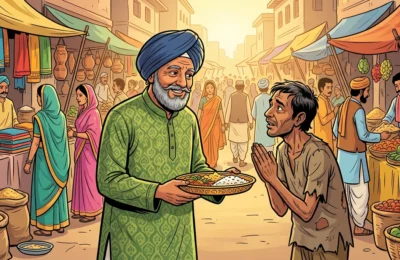
The Story of the Merchant of Seri
The Story of the Merchant of Seri: Source: Jataka Tales Ellen C. Babbit | Type: Jataka | Country: India | Language: English In the country of Seri there was
 Jataka Tales
Ages 3-5
Jataka Tales
Ages 3-5
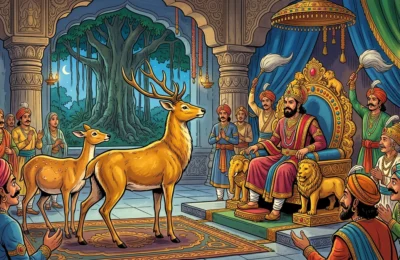
The Story of the Banyan Deer
The Story of the Banyan Deer: Source: Jataka Tales Ellen C. Babbit | Type: Jataka | Country: India | Language: English Once upon a time a Deer lived in a
 Jataka Tales
Ages 3-5
Jataka Tales
Ages 3-5
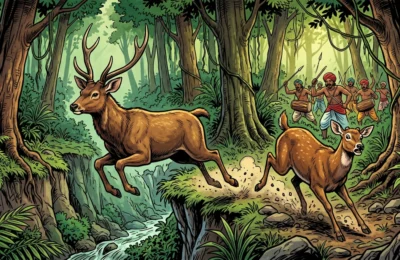
The Two Stags
The Two Stags: Source: Jataka Tales Sacred Texts | Type: Jataka | Country: India | Language: English In a certain forest there lived two stags, brothers born