The Two Stags
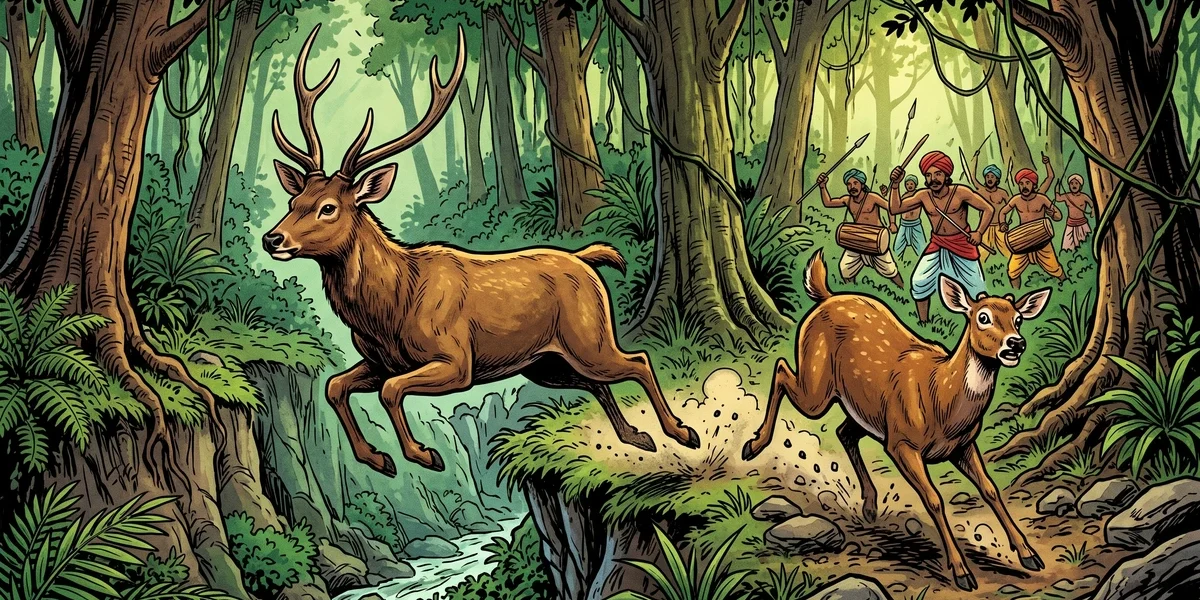
The Two Stags: Source: Jataka Tales Sacred Texts | Type: Jataka | Country: India | Language: English In a certain forest there lived two stags, brothers born
Origin and Attribution
The story of the Two Stags comes from the Lakkhana Jataka, the eleventh tale in the Pali Jataka collection. Lakkhana refers to an auspicious mark or characteristic — a title that gestures toward the moral quality the tale wishes to illustrate through the figure of the Bodhisatta stag. The Jataka is one of several animal-birth stories in the early part of the collection in which the Bodhisatta appears as the leader of a herd, and its political allegory is explicit: the relationship between a stag and his herd is the Jataka tradition’s preferred vehicle for teaching about the relationship between a ruler and his people.
The tale is framed by the Buddha’s identification of the two stags with himself and his cousin Devadatta — the figure who, in the “story of the present,” had attempted to split the monastic community and had opposed the Buddha’s teaching. The contrast between the Bodhisatta stag’s selfless courage and his rival’s cowardly self-preservation is thus a judgment delivered in narrative form about the nature of genuine versus counterfeit leadership, a judgment the tradition wanted its audience to be able to apply in their own social and political contexts.
Beat I — The Two Herds and the Hunters
In a former life in the forests near Benares, the Bodhisatta was born as a golden stag of extraordinary beauty and intelligence, leader of a herd of five hundred deer. A rival stag — equally impressive in appearance — led another herd of the same size. The two herds shared the same forest and were at peace with each other; the two stag-leaders maintained a mutual respect without intimate alliance.
The king of Benares loved hunting and had established a game drive in the forest: his hunters would beat through the undergrowth, driving the deer toward a lake where they could be taken easily. Every season the drive devastated the forest herds, killing not only stags but does and fawns indiscriminately, and terrifying the survivors into the kind of exhausted panic that made them easy prey for months afterward.
The Bodhisatta stag, observing the pattern of the king’s drives, recognised something the other animals did not: the suffering caused by the drives was not random but structural — a consequence of the manner in which the hunt was conducted. He also recognised that the king was not malicious but simply had not considered the full consequences of his method. This distinction mattered to the Bodhisatta’s response: he would address the king as a rational interlocutor, not as an enemy.
Beat II — The Stag’s Audience with the King
The Bodhisatta made his way to the palace — the Jataka does not explain the mechanism of a stag gaining audience with a king, operating as it does in the space of fable — and addressed the king directly. He did not beg for mercy or protest the hunt on the grounds of his own suffering. He made an administrative argument: the current method of hunting produced enormous collateral damage among does and fawns that yielded no useful meat and merely reduced the future population of game available to the king’s hunts. A more targeted arrangement would serve the king better over time.
His specific proposal was this: the two herds would provide a single stag each day by lot — taking turns according to a fair rotation — to present themselves at the palace kitchen. The king would receive fresh venison daily without the expense and disruption of an organised drive; the herds would suffer predictable, individually-borne losses rather than the mass terror of periodic slaughter. The king, recognising the reasonableness of the proposal, agreed.
For a time the arrangement worked. Each morning a stag went to the palace of his own accord and died there, and the rest of the herd grazed in peace. Then the lot fell to a pregnant doe in the rival stag’s herd. The rival stag, faced with the problem of a doe who could not be sent — her death would mean two deaths — did not sacrifice himself in her place. He passed the assignment to a doe from the Bodhisatta’s herd instead, an act of transferring burden that violated the spirit and the letter of the arrangement.
Beat III — The Bodhisatta’s Response
When the problem was brought to the Bodhisatta, he did not protest the rival stag’s cowardice or appeal to the king to enforce the original terms. He went himself. He stood at the palace gate and presented himself in the doe’s place. The king’s servants recognised him as the stag who had made the original agreement and sent for the king, who came to see what had happened. The Bodhisatta explained the situation plainly: the pregnant doe could not be sent without killing two lives; he had come in her place; he did not object to his own death but wanted the king to understand why he was there.
The king was silenced. He asked a series of questions — which herd did the doe belong to, who was the leader who should have sent her, why had that leader not come himself — and received the answers with growing recognition of what he was actually seeing: a leader sacrificing his own life because a member of a rival herd was in danger, on the basis of a principle of fairness that the rival’s leader had abandoned. The king released the Bodhisatta, then released the pregnant doe, then released the stag’s herd, then released all the deer in the forest from the arrangement entirely, ending the organised slaughter.
Beat IV — The Moral and Its Living Relevance
The Lakkhana Jataka encodes a leadership principle that the Jataka tradition returns to repeatedly across its five hundred and forty-seven stories: the leader who is willing to sacrifice his own safety for the wellbeing of those who depend on him — and even for those who do not — exercises a moral authority that compels recognition even from enemies and strangers. The Bodhisatta stag’s act does not work because of any legal or institutional mechanism; it works because the king can see, in the act itself, what genuine leadership looks like, and the sight of it changes him.
“The king who would rule justly must first meet a leader willing to die justly; only then does he know what justice requires of one who holds power over others.”
The contrast with the rival stag is the tale’s analytical centre. The rival stag is not cruel — he simply optimises for his own herd’s protection at the expense of a doe who was his responsibility by the terms of the agreement. This is the Jataka tradition’s portrait of competent but not exceptional leadership: adequate in ordinary circumstances, inadequate precisely in the moments of moral difficulty that define leadership quality. The Bodhisatta stag’s response — going himself — is the portrait of the exceptional leader who does not calculate personal cost when the principle at stake is clear.
The political philosophy here converges with elements of the Arthashastra but extends beyond it. Kautilya advocates for the king’s welfare as the goal of statecraft, arguing that a prosperous king produces a prosperous kingdom. The Jataka tradition inverts the priority: the welfare of those who depend on the leader is the goal, and the leader’s personal welfare is secondary to that. The king of Benares is educated into this inversion not by argument but by witnessing it in action.
Why This Story Lasted
The Two Stags story survived because it dramatises a genuine paradox at the heart of leadership: the leader with the most power is also the one most exposed to the temptation to use that power self-protectively rather than for those who depend on it. The rival stag has power over his herd; he uses it to transfer burden away from himself. The Bodhisatta stag has the same power; he uses it to transfer burden onto himself. The tale shows that these two uses of power produce radically different outcomes — not only for those affected but for the leaders themselves, whose moral authority either grows or shrinks with each such decision. Stories that accurately describe how leadership quality accumulates and decays through specific choices are the ones that rulers and citizens alike find worth keeping.
You May Also Like
 Jataka Tales
Ages 3-5
Jataka Tales
Ages 3-5
The Wise Hare: Generosity Writes Itself on the Moon
The Wise Hare: Generosity Writes Itself on the Moon - a folk tale retold for young readers with a clear moral, simple words, and the warmth of a bedtime...
 Jataka Tales
Ages 6-8
Jataka Tales
Ages 6-8
The Banyan Deer (Nigrodhamiga Jataka)
The Banyan Deer (Nigrodhamiga Jataka): Source: Jataka Tales Sacred Texts | Type: Jataka | Country: India | Language: English In the kingdom of Varanasi there
 Jataka Tales
Ages 3-5
Jataka Tales
Ages 3-5
The Story of the Merchant of Seri
The Story of the Merchant of Seri: Source: Jataka Tales Ellen C. Babbit | Type: Jataka | Country: India | Language: English In the country of Seri there was