The Banyan Deer
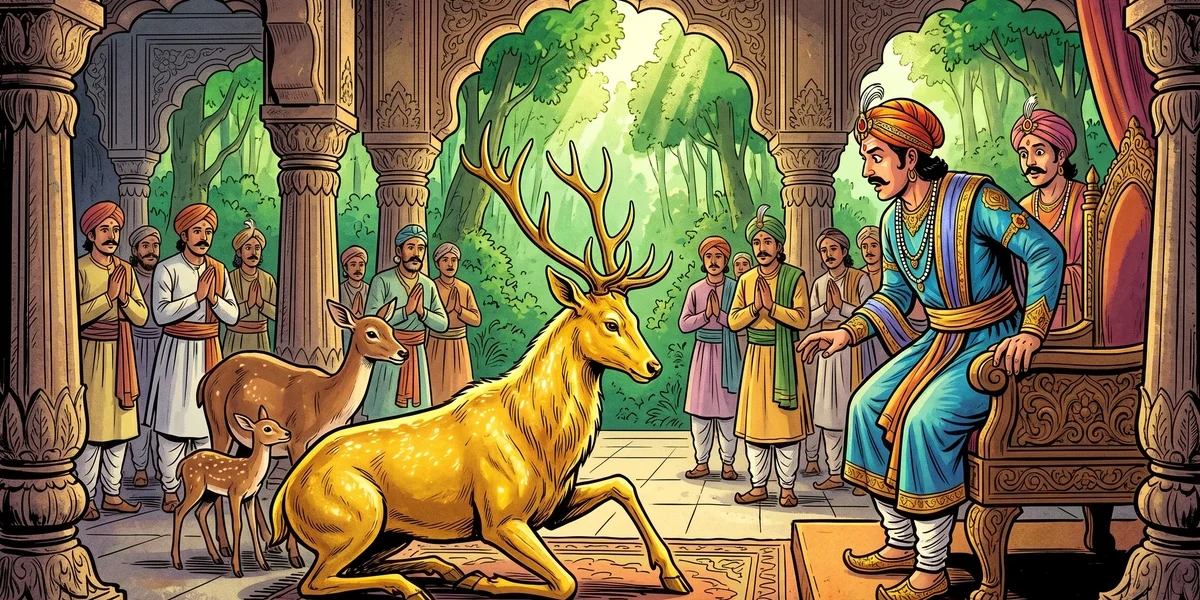
The Banyan Deer: Source: Jataka Tales Ellen C. Babbit | Type: Jataka | Country: India | Language: English ONCE upon a time there was a deer named Banyan. A
Origin and Attribution
The Nigrodhamiga Jataka — the story of the Banyan Deer — occupies a special place in the Jataka corpus not only because of the moral beauty of the tale itself but because of what it reveals about the Buddhist doctrine of the Bodhisatta-path: the immensely long journey across lives and forms that the being who will become a Buddha undertakes in order to perfect the qualities that Buddhahood requires. The Jataka collection as a whole is, at one level, a biography of this development: five hundred and forty-seven snapshots of a being who, life after life in every conceivable form — god, human, animal, and spirit — is cultivating the ten perfections (dasa-paramita) that culminate in the enlightenment of Gautama Siddhattha under the Bodhi tree.
The Banyan Deer story, occurring in the twelfth Jataka, belongs to a stage in this biography when the Bodhisatta is perfecting sila (moral conduct) and nekkhamma (renunciation) — not primarily through philosophical understanding but through the actual enactment of these qualities in an animal life stripped of the social conventions and institutional supports that make virtue easy for human beings. An animal cannot claim virtue through ritual, lineage, or social performance; it can only express it through action. The golden stag at the block is the Bodhisatta’s sila in its purest form: not a rule followed but a quality of character expressed in a moment when it costs everything.
Beat I — The Animal Bodhisatta
The Buddhist doctrine of rebirth holds that beings pass through multiple realms of existence across many lives — human, divine, animal, hungry ghost, hell-being — depending on the quality of their karma. For ordinary beings this cycle of rebirth (samsara) is experienced as suffering and driven by ignorance and craving. For the Bodhisatta — the being aspiring to Buddhahood — the same cycle is deliberately traversed as a curriculum: each birth in each realm offers specific conditions for cultivating specific perfections that human life alone cannot provide.
The animal realm, in the Jataka tradition’s account, offers something human life tends to obscure: moral clarity without social mediation. A stag cannot give to impress others or renounce for status. His generosity and his courage are expressed directly, without the layer of self-presentation that human moral life inevitably involves. This is why many of the Bodhisatta’s most significant moral acts in the Jataka collection occur in animal births: the actions are unambiguous expressions of character because there is no other reason for them.
The golden stag of the Nigrodhamiga Jataka is one of the collection’s most vivid animal-Bodhisattas. His beauty — the golden coat, the extraordinary grace noted in the Pali text — is the external expression of the accumulated merit of many previous lives. His intelligence — the negotiation with the king, the daily care for five hundred deer — reflects the wisdom that those lives have cultivated. And his act at the block reflects the sila that is now, in this life, approaching the fullness that the Bodhisatta-path requires it to reach.
Beat II — The Perfection of Sila in Animal Form
The Pali canonical tradition identifies ten paramitas whose progressive perfection across the Bodhisatta’s lives culminates in the qualities that make Buddhahood possible: generosity (dana), moral conduct (sila), renunciation (nekkhamma), wisdom (panna), energy (viriya), patience (khanti), truthfulness (sacca), resolution (adhitthana), loving-kindness (metta), and equanimity (upekkha). The Banyan Deer story engages several of these simultaneously in a way the commentaries explicitly note.
Sila is expressed in the stag’s refusal to let a pregnant doe die when he has the capacity to prevent it — a moral conduct that goes beyond what any rule requires. Nekkhamma is expressed in his willingness to give up his life without clinging to it — the renunciation of self-preservation. Sacca (truthfulness) is expressed in his plain account to the king of why he is at the block — no pleading, no embellishment, only the truth of the situation. Metta (loving-kindness) is expressed in the quality of attention he brings to the doe from the rival herd — the same attentiveness he gives to members of his own flock.
The commentaries note that the Bodhisatta’s act is not experienced by him as sacrifice in the human sense of giving up something valued. The golden stag does not struggle with the decision; he does not calculate the cost and then override the calculation with heroic will. He simply goes. This effortlessness — the quality of action that flows from character so thoroughly cultivated that it requires no deliberation — is what the tradition identifies as the mark of a paramita fully developed: the virtue that operates as naturally as breathing, without the friction of competing desire.
Beat III — The Frame Story and Its Teaching
The “story of the present” that frames the Nigrodhamiga Jataka in the standard Pali presentation involves a monk named Devadatta — the Buddha’s cousin and the tradition’s figure of spiritual rivalry and sectarian ambition — who is identified as the Branch Deer of the past life. This identification carries a judgment that the Jataka tradition delivers through narrative rather than argument: Devadatta’s current conduct (attempting to split the monastic community, seeking personal power at the expense of the dharma) is of a piece with the Branch Deer’s ancient conduct (refusing to take the doe’s place, prioritising self-protection over principle).
The identification also carries an implicit account of why the Buddha and Devadatta are so different despite comparable practice. The Buddha’s many lives of paramita cultivation — across every form of existence, each one a specific training in a specific virtue — have produced a character that acts from fullness rather than deficiency. Devadatta’s rivalry with the Buddha is, in the Jataka framework, the rivalry of the Branch Deer watching the Banyan Deer from a safe distance: recognising excellence, being disturbed by it, and responding with the specific resentment of a being who knows what he is watching but cannot yet be it.
The teaching here is about the mechanics of moral development: it is gradual, it is cumulative, it requires actual enactment across actual circumstances rather than intellectual agreement with good principles. The Branch Deer knows what the Banyan Deer is doing is right; he does not do it. This gap — between moral knowledge and moral action — is what the Bodhisatta-path is, across five hundred and forty-seven lives, progressively closing.
Beat IV — The Moral and Its Living Relevance
The Banyan Deer story, read as a moment in the Bodhisatta’s long biography, encodes a teaching about moral development that is as relevant to the practitioner reading it as it is to the characters within it. The tradition is not presenting the golden stag’s act as something admirable but beyond reach — a heroic standard that ordinary human beings can only observe from the distance of aspiration. It is presenting it as a stage in a progression that begins with the simplest acts of generosity and moral conduct and moves, through patient cultivation across many circumstances, toward the effortless virtue that the golden stag exemplifies.
“The golden stag did not decide to be compassionate in the moment of crisis. He had been becoming compassionate across many lives; the moment of crisis only showed what he had already become.”
This is the Jataka tradition’s most important contribution to moral psychology: the shift from virtue as decision to virtue as character, from ethics as a set of rules applied at moments of choice to ethics as the accumulated quality of a life lived with consistent attention to what the situation actually requires. The Branch Deer makes a decision at the moment of crisis and makes it badly. The Banyan Deer does not make a decision in the ordinary sense; he expresses what he has become. The gap between these two modes of moral action is the work of a path — in the Jataka’s account, a very long one, but one that begins with the next act of generosity or moral conduct available to the practitioner in their current life.
Why This Story Lasted
The Banyan Deer story has been retold in every Buddhist culture across Asia for more than two thousand years because it holds two things in a single image that are rarely held together: the sublime and the ordinary. The golden stag’s act is sublime — it stops a king’s heart and reforms a kingdom’s law. But it is also ordinary in the deepest sense: it is simply what a being of fully cultivated character does when a pregnant doe is in front of them and no one else is going to help. The story tells Buddhist practitioners that this kind of ordinariness is achievable — not immediately, not without the long work of the path, but achievable — and that the path begins with the next thing, however small, that the situation requires and that you are capable of doing. Stories that hold the sublime and the ordinary together, without collapsing one into the other, survive.
Frequently Asked Questions
What is the moral of The Banyan Deer?
What is the origin of The Banyan Deer story?
What is the story of The Banyan Deer?
What is the Buddhist significance of The Banyan Deer Jataka?
Why is The Banyan Deer depicted in ancient Indian art?
You May Also Like
 Jataka Tales
Ages 3-5
Jataka Tales
Ages 3-5
The Story of the Merchant of Seri
The Story of the Merchant of Seri: Source: Jataka Tales Ellen C. Babbit | Type: Jataka | Country: India | Language: English In the country of Seri there was
 Jataka Tales
Ages 3-5
Jataka Tales
Ages 3-5
The Happy Monk
The Happy Monk: Source: Jataka Tales Sacred Texts | Type: Jataka | Country: India | Language: English In the city of Rajagaha there was a king named Bimbisara.
 Jataka Tales
Ages 6-8
Jataka Tales
Ages 6-8
The King’s White Elephant
The King's White Elephant: Source: Jataka Tales Ellen C. Babbit | Type: Jataka | Country: India | Language: English ONCE upon a time a number of carpenters