The King’s White Elephant
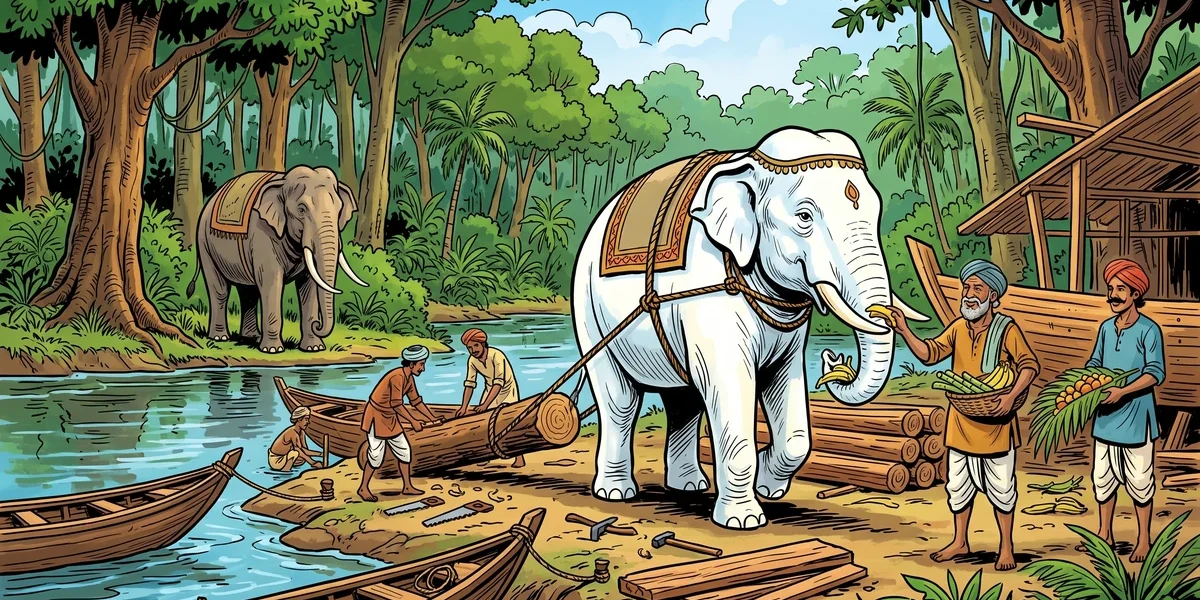
The King's White Elephant: Source: Jataka Tales Ellen C. Babbit | Type: Jataka | Country: India | Language: English ONCE upon a time a number of carpenters
Origin and Attribution
The King’s White Elephant story belongs to the tradition of the Chaddanta Jataka (Jataka No. 514), one of the longest and most structurally complex tales in the Pali Jataka collection. Chaddanta refers to the six-tusked elephant — the form the Bodhisatta takes in this birth — whose six tusks are symbols of the six perfections he has cultivated to an extraordinary degree. The full Chaddanta Jataka is an elaborate narrative involving a king, two consort-elephants, a queen’s jealousy, a hunter sent across the world to cut the ivory from the six-tusked elephant’s head, and the elephant’s response when the hunter finds him: he grants the task himself, helping the hunter saw off his own tusks, dying as a result.
This story is among the Jataka tradition’s most powerful explorations of the perfection of upekkha — equanimity — in its highest form: the capacity to be fully present with one’s own death, free from resentment toward the agent of it, and to extend active assistance to the being who is unwittingly serving as the instrument of an unjust command. The white elephant’s ivory cannot be taken by force; it is given. This distinction is the moral heart of the tale.
Beat I — The Magnificent Six-Tusked Elephant
In a former life in the great forests of the Himavanta — the mythic forest realm of the Jataka tradition — the Bodhisatta was born as a magnificent white elephant with six great tusks, leader of eight thousand elephants who lived under his protection and guidance. He was renowned not only for his physical magnificence but for the quality of his conduct: gentle, fair in his leadership, attentive to the welfare of every animal in his care, and possessed of the equanimity that comes from many lives of spiritual cultivation.
He had two consort-elephants whom he loved equally and to whom he showed equal care and affection. One day, during the distribution of a flowering lotus branch — a gift he had gathered — one consort received it while the other did not, through a circumstance of timing rather than preference. The second consort felt the slight as real, nursed it as a grievance, and at her death was reborn as a human woman — a queen in Benares — carrying the memory of the injury and the determination to avenge it.
As queen, she described the six-tusked elephant to hunters, offered enormous rewards for his ivory, and sent the greatest hunter in the kingdom on a quest to find him and bring back his tusks. The hunter searched for years through impossible terrain before finally locating the white elephant and approaching him in the forest.
Beat II — The Hunter’s Arrival
The hunter knew he could not take the six-tusked elephant by force — no human weapon or trap could subdue a creature of such size and power. He disguised himself as a wandering ascetic, knowing that the elephant’s reverence for the robe of a holy man would prevent him from attacking. He entered the elephant’s forest in this disguise and shot the elephant with a poisoned arrow.
The poison began to work. The six-tusked elephant felt the pain and understood immediately what had happened: a man disguised as a holy man had shot him. His initial instinct — the instinct of eight thousand elephants watching their leader under attack — was rage. The herd moved toward the hunter. The elephant restrained them. He had recognised something the herd had not: the man was acting under instructions, not from his own malice. He was a hunter doing what hunters do, for reasons that lay behind him in the human world, not in front of him in this forest.
The elephant approached the hunter directly, towering over him — and spoke. He wanted to understand the situation before responding to it. Why had the hunter come? Who had sent him? What was the purpose of the arrow? The hunter, terrified but recognising that he was not going to be harmed, told the truth: he had been sent by the queen of Benares to obtain the six tusks, and the queen had offered everything she had for them.
Beat III — The Gift of the Tusks
The six-tusked elephant was silent for a moment. He understood now what the Pali commentary makes explicit: the queen’s hatred was the consequence of an old karmic connection — the former consort’s nursed grievance, carried through death and rebirth into a new life and a new form of expression. The arrow was, in this framework, not an injustice to be resisted but a consequence to be met with the quality of mind that the Bodhisatta’s cultivation had prepared him for.
He lay down, placed his head on the ground, and told the hunter to take the tusks. The hunter tried. The tusks were too firmly embedded; he could not cut them with his saw. The elephant, dying from the poison, took the saw from the hunter’s hands and worked it himself, cutting through his own tusks and delivering them into the hunter’s hands. The Pali text records that the blood ran down, that the pain was immense, and that the elephant showed no sign of anger or resentment — only the steady equanimity that had been his character across many lives.
As he handed the tusks over, he asked the hunter one thing: tell the queen that these are given freely, not taken. The Jataka commentary notes that this request was not for the queen’s benefit — she would not understand it — but for the record of the act itself. The tusks were not conquered; they were offered. The distinction mattered to the Bodhisatta even at the moment of his death.
Beat IV — The Moral and Its Living Relevance
The Chaddanta Jataka’s governing teaching is expressed in the Pali commentary’s observation about the nature of true upekkha: equanimity is not the absence of feeling but the presence of full awareness without the distortion of self-protective reactivity. The six-tusked elephant felt the pain of the poison and the saw; he was not numb. What he did not feel was the resentment that would have been the natural accompaniment of that pain in a being of lesser cultivation. The pain was allowed to be pain; the hunter was allowed to be doing what he was doing; the queen’s hatred was allowed to be the karma it was — and none of these facts disrupted the elephant’s capacity to respond to the situation with the fullness of his character rather than the contraction of self-defense.
“The tusks cut from an unwilling elephant are ivory. The tusks given by a willing one are something the queen could never have asked for and will never fully understand she received.”
The story also encodes a teaching about the relationship between karma and response. The queen’s hatred was real, her act of sending the hunter was real, and its consequences for the elephant were real. The Jataka tradition does not present the elephant’s death as just or deserved; it presents it as a karmic consequence that was met with the quality of response that transforms rather than perpetuates. The elephant’s equanimity in accepting the situation — while acting within it with full moral agency — is the Jataka tradition’s account of how a being of advanced cultivation navigates unjust circumstances: not by denying the injustice but by refusing to let the injustice determine the quality of their response to it.
The contemporary resonance is in the distinction between what happens to us and what we do with what happens to us. The six-tusked elephant did not choose his karma, did not choose the queen’s hatred, did not choose the hunter’s arrow. He chose only the quality of his response to all of these — and that choice, made from the accumulated character of many lives of cultivation, is the one the Jataka tradition considers worth recording.
Why This Story Lasted
The Chaddanta Jataka is among the longest and most elaborately told stories in the Jataka collection, preserved with extraordinary care across the Pali canonical tradition and represented in Buddhist art at Sanchi (one of the Sanchi stupa’s major narrative panels depicts a version of this story) and in Southeast Asian manuscript traditions. Its preservation reflects the tradition’s recognition that the teaching it encodes — the distinction between suffering passively and acting from one’s full character within suffering — requires narrative space to unfold properly. The white elephant’s six tusks, the two consort-elephants, the queen’s rebirth, the hunter’s disguise, the cutting of the ivory: each element of the story is necessary to create the conditions in which the final act — the elephant handing the saw back — can be understood for what it is. Stories that require their full length to deliver their meaning are the stories that resist compression and survive intact.
You May Also Like
 Jataka Tales
Ages 3-5
Jataka Tales
Ages 3-5
The King’s Elephant
The King’s Elephant: Long ago, the mighty Himalayas were home to a large herd of eighty thousand elephants headed by a magnificent white elephant. He had a
 Jataka Tales
Ages 3-5
Jataka Tales
Ages 3-5
The Monkey King’s Sacrifice: A Tale of Selfless Love
The Monkey King's Sacrifice: A Tale of Selfless Love: The Monkey King’s Sacrifice A Jataka Tale of Selfless Courage and Transformation In the ancient times
 Jataka Tales
Ages 3-5
Jataka Tales
Ages 3-5
The Moon Rabbit – A Japanese Folktale For Children
The Moon Rabbit – A Japanese Folktale For Children: A monkey, an otter, a jackal and a rabbit resolved to practice charity on the day of the full moon.