The King’s Elephant
The King’s Elephant: Long ago, the mighty Himalayas were home to a large herd of eighty thousand elephants headed by a magnificent white elephant. He had a

Origin and Attribution
The story of the King’s Elephant in the Jataka tradition draws on one of the most celebrated accounts in the Pali canonical literature: the episode of the elephant Nalagiri, preserved in both the Vinaya Pitaka’s Cullavagga and in the Jataka corpus. In the canonical account, the Buddha’s rival Devadatta conspired with King Ajatasattu of Magadha to release the royal war elephant Nalagiri — maddened with liquor and goaded to aggression — into the street through which the Buddha was walking, intending to have him killed by the elephant’s charge. What followed became one of the most reproduced images in Buddhist narrative art: the Buddha standing calm in the street, extending metta (loving-kindness), and the great elephant stopping, kneeling, and being stroked gently on the head by the one who had not moved.
The Jataka tradition extends this episode into a broader framework of stories about the relationship between royal elephants, their keepers, and the quality of mind that can calm an animal whose every physical instinct has been directed toward destruction. This story focuses on a past life in which the Bodhisatta was born as the royal elephant itself — experiencing from within the animal’s perspective the strange power of a calm and compassionate presence to interrupt violence that has been carefully constructed and set in motion.
Beat I — The Royal War Elephant
In a former life in a great kingdom of northern India, the Bodhisatta was born as the king’s finest elephant — enormous, magnificently trained, the pride of the royal stables and the most feared animal in the kingdom’s war capacity. He had served the king faithfully for many years, participated in campaigns that had expanded the kingdom’s borders, and was known to the mahouts (elephant keepers) as a creature of unusual intelligence and reliable temperament — fierce in battle, gentle outside it, responsive to instruction in ways that lesser elephants were not.
The elephant’s life was organised around two modes of being that the Jataka tradition found philosophically interesting: the mode of disciplined service, in which he acted entirely in accordance with training and instruction, and the mode of natural being, in which he moved through his own perception and disposition. In the first mode he was formidable; in the second he was gentle. The story is about what happens when these two modes are forced into collision by the intervention of malice.
A conspiracy formed — the Jataka tradition does not require a named villain; it is interested in the mechanism rather than the person — and the royal elephant was drugged with liquor mixed into his feed, then goaded and frightened until his natural gentleness was entirely submerged and he was in the state the tradition calls mattagaja: a maddened elephant, his intelligence still operating but now directed entirely by pain, fear, and chemically induced aggression. In this state he was released into the city streets at the hour when a great holy man was known to be walking.
Beat II — The Charge and the Stopping
The streets cleared. The crowd scattered. The elephant moved through the empty street toward the holy man who had not moved — who had not stepped aside, had not fled, had not raised a hand or a word of command. The Pali accounts of the Nalagiri episode describe the Buddha’s companions trying to interpose themselves between him and the charging animal; he asked them to step aside. This detail matters: the response to the maddened elephant was not protection but presence — the direct, unmediated encounter between the elephant’s aggression and the quality of mind that neither feared it nor hardened against it.
The elephant stopped. The Pali text does not offer a mechanical explanation; it notes that the Bodhisatta’s — or in the canonical episode, the Buddha’s — radiation of metta reached the elephant and that the animal became suddenly calm, as if emerging from a dream. He knelt. He allowed his great head to be stroked. The liquor and the goading had been overcome not by counter-force but by the encounter with a quality of attention that the maddened animal’s own deepest nature recognised and responded to.
In the Jataka version in which the Bodhisatta is born as the elephant himself, this recognition is described from inside the animal’s experience: a moment of perceiving something — a stillness, a quality of regard — that cut through the chemical and fear-induced aggression and made something else possible. The elephant’s intelligence, which the drugs had not destroyed but had only redirected, found a new direction in the presence of the holy man’s calm.
Beat III — The Philosophy of Metta
The Pali canonical tradition has an elaborate account of metta — loving-kindness — as a specific meditative practice with specific effects. The Metta Sutta (Sutta Nipata 1.8) describes metta as radiating outward to all beings without limit — above, below, across, without boundary, without exception. The practice involves the systematic cultivation of genuine goodwill toward beings in expanding circles: oneself, loved ones, neutral beings, difficult beings, and finally all beings without discrimination. The tradition claims that genuine metta has effects on the beings it encounters: it produces a quality of safety and ease in those who receive it, and it removes the hostility of those who approach with aggressive intent.
The Nalagiri episode is the tradition’s canonical demonstration of this claim. The elephant’s aggression was real — chemically and physically induced, massive in its force, experienced by every witness as genuine mortal danger. The metta that stopped it was not a technique applied to a tame or cooperative animal; it was directed at a creature in a state of maximum aggression who had been specifically prepared to kill. The tradition is making a strong claim: genuine metta reaches even this.
The Jataka commentary tradition connects this episode to the broader doctrine of the Bodhisatta’s accumulated merit: the elephant’s response to metta was possible because the elephant itself — in a past life as the Bodhisatta — had generated enormous accumulated goodwill through many lives of compassionate action. The metta reached him because there was something in him to reach. This is the tradition’s way of saying that the response to compassion is not automatic or mechanical; it requires a quality of being in the receiver as well as the giver.
Beat IV — The Moral and Its Living Relevance
The King’s Elephant story encodes a teaching about the specific power of non-reactive compassion in the face of organised aggression. The conspiracy that released the elephant was designed to be lethal; it employed the most dangerous animal available, drugged and goaded beyond ordinary control, aimed at a specific target. The response that defeated it was the refusal to meet force with force, fear with fear, or aggression with counter-aggression — only the steady radiation of goodwill toward the elephant himself, the conspiracy’s instrument, who was also its victim.
“The elephant charged because it had been made to charge; it stopped because it encountered something that its making had not prepared it for: a being who was not afraid of it and wished it well.”
The contemporary relevance of this teaching is in the specific claim it makes about the relative power of fear-response and compassion-response to aggression. The tradition is not saying that metta is always sufficient or that physical danger should never be taken seriously. It is saying that in the specific situation where the aggressor retains some capacity for recognition — where the violence is instrumentalised rather than intrinsic — a compassionate presence that refuses to confirm the aggressor’s projected role may reach something in the aggressor that force cannot. The maddened elephant was not intrinsically aggressive; he was an intelligent being who had been made aggressive by external intervention. The metta found the being under the making.
Why This Story Lasted
The Nalagiri elephant episode is one of the canonical images most reproduced in Buddhist art across Asia — Sanchi, Ajanta, and dozens of Southeast Asian temple complexes all contain representations of the Buddha facing the charging elephant. Its preservation reflects the tradition’s recognition that this image encodes something important about the specific quality of compassion the tradition was trying to cultivate: not compassion that extends only to the harmless and the grateful, but compassion that can be present with maximum aggression without being destabilised by it. Stories that show virtue operating at its most difficult — not in easy circumstances but in the specific moment of genuine danger — are the stories that carry the heaviest teaching. This one has carried it across two and a half millennia.
Frequently Asked Questions
**Q: Why is this story important?**
You May Also Like
 Jataka Tales
Ages 6-8
Jataka Tales
Ages 6-8
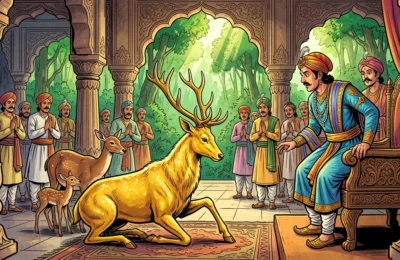
The Banyan Deer
The Banyan Deer: Source: Jataka Tales Ellen C. Babbit | Type: Jataka | Country: India | Language: English ONCE upon a time there was a deer named Banyan. A
 Jataka Tales
Ages 3-5
Jataka Tales
Ages 3-5
The Wise Hare: Generosity Writes Itself on the Moon
The Wise Hare: Generosity Writes Itself on the Moon - a folk tale retold for young readers with a clear moral, simple words, and the warmth of a bedtime...
 Jataka Tales
Ages 6-8
Jataka Tales
Ages 6-8
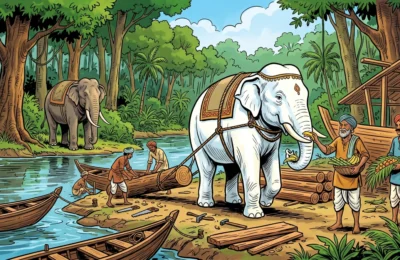
The King’s White Elephant
The King's White Elephant: Source: Jataka Tales Ellen C. Babbit | Type: Jataka | Country: India | Language: English ONCE upon a time a number of carpenters