The Quarrel of the Quails
The Quarrel of the Quails: Source: Jataka Tales Ellen C. Babbit | Type: Jataka | Country: India | Language: English ONCE upon a time many quails lived together
Origin and Attribution
The Quarrel of the Quails comes from the Sammodamana Jataka, the thirty-third tale in the Pali Jataka collection. Sammodamana means “living in harmony” or “taking delight together” — the positive virtue that the tale demonstrates through its absence, showing what becomes possible when a community acts in concert and what becomes inevitable when it does not. The Jataka is one of the most direct political parables in the collection: its subject is not the individual virtue of any single bird but the collective quality of a flock, and the lesson it teaches is not personal but communal.
The tale is framed by the Buddha addressing a dispute between two factions of monks that had escalated to the point of threatening the monastic community’s stability. By telling the story of the quails — a former life in which the same conflict pattern had already played out, with lethal consequences — the Buddha is identifying the quarrel as a recurrence of something old, something the tradition has already diagnosed, and offering the corrective that history recorded: unity or death, with no third option available when a skilled hunter is working the field.
Beat I — The King of the Quails
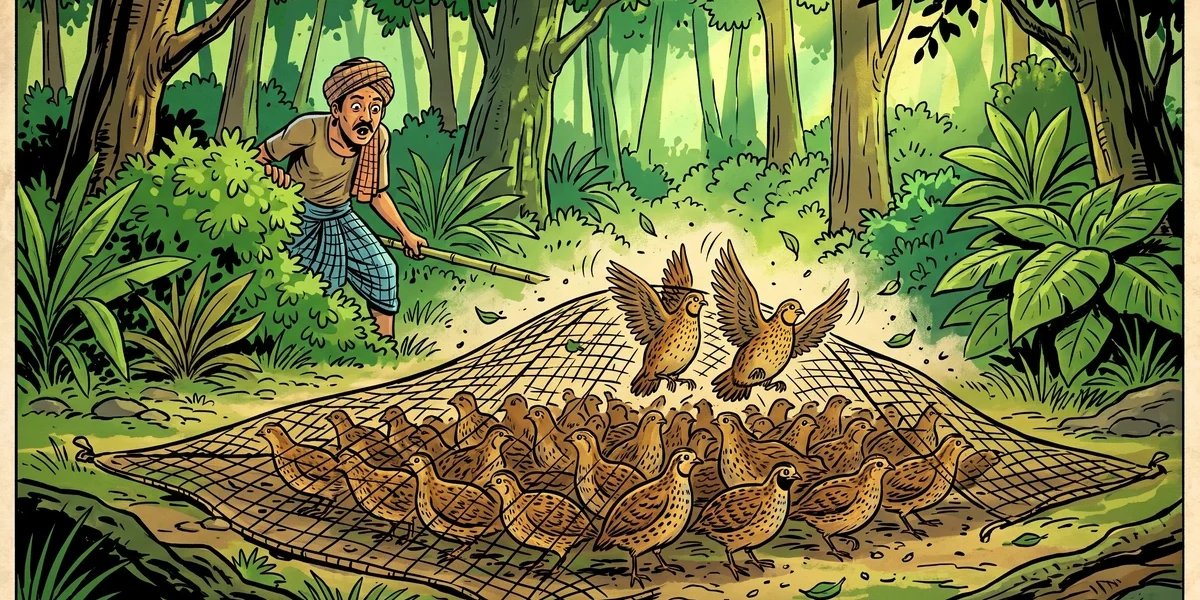
In a vast forest in a former life, a great flock of quails — many thousands of birds — lived under the leadership of a king quail who was the Bodhisatta. This quail-king was not merely admirable in character; he was a practical strategist who had observed the specific threat facing his flock and had devised a specific counter-measure to it. The threat was a skilled bird-catcher who had learned to imitate the call of quails perfectly, would lure a portion of the flock to land together, cast his net over them, bundle them up, and carry them to market.
The quail-king’s counter-measure was elegant and entirely dependent on cooperation. He instructed the flock: when you land and feel the net falling over you, do not panic and scatter. Instead, each bird puts its head through a mesh of the net, and together — at the same moment, on a shared signal — the entire group beats its wings and lifts. A net containing dozens of birds trying to scatter in different directions is unmanageable; a net carried upward by dozens of birds coordinating their lift is simply lifted. The flock can carry the net to a thornbush, drop it there, and escape through the thorns while the bird-catcher spends an hour disentangling his net from the brambles.
This plan was tested, and it worked. The bird-catcher cast his net several times over different portions of the flock; each time the birds coordinated their lift, carried the net to thorns, escaped, and left him with nothing but a tangled net and lost time. He could not understand how it was happening. He went home day after day empty-handed.
Beat II — The Quarrel That Undid Everything
The plan’s only vulnerability was its dependence on genuine cooperation — not the theoretical cooperation of birds who agreed in principle but the actual cooperation of birds who, in the moment of panic when a net was falling on them, suppressed their individual flight instinct and coordinated with their neighbours. For a time, the shared memory of the plan’s success was enough to maintain this discipline. Then a quarrel began.
The Jataka text does not identify the quarrel’s cause as anything profound. It began with a trivial collision: one quail accidentally stepped on another’s foot while landing. The stepped-on quail objected. The quail who had stepped said something dismissive. Words were exchanged. Other birds took sides. The flock divided — not into two equal parties with coherent positions, but into the fragmented condition of a community that has lost its habit of speaking courteously to one another and has replaced it with the habit of nursing injuries and counting offenses.
The bird-catcher noticed. He had been watching the flock for weeks, trying to understand why his net kept failing. Now he saw something different: the quails were arguing when they landed. Birds from one faction landed separately from birds of the other. When he cast his net over one group, there were not enough birds under it to lift it cooperatively — and crucially, the birds of the other faction did not come to help. They watched from a distance. The net held. The bird-catcher gathered his catch. He returned the next day and did it again. And again. Over weeks, he caught and sold most of the flock, handful by handful, while the surviving birds of each faction watched the other faction’s losses with something close to satisfaction.
Beat III — The Bodhisatta’s Analysis
The quail-king had seen this coming. When the quarrel first broke out, he had addressed both factions: “While you quarrel over who stepped on whose foot, the bird-catcher is studying us. He will not need to change his technique — you are changing it for him. Stop.” Neither faction listened. Each was convinced its grievance was legitimate and the other faction’s response was intolerable. The quail-king, unable to compel unity, departed to another forest rather than preside over the flock’s self-destruction.
The Pali commentary draws the analysis explicitly: the birds were not foolish in the abstract. They had understood the cooperation plan perfectly; they had executed it successfully for weeks. What undermined them was not ignorance of what cooperation required but the specific erosion of samagga — concord, the shared disposition to act together — by repeated small frictions that were individually manageable but cumulatively corrosive. The Jataka tradition identifies samagga as the quality most necessary for any group that faces a skilled adversary, and identifies the mechanism of its erosion as always the same: trivial grievances nursed until they feel major, minor distinctions of faction or precedence elevated until they feel like matters of principle.
The political parallel that the Jataka draws explicitly — between the quails and a monastic community at odds — applies equally to any community or organisation facing an external challenge while simultaneously managing internal conflict. The bird-catcher in the Jataka is any adversary skilled enough to recognise that a divided opponent requires no effort to defeat: one simply waits while the opponent defeats itself.
Beat IV — The Moral and Its Living Relevance
The Sammodamana Jataka’s governing verse is among the most quoted in the Pali canon: “Unity is strength; discord is weakness. The quails who lifted the net together were free; the quails who quarrelled over a footstep were eaten.” The formulation is blunt because the Jataka tradition intends it to be: there is no middle path between samagga and its absence when the external threat is real. The network that works is the one in which members suppress their individual irritations long enough to coordinate; the network that fails is the one in which members prioritise their individual irritations over the coordination that survival requires.
“A flock that quarrels over a footstep teaches the hunter everything he needs to know; a flock that acts together teaches him only that his net is lighter than a thousand wings.”
The contemporary applications of this teaching are broad and obvious. Military history is filled with examples of technically capable forces defeated by the internal conflicts that their adversaries cultivated — divide-and-conquer is the oldest military strategy precisely because it is the most reliable. Commercial history offers the same pattern: companies whose internal political fragmentation prevented the coordination that customers required. Community history offers it most reliably of all: every social movement that has been destroyed not by the power of its opponents but by the energy it expended fighting itself.
The Jataka’s specific contribution to this familiar observation is the mechanism it identifies: not spectacular betrayal or major schism but the trivial footstep, the careless word, the minor grievance nursed past its natural expiration date. The tradition is saying that the quarrel that destroys communities almost never starts as a quarrel that looks fatal. It starts as an argument about whose foot was whose, and it ends when the bird-catcher comes home full.
Why This Story Lasted
The Quarrel of the Quails is one of the Jataka tales most frequently referenced in Southeast Asian Buddhist political literature, appearing in Thai, Burmese, and Cambodian texts that used it as a warning to rulers and communities about the specific danger of internal division when external threats were present. Its staying power lies in the precision with which it identifies the mechanism of communal self-destruction: not the great betrayal but the accumulated small friction, the faction that forms around a trivial injury, the watching adversary who recognises what the quarrelling parties cannot see — that they have already lost. Stories that accurately name the specific failure mode rather than merely its general category survive as long as the failure mode recurs, which in this case is always.
You May Also Like
 Jataka Tales
Ages 3-5
Jataka Tales
Ages 3-5
The King’s Elephant
The King’s Elephant: Long ago, the mighty Himalayas were home to a large herd of eighty thousand elephants headed by a magnificent white elephant. He had a
 Jataka Tales
Ages 3-5
Jataka Tales
Ages 3-5
The Story of the Merchant of Seri
The Story of the Merchant of Seri: Source: Jataka Tales Ellen C. Babbit | Type: Jataka | Country: India | Language: English In the country of Seri there was
 Jataka Tales
Ages 3-5
Jataka Tales
Ages 3-5
The Happy Monk
The Happy Monk: Source: Jataka Tales Sacred Texts | Type: Jataka | Country: India | Language: English In the city of Rajagaha there was a king named Bimbisara.