The Banyan Deer (Nigrodhamiga Jataka)
The Banyan Deer (Nigrodhamiga Jataka): Source: Jataka Tales Sacred Texts | Type: Jataka | Country: India | Language: English In the kingdom of Varanasi there
Origin and Attribution
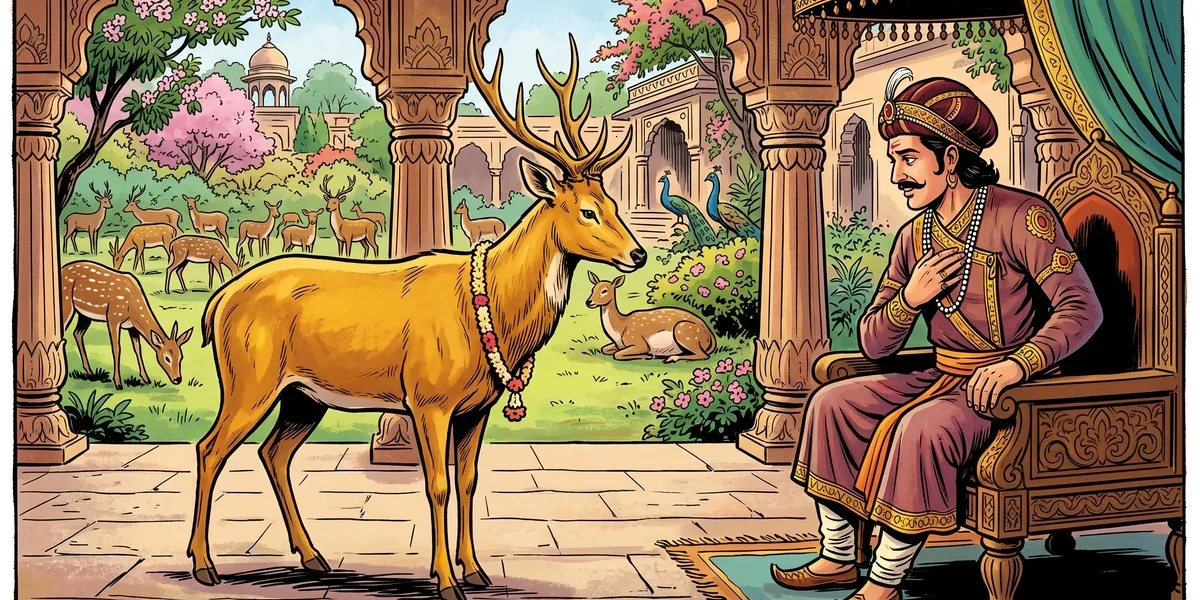
The tale of the Banyan Deer is drawn from the Nigrodhamiga Jataka, the twelfth story in the Pali Jataka collection and one of the most beloved and frequently cited of all the Jataka tales. Nigrodha refers to the banyan tree — the great spreading fig tree under which the Bodhisatta stag habitually rested, and which became the name by which he was known. The Nigrodhamiga Jataka is the second of the Jataka’s major stag-leadership stories (after the Lakkhana Jataka) and develops the leadership theme in a new direction: here the Bodhisatta does not simply sacrifice himself but enacts a compassion so precise and so unexpected that it changes the moral understanding of the most powerful figure in the kingdom.
The Jataka was preserved with particular care in the Theravada tradition and appears in Sinhalese, Burmese, and Thai artistic and literary traditions extensively. The tale’s image — a golden stag offering his own neck in place of a pregnant doe — became one of the most recognisable icons of Buddhist compassion in South and Southeast Asian art, appearing in temple murals and manuscript illuminations across more than a thousand years.
Beat I — The Two Herds and the Royal Garden
In the forests near Benares in a former life, the Bodhisatta was born as the Banyan Deer — a golden stag of extraordinary beauty, intelligence, and leadership. He guided a herd of five hundred deer through the forest with the same qualities the Jataka tradition consistently attributes to the ideal leader: courage, foresight, fairness, and genuine care for each member of the herd, not merely the strong and capable ones.
A rival stag, the Branch Deer, led another herd of equal size. When the king of Benares enclosed a great garden as a royal hunting ground, both herds were driven into it and trapped. The king agreed to an arrangement similar to that in the Lakkhana Jataka: each day a deer from each herd would present itself at the palace kitchen by lot, sparing the rest of the herd the terror of a hunt. The Banyan Deer and the Branch Deer each managed their herd’s participation in this arrangement.
The daily loss was bearable. What the arrangement could not address was the deeper wrong of the captivity itself — five hundred deer from each herd confined to a garden, their lives forfeit one by one to the king’s kitchen. The Bodhisatta understood this but did not yet know how to address it. He continued his care for the herd, ensuring the rotation was fair, that the weak and old were not sacrificed before the strong, that the does with fawns were given what protection the arrangement allowed.
Beat II — The Pregnant Doe
The crisis arrived when the lot fell to a pregnant doe in the Branch Deer’s herd. She went to the Branch Deer and explained her condition: she was close to giving birth, and if she died now, two lives would be lost rather than one. She asked him to pass the lot to another deer or to defer her turn until after the birth. The Branch Deer — the rival stag who in the Jataka tradition is the Bodhisatta’s foil — refused both requests. He would not give her an exemption, and he would not take her place himself. He sent her away to report to the palace on her appointed day.
The doe came instead to the Banyan Deer. She was not from his herd; she had no claim on his protection. But the Bodhisatta listened to her situation without calculation. He told her to return to her herd. Then he walked to the palace himself, lay down at the butcher’s block, and presented his neck. The palace servants recognised him immediately — this was the golden stag who had arranged the system — and sent for the king in astonishment.
The king arrived and asked what had brought the Banyan Deer to the block on a day that was not his herd’s turn. The Bodhisatta told him plainly: the lot had fallen to a doe with young; neither she nor her fawn deserved to die; her own leader had refused to take her place; he had come instead. He acknowledged that his own life was now forfeit under the terms of the arrangement, and he did not ask for mercy — only for the king’s understanding of why he was there.
Beat III — The King’s Recognition and the New Law
The king was undone by what he saw. He told the Banyan Deer: “I have never seen this quality even in a human being — you sacrifice yourself for a doe not your own, from a rival herd.” He released the Banyan Deer immediately and unconditionally. Then he released the pregnant doe. Then he released the Banyan Deer’s herd. Then he released the Branch Deer’s herd. Then he considered what he was actually doing in his garden and his kitchen, and he extended the protection outward: to all the deer in the royal forest, then to all the birds, then to all the fish in the river, then to all the animals within the boundaries of his kingdom.
The Jataka records this as a genuine conversion — not a political calculation but a moral awakening triggered by witnessing the Bodhisatta’s act. The king did not merely exempt the individual animals before him; he rethought the entire framework of his relationship to the living creatures in his domain. The Banyan Deer’s compassion, extended to a stranger at mortal cost, propagated outward until it had restructured the law of an entire kingdom.
The Branch Deer is quietly present in this resolution as a counterpoint. He is not punished; the Jataka does not concern itself with punishment. But the contrast is complete: the leader who refused to sacrifice himself for a member of his own herd, and the leader who sacrificed himself for a member of a rival herd. The difference in their actions measures the difference in their characters with precision that no argument could match.
Beat IV — The Moral and Its Living Relevance
The Nigrodhamiga Jataka’s governing moral is expressed in the Pali commentary’s observation that the Bodhisatta’s compassion was aparimana — unlimited, unbounded — not restricted by herd membership, species, or personal relationship. The Jataka tradition identifies this unbounded compassion as the quality that distinguishes the Bodhisatta’s character across his five hundred and forty-seven lives: he does not calculate who falls within his circle of obligation and who falls outside it. Suffering, wherever he encounters it and whatever its source, draws his response.
“The compassion that calculates its own safety is not compassion but commerce; true karuna extends to the stranger and the rival without counting the cost.”
The tale also encodes a political theory of moral transformation. The king of Benares is not an evil king; he is an ordinary king who has not examined his practices carefully. The Bodhisatta’s act does not confront him with an argument; it confronts him with an example so clear that his own moral sense is activated. This is the Jataka tradition’s political theory: the change in a ruler that matters most is not produced by law or argument or force but by the witness of an act so precisely right that the observer cannot avoid seeing what rightness looks like.
The contemporary resonance of this teaching is broad. In the Buddhist traditions of Southeast Asia, the Nigrodhamiga Jataka was used explicitly in advocacy against the hunting of deer and the killing of animals more generally, the Bodhisatta stag serving as a compelling figure for the extension of moral consideration beyond the human circle. In the modern context, the tale’s logic applies equally to any situation in which an act of unexpected compassion for those outside one’s immediate group — crossing lines of nation, class, religion, or species — transforms the moral perception of those who witness it.
Why This Story Lasted
The Banyan Deer story is among the most widely reproduced of all Jataka tales in the visual arts of Buddhist Asia — appearing in Sanchi stupa reliefs (c. 1st century BCE), Ajanta cave paintings (c. 5th century CE), and countless temple murals across Sri Lanka, Burma, Thailand, Cambodia, and Laos. Its survival in so many media across so many centuries reflects the power of its central image: a golden deer, not required to do so, offering his neck. This image is not reducible to a doctrine or a proposition; it is an experience of seeing that changes the observer, just as the king of Benares was changed. Stories whose central image operates at this level of immediacy persist as long as there are human beings capable of being moved by the sight of an act that exceeds what duty requires.
You May Also Like
 Jataka Tales
All Ages
Jataka Tales
All Ages
The Wise and Foolish Merchants
The Wise and Foolish Merchants: Source: Jataka Tales Sacred Texts | Type: Jataka | Country: India | Language: English Once on a time in the city of Benares in
 Jataka Tales
Ages 3-5
Jataka Tales
Ages 3-5
The Deer King Nigrodha: Sacrifice Changes the Heart of a Hunter
The Deer King Nigrodha: Sacrifice Changes the Heart of a Hunter: The Deer King Nigrodha A Jataka Tale of Compassion and Redemption In the shadow of the great
 Jataka Tales
Ages 6-8
Jataka Tales
Ages 6-8
The Quarrel of the Quails
The Quarrel of the Quails: Source: Jataka Tales Ellen C. Babbit | Type: Jataka | Country: India | Language: English ONCE upon a time many quails lived together