The Faggot-Bearer
The Faggot-Bearer: Source: Jataka Tales Sacred Texts | Type: Jataka | Country: India | Language: English Once on a time in Benares Brahmadatta the king, having
Origin and Attribution
The Katthahari Jataka is the seventh story in the Pali Jataka collection. Katthahari means faggot-bearer or wood-gatherer — one who collects and carries firewood, among the most arduous and socially humble forms of physical labour in ancient India. The tale recounts a former life of the Bodhisatta as a man of noble birth reduced by poverty to the work of a faggot-bearer, and traces his encounter with a great king whose recognition of quiet dignity changes both their lives.
The Jataka is framed by the “story of the present” in which the Buddha identifies the faggot-bearer’s patient endurance as an earlier form of his own character, and the king as a former life of one of his principal disciples. The tale’s placement near the beginning of the collection signals the tradition’s valuation of khanti — patience or forbearance — as a foundational virtue that precedes and enables all others. Without the capacity to endure difficulty without being deformed by it, the Jataka tradition argues, no other virtue can be stably maintained under pressure.
Beat I — The Fallen Noble
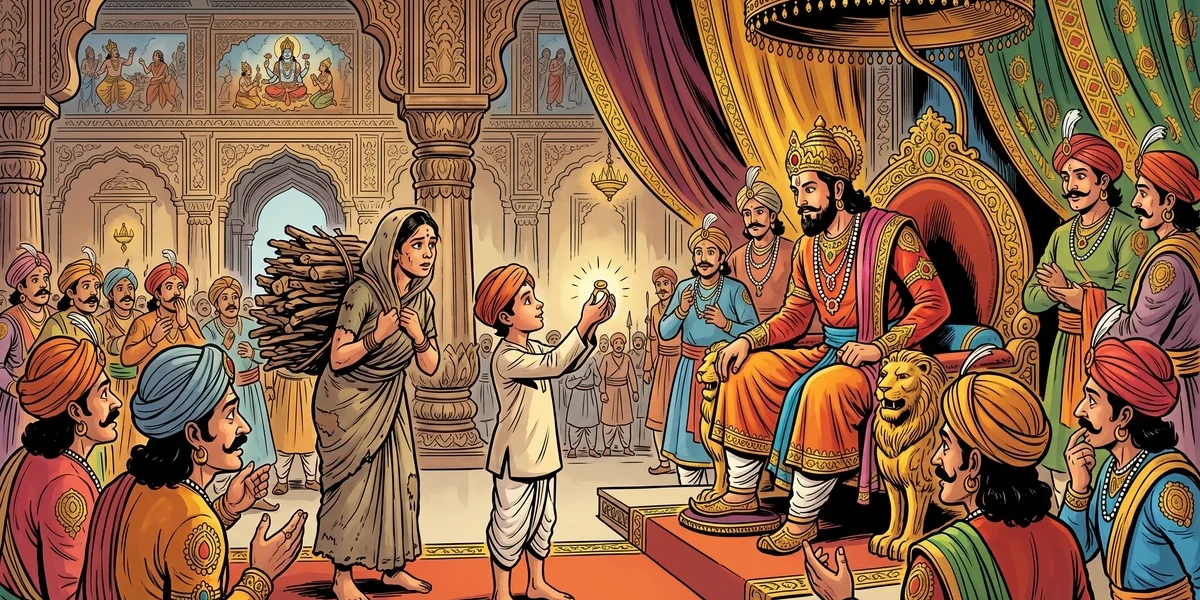
In a former age in the city of Benares, a man of good family had fallen into poverty through misfortune — the death of a patron, the failure of a trade, the dissolution of an inheritance — and was now reduced to gathering firewood in the forest and selling it in the city market. He performed this work without self-pity and without the resentment that social displacement often breeds. He rose before dawn, walked far into the forest, cut and bound his faggots with care, balanced the load across his shoulders, and carried it to market with the discipline and attention of a man who respects his work regardless of what that work is.
His bearing was the thing that set him apart. Poverty had not made him servile or resentful. He moved through the city market with a quiet authority that other wood-gatherers did not possess — not pride in the defensive sense but a settled self-possession that comes from having oriented one’s identity toward something more durable than social position. The Pali text uses the word thita — steadfast, established, immovable — to describe his carriage and manner.
The king of Benares was riding through the market that morning on a royal inspection. Kings in the Jataka tradition frequently appear in markets precisely because direct observation of trade and labour is presented as the mark of a good ruler — one who understands his kingdom from the ground rather than only from the palace. The king noticed the faggot-bearer immediately: among a crowd of vendors and labourers, this man’s bearing was anomalous. The king sent a servant to inquire who he was.
Beat II — The Recognition and Its Consequences
The faggot-bearer told the king’s servant his story plainly, without embellishment in either direction — neither minimising his current poverty nor inflating his former status. The king was struck by what the servant reported: a man of documented good family, performing the hardest labour, who had neither collapsed into despair nor cultivated false dignity by disdaining the work he now did.
The king summoned the faggot-bearer directly. Their conversation was brief but consequential: the king recognised in this man the qualities — steady mind, honest speech, non-attachment to status — that he had been unable to find in his own court ministers, who were capable and shrewd but whose loyalty was contingent on reward. He offered the faggot-bearer a position in the royal household. The faggot-bearer accepted, not with relief or eagerness but with the same steady composure he had brought to his morning’s wood-gathering.
What follows in the Jataka is a record of the faggot-bearer’s rise within the royal household, not through political manoeuvring but through the consistent application of the same quality that had distinguished him in the market: steadiness under pressure, honest assessment of situations, and the freedom from personal ambition that paradoxically made him more effective than those who pursued advancement directly. The Jataka’s point is structural: the man whose identity is not hostage to his position can advise a king honestly, because he has nothing to protect by flattering him.
Beat III — The Analysis of Khanti
The Katthahari Jataka’s Pali commentary makes the virtue of khanti — patience or forbearance — its explicit analytical subject. The tradition identifies three dimensions of khanti that the faggot-bearer demonstrates. The first is titiksha — bare endurance, the simple capacity to bear physical difficulty without being broken by it. The second is kshama — patience with others, the freedom from reactive anger when people treat one according to one’s surface circumstances rather than one’s actual quality. The third and highest is what the tradition calls adhivasa — the capacity to hold a steady state of mind in circumstances that would destabilise a person whose equanimity was shallower.
The Jataka tradition sees these three not as passive but as actively generative. The person who has developed genuine khanti is not defeated by adverse circumstances — they are refined by them. The faggot-bearer’s market morning is not a low point in his story but, on the Buddhist analysis, a high point: the moment at which the quality he had been cultivating across many lifetimes was operating at full expression, untested by comfort or recognition.
The political implication is drawn explicitly in the commentary: a ruler who seeks advisers of genuine quality must look past the markers of status and position to the quality of a person’s bearing under difficulty. The Arthashastra makes a parallel point through the device of upadha (temptation testing); the Katthahari Jataka makes it narratively, showing what genuine quality looks like when it has been stripped of all its social decoration. The faggot-bearer is the Arthashastra’s ideal minister in disguise, recognisable only to a king perceptive enough to look through the wood-bundle to the man carrying it.
Beat IV — The Moral and Its Living Relevance
The governing moral of the Katthahari Jataka is expressed in the Pali commentary’s formulation: “The man who performs the smallest task with the full attention he would give the greatest shows the quality of his mind, not the quality of his circumstances.” This is a claim about what human dignity actually consists of — not in the work one happens to be doing but in the manner in which one brings oneself to the work, regardless of what it is.
“Misfortune is the truest test: the fire that burns straw reveals gold. The faggot-bearer’s patience was his crown, worn long before the king placed any other on his head.”
This moral had direct relevance in a society organised around caste and hereditary status. The Jataka tradition is frequently in implicit conversation with the Brahmanical social order, offering a counter-principle: genuine quality is not inherited but cultivated, and it is visible not in one’s birth certificate but in one’s bearing under adverse circumstances. The faggot-bearer is of noble birth, so the tale is not simply inverting the hierarchy — it is making a deeper point that noble birth and noble character are separable, and that it is the latter that actually matters.
The contemporary relevance is in the principle of attention to one’s current work regardless of its prestige. The psychological research on what produces wellbeing and competence over time consistently shows that the capacity to be fully present in whatever one is doing — rather than performing the work while mentally resenting it or fantasising about something more prestigious — is one of the strongest predictors of both satisfaction and excellence. The faggot-bearer’s practice is a two-and-a-half-thousand-year-old instantiation of this finding.
Why This Story Lasted
The Katthahari Jataka survived because it addresses the universal experience of undeserved adversity with neither false comfort nor passive resignation. It does not say that the faggot-bearer’s poverty was just, or that all hard work is rewarded, or that the king’s recognition was guaranteed. It says something more useful: that the quality of one’s inner bearing is something one controls when circumstances are not, and that this control is both intrinsically valuable and — contingently, not necessarily — what makes recognition possible when the opportunity for recognition finally arrives. Stories that accurately describe how to live well in adverse circumstances, without promising outcomes that cannot be guaranteed, are the ones that persist across the generations that need them.
You May Also Like
 Jataka Tales
Ages 3-5
Jataka Tales
Ages 3-5
The Brave Little Quail: Small Courage Defeats Great Pride
The Brave Little Quail: Small Courage Defeats Great Pride: The Brave Little Quail A Jataka Tale of Wisdom and Unlikely Alliance In the days when animals could
 Jataka Tales
Ages 3-5
Jataka Tales
Ages 3-5
The Wise Hare: Generosity Writes Itself on the Moon
The Wise Hare: Generosity Writes Itself on the Moon - a folk tale retold for young readers with a clear moral, simple words, and the warmth of a bedtime...
 Jataka Tales
Ages 9-12
Jataka Tales
Ages 9-12
The Mouse Merchant
The Mouse Merchant: Source: Jataka Tales Sacred Texts | Type: Jataka | Country: India | Language: English Once on a time when Brahmadatta was reigning in