How the Turtle Saved His Own Life
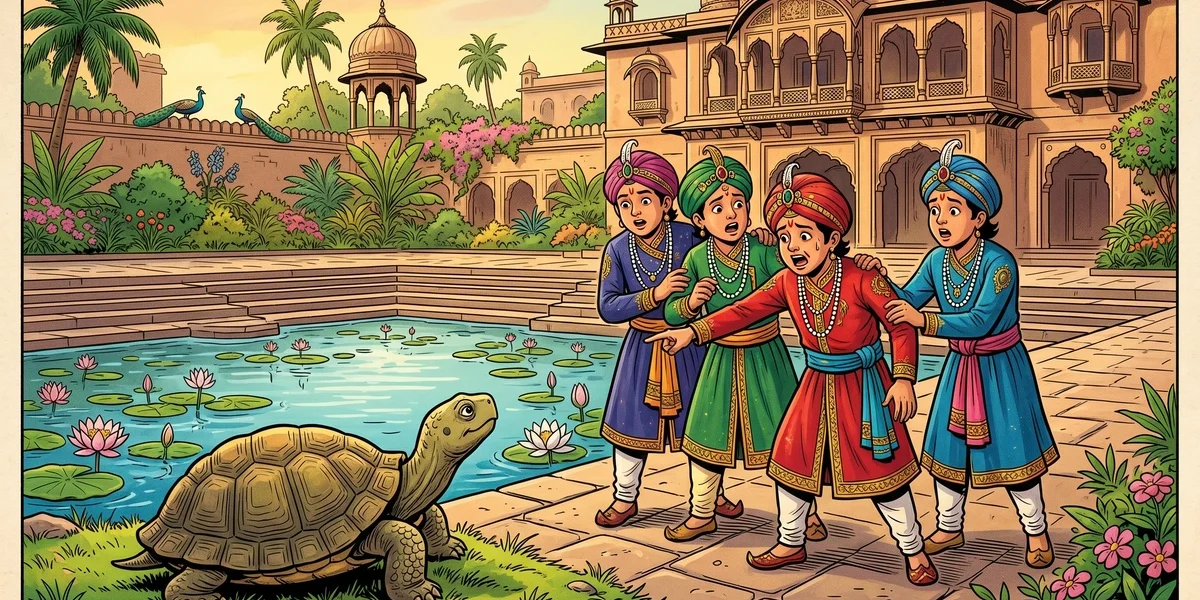
How the Turtle Saved His Own Life: Source: Jataka Tales Ellen C. Babbit | Type: Jataka | Country: India | Language: English A KING once had a lake made in the
Origin and Attribution
The story of How the Turtle Saved His Own Life is drawn from the Kacchapa Jataka in the Pali Jataka collection. Kacchapa is the Sanskrit and Pali word for tortoise or turtle, and the tale belongs to the rich group of Jataka stories in which aquatic animals serve as vehicles for teachings about the control of speech. The tale shares its basic structure with versions found in the Panchatantra (where it is the story of the Tortoise and the Two Geese) and in the Hitopadesha, making it one of the most widely distributed story-shapes in Indian narrative literature — but each telling serves a distinct doctrinal emphasis. The Jataka version focuses specifically on the deliberate exercise of silence as a survival skill learned through experience rather than merely recommended as advice.
The tale is framed by the Buddha applying the story to a monk in the current assembly who has been speaking carelessly — making jokes and idle remarks that were causing minor but real harm to the community. The identification of the Bodhisatta with the turtle who learns to keep silent, and the identification of the careless monk with the turtle’s near-fatal loquacity, gives the teaching a double edge: it is simultaneously a warning about the social consequences of unguarded speech and a tribute to the capacity for genuine self-correction.
Beat I — The Turtle and the Geese
In a former life in a great lake near Benares, the Bodhisatta was born as a turtle — intelligent, sociable, and possessed of a conversational impulse that his friends the geese had come to regard with fond exasperation. The two geese and the turtle had been companions for many seasons, living peacefully at the lake’s edge and spending their days in philosophical conversation about the nature of water, air, the habits of fishermen, and the prospects of the weather. The turtle was a gifted conversationalist — quick with an observation, fond of the telling phrase, unable to resist the opportunity for a well-timed remark even when restraint would have served him better.
A drought came to the region. The lake shrank. The geese, able to fly to distant water, faced a decision: stay and share the turtle’s shrinking world or move to a better lake and abandon their friend. The friendship was real and they did not want to abandon him. After consideration, they proposed a plan: they would carry the turtle to the new lake by having him bite on a stick held at each end by one of the geese. He would ride between them through the air. The plan would work perfectly, with one condition: the turtle must not open his mouth. Speaking would be fatal.
The turtle agreed. He understood the physics of the situation clearly enough. He bit down on the stick with genuine determination, and the geese lifted him into the air. The countryside passed below. The journey was going well. Then they flew over a village where children playing in the street looked up and saw the remarkable sight of a turtle flying between two geese.
Beat II — The Almost-Fatal Remark
The children shouted up in astonishment: “Look! A turtle flying through the air! How extraordinary!” Several laughed. One called out mockingly: “Carried by birds like a piece of luggage!” This was too much. The turtle had a response. It was a perfectly good response — witty, pointed, the kind of remark that would have silenced the child and impressed everyone who heard it. He opened his mouth to deliver it, and fell.
The Jataka is careful here: the turtle did not die. The children caught him — or he fell on soft ground, depending on the version — and the shock of the fall, and the sight of the geese circling in distress above, was enough to restore his senses. The geese landed, asked if he was hurt, and then asked the question the Jataka wants asked: why did you open your mouth? The turtle, shaken and genuinely ashamed, had no answer that satisfied him. He had known the rule. He had agreed to it. He had understood why it was necessary. And at the first provocation he had abandoned it for a remark that no one needed him to make.
The geese, with the patient forbearance of true friends, did not abandon the project. They resumed the journey, the turtle bit down again on the stick — this time with the hard-won knowledge of what silence actually cost to maintain — and they reached the new lake safely. The turtle spent the rest of his life near that lake, speaking less and listening more, and the Jataka notes that he was respected for the change.
Beat III — The Doctrine of Vaci-Samvara
The Kacchapa Jataka’s Pali commentary uses the turtle’s experience to elaborate the concept of vaci-samvara — restraint of speech — which the Buddhist tradition identifies as one of the core disciplines of the monastic life and, by extension, of any life lived in community with others. Vaci means speech; samvara means restraint, containment, or guarding. The metaphor the tradition favours is of a gate: speech that flows without a gate causes unpredictable damage; speech that is gated — measured, chosen, timed — causes only the damage one intends and often produces good instead.
The turtle’s specific failure is instructive. He was not speaking out of malice or self-interest; he was speaking out of the habitual impulse to respond, to be present in the conversation, to not let a provocation pass unanswered. The Jataka tradition identifies this habitual responsiveness as the condition the discipline of vaci-samvara is specifically designed to address. The impulse to speak is not in itself wrong; but the cultivation of a pause between impulse and speech — a moment in which the appropriateness, necessity, and consequence of the speech can be assessed — is the practice the tradition prescribes.
The parallel teaching in the Dhammapada (verse 65) states: “The wise one who guards his mouth as the gates of a city are guarded is not easily defeated.” The turtle’s near-death is the narrative equivalent of this verse: the unguarded mouth, in a moment of genuine danger, cost him almost everything. The guarded mouth, maintained through the rest of the journey despite renewed temptation, saved him.
Beat IV — The Moral and Its Living Relevance
The governing moral of the Kacchapa Jataka is stated in the Bodhisatta’s reflection after the fall: “My own tongue was my greatest enemy; I had a hundred enemies outside me and managed them all, but one unguarded moment with my own tongue nearly finished what they could not.” This is the story’s deepest insight — not merely that silence is sometimes prudent, but that the impulse to speak is a form of internal danger as real as any external threat, and that the discipline of managing it requires the same vigilance one would give to managing an enemy.
“The turtle who learned to be silent saved his life; the turtle who had not yet learned lost it a moment before recovering it. Only one thing is harder than holding one’s tongue: learning to hold it after failing to.”
The contemporary resonance of this teaching is immediate in an era when the technological infrastructure for instant public speech has removed almost all the natural friction that once existed between thought and utterance. The turtle’s problem — the inability to let a provocation pass unanswered even when the stakes of answering were mortally clear — is now structurally embedded in digital communication, where the response mechanism is faster than thought and the consequences of speech are both wider and more permanent than they were in a village conversation. The Kacchapa Jataka’s discipline of vaci-samvara is not less relevant for being twenty-five centuries old; the case for it is, if anything, stronger now than when the tale was first told.
In practical terms, the story encodes a three-part practice: know the stakes of speaking before you speak; identify your specific vulnerability (the type of provocation you cannot resist answering); and cultivate the pause between impulse and speech long enough for genuine assessment to occur. The turtle knew the stakes but had not adequately identified his vulnerability — public mockery — and had cultivated no pause. The second half of the journey was successful because all three elements were now present.
Why This Story Lasted
The Kacchapa Jataka is found, in recognisably similar form, in the Panchatantra, the Hitopadesha, Aesop’s fables, Arabic story collections, and European medieval literature, making it one of the most widely travelled story-shapes in world narrative history. Its remarkable cross-cultural persistence reflects the universality of the problem it addresses: the impulse to speak at the wrong moment is not culturally specific, and neither is the damage that follows from it. The Buddhist version distinguishes itself from other tellings by making the turtle survive and learn — by showing that the capacity for genuine self-correction is possible and worth the effort — rather than ending with punishment. This note of correctable fallibility is the Jataka tradition’s characteristic contribution to a story that other traditions often use merely as a cautionary warning.
You May Also Like
 Jataka Tales
Ages 3-5
Jataka Tales
Ages 3-5
The Deer King Nigrodha: Sacrifice Changes the Heart of a Hunter
The Deer King Nigrodha: Sacrifice Changes the Heart of a Hunter: The Deer King Nigrodha A Jataka Tale of Compassion and Redemption In the shadow of the great
 Jataka Tales
Ages 3-5
Jataka Tales
Ages 3-5
The Gray Hair
A Jataka tale about the ancient king Makhadeva, who retires to the forest on seeing his first gray hair. A story about mindfulness and timely detachment.
 Jataka Tales
Ages 6-8
Jataka Tales
Ages 6-8
The Banyan Deer (Nigrodhamiga Jataka)
The Banyan Deer (Nigrodhamiga Jataka): Source: Jataka Tales Sacred Texts | Type: Jataka | Country: India | Language: English In the kingdom of Varanasi there