The Brave Little Quail: Small Courage Defeats Great Pride
The Brave Little Quail: Small Courage Defeats Great Pride: The Brave Little Quail A Jataka Tale of Wisdom and Unlikely Alliance In the days when animals could
Origin and Attribution
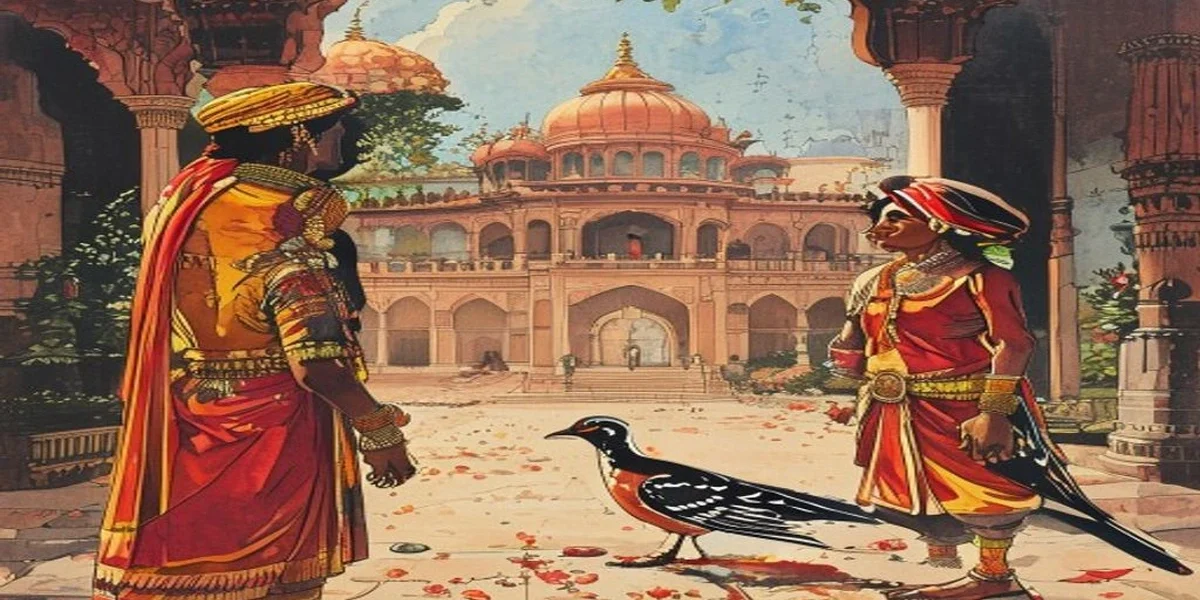
The story of the Brave Little Quail comes from the Vattaka Jataka, the thirty-fifth tale in the Pali Jataka collection. Vattaka is the Pali word for quail — a small ground-nesting bird, among the most physically vulnerable of forest creatures, whose use as the Bodhisatta’s birth form in this story is entirely deliberate. The tradition is presenting the case for a power that has nothing to do with physical capacity: the power of sacca-kiriya — the act of truth, the utterance of a true and morally weighted statement that, in the Buddhist and broader Indian philosophical framework, has causal efficacy in the world by virtue of the accumulated virtue from which it proceeds.
The Vattaka Jataka is one of the clearest illustrations in the Jataka corpus of the ancient Indian doctrine that truth (sacca) is not merely a quality of speech but a force — that a statement made with perfect sincerity by a being of genuine virtue has the capacity to affect physical reality in ways that exceed ordinary causation. This doctrine appears in the Pali canonical texts, in the epic tradition (Sita’s test by fire, Savitri’s rescue of Satyavan), and in the Vedic ritual literature that preceded both. The quail’s encounter with the forest fire is the Jataka’s demonstration of this doctrine in a form vivid enough to transmit it across the generations.
Beat I — The Quail Chick in the Nest
In a former life in a great forest, the Bodhisatta was born as a quail chick — newly hatched, unable yet to fly, unable to run with any speed, with wings not yet strong enough to carry him and legs not yet coordinated enough to flee effectively. His parents had built the nest carefully in a clearing, but the chick was, in the most literal sense possible, helpless: dependent entirely on his parents’ return for food and protection, unable to save himself from any threat that arrived at the nest.
A forest fire broke out. It moved through the dry undergrowth with the speed that such fires move — unpredictable in direction, consuming everything it reached, driven by wind that could shift at any moment. The quail chick saw it coming. His parents were away gathering food and could not be called back in time. He could not fly. He could not run. He had no physical means of escape and no physical means of defence.
What he had was his accumulated virtue — not as an abstraction but as a specific claim he could make on the moral order of the world. The Pali text describes the chick settling in the nest, composing his mind, and preparing to speak a sacca-kiriya: an utterance of truth backed by the full weight of everything he actually was.
Beat II — The Act of Truth
The quail chick’s sacca-kiriya in the Vattaka Jataka is one of the most frequently quoted passages in the Pali canonical literature. The chick speaks to the fire directly — not as a plea, not as a prayer, but as a statement of fact backed by moral weight: “I have no strength to fly. My wings are not yet wings. My feet are not yet feet. My parents are away. I cannot escape. But I know this: since the world of the Bodhisatta began, since the fire-god was born, no fire has ever harmed a Bodhisatta. By the truth of this, by the virtue that has accumulated across my lives, let the fire turn back.”
The fire turned back. The Pali text records this without mechanical explanation, as a direct consequence of the sacca-kiriya: the fire advanced to within a certain distance of the nest, stopped, and moved in another direction. The clearing where the quail chick lay was untouched. The rest of the forest burned around it. The circle of land that remained green in the middle of the ash was, the tradition records, visible for generations — a permanent marker at the spot where the weakest creature in the forest had stopped one of nature’s most powerful forces with the only weapon available to him: the truth of what he was.
The Pali commentary notes that this was not magic or divine intervention — it was the operation of a moral law that the tradition considered as reliable as physical law: the accumulated merit of many lives of genuine virtue, when invoked with complete sincerity and complete accuracy, constitutes a claim on the moral structure of the world that the world honours. The fire was not defying its own nature; it was, in the Jataka’s cosmological framework, responding to a force as real as heat and wind.
Beat III — The Doctrine of Sacca-Kiriya
The sacca-kiriya — act of truth — is one of the most distinctive features of the Buddhist and broader Indian narrative tradition, appearing in contexts ranging from the Jataka corpus through the Mahabharata, Ramayana, and the folk literature of virtually every Indian language. Its underlying logic is the claim that moral reality and physical reality are not separate domains: that genuine virtue, genuinely invoked, has effects in the physical world because virtue is not merely a psychological state but an actual force in the structure of things.
The Pali canonical tradition articulates this through the doctrine of puñña — merit, the accumulated positive karmic force generated by virtuous action across many lives. The Bodhisatta’s puñña is, by the thirty-fifth Jataka in the collection, already vast; but the crucial element of the sacca-kiriya is not merely the quantity of accumulated puñña but the accuracy of the statement. The quail chick does not claim more than he is; he claims exactly what he is, in the most precise terms available. This accuracy — the complete absence of exaggeration or embellishment — is what gives the sacca-kiriya its force. A statement that is true and precisely true is different in kind from a statement that is true but inflated.
The broader Indian tradition’s use of sacca-kiriya in epic contexts — Sita walking through fire, Savitri reversing death — follows the same logic. The power of the utterance is not in its boldness or its eloquence but in its accuracy. The being who makes the sacca-kiriya must be exactly what they claim to be, no more and no less, and must know this with complete certainty. The quail chick knows what he is: a being of accumulated virtue, in a helpless body, making an accurate claim on the moral order. This is enough.
Beat IV — The Moral and Its Living Relevance
The Vattaka Jataka’s central teaching is about the relationship between honesty, accumulation, and power. The quail chick has no physical power; he has honesty — the capacity to make a precise and accurate claim about his actual moral condition — and he has the accumulated virtue that makes the claim true. Together these produce an effect that physical power in any quantity could not produce: the stopping of a fire.
“I cannot fly. I cannot run. I am what I am, and what I am is this: a being in whom the truth has never been violated. By that truth — exactly that, nothing more — let the fire be still.”
The contemporary resonance of sacca-kiriya is in the specific kind of moral authority it requires: not authority derived from position, power, wealth, or eloquence, but authority derived from the actual quality of one’s accumulated conduct. The quail cannot impress the fire with his size; he cannot threaten it; he cannot beg it. The only claim available is the accurate one: this is what I am. This form of moral authority — the authority of genuine integrity, invoked precisely and without exaggeration — is available to the physically weakest being in any situation, and the Jataka tradition’s claim is that it is, in the final analysis, the most powerful form of authority there is.
The story also encodes a teaching about the conditions under which this authority operates. It is not available to the dishonest or the inflated self-presenter. It is not available as a technique or a performance. It is available only to the being who has genuinely accumulated what it claims to have accumulated, and who claims exactly that and nothing more. This is why it is the quail chick — tiny, helpless, honest — who stops the fire, and not any of the forest’s larger, stronger, more impressive creatures.
Why This Story Lasted
The Vattaka Jataka survived because it makes a claim about power that is both radical and precise: the weakest creature, by virtue of accumulated integrity honestly invoked, can arrest forces that physical strength cannot touch. This claim is radical because it inverts the ordinary assumption about the relationship between power and physical capacity. It is precise because it specifies exactly what is required: not virtue in general but accurately claimed virtue, no more and no less than what is actually true. Stories that make specific rather than general claims about how moral reality works — stories that can in principle be tested against experience — survive longer than stories that merely assert the superiority of goodness. The quail chick’s sacca-kiriya is a specific claim, and the specificity is what has kept it alive.
You May Also Like
 Jataka Tales
Ages 6-8
Jataka Tales
Ages 6-8
The Banyan Deer (Nigrodhamiga Jataka)
The Banyan Deer (Nigrodhamiga Jataka): Source: Jataka Tales Sacred Texts | Type: Jataka | Country: India | Language: English In the kingdom of Varanasi there
 Jataka Tales
Ages 6-8
Jataka Tales
Ages 6-8
The Banyan Deer
The Banyan Deer: Source: Jataka Tales Ellen C. Babbit | Type: Jataka | Country: India | Language: English ONCE upon a time there was a deer named Banyan. A
 Jataka Tales
All Ages
Jataka Tales
All Ages
The Wise and Foolish Merchants
The Wise and Foolish Merchants: Source: Jataka Tales Sacred Texts | Type: Jataka | Country: India | Language: English Once on a time in the city of Benares in