The Hawks And Their Friends
Hawks and animal friends learn that loving-kindness, not kinship, binds hearts together across difference.
Origin and Attribution
The story of the Hawks and Their Friends comes from the Kulava Jataka, the thirty-first tale in the Pali Jataka collection. Kulava means nest or nesting place — the hawk family’s home is the centre of the tale, and the wisdom encoded in it is about how to make a home genuinely safe in a world where power is unevenly distributed and danger is always possible. The Jataka is one of the collection’s clearest teachings on the political value of alliance — the systematic cultivation of relationships with beings who have the power to deter threats before they materialise.
The tale is framed by a comparison in the “story of the present”: a family of monks is being threatened by a hostile faction, and the Buddha responds by telling this story of hawks who survived because their parent had cultivated friendships with a lion, an elephant, and a tree spirit before any threat had arisen. The teaching is explicitly anticipatory: the time to build the relationships that will protect you is before you need them, not when you are already in danger.
Beat I — The Hawk Family and Their Protector Friends
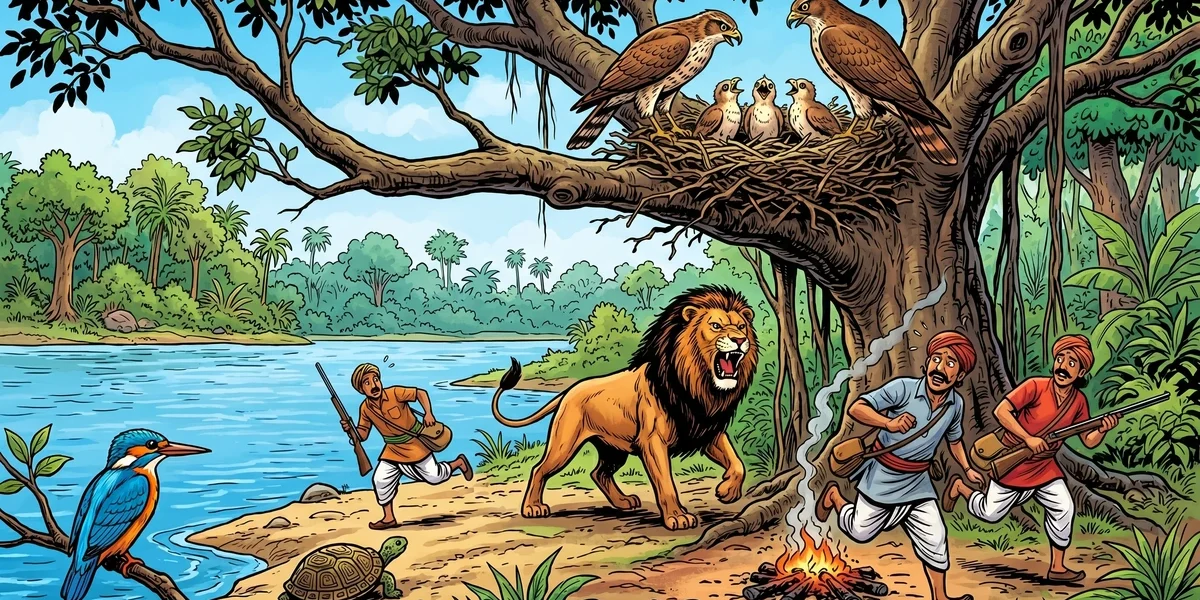
In a great forest near Benares in a former life, a pair of hawks made their nest in a large tree at the forest’s edge. The parent hawk — the Bodhisatta — was an unusually far-sighted bird who understood that a nest in a tree was vulnerable to many threats: humans who might fell the tree, animals who might climb it, and the specific predators that targeted nesting birds during the season when the fledglings were helpless.
Rather than relying on speed, concealment, or the pair’s own fighting ability, the parent hawk made a systematic decision: he would cultivate genuine friendships with three beings of very different kinds of power, each capable of deterring a threat that the hawks alone could not. He befriended a lion who lived in that part of the forest. He befriended an elephant of great size and authority. And he befriended the spirit of the great tree in which the nest was built — the rukkha-devata, the tree spirit, who had influence over the tree itself and the immediate vicinity around it.
The Pali text emphasises that these were genuine friendships cultivated over time, with mutual benefit and mutual respect — not instrumental alliances entered into only when the hawk needed something. The lion was visited regularly; the hawk brought news of the forest’s far reaches that the lion, forest-bound, could not easily obtain. The elephant was greeted and honoured. The tree spirit was acknowledged and respected. The relationships were maintained in their own right, not merely held in reserve for emergency use.
Beat II — Three Threats, Three Protectors
The season of nesting came. The fledgling hawks were in the nest, helpless and vulnerable. Three separate threats arrived in the same period, from three different directions, each of a kind the parent hawks could not have countered alone.
First, a party of hunters came to the forest seeking timber and firewood. They identified the hawk’s tree as large and valuable and marked it for felling. The tree spirit, alerted to the danger from within its own wood, caused the tree to appear diseased and unsuitable — bark patterns that suggested rot, a hollowness in the sound when struck — and the hunters moved on to other timber. The hawks never knew a threat had been averted.
Second, a large snake — drawn by the sound of the fledglings — began to climb the tree toward the nest. The tree spirit could not stop it; the hawk pair could not fight it; this was a threat beyond the reach of their powers. The parent hawk flew to the elephant and described the situation. The elephant came, took the snake in its trunk, carried it away from the tree, and deposited it in a distant part of the forest. The fledglings were safe.
Third, a group of boys from a nearby village came to the tree with the specific intention of taking the fledgling hawks as pets or food. Boys who know where a nest is are a persistent danger; they would return each day until the nest was cleared or abandoned. The parent hawk went to the lion. The lion approached the tree, stood in plain sight of the boys, and roared once. The boys scattered and did not return. The fledglings lived.
Beat III — The Analysis of Protective Alliance
The Kulava Jataka’s Pali commentary draws the structural lesson explicitly: the parent hawk survived three threats that it could not have survived alone because it had cultivated three relationships with three kinds of power before any threat existed. The lesson is not merely “make friends with powerful animals” — it is a specific teaching about the anticipatory quality of wisdom in the domain of security and alliance.
The Arthashastra parallel is direct. Kautilya devotes extensive analysis to the concept of mitra (ally) in the framework of mandala politics — the geometric theory of inter-kingdom relations in which every ruler is surrounded by natural enemies (the adjacent kingdoms), natural friends (the kingdoms beyond the enemies), and potential allies whose alignment can be cultivated through strategic gift, marriage, and shared interest. The hawk’s three friendships are a domestic-scale version of this system: identify the threats you cannot counter alone, cultivate relationships with those who can counter them, and maintain those relationships in good times so they exist in bad ones.
The Buddhist tradition’s commentary adds a dimension that the Arthashastra does not emphasise: the friendships must be genuine to be reliable. A lion visited only when the hawk needs something is an acquaintance, not an ally. The lion who helped the hawk family was a lion who had been genuinely visited, genuinely communicated with, genuinely regarded as a being of value in its own right. This quality of the relationship — its reciprocity and its reality — is what made it available when the crisis arrived.
Beat IV — The Moral and Its Living Relevance
The Hawks and Their Friends encodes a teaching about social intelligence that the Jataka tradition considered important enough to place in the first hundred tales of its collection. The moral is explicit and practical: identify the threats you cannot counter alone; identify who has the power to counter each kind of threat; cultivate genuine relationships with those beings before any threat materialises. This is not manipulation or calculation — it is the proper use of the social capacity that distinguishes wise beings from merely clever ones.
“The hawk who waits until the hunters arrive to seek a lion’s friendship will find the lion busy; the hawk who befriended the lion in the quiet season finds him available and willing in the season of need.”
The contemporary applications of this teaching are immediate in any domain where individuals or organisations face threats they cannot counter alone: legal, financial, competitive, or physical. The capacity to build a network of relationships that provides protection without being transactional — relationships maintained for their own value, that also happen to provide security when needed — is one of the most durable forms of social intelligence the Indian tradition identified and the Jataka corpus encoded.
The three-protector structure of the tale is also analytically useful: the tree spirit protects against threats to the environment itself (habitat); the elephant protects against physical threats (predators); the lion protects against social threats (human interference). The hawk family’s security comes from having coverage across all three categories. The principle generalises: genuine security requires relationships that address different categories of threat, not multiple relationships that address the same one.
Why This Story Lasted
The Kulava Jataka survived because it names a form of practical wisdom that every family and community needs and few systematically cultivate: the anticipatory building of protective relationships before protection is needed. The three-part structure — lion, elephant, tree spirit; human interference, animal predation, environmental threat — provides a memorable framework for thinking about the categories of danger that any fixed dwelling faces. Stories that provide not only a moral but a practical framework for applying it survive as working tools; this one has served that function in Buddhist communities across South and Southeast Asia for more than two thousand years.
Frequently Asked Questions
**Q: Why is this story important?**
You May Also Like
 Jataka Tales
Ages 6-8
Jataka Tales
Ages 6-8
The Banyan Deer (Nigrodhamiga Jataka)
The Banyan Deer (Nigrodhamiga Jataka): Source: Jataka Tales Sacred Texts | Type: Jataka | Country: India | Language: English In the kingdom of Varanasi there
 Jataka Tales
Ages 6-8
Jataka Tales
Ages 6-8
The Quarrel of the Quails
The Quarrel of the Quails: Source: Jataka Tales Ellen C. Babbit | Type: Jataka | Country: India | Language: English ONCE upon a time many quails lived together
 Jataka Tales
Ages 3-5
Jataka Tales
Ages 3-5
How the Turtle Saved His Own Life
How the Turtle Saved His Own Life: Source: Jataka Tales Ellen C. Babbit | Type: Jataka | Country: India | Language: English A KING once had a lake made in the