The Moon Rabbit – A Japanese Folktale For Children
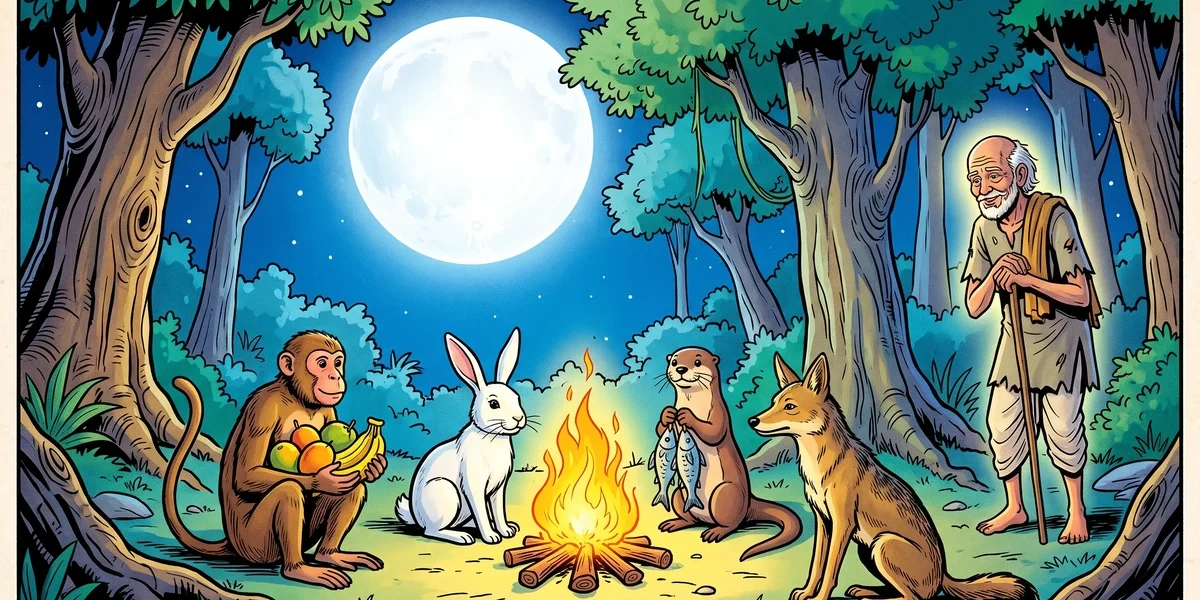
The Moon Rabbit – A Japanese Folktale For Children: A monkey, an otter, a jackal and a rabbit resolved to practice charity on the day of the full moon.
Origin and Attribution
The Moon Rabbit is one of the world’s most widely recognised images: a rabbit visible in the shadows of the full moon, pounding rice or mixing medicine in a mortar. The image is ancient across East Asia, appearing in Han dynasty Chinese art, in Korean folk tradition, and in Japanese culture as the legend of Tsuki no Usagi — the Moon Rabbit. But the story behind the image originates in the Indian Buddhist tradition, specifically in the Sasa Jataka (Jataka No. 316) of the Pali canonical collection, where the Bodhisatta is born as a rabbit who offers the supreme gift of self-sacrifice to a wandering ascetic.
The story travelled east with Buddhism: from India to Sri Lanka, from Sri Lanka to Southeast Asia, from Southeast Asia through central Asian routes to China, Korea, and Japan. At each stage of transmission it absorbed elements of local cosmology and storytelling — the Japanese version situates the rabbit on the moon itself, looking down on a world it illuminates — while preserving the core moral structure of the original: a creature of small means faces a moment when the only gift available is itself, and offers it without hesitation.
The Sasa Jataka’s preservation in the Pali canon as Jataka No. 316 indicates that the tradition regarded it as a relatively advanced moment in the Bodhisatta’s development — the generosity (dana) expressed here is not the giving of wealth or provision but the giving of life itself, which the tradition identifies as jivita-dana, the highest form of the first perfection.
Beat I — The Four Friends and the Wandering Ascetic
In the forests of a former life, the Bodhisatta was born as a rabbit, living in companionship with three friends: an otter, a jackal, and a monkey. The four were unusual in that they had, under the rabbit’s gentle influence, developed the habit of keeping the lunar observance day — the uposatha — by fasting and devoting the day to reflection and generosity. On uposatha days, each animal set aside whatever food it had gathered in order to give it to anyone who might come seeking.
The Bodhisatta rabbit reflected on this practice with the clarity the tradition attributes to his advanced cultivation. The otter could offer fish; the jackal could offer meat; the monkey could offer fruit. But the rabbit lived on grass — and grass was not suitable food for a human ascetic. If a wandering holy man came on an uposatha day seeking food, what could the rabbit give? The only answer he found was: himself. He was grass-fed, clean, appropriate as food. If a genuine need arose, he would jump into the fire and offer his own roasted body.
He held this resolution not with anguish or heroic determination but with the calm clarity that the Jataka tradition associates with a being whose compassion has become so fully developed that the distinction between giving what one has and giving what one is has ceased to feel significant. The grass on which he had fed belonged to the forest; his body was the accumulated product of many lives of cultivation; if it could nourish someone who needed nourishment, it should do so.
Beat II — Sakka’s Test
The story of the four friends reached the realm of the gods. Sakka — the king of the gods in the Pali tradition, who in the Jataka corpus frequently serves as the divine examiner who tests whether the qualities attributed to extraordinary beings are genuine — decided to investigate the rabbit’s resolve. He descended to earth disguised as a wandering Brahmin and visited each of the four friends in turn on an uposatha day, claiming hunger.
The otter offered his store of fish. The jackal offered meat he had gathered. The monkey offered mangoes. Each offered generously and without reluctance. Then Sakka came to the rabbit. The rabbit confirmed immediately: I have grass, which is not food for a human. But I have myself. Build a fire. He did not hesitate, did not ask Sakka to explain himself, did not inquire whether there were other options. He had already resolved the question; the arrival of the situation simply activated the resolution.
Sakka manifested a fire. The rabbit shook himself three times — the Pali text notes this detail without explaining it fully; the commentaries suggest it was to ensure no small creatures living in his fur would be harmed — and jumped into the flames. The fire did not burn him. Sakka had created a fire of divine testing, not of ordinary combustion, and the rabbit emerged unharmed. Sakka then revealed himself, praised the rabbit’s act as surpassing anything he had ever witnessed, and as a memorial — so that the rabbit’s resolution would be visible to all beings for as long as the moon shone — he squeezed the essence of a mountain and drew the rabbit’s image on the face of the moon.
Beat III — The Japanese Transmission and Its Additions
The Japanese version of the Moon Rabbit story, which became established during the Heian period (794–1185 CE) and circulated widely in illustrated form through the medieval period, preserved the core structure of the Sasa Jataka while adding elements that resonated with Japanese Buddhist and Shinto sensibility. The Japanese rabbit typically pounds rice or prepares medicine in a mortar — an image that connects the moon rabbit to the Japanese association of the full moon with abundance, harvest, and the making of mochi (rice cakes) for the autumn moon-viewing festival (tsukimi).
The Japanese tradition’s embellishment is significant: it does not merely preserve the rabbit on the moon as a memorial but imagines the rabbit as continuing to act — to work, to prepare, to offer — from his lunar position. The image is not static commemoration but active generosity perpetuated across time. The rabbit who jumped into the fire is now pounding rice for all who look up at the moon on a clear night and see the shape of his labour. The gift does not end with the death; it becomes permanent, offered to every human being who has ever looked at the full moon.
This elaboration is consistent with the Buddhist transmission’s understanding of how the Bodhisatta’s acts propagate across time: the gift freely given at one moment continues to nourish across many subsequent moments, in ways the giver could not have anticipated and for recipients who did not exist when the gift was made.
Beat IV — The Moral and Its Living Relevance
The Moon Rabbit story encodes the apex of the generosity teaching in the Jataka tradition. The other three animals gave from what they had gathered; the rabbit gave what he was. This is the distinction between samvibhaga-dana (sharing what one has) and jivita-dana (giving life itself) — two levels of generosity that the tradition recognises as qualitatively different rather than merely quantitatively so. The rabbit’s act is not simply a larger version of the otter’s fish; it is a different kind of giving altogether, the kind that the tradition reserves for the Bodhisatta at the most advanced stages of the dana-paramita.
“The rabbit shook himself three times before he jumped, that no small creature in his fur would share the fire. Even in the act of giving everything, he looked after what he could still protect.”
The image of the rabbit on the moon is the Jataka tradition’s way of saying: this act deserves permanent witness. Most acts of generosity are private, local, and temporary — known to giver and receiver and perhaps a few others, then forgotten. The Moon Rabbit’s act is encoded in the face of the full moon so that every human being who has ever lived under clear skies has been, whether they knew the story or not, in the presence of its memorial. The tradition is making a claim about the scale at which genuinely supreme generosity reverberates: not just within a forest, not just within a human life, but across the visible cosmos.
The contemporary resonance is in the detail that the Pali text includes and the Japanese tradition elaborated: the rabbit who shakes himself three times before jumping, ensuring no small creature is harmed. Even at the moment of ultimate generosity — giving everything — there is still attention to what can be cared for. This is not a compromise of the gift; it is the fullest expression of the quality of mind from which the gift flows.
Why This Story Lasted
The Moon Rabbit story has lasted across India, Sri Lanka, China, Korea, Japan, and the broader world for more than two thousand years because it attached the highest moral teaching in the Buddhist tradition — the willingness to give one’s life for a stranger — to the most universally visible object in the natural world. Every full moon is a reminder. Every person who has ever looked at the moon and seen the rabbit’s shape, in any of the dozen cultures that perceive it, has been in inadvertent contact with a teaching about the nature of supreme generosity that originated in a Pali Jataka tale about a grass-eating rabbit who decided that if he had nothing else to give, he still had himself. The story survives because it made itself visible in the sky.
Frequently Asked Questions
**Q: Why is this story important?**
You May Also Like
 Jataka Tales
Ages 3-5
Jataka Tales
Ages 3-5
The Wise Hare: Generosity Writes Itself on the Moon
The Wise Hare: Generosity Writes Itself on the Moon - a folk tale retold for young readers with a clear moral, simple words, and the warmth of a bedtime...
 Jataka Tales
Ages 6-8
Jataka Tales
Ages 6-8
The Faggot-Bearer
The Faggot-Bearer: Source: Jataka Tales Sacred Texts | Type: Jataka | Country: India | Language: English Once on a time in Benares Brahmadatta the king, having
 Jataka Tales
Ages 3-5
Jataka Tales
Ages 3-5
The Story of the Banyan Deer
The Story of the Banyan Deer: Source: Jataka Tales Ellen C. Babbit | Type: Jataka | Country: India | Language: English Once upon a time a Deer lived in a