The Wise Hare
Four animal friends keep a fast day; when Sakka tests them, the hare offers himself to the fire and his image is painted on the moon.
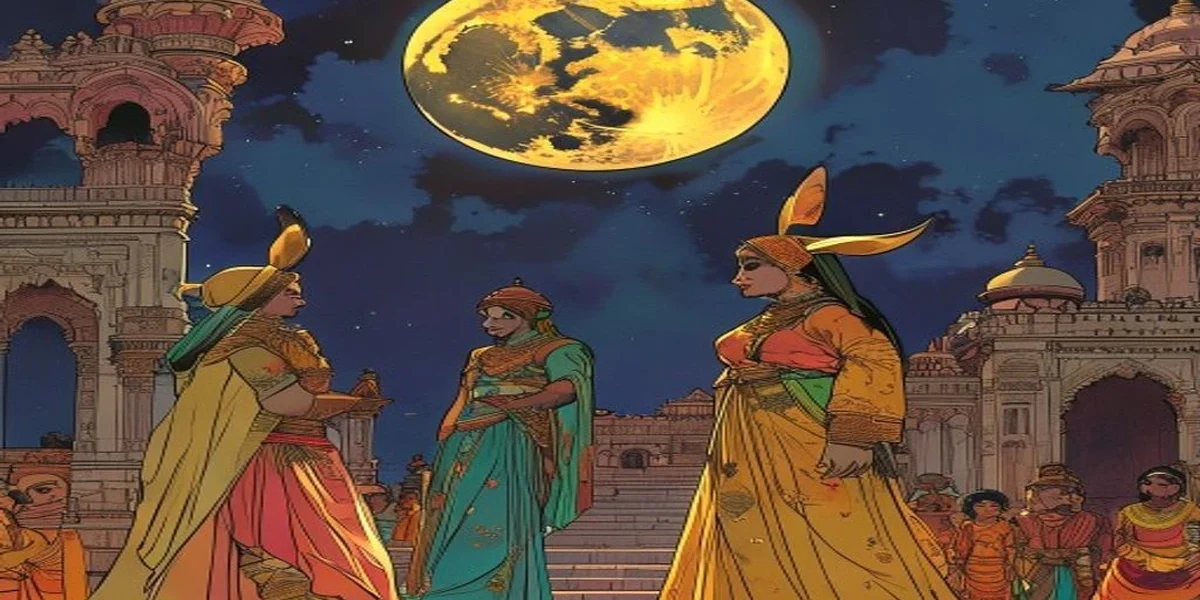
Long ago, when Brahmadatta reigned in Benares, the Bodhisatta was born as a young hare and lived in the forest. He had three friends—a monkey, a jackal, and an otter. By day each found food on his own hunting ground; in the evening they came together again. The hare, who was wise, often taught them about giving and about keeping the fast days.
In time the Bodhisatta looked at the sky and the moon and knew that the next day would be a fast day. He told his friends that they must keep the holy day and that if a beggar came they should give from what they had. The otter, the jackal, and the monkey agreed.
Early the next morning the otter went down to the river bank. He found seven red fish left on the sand by a fisherman and brought them home to his lair, thinking he would eat them in due season—or give them if a guest appeared. He felt pleased with his own virtue.
The jackal went out and came upon a lizard and a pot of curds that a field-watcher had set down, along with two roasting-spits. He took them—wrongfully, he later admitted—and laid them up for the day.
The monkey entered a clump of trees, gathered ripe mangoes, and stored them in his place in the jungle.
The Bodhisatta came out to graze on kusa grass. As he lay in the jungle he thought, “If any beggar appeals to me, I have no sesame, beans, or rice. I shall have to give him my own flesh.” At that splendid resolve Sakka in heaven took notice and came down to test the royal hare.
First Sakka stood by the otter’s dwelling disguised as a brahmin and said he needed food. The otter offered the seven red fish and spoke a verse inviting the guest to eat his fill and stay in the wood. The brahmin answered, “Let be till tomorrow. I will see to it by and by.”
Next he went to the jackal. The jackal too promised food and spoke of the lizard, the jar of curds, and the spits he had taken, offering what he had if the brahmin would stay. Again the brahmin said, “Let be till tomorrow.”
Then he went to the monkey. The monkey offered icy stream-water, ripe mango, and greenwood shade, and invited him to dwell content in the glade. Once more the brahmin put him off till tomorrow.
At last he stood before the wise hare and made the same request. The Bodhisatta was highly delighted. “Brahmin, you have done well to come to me,” he said. “This day I will grant a gift I have never granted before, yet you shall not break the moral law by taking life with your own hand. Go, pile logs, kindle a fire, and tell me when it burns. Then I will sacrifice myself by falling into the flames, and when my body is roasted you shall eat.” He spoke a verse: he had no sesame, beans, or rice, but he would yield his flesh if the guest would live with them.
Sakka caused a heap of burning coals to appear by magic. The hare rose from his bed of kusa grass, came to the place, and thrice shook himself so that any insects in his coat might fall away unharmed. Then, offering his whole body as a free gift, he sprang up like a royal swan and leapt into the blaze.
But the flame failed to heat even the pores of his hair. It was as if he had entered a region of frost. “Brahmin,” he said, “the fire you kindled is icy cold. What does this mean?”
“Wise sir,” came the answer, “I am no brahmin. I am Sakka, and I came to put your virtue to the test.”
The Bodhisatta replied that if Sakka and all the world tested him in generosity they would find no unwillingness to give, and he uttered a cry of exultation like a lion’s roar. Then Sakka said, “O wise hare, be your virtue known throughout a whole aeon.” He squeezed the mountain, took the essence, and daubed the sign of a hare upon the orb of the moon. He set the hare back on a bed of young kusa grass in the same jungle and returned to heaven. And those four wise creatures dwelt happily and harmoniously together, keeping the moral law and the fast days, until they departed according to their deeds.
Where this tale comes from
This is the Sasa Jātaka (Ja 316) in the English line of Cowell’s translation as hosted by Ancient Buddhist Texts. Four animal friends keep the fast; Sakka tests them; the hare offers his own body and is rewarded by having his image set on the moon.
Moon-hare legends appear across Asia; this Buddhist telling ties the mark on the moon to a test of generosity. The otter, jackal, and monkey offer food; only the hare offers himself—and the fire will not burn him.
Read the original: Sasa Jātaka (Ancient Buddhist Texts)
For older readers with guided discussion: includes an attempted self-sacrifice by fire, prevented by supernatural protection. This is not an action to imitate.
The smallest lives still matter
Before the leap, the hare shakes insects from his coat so they will not be harmed. That small pause connects the extraordinary offering to care for others, rather than to a desire to die. The episode is a Buddhist story of exceptional generosity, and its outcome depends on Sakka’s miraculous protection: the fire is cold and the hare survives.
The other friends offer food, water and shade. Those practical gifts provide ways to discuss generosity without copying the hare’s dangerous action. Giving does not require a child to be hurt.
Compare the gifts
Make a list of what each friend offers. Notice which gifts nourish or shelter a guest and how the hare protects the insects. Write a possible act of care using food, time or help that keeps both giver and receiver safe. Keep the fire scene as a literary discussion.
Think about it
- What do the hare and his friends promise for the Uposatha day?
- How does Sakka test them, and what does the hare offer that the others do not?
- What happens when the hare leaps into the fire, and what sign does Sakka leave on the moon?
More stories like this
- The Firewood Gatherer — another Jātaka of truth proved before a king
- The Banyan Deer — Jātaka courage that protects the weak
- King Shibi and the Dove — a ruler who offers his own flesh
Also known as: Sasa Jataka, The Hare in the Moon
Frequently Asked Questions
Who are the hare's friends?
How does Sakka test the friends?
What does the hare offer?
Why is there a hare on the moon?
You May Also Like
 Jataka Tales
Ages 3-5
Jataka Tales
Ages 3-5
The Elephant and the Dog
When a farmer buys away the little dog who shares his meals, the king's elephant will not eat or bathe, and the king must find out why his elephant is so sad.
 Jataka Tales
Ages 9-12
Jataka Tales
Ages 9-12
The Banyan Deer (Nigrodhamiga Jataka)
A golden deer king offers his own neck on the block to spare a mother doe, and his courage moves the king to protect every creature in the land.
 Jataka Tales
Ages 9-12
Jataka Tales
Ages 9-12
The Firewood Gatherer
A stick-gatherer’s son proves he is the king’s child by sitting in mid-air, then grows up to rule as the Firewood Gatherer king.