The Donkey and His Shadow – An Aesop’s Fable
The Donkey and His Shadow – An Aesop’s Fable: Once in Africa there lived a man and his donkey. The man earned his living by hiring his donkey out to travelers.
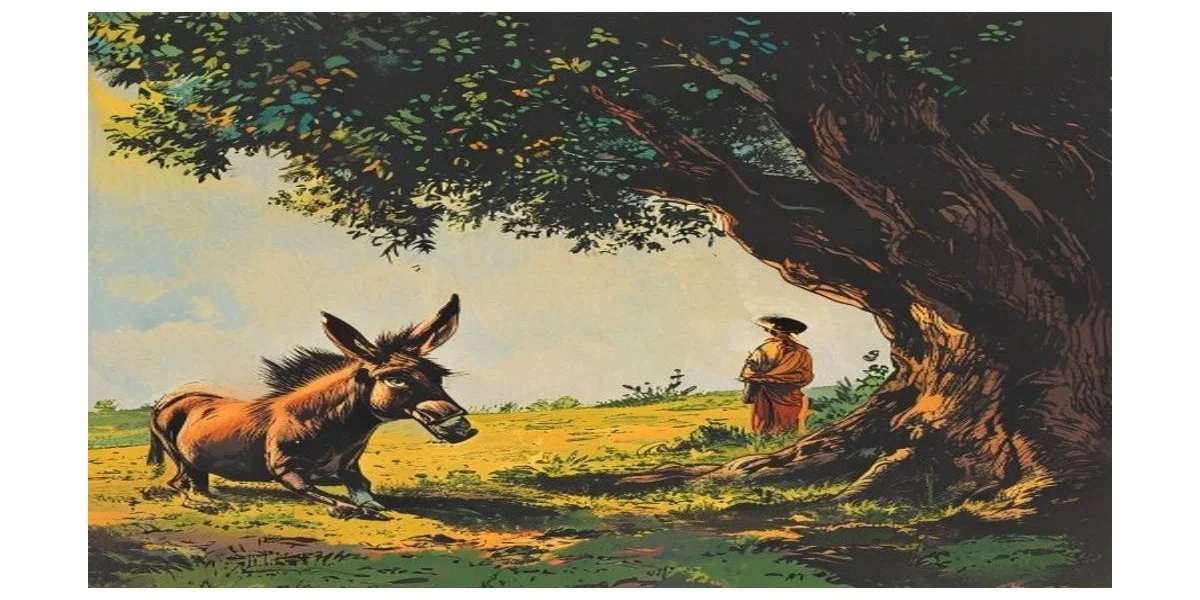
A traveller rents a donkey. The sun blazes. Both traveller and donkey-owner seek the only shade available: the shadow cast by the donkey itself. Who owns the shadow? The traveller, who rented the donkey? The owner, who rented only the donkey’s labour and body, not its shadow? And while the two men argue — and argue, and argue — what happens? The donkey walks away. The Aesopic tradition, at its most precise, had never asked a more exact question: what is the cost of the disputable interpretation?
I. The Fable as Legal Comedy: Contracts and Their Shadows
The Donkey and His Shadow belongs to a rich ancient tradition of legal comedy, in which the absurdity of strict legal reasoning is exposed through a case so extreme it becomes self-refuting. The dispute at the heart of the fable — whether the rental of a donkey includes the right to use its shadow — is not as frivolous as it first appears. Ancient Greek and Roman contract law was genuinely concerned with the distinction between the res (the thing contracted for) and its incidental attributes; whether shade, odour, view, or sound fell within a contract’s scope was a real question for jurists.
Demosthenes, the Athenian orator, reportedly used “the donkey’s shadow” as a proverbial phrase for trivial disputation — evidence that the fable was well-known enough in classical Athens to have generated a proverb before it was written down in its current form. The fable likely circulated orally before Aesop’s collection fixed it, part of a broader tradition of stories mocking the litigiousness that Athenian democracy famously encouraged. Athens had thousands of cases in its popular courts each year; the Athenians were passionate litigators, and their comic writers — Aristophanes above all — mocked this passion without mercy.
The fable’s legal point is precise: ambiguous contracts invite disputes, and disputes, however rationally argued, often destroy the very thing being disputed. While the traveller and the donkey-owner argue about who has the right to the shadow, neither is attending to the donkey. The donkey — patient, logical in his own way — simply leaves. The shadow leaves with him. The legal victory, if it comes, is worthless: there is no longer any shadow to own.
II. The Semiotics of the Shadow: What Exactly Was Rented?
The fable turns on a genuine philosophical puzzle about the nature of objects and their attributes. The shadow is causally dependent on the donkey: no donkey, no shadow. It is also temporally dependent: the shadow changes with the sun’s position, disappears at night, and has no independent existence. Can something with no independent existence be the subject of a property right? Can it be included or excluded from a contract?
Ancient philosophers were interested in exactly this kind of question. Aristotle’s distinction between substance and accident bears directly on the shadow dispute: the donkey is a substance; its shadow is an accidental property, dependent on the substance’s existence and on external conditions (sunlight, angle). To contract for the substance (the donkey) might or might not include its accidents (shadow, warmth, smell). The fable exploits this philosophical ambiguity for comic and moral purposes: the two men are not being irrational in their dispute — they are following a genuinely hard question about contractual scope — but their rationality is producing an irrational outcome.
The Indian philosophical tradition offers a parallel through the maya concept: the shadow is paradigmatically unreal, a projection without independent substance, yet it is this unreal thing that the two men fight over while the real thing (the donkey, the journey’s purpose) escapes. The fable can thus be read as a parable about mistaking the projection for the substance — a lesson with obvious Buddhist and Advaita resonances even if those were not in Aesop’s mind.
III. The Donkey’s Departure: The Logic of the Bystander
The fable’s most sophisticated moment is the donkey’s departure. The donkey is the silent third party in the dispute — the subject of the contract, present throughout the argument, invisible to the arguers in any morally relevant sense. When the donkey walks away, the fable completes its lesson: the disputants have been so focused on the legal abstraction (the shadow-right) that they have lost track of the material reality (the donkey itself).
This structure — two parties fighting over an abstraction while a concrete reality escapes — recurs throughout world folk tradition under the name of the “two-quarrellers and the arbitrator” pattern. In Indian versions, the arbitrator (typically a clever third party — a Brahmin, a judge, a Birbal-figure) takes the disputed object for himself while the quarrellers are absorbed in argument. In the Aesopic version, the donkey performs this function unselfconsciously: it is not clever, not strategic; it simply moves on, as donkeys do, when no one is holding it.
The moral generalisation is clear: disputes over interpretive abstractions cost you the concrete good you were both after. The traveller wanted to complete his journey in shade; the owner wanted to be paid. Both end up with nothing because neither was attending to the actual situation. The fable thus belongs to the long lineage of wisdom stories about the priority of practice over theory, of presence over abstraction — and the donkey, in its patient departure, is the most eloquent argument.
“While men argue about the shadow, the donkey carries the sun with him.”
— Proverbial wisdom derived from the Aesopic tradition
Why This Story Lasted
The Donkey and His Shadow lasted because contract disputes have never gone away, and the human tendency to elevate interpretation over outcome has never diminished. Every generation of lawyers, merchants, neighbours, and partners has experienced the version of this fable in which the shadow (the disputed detail, the contractual ambiguity) consumed the dispute while the donkey (the actual business relationship, the shared purpose) walked off into the distance. The fable is a standing warning against the substitution of legal correctness for practical wisdom.
It also lasted because it is funny, and its comedy is of the highest kind: comic not because the disputants are stupid, but because they are rational in exactly the wrong way. They are right about the legal question and catastrophically wrong about the real situation. This is the comedy of intelligence defeating itself — the most durable comedy there is.
What is the moral of The Donkey and His Shadow?
The primary moral is that disputes over abstractions or technicalities can cause both parties to lose the concrete good they were both pursuing. While the traveller and the donkey-owner argue about who has the right to the donkey’s shadow, neither attends to the donkey itself — which walks away, taking the shadow with it. The fable warns against substituting interpretive correctness for practical wisdom, and against allowing litigation over details to destroy the underlying purpose of an agreement.
What is the historical background of this Aesop’s fable?
The fable was well-known in classical Athens, where Demosthenes used “the donkey’s shadow” as a proverbial phrase for trivial disputation. Athens had a highly litigious culture, with thousands of cases heard in popular courts each year — a tendency mocked by comic writers like Aristophanes. The fable likely pre-dates its written form in Aesop’s collection, circulating orally as a comment on the absurdity of strict legal reasoning and the social costs of excessive litigiousness.
How does the shadow relate to philosophical concepts like maya?
In Indian philosophy, the shadow is paradigmatically unreal — a projection without independent substance, causally dependent on the object casting it and on external conditions like sunlight. The fable can be read as a parable about mistaking the projection (the shadow, the abstract dispute) for the substance (the donkey, the practical purpose of the journey), resonating with Buddhist and Advaita Vedanta teachings about the danger of pursuing maya (illusion) while neglecting reality.
What does ancient Greek contract law say about the shadow dispute?
Ancient Greek and Roman contract law distinguished between the res (the thing contracted for) and its incidental attributes. Whether a rental of property included the right to use incidental benefits — shade, view, sound — was a genuine legal question. Using Aristotelian terms, the donkey is a substance and its shadow is an accidental property, dependent on external conditions. The fable exploits this genuine legal ambiguity to make its comic and moral point: the disputants are not irrational — they are pursuing a hard legal question — but their rationality produces an irrational outcome.
How does the “two quarrellers” pattern appear in Indian folk tales?
In Indian folk tradition, the “two quarrellers” pattern typically features two parties disputing an object while a clever third party — a Brahmin, a village judge, or a wit like Birbal or Tenali Rama — takes the disputed item for himself while the quarrellers are absorbed in argument. The Donkey and His Shadow inverts this: there is no clever third party; the donkey itself performs the resolution by simply walking away when no one is holding it. This makes the fable more austere than its Indian cognates — the loss is unrecoverable and nobody profits from the dispute.
Frequently Asked Questions
**Q: Why is this story important?**
You May Also Like
 Aesop's Fables
Ages 9-12
Aesop's Fables
Ages 9-12
The Crow and the Pitcher
The Crow and the Pitcher: On a scorching afternoon in the ancient lands of Persia, when the sun hung directly overhead like a merciless eye examining every
 Aesop's Fables
Ages 6-8
Aesop's Fables
Ages 6-8
The Farmer and the Money-Lender
The Farmer and the Money-Lender: A poor farmer suffered constantly under a money-lender who grew rich while the farmer remained trapped in hardship. With
 Aesop's Fables
Ages 3-5
Aesop's Fables
Ages 3-5
The Fox and the Grapes: Pride, Desire, and Self-Deception
The Fox and the Grapes: Pride, Desire, and Self-Deception: Autumn had arrived in the woodland with a quiet intensity, painting the leaves in shades of amber