The Donkey in the Lion’s Skin
The Donkey in the Lion's Skin: In a time when the beasts of the earth still held council and wisdom was sought from all creatures, there lived a donkey of

The Borrowed Mane: When Appearance Diverges from Nature
A donkey finds a lion’s skin, drapes it over himself, and succeeds — temporarily — in terrifying the surrounding countryside. All goes perfectly until the donkey, overcome with the joy of its newfound power, brays. The sound is instantly recognized; the disguise is dissolved; and the donkey is beaten soundly for its presumption. This tale (Aesop’s Fable 188, Perry Index; known as “The Ass in the Lion’s Skin”) is among the most economical fables in world literature — its central image requiring barely a sentence to establish, its lesson requiring less than one to state. In Indian retellings, the tale acquires philosophical depth through the concept of svabhava (essential nature): the idea that a being’s true nature will inevitably express itself regardless of the disguise it adopts, because nature is not a performance but a structural fact about what a being is.
The Panchatantra contains a variant of this theme in the story of the dyed jackal who passes as a rare divine animal until his fellow jackals howl at the moon and he cannot resist joining them — instantly revealing himself. The structural principle is identical: adopted persona can suppress true nature for a time, but cannot permanently override the reflexes, sounds, and behaviors that express what a being fundamentally is. The Indian telling adds a specifically Sanskrit philosophical register: guna-theory (the three qualities of nature — sattva, rajas, tamas) insists that beings act according to their dominant guna regardless of circumstance. A tamasic donkey wearing a sattvic lion skin is not thereby elevated to sattva; its tamas will find expression.
Svabhava and Its Expressions: The Donkey’s Bray as Ontological Signature
In Sanskrit philosophical tradition, svabhava (own-nature, essential character) is one of the most fundamental concepts in the analysis of beings and their behavior. The Bhagavad Gita repeatedly invokes svabhava as the basis of proper action: each being should act according to its own nature (svabhavaja karma), because action contrary to one’s nature is both unstable and spiritually compromising. The donkey’s bray is its svabhava-expression — not a mistake that a sufficiently disciplined donkey could suppress indefinitely, but the inevitable acoustic signature of what the donkey ontologically is. No lion skin changes the structure of the donkey’s vocal apparatus or the nervous impulse that triggers the bray.
This ontological point extends beyond animal fable into social commentary. Indian caste ideology (which we must analyze without endorsing) historically invoked svabhava as an explanation for why people of different hereditary groups behaved differently even when circumstances changed — the argument being that svabhava is heritable and indelible. The Panchatantra story of the mouse who was transformed into a girl but still chased mice invokes the same logic. The folk tale thus participates in a deep and contested philosophical conversation about whether nature is fixed or transformable — a conversation that Indian philosophy has conducted with remarkable sophistication for over two millennia.
The Fox Knows the Voice: Detection, Intelligence, and the Limits of Deception
In many versions of the fable (including some Indian variants), it is a fox — traditionally the figure of cunning intelligence — who first detects the fraud. The fox is not deceived by the lion skin because it attends to the voice rather than the appearance. This detail is philosophically significant: the fox possesses viveka (discriminative wisdom) — the capacity to distinguish appearance from reality by attending to the correct evidence. The surrounding animals who are deceived by the lion skin have committed the epistemological error of using the wrong pramana (valid means of knowledge): they are judging by pratyaksha of the visual kind, ignoring the auditory evidence that would immediately reveal the fraud.
The fox’s detection thus performs the same function as a sage in Indian narrative: it demonstrates the quality of discrimination that cuts through maya (illusion) to perceive the underlying reality. Sankara’s Advaita Vedanta uses the snake-in-the-rope metaphor to illustrate maya — a rope perceived as a snake in dim light, with fear and avoidance responses fully activated by the perception. The donkey-in-the-lion-skin is a social maya: an appearance that generates community responses (fear, deference, retreat) appropriate to a lion rather than to a donkey. The fox’s viveka dissolves this social maya by finding and attending to the evidence that does not lie.
The Comedy of Pretension: Pratiloma Identity and Its Social Dangers
The donkey’s pretension is a form of what Sanskrit social theory calls pratiloma — the reversal of natural or social order, the lower claiming the status of the higher. Unlike anuloma (the proper downward flow of status) or progressive social mobility achieved through legitimate means, pratiloma assumes the markers of a higher status without the qualities that those markers are meant to signify. The danger of pratiloma, in Indian social theory, is not merely individual dishonesty but social confusion: the community cannot correctly orient itself toward the donkey-as-lion because the signals it uses for orientation have been falsified.
The tale’s comedy derives from the gap between the donkey’s self-perception (magnificent, powerful, feared) and the community’s eventual re-perception (ridiculous, pretentious, properly punished). This gap is the engine of most pretension comedy — the audience knows what the pretender does not know (that they will be caught) or knows before the pretender does (that the bray has begun). In Indian theatrical tradition, the vidushaka (court jester) frequently exposes pretension through exactly this mechanism: the person of genuine quality needs no disguise; only the person without genuine quality requires borrowed symbols of it.
“He wore the lion’s silence magnificently — until the moon rose and the night was deep and the joy of it all became too great, and from within the lion’s roar came the unmistakable sound of a donkey.”
Why This Story Lasted
The Donkey in the Lion’s Skin endures because pretension is a permanent feature of social life — every era produces its donkeys in lion skins, and every community eventually hears the bray. What the tale offers is not a strategy for permanent detection (the fox already has viveka, which is not learnable from a fable) but a reminder: nature will out. The disguise is temporary; the svabhava is permanent. For those tempted by borrowed symbols of status they have not earned, the tale offers a gentle warning about the inevitable moment when the voice, the gesture, the unguarded word reveals what the costume could not conceal. For those who have already heard the bray — the tale offers the quiet satisfaction of confirmed perception.
Frequently Asked Questions
What is svabhava and why does the donkey’s bray reveal it?
Svabhava (own-nature, essential character) is a fundamental Sanskrit philosophical concept — the structural fact of what a being is, not a performance it can maintain or abandon. The Bhagavad Gita identifies svabhavaja karma (action arising from one’s own nature) as the basis of proper conduct. The donkey’s bray is its svabhava-expression: the acoustic signature of its ontological identity that no lion skin can permanently suppress.
How does the Panchatantra’s dyed jackal relate to this tale?
The Panchatantra’s dyed jackal passes as a divine animal until it cannot resist howling with its fellow jackals at the moon — instantly revealing its true nature. The structural principle is identical to the donkey’s bray: adopted persona can suppress true nature temporarily but cannot permanently override the reflexes and behaviors that express what a being fundamentally is. Both tales enact the svabhava principle through comic exposure.
Why does the fox detect the fraud when other animals cannot?
The fox possesses viveka (discriminative wisdom) — attending to voice rather than appearance, using the correct pramana (valid evidence source). The deceived animals commit an epistemological error: judging by visual pratyaksha while ignoring auditory evidence that immediately reveals the fraud. The fox’s detection mirrors the Indian sage’s function: cutting through maya (illusion) to perceive underlying reality through correct discrimination.
What is pratiloma and how does it describe the donkey’s behavior?
Pratiloma (reversal of natural/social order) describes the lower claiming the markers of the higher without possessing the qualities those markers signify. The donkey’s lion-skin disguise is pratiloma: it assumes the symbols of lion-status while remaining a donkey in svabhava. Indian social theory identifies the danger as community disorientation — the social signals used for correct orientation have been falsified, making collective response impossible.
Is this fable pessimistic about the possibility of transformation?
The fable focuses specifically on disguise (externally adopted persona) rather than transformation (internally achieved change). Indian philosophy distinguishes these sharply: the mouse-maiden who still chases mice after transformation illustrates svabhava persistence; but the Yoga tradition insists that genuine inner transformation is possible through sustained practice (tapas, svadhyaya, Ishvara-pranidhana). The donkey’s failure is not that transformation is impossible but that it sought it through costume rather than practice.
You May Also Like
 Aesop's Fables
Ages 9-12
Aesop's Fables
Ages 9-12
The Talkative Tortoise
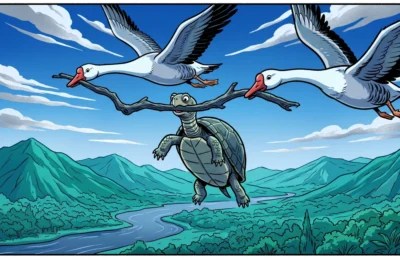
The dual-rooted Indian fable of Kambugrīva — "Conch-Necked," the tortoise of Phullotpala pond — and his two wild-goose friends Saṅkaṭa and Vikaṭa, who try to lift him out of a drought by carrying him on a stick. The story comes to us through two ancient traditions at once: the Buddhist Pali Canon as Kacchapa Jātaka No. 215, and the Hindu Panchatantra as Book I, Mitrabheda. It is not, as is often claimed, a tale of Aesop. T.W. Rhys Davids' 1880 translation is preserved in full alongside the Sanskrit retelling, with Sanskrit names restored, the dual-tradition origin explained, and the story's two-thousand-year journey through Pahlavi, Arabic, Persian, Hebrew, Latin, and finally La Fontaine's French traced.
 Aesop's Fables
Ages 3-5
Aesop's Fables
Ages 3-5
Story Of The Faithless Wife And The Ungrateful Blind Man
Story Of The Faithless Wife And The Ungrateful Blind Man: In the town of Mithila there lived a young Brâhmaṇ who, having had a quarrel with his father-in-law
 Aesop's Fables
Ages 3-5
Aesop's Fables
Ages 3-5
The Little Mermaid
The Little Mermaid: Deep in the big blue ocean, there lived Meena, a Little Mermaid. Meena loved listening to her Grandma’s stories of the world beyond the