The Little Mermaid
The Little Mermaid: Deep in the big blue ocean, there lived Meena, a Little Mermaid. Meena loved listening to her Grandma’s stories of the world beyond the
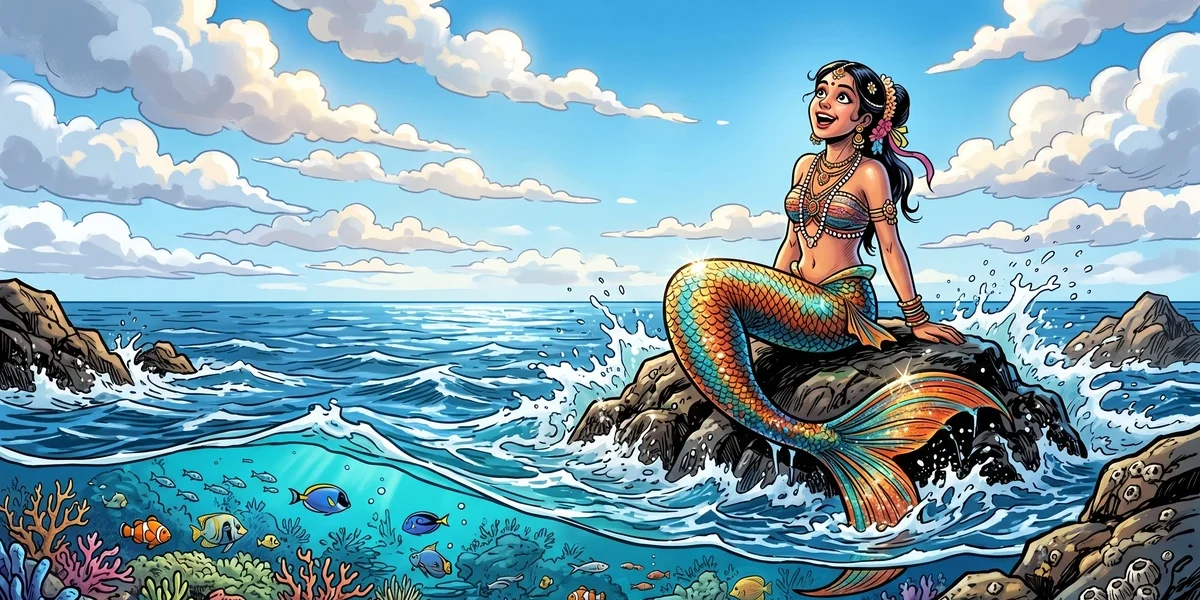
She lives beneath the water in a world of beauty and abundance, with a voice of extraordinary power and a family who loves her. She wants to be human. This desire — which will cost her everything she has in exchange for something she cannot be certain of receiving — is the engine of one of the most philosophically precise stories in the world folk-mythological tradition. The Little Mermaid’s longing is not merely a love story; it is a story about the structure of desire itself: that desire is always for the other domain, and that the price of crossing from one domain to another is paid in the currency of what one was in the first.
I. The Apsara Reversed: Water-Beings Who Long for Land
Indian mythology has its own water-beings who inhabit the boundary between aquatic and human worlds: the apsaras (celestial nymphs of the water and clouds), the nagas and their female counterparts the naginis, and the various regional traditions of river maidens and lake spirits. These beings typically move in the direction opposite to the Little Mermaid’s longing: they enter the human world from above or below, become entangled with human lovers, and must eventually return to their own domain — often at great cost to both parties.
The apsara Urvashi and the human king Pururava in the Rigveda and the Mahabharata is the paradigmatic Indian version of this inter-domain romance: the celestial being who spends time in the human world, loves a human, and must ultimately return, leaving devastation behind. The Little Mermaid’s story inverts this direction: instead of the celestial being descending into the human world, the aquatic being ascends toward it. But the structural dynamic is identical — the being from the other domain who desires the human world, the price paid for the crossing, and the tragic impossibility of full belonging in the domain one has chosen.
Scholars of comparative mythology note that trans-boundary desire tales — stories in which a being from one cosmic domain longs for another — are among the most universally distributed narrative types in world folk tradition. They appear in every culture that distinguishes between the human and non-human worlds, and they consistently encode the same insight: the boundary between domains is not just physical but ontological, and crossing it requires the surrender of something essential to one’s original nature. The price of becoming is the cost of having been.
II. The Structure of Desire: Why Always the Other Domain?
The Little Mermaid’s desire for the human world raises a question that the tale’s emotional power tends to obscure: why does she want what she does not have, when what she has is by any measure extraordinary? Her underwater world is beautiful; her voice is the most powerful in the sea; she is loved. The human world she desires is, from any objective perspective, less rich and less permanent than what she has. And yet she desires it with a completeness that renders everything she has insufficient.
This is a precise portrait of desire as such — not of the Little Mermaid’s personal psychology but of desire as a structural phenomenon. Desire is always for the absent rather than the present, always for the other domain rather than one’s own, always for what would complete what feels incomplete even when that feeling of incompleteness is not supported by any objective deficit. The Indian concept of trishna (thirst, craving) in Buddhist thought captures exactly this: the restless reaching toward what is not present, which is the fundamental condition of the unenlightened mind regardless of what the present contains.
What makes the Little Mermaid’s desire particularly poignant is that its object is ontological rather than merely material. She does not want a specific thing from the human world; she wants to be a different kind of being. This ontological desire — the desire to be otherwise than one is — is the deepest and most painful form of longing, because no acquisition can satisfy it. Every object she might obtain from the human world, including the prince’s love, is not the same as being human. Only transformation can address this desire, and the tale explores with merciless precision the price that such transformation demands.
III. The Price of Crossing: Voice, Pain, and the Possibility of a Soul
The bargain the Little Mermaid strikes — her voice for the ability to walk on land, with each step causing intense pain — is the tale’s most philosophically loaded element. The voice she surrenders is precisely the gift that makes her distinctive, the quality through which she communicates and enchants and is known as herself. To give up the voice is to give up the capacity for authentic self-expression in exchange for the ability to inhabit a different domain — to be present in the human world but unable to speak in it.
This bargain maps precisely onto the experience of the immigrant, the exile, the person who has crossed from one cultural or linguistic world to another: present in the new world, mute in ways that matter, living with a metaphorical pain with each step taken in the adopted domain. The surrender of the voice as the price of the crossing resonates with every experience of cultural translation in which the self that could speak fluently in the original domain finds itself unable to express itself with equal power in the new one.
The immortal soul that the Little Mermaid pursues through the prince’s love is Andersen’s Christian overlay on an older folk motif, but it encodes a genuinely universal insight: the water-being lacks something the human possesses, and that something is what she is ultimately after, with the prince as its proxy. In the Indian framework, this maps onto the desire for a specific quality of consciousness — the human capacity for the kind of reflective awareness that can accumulate karma, pursue dharma, and achieve liberation. The mermaid wants not just the prince but the form of being that the prince represents.
“The mermaid who longs for legs does not know what she will pay for each step; the human who longs for fins does not know what he will pay for each dive.”
— Cross-cultural wisdom on trans-boundary desire
Why This Story Lasted
The Little Mermaid lasted because ontological longing — the desire to be otherwise than one is — is among the most universal and most painful of human experiences, even though it is paradoxically most acute in human beings, who are already in the domain most myths designate as the chosen one. We are all, in the folk tradition’s deepest reading of this tale, longing for a domain that is not quite our own — and the mermaid’s story is the most precise account of what that longing costs and what it produces.
The tale’s refusal of easy consolation — in the Andersen version, the mermaid does not get the prince; she dissolves into seafoam or, in a later addition, becomes an air spirit — is part of what makes it endure. It does not promise that the price of crossing will be repaid. It insists only that the crossing is possible, that the desire is real, and that what one becomes in the crossing, whatever it is, is different from what one was. In a world that offers many promises of transformation, the Little Mermaid’s story is among the few that refuses to lie about the price.
What is the philosophical meaning of the Little Mermaid’s desire?
The Little Mermaid’s desire for the human world despite having an objectively rich and beautiful aquatic life is a precise portrait of desire as a structural phenomenon: always for the absent rather than the present, always for the other domain rather than one’s own. In Buddhist terms, this maps onto trishna (craving) — the restless reaching toward what is not present that characterises the unenlightened mind regardless of what the present contains. Her desire is specifically ontological: she does not want things from the human world but to be a different kind of being, which is the deepest and most painful form of longing.
How does the Little Mermaid story connect to Indian water-being mythology?
Indian mythology features its own trans-boundary beings: apsaras (celestial water nymphs), naginis (serpent maidens), and river spirits who cross between aquatic and human worlds. The classic Indian version — the apsara Urvashi and the human king Pururava — inverts the Little Mermaid’s direction: a celestial being descends into the human world rather than an aquatic one ascending toward it. But the structural dynamic is identical: a being from another domain desires the human world, crosses into it at great cost, and finds that full belonging in the adopted domain is impossible. Both traditions encode the ontological price of trans-boundary desire.
What does the surrender of the mermaid’s voice represent?
The mermaid’s voice is her most distinctive quality — the gift through which she is known as herself and through which she communicates and enchants. Surrendering it for the ability to walk on land means being present in the new domain but unable to speak authentically within it. This resonates with the experience of cultural translation and immigration: present in a new world, muted in ways that matter most, unable to express the self that spoke fluently in the original domain. The voice-for-legs bargain is the folk tale’s most precise metaphor for what is paid when one crosses from one world of meaning to another.
What is the significance of the immortal soul in Andersen’s version?
The immortal soul that the Little Mermaid pursues through the prince’s love is Andersen’s Christian theological overlay on an older motif, but it encodes a genuinely universal insight: the water-being lacks something essential that humans possess, and that something is the ultimate object of desire — with the prince serving as proxy for it. In the Indian framework, this maps onto the desire for the specific quality of consciousness that enables reflective awareness, karma accumulation, dharmic pursuit, and ultimately liberation — capacities the tradition associates specifically with human embodiment.
Why does the Little Mermaid story refuse easy consolation?
In Andersen’s original version, the mermaid does not get the prince and dissolves into seafoam (or becomes an air spirit in later additions) — a refusal of the romantic happy ending that would falsify the tale’s most honest insight: that the price of crossing between ontological domains is real and not guaranteed to be repaid by success in the new domain. The tale insists only that the crossing is possible, the desire is real, and transformation happens regardless of whether the desired outcome is achieved. This refusal of consolation is part of what makes the story endure as philosophy rather than merely as sentiment.
Frequently Asked Questions
**Q: Why is this story important?**
You May Also Like
 Aesop's Fables
Ages 3-5
Aesop's Fables
Ages 3-5
The Story Of The King Who Would Be Stronger Than Fate
The Story Of The King Who Would Be Stronger Than Fate: Once upon a time, far away in the east country, there lived a king who loved hunting so much that, when
 Aesop's Fables
Ages 3-5
Aesop's Fables
Ages 3-5
The Son Of Seven Mothers
The Son Of Seven Mothers: Once upon a time there lived a King who had seven wives, but no children. This was a great grief to him, especially when he Greed and
 Aesop's Fables
Ages 3-5
Aesop's Fables
Ages 3-5
The Mother In Law Became An Ass
The Mother In Law Became An Ass: Little by little the mother-in-law became an ass - vara vara mâmi kaludai pôl ânâl̤, is a proverb among the Tamil̤s, applied