The Son Of Seven Mothers
The Son Of Seven Mothers: Once upon a time there lived a King who had seven wives, but no children. This was a great grief to him, especially when he Greed and
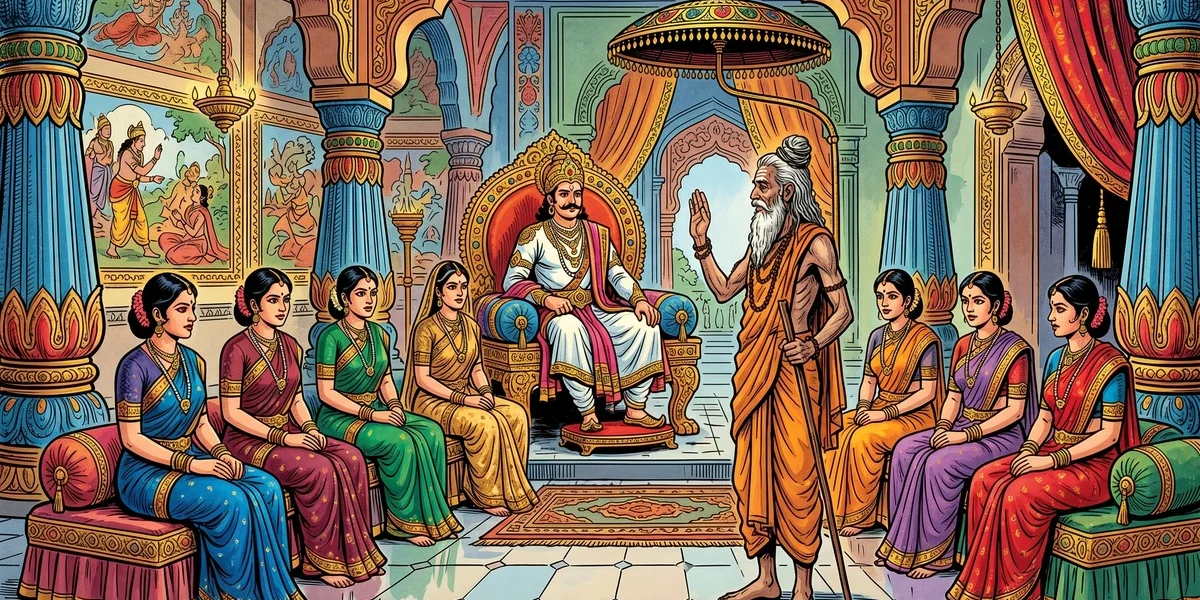
Seven Mothers and One Son: The Theology of Miraculous Birth
In the cosmology of Indian folk narrative, the number seven carries sacred weight: seven sages (saptarishi), seven worlds (sapta-loka), seven rivers (sapta-sindhu), seven vows of marriage. A hero born of seven mothers enters the story already stamped with cosmic significance — he is not merely the son of one woman but the concentrated essence of a sacred number. The tale of The Son of Seven Mothers belongs to the pan-Indic narrative tradition of miraculous birth, in which the hero’s extraordinary origin prefigures his extraordinary destiny. Where ordinary heroes are born, these are avatara-like figures — assembled, concentrated, or collectively generated by the universe’s need for a champion.
The seven-mother motif has deep Puranic roots. The Saptamatrika — the Seven Divine Mothers (Brahmi, Maheshvari, Kaumari, Vaishnavi, Varahi, Indrani, and Chamunda) — appear as a group throughout the Devi Mahatmya (Markandeya Purana) and in temple iconography across the subcontinent. These divine mothers collectively generate and sustain warriors in cosmic battles. When a folk tale hero has seven human mothers, the resonance with this divine council is unmistakable: the seven mothers are an earthly shadow of the Saptamatrika, collectively investing the child with their combined vitality, skill, and protective love.
Polymaternal Childhood: Nurture as Collective Obligation
The folk tale’s emotional core often lies not in the hero’s eventual feats but in the richness of his childhood: surrounded by seven mothers, he receives not merely sustenance but a plurality of maternal perspectives, skills, and affections. This collective nurturing structure reflects a social reality — the joint family system of traditional India, in which a child might be raised simultaneously by biological mother, aunts, grandmothers, and elder sisters-in-law, all sharing the work and joy of child-rearing. The seven-mother tale elevates this ordinary joint-family experience into mythic register, suggesting that the collective investment of multiple women in a child’s formation is not merely practical but cosmically significant.
Sociologist A. M. Shah’s studies of the Indian joint family noted that children raised within them frequently exhibited stronger networks of trust and social obligation than those raised in nuclear structures. The Son of Seven Mothers is, on this reading, the perfect joint-family product: he owes love and loyalty to seven women, and this web of obligation shapes him into a being of exceptional relational capacity — exactly the quality required of a hero whose task will be to restore, protect, or connect a fragmented community.
The Hero’s Burden: Destiny, Debt, and the Seven-Fold Bond
Classical Sanskrit poetics identify several types of heroic motivation: dharma-vira (duty-heroism), daya-vira (compassion-heroism), and dana-vira (generosity-heroism). The Son of Seven Mothers is typically motivated by all three simultaneously, because his debt (rin) to seven women rather than one multiplies his obligation accordingly. He cannot simply serve one mother’s need; the tale structures his quest so that each of the seven has contributed something irreplaceable, and the climax often requires him to satisfy all seven obligations in a single transformative act.
This narrative structure encodes the Indian philosophical principle of kritajnata — gratitude as a moral imperative. The Mahabharata repeatedly insists that ingratitude (akritajna) is among the most serious of moral failures; to forget those who gave you life and nurture is to sever the web of reciprocity that constitutes society. A hero with seven mothers is a hero with seven-fold gratitude obligations — and the story’s resolution often hinges on whether he can honor all of them, rather than simply the most convenient one.
Seven as Sacred Number: Numerical Symbolism in Indian Narrative
Why seven, rather than three or twelve? In Indian cosmological arithmetic, seven is the number of completion and traversal: seven chakras in the subtle body, seven notes in the musical scale (saptasvara), seven colors in the rainbow, seven days in the week assigned to planetary deities. A hero formed by seven mothers has been shaped by all the registers of embodied experience — a complete formation. Three mothers would be incomplete; seven constitutes a whole.
This numerological completeness prefigures the hero’s capacity for total action. He can navigate all realms, address all types of challenge, sustain all registers of relationship — because his origin encompassed all of them. The number seven in his birth is thus a structural promise to the audience: whatever obstacles the tale throws at him, he is constitutionally equipped to address them all. Indian storytellers embedded this mathematical theology in the tale’s premise, allowing the number to do heavy narrative work before the plot had even properly begun.
“Seven mothers poured their hearts into one child — and the world discovered that what seven loves make, no single sorrow can unmake.”
Why This Story Lasted
The Son of Seven Mothers endures because it speaks to the deepest functions of community in raising children and the sacred weight of collective nurture. In an era when nuclear family isolation increasingly replaces the joint-family web, this tale is a reminder of what is lost when a child has only one source of love rather than seven. It is also a story about gratitude’s scope: the hero who honors seven mothers rather than seeking to choose among them demonstrates that mature love is not competitive but cumulative. Each telling renews the community’s recognition that children belong not to one parent but to a web of caring adults — and that heroes are what that web, at its most generous, produces.
Frequently Asked Questions
Who are the Saptamatrika and how do they relate to this tale?
The Saptamatrika (Seven Divine Mothers — Brahmi, Maheshvari, Kaumari, Vaishnavi, Varahi, Indrani, and Chamunda) appear throughout the Devi Mahatmya as a collective divine war council who generate and empower warriors. The seven human mothers in the folk tale echo this divine council, collectively investing the child with their combined vitality and protective power.
What social reality does the seven-mother motif reflect?
The motif reflects the Indian joint family system in which children are raised simultaneously by biological mother, aunts, grandmothers, and sisters-in-law. The tale elevates this ordinary joint-family experience into mythic register, suggesting that collective maternal investment is cosmically significant — producing heroes through the abundance of communal love.
Why is the number seven significant in Indian cosmology?
Seven is the number of completion in Indian cosmology: seven saptarishi (sages), seven lokas (worlds), seven saptasindhu (sacred rivers), seven chakras, seven musical notes (saptasvara). A hero born of seven mothers has been shaped by all registers of embodied experience — a structurally complete formation that prefigures his capacity for total action.
What does kritajnata (gratitude) have to do with the hero’s quest?
Kritajnata — gratitude as moral imperative — is central to the tale’s ethical architecture. The Mahabharata identifies ingratitude (akritajna) as among the gravest moral failures. A hero with seven mothers bears seven-fold gratitude obligations, and the story’s climax often requires him to honor all seven simultaneously, demonstrating that mature love is cumulative rather than competitive.
How does The Son of Seven Mothers compare to other miraculous birth tales in Indian tradition?
Indian tradition is rich with miraculous birth narratives: Karna born from the sun, Krishna born in prison at midnight, Sita born from the earth. The Son of Seven Mothers belongs to the sub-category of collectively generated heroes — like warriors empowered by the Saptamatrika — where the plurality of sources rather than the singularity of divine origin constitutes the miracle.
Frequently Asked Questions
**Q: Why is this story important?**
You May Also Like
 Aesop's Fables
Ages 9-12
Aesop's Fables
Ages 9-12
The Wolf in Sheep’s Clothing
The Wolf in Sheep's Clothing: In the rolling hills of ancient Macedonia, where olive groves stretched across sun-baked valleys and shepherds tended their
 Aesop's Fables
Ages 3-5
Aesop's Fables
Ages 3-5
The Close Alliance A Tale Of Woe
A farmer’s bullocks lead him into a crocodile-infested river—a parable of how bad companions drag the virtuous toward ruin.
 Aesop's Fables
Ages 3-5
Aesop's Fables
Ages 3-5
Sun Moon And Wind Go Out To Dinner
An Indian folk tale where Sun and Wind's selfishness brings curses while Moon's kindness earns eternal blessings.