Boy Cried Wolf
An Aesop's Fable story. A boy's cries of wolf are ignored when the wolf finally comes. Lies destroy trust forever.


Where the Tale Comes From
“The Boy Who Cried Wolf” is one of the most universally recognised fables in world literature. It is attributed to Aesop, the Greek storyteller of the sixth century before the common era, and it carries the catalog number Perry 210 in the standard scholarly index of the Aesopic corpus. The principal Greek source-form survives in the prose Aesopica (the Augustana recension, around the first or second century of the common era), under the title Ποιμὴν παίζων — Poimēn paízōn, “the shepherd-boy at play.” From there it travelled into Latin through the medieval Romulus prose-collections and the verse-Aesop of Walter of England, into the first printed English edition by William Caxton in 1484, and into the popular eighteenth-century English Aesop of Samuel Croxall (1722), from whom most modern English-language schoolbook versions are descended. La Fontaine, surprisingly, did not include this fable in his Fables, so the European children of the last three centuries have learned it directly from the English line of transmission.
The story belongs to a very old international family of tales about the false alarm that destroys credibility. The folklorists Aarne, Thompson, and Uther catalogue it as type ATU 1333 — “The Shepherd Who Cries ‘Wolf!’ Too Often.” Versions of the same plot are told across the world: in Hebrew tradition the Talmud preserves a parallel about the man who cries out for help so often that no one comes when he is in real trouble; in the Arabic and Persian fable-tradition the false alarm is a recurring motif; in the Sanskrit Pañcatantra, the fifth book — Aparīkṣitakāraka, “the acted-without-examination tales” — and the Hitopadesha contain related stories of repeated false reports destroying trust between the village and the watcher.
We tell here the classical Greek form of the fable, in the spirit Aesop set it down, with the final moral given in the simple words of the prose Aesopica.
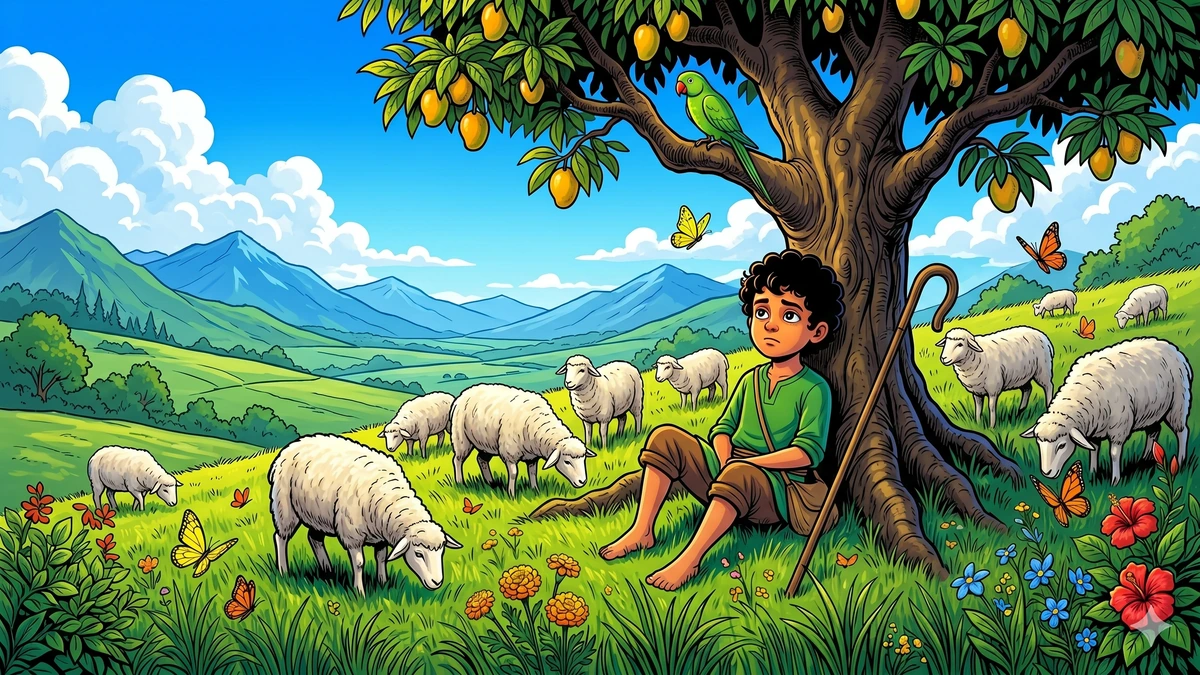
The Shepherd-Boy and the Flock
There was once a small village. It sat at the foot of a long green hill, and the green hill rose in soft slopes towards a dark wood at the top, and beyond the dark wood lay the wild country where no one walked. The village was a good village. Its houses had whitewashed walls and red-tiled roofs and small flower-gardens; its streets were narrow and clean; its market-day was Wednesday; its people knew one another by name. The most valuable thing the village owned was its flock of sheep.
The flock was the wealth of the village. Every family had a few sheep in it; the wool was their cloth; the milk was their cheese; the lambs in the spring were their hope of the year. The sheep were not owned by any one family but watched over together — a village flock — and each year a different boy was given the trust of taking the sheep up the hill to the high pasture and watching over them through the long bright days.
This year, the trust had fallen on a young shepherd-boy. He was perhaps twelve years old. He had bright dark eyes and a quick clever mind, and he was very pleased on the morning of his first day, when his father gave him the wooden crook of the shepherd and his mother gave him the small leather bag of bread and cheese for his lunch and the older men of the village gave him their grave instructions: take the sheep up the hill at sunrise, watch them all the day, count them carefully, and at the first sign of a wolf — the first sign — call out at the top of his voice, “Wolf! Wolf!” and the men of the village would come running with their staves and their dogs to drive the wolf away.
“Mind, son,” said the eldest of the men, his hand heavy on the boy’s shoulder, “the sheep are the village. If we lose them, we lose all of us. The wolf is real. Do your duty well, and call quick if you see him.”
“I will,” said the boy.
And on that first morning he did. He walked the white woolly flock up through the village street, out through the gate, along the dusty path, up the long green slope to the high pasture, with the rising sun behind him and the dew bright on every blade of grass. He thought to himself, as he walked, that he was the most important boy in the village that day. He was the keeper of the flock. The whole village was in his hands.
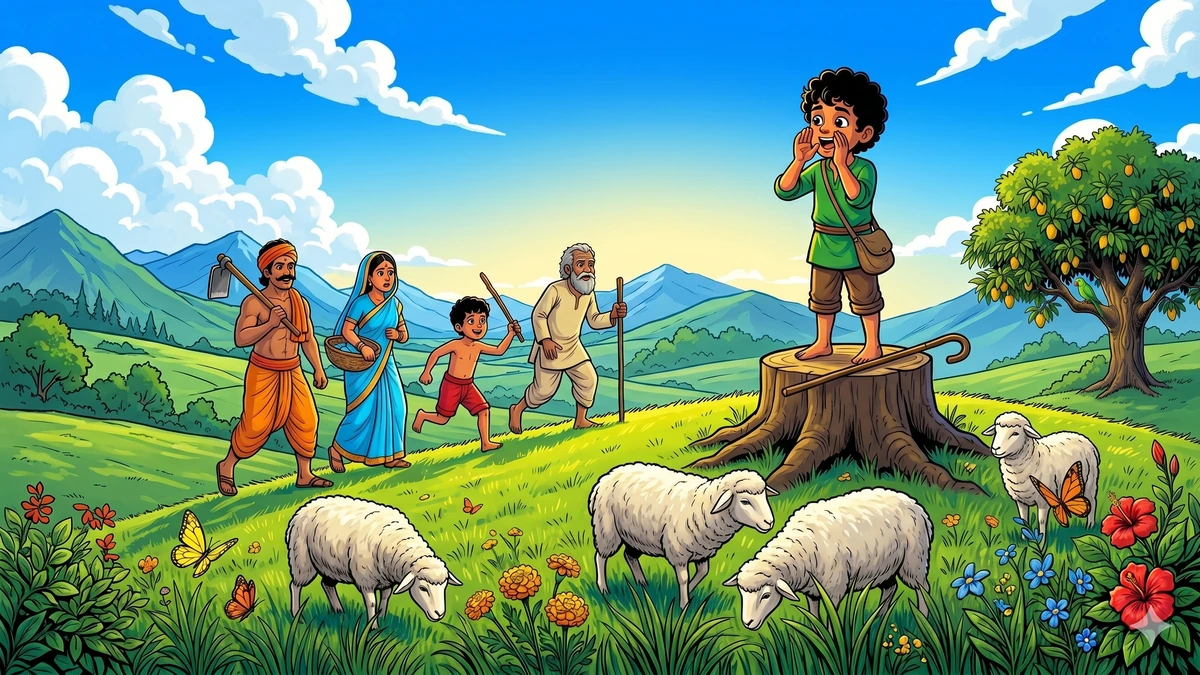
The Long Quiet Hours
The high pasture was a beautiful place. The grass was long and green and full of small bright wildflowers. A clear cold spring ran out from the rocks at one corner. A great old mango tree stood at the edge of it, throwing a circle of cool dappled shade. The sheep, when they reached it, spread out across the meadow in small contented groups and began to crop the grass, and the soft sound of their cropping mixed with the soft sound of the wind in the mango tree, and the boy sat down under the tree with his crook beside him and his lunch-bag in his lap, and the long bright morning of his shepherding began.
It was beautiful. It was also, after the first hour or two, very, very quiet.
The sheep did not move much. They cropped the grass, and they walked a step or two, and they cropped the grass again, and they bleated occasionally to one another in their soft sheep-language, and that was all. There were no wolves. There was no danger. There was no excitement of any kind. The sun moved slowly across the sky. The shadow of the mango tree moved slowly across the grass. The boy ate his bread and his cheese, drank from the cold spring, watched a lazy butterfly cross the meadow, watched a small green parrot land in the tree above him, watched the same small green parrot fly away again, and then there was nothing left to watch.
By noon he was bored. By the early afternoon he was wishing, with a small mean wish in the back of his mind, that something — anything — would happen. By the late afternoon, with the long slow hours of the high pasture stretching ahead and the long slow days of the whole summer stretching ahead beyond that, the small mean wish in the back of his mind put a small mean idea into his head.
What if something did happen? What if he made it happen?
The men of the village had said: at the first sign of a wolf, call out at the top of your voice, and they would come running. The boy thought of the men of the village dropping their work in the fields and running up the hill with their staves and their dogs. He thought of how exciting that would be to watch. He thought how funny it would be when they reached the top and found everything peaceful and the boy laughing on his stump.
It was a small thought. It was a stupid thought. But the boy was twelve years old, and he was bored, and the long bright afternoon was longer than any afternoon he had ever known, and so he stood up. He walked to the highest stump in the meadow. He cupped his small hands around his mouth. And he shouted.
The First False Alarm
“Wolf! Wolf! A wolf is among the sheep! Help! Help! Come quickly!”
His voice rolled down the hill. It rolled across the village. It carried into the open doors of the houses, into the yards where the women were beating clothes, into the fields where the men were tending the millet, into the workshop of the carpenter and the smithy of the blacksmith. And the village, which had been waiting all day for any cry from its boy on the hill, dropped everything in an instant.
The boy on the stump watched in delight as the village came up the hill. He saw the eldest of the men running heavily with his stave; he saw the carpenter still in his apron with a hammer in his hand; he saw the boy’s own father with a long stout walking-stick; he saw the women coming half a step behind, with their skirts kilted up; he even saw the village dogs racing ahead of the men, all teeth and bared throats. The whole village came up the long green slope at a run.
And when they reached the top of the slope, the boy was sitting on his stump, laughing.
The men of the village stood at the edge of the meadow with their breath heaving. They looked at the peaceful sheep. They looked at the empty hillside. They looked at the boy laughing. And the eldest of the men, when he had got his breath back, walked across the meadow to where the boy sat, and he said, in the kind of voice that is more disappointed than angry, “There is no wolf, son?”
“No, sir,” said the boy, still laughing.
“You called out for nothing?”
“I — I was bored, sir.”
The eldest of the men was silent for a long moment. He looked at the boy for a long time. Then he said: “We were in the field, son. We dropped our hoes and we came up this hill at a run. The carpenter dropped his work. The blacksmith dropped his hammer. Your mother left the bread half-baked in the oven. We came because the village trusts you to call only when there is a wolf. Do you understand?”
“Yes, sir,” said the boy. He was not laughing now. The red was rising in his cheeks. “I am sorry, sir. It will not happen again.”
The eldest of the men nodded. The men of the village turned, in silence, and walked back down the long green slope, and the women followed, and the dogs followed the women, and the boy was left alone on the hill with the sheep, and his face was very hot, and his ears were ringing with the silence the men had left behind them.
For the rest of that afternoon he did not move from his stump.
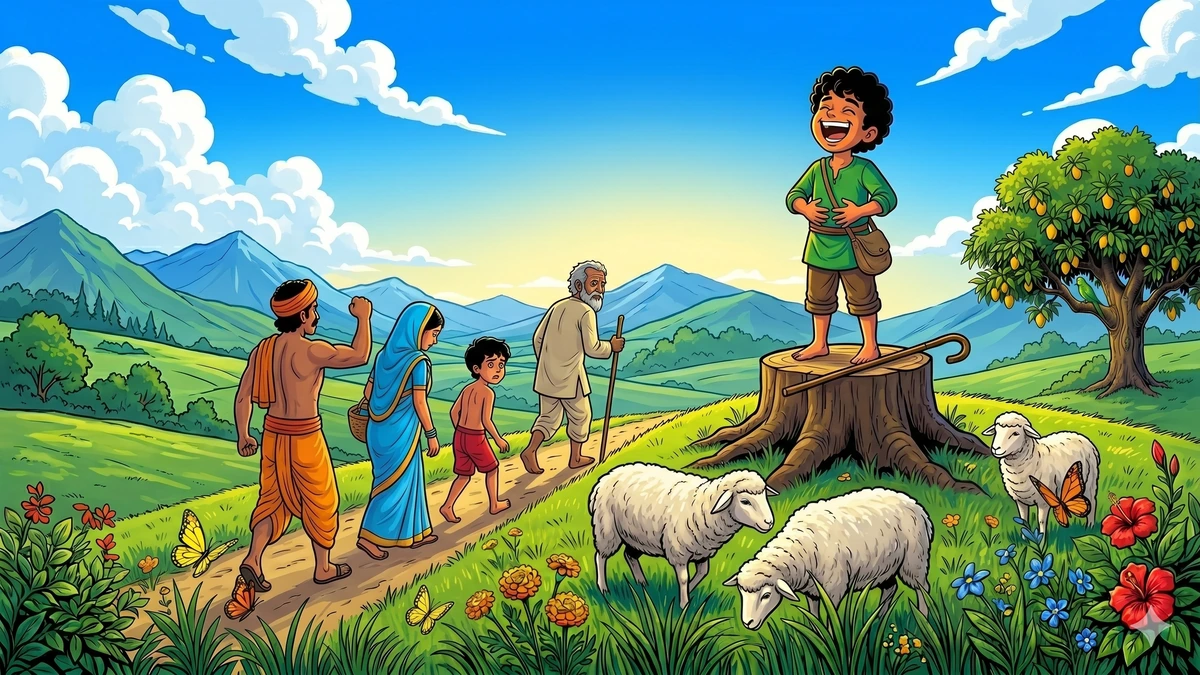
The Second False Alarm
It is a strange thing about the human heart that the lessons we learn in the heat of shame do not always last as long as they should. The boy went home that evening quiet and humbled. He did his work the next day, and the next, with proper attention. But after three or four days the long bright hours of the high pasture began to weigh on him again. And after a week the small mean idea that had got him into trouble the first time crept back into the corner of his mind. And the boy, who had told himself a hundred times that he would never do that stupid thing again, found himself one slow yellow afternoon standing on the stump with his hands cupped around his mouth a second time.
“Wolf! Wolf! Help! Help! The wolf is among the sheep!”
And the village came running. Not all of it, this time — some of the men were too far away in the back fields to hear; some of the women were doubtful; the carpenter shook his head and stayed at his bench. But the eldest of the men came, and the boy’s father came, and three or four others came, and the village dogs came, and they ran up the long green slope just as before, and they reached the top of the slope, and they saw the boy on his stump.
The boy was laughing. He could not help himself. The sight of the men running, the seriousness of their faces, the heaving of their breath, was as funny on the second telling as on the first; and the boy, who had told himself he would never do this again, doubled over on the stump and laughed and laughed and laughed until tears ran down his cheeks.
The men of the village did not laugh. They did not say anything at all. The eldest of the men stood at the edge of the meadow and looked at the boy for a long moment, and there was no anger in his face, only a deep quiet weight; and then he turned, and he walked back down the long green slope, and the other men turned and followed him, and they did not speak as they went, and they did not look back.
The boy’s laughter died in his throat as he watched them go. He understood, dimly and not very fully, that he had done something different this time — something worse than the first. The first time the men had been disappointed; the second time they had been silent. He did not know yet, on that long yellow afternoon, that silence was the worst sound a village could make.
That night his father did not speak to him at supper. His mother put his bread and his bowl in front of him without looking at his face. The boy ate in silence. He went to bed in silence. He told himself again, more grimly this time, that he would never play that trick again.
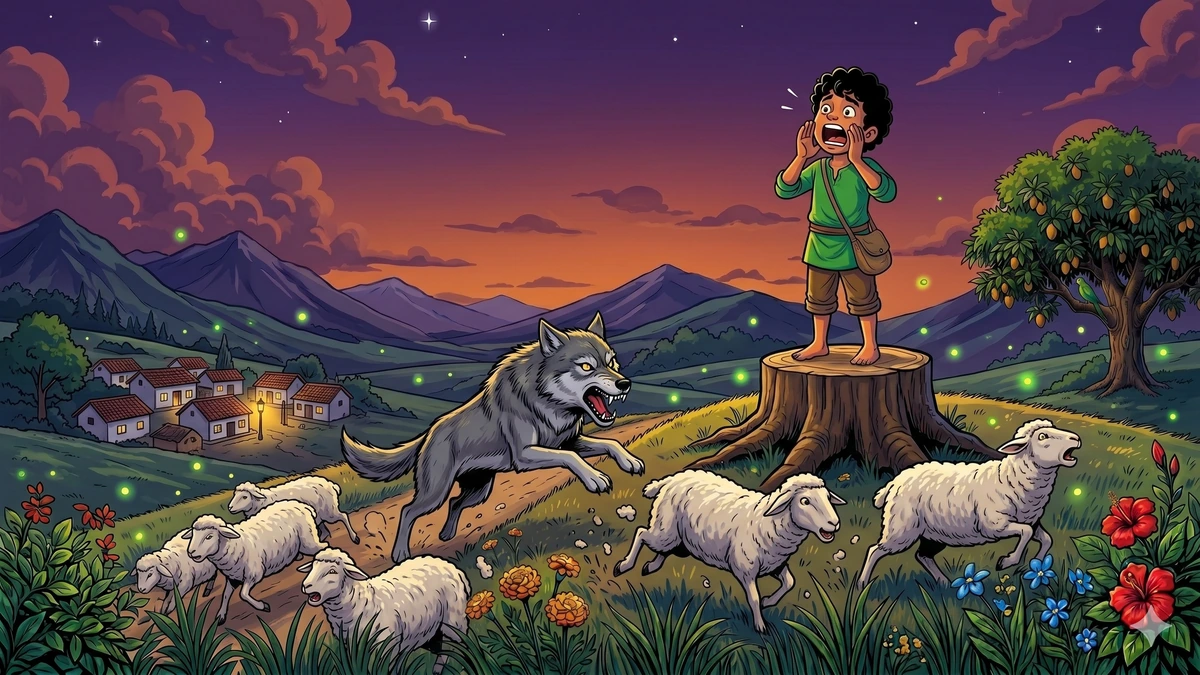
The Day the Wolf Came
Three days passed. The boy kept his promise to himself. He took the flock up the hill at sunrise and brought them down again at sunset, and he did not call out, not once, for any reason, and the long quiet days went by without trouble.
And then, on the fourth afternoon, towards twilight, the wolf came.
The boy did not see him at first. He was sitting on his stump, watching the long shadows stretch across the meadow, thinking about supper, when one of the sheep at the edge of the flock gave a sudden frightened bleat. The boy looked up. He saw the sheep huddle and turn. He saw, at the edge of the dark wood at the top of the hill, a long grey shape sliding out from between the trees.
It was real. It was huge. Its grey fur was thick and matted; its yellow eyes were fixed on the flock; its lean shoulders rolled as it walked. It came out of the wood not at a run but at a slow purposeful walk, the walk of a creature that knows it has the time, the walk of a creature that knows the meadow belongs to it now.
The boy froze. For one long terrible second he could not move and he could not breathe and the world around him went very quiet, and then he leapt from the stump and he ran to the edge of the slope and he cupped his hands around his mouth and he shouted with everything in him.
“Wolf! Wolf! A real wolf! Help! Help! Come quickly! It is real this time! Help!”
His voice rolled down the hill. It rolled across the village. It carried into the open doors of the houses, into the yards where the women were beating clothes, into the fields where the men were tending the millet, into the workshop of the carpenter and the smithy of the blacksmith. The men of the village heard the boy on the hill calling “Wolf! Wolf!” and the men of the village paused, and the men of the village shook their heads, and the men of the village went back to their work.
The carpenter said to his apprentice, “The boy is at it again. Pay him no mind.”
The blacksmith said to his bellows-boy, “He’ll cry himself out. The third time is no different from the first.”
The boy’s own father, in the millet-field, heard the high desperate voice of his son rolling down the long green slope, and he set his jaw very hard, and he did not lift his hoe from the earth, and he did not run.
The boy, on the hill, called and called and called. He cried, “Help! Help! It is real! It is real this time! The wolf is here! Please come, please, please come!” His voice broke. He stood on the slope until his lungs ached and his throat went raw and the long shadows of evening grew longer and longer and the great grey wolf walked among the sheep at the top of the meadow and chose his prey at his own slow pace.
No one came.
The Walk Home
When at last the wolf had finished what he had come to do and slunk back into the dark wood at the top of the hill, the boy walked slowly across the meadow. The flock was scattered. Several sheep were missing — gone into the dark wood with the wolf. Several others had been chased away into the rocks beyond the meadow. The remaining sheep huddled together, silent and trembling.
The boy gathered what was left of the flock in the failing light. He counted them — once, then twice, then a third time, because he could not believe the count was right. Then he turned, and he led the small broken flock down the long green slope towards the village, with the deep purple of evening coming on overhead and the first faint stars beginning to show.
The village was waiting at the gate.
The men were there with their staves. The women were there with their lanterns. The eldest of the men stood at the front with his arms folded across his chest, and his face in the lantern-light was older than the boy had ever seen it. The boy walked up to the gate with his small remnant of a flock at his heels.
“How many missing?” said the eldest of the men quietly.
“Eleven,” said the boy. His voice was very small.
The eldest of the men closed his eyes for a long moment. Then he opened them.
“I am sorry, sir,” said the boy. The tears were running down his face. “I called. I called and called. The wolf was real this time. I did not lie. He was real. I called and you did not come.”
“We heard you call, son.”
“Then why?” said the boy. “Why did you not come?”
The eldest of the men did not answer for a long moment. He looked at the boy in the lantern-light. And then he said, slowly, “Because two days ago we ran up that hill for nothing, and three days before that we ran up that hill for nothing, and we did not believe you, son. That is why we did not come. We did not believe you.”
The boy understood, then, for the first time, what he had done. The men had not failed him. He had failed himself. He had used his voice up. He had spent the village’s trust in two foolish afternoons of laughter, and on the day he needed it back, there was nothing left to draw on. The wolf had not stolen the sheep from the village. The boy had stolen the trust, and the wolf had come and taken what was no longer guarded.
He stood at the gate with his small broken flock, and he did not say anything more, because there was nothing more to say.
The Moral of the Tale
The Greek prose Aesopica preserves the moral in plain unadorned form:
τοῦτο πάθος γίνεται τοῖς ψευδομένοις, οὐδ᾽ ὅταν ἀληθεύωσιν, πιστεύονται.
“This is what happens to those who lie: even when they tell the truth, they are not believed.”
The English schoolbook tradition, descending from Caxton in 1484 and Samuel Croxall in 1722, has set the lesson in the form by which most English-speakers know it today:
A liar will not be believed, even when he speaks the truth.
Two languages, two thousand years apart, the same simple truth. The fable is not really a story about a boy and a wolf. It is a story about trust — about the long slow hard work of earning it and the quick easy careless work of throwing it away. Trust is a strange thing. We do not see it like we see the sheep on the hillside. We do not count it the way the boy counted his flock at the end of the day. But it is more valuable than any flock, and once it is gone, no shouting, however true, will bring it back in time.
Why This Story Has Lasted
“The Boy Who Cried Wolf” has lasted, across more than two and a half thousand years and across every continent on which human beings tell stories, because it captures something deeply true about how human community works. We are creatures who depend on one another’s word. The village trusted the boy to call out only when there was a wolf, and the boy trusted the village to come when he called. That trust was the invisible rope that bound the village together. When the boy cut the rope with his foolish laughter, he did not just lose his own credibility — he lost the village’s ability to come to his aid. The wolf stole the sheep, but the boy himself had stolen the village’s protection.
The fable speaks to every age and to every adult listener as much as to every child. We have all met the person who has cried wolf. We have all, sometimes, been the person who has cried wolf — who has exaggerated for attention, who has raised a false alarm for amusement, who has made a small lie because the truth was boring. And we have all then watched, in some quieter and more painful moment, the cost of that small lie come back at us — the friend who does not believe us when at last we are telling the truth, the family member who does not take our pain seriously because we have cried out too often, the colleague who shrugs off our warning because our last warning was wrong. The wolf, in the end, comes for everyone. The fable simply asks: when the wolf comes for you, will the village come running?
The story is also, in a quieter way, a story about boredom. The boy did not cry wolf because he was wicked; he cried wolf because he was bored. He was twelve years old on a long bright afternoon with nothing to do, and the small mean wish in the back of his mind became a small mean idea, and the small mean idea became a foolish action, and the foolish action cost him eleven sheep and the trust of his village. The fable is, among other things, a warning about what we do with our boredom. The empty afternoon is dangerous. The slow yellow hour with no work is the hour in which the small mean ideas grow. The wise watcher does not let his boredom become a story; he lets the long quiet hours pass, and he keeps his voice for the moment when his voice will be needed, and he understands that the trust of the people who depend on him is the most precious thing he carries.
Keep your word. Use your voice for what is real. The wolf will come, sooner or later, for all of us. When he comes, we want the village to run.
Frequently Asked Questions
What is the moral of The Boy Who Cried Wolf?
Who wrote The Boy Who Cried Wolf?
What is the summary of The Boy Who Cried Wolf?
What can children learn from The Boy Who Cried Wolf?
Is The Boy Who Cried Wolf based on a true story?
You May Also Like
 Aesop's Fables
Ages 3-5
Aesop's Fables
Ages 3-5
The Mother In Law Became An Ass
The Mother In Law Became An Ass: Little by little the mother-in-law became an ass - vara vara mâmi kaludai pôl ânâl̤, is a proverb among the Tamil̤s, applied
 Aesop's Fables
Ages 9-12
Aesop's Fables
Ages 9-12
The Goldsmiths Fortune
The Goldsmiths Fortune: Once upon a time there was a goldsmith who lived in a certain village where the people were as bad and greedy, and covetous, as they
 Aesop's Fables
All Ages
Aesop's Fables
All Ages
The Ant and the Grasshopper
The Ant and the Grasshopper: One summer day, a grasshopper was hopping about, playing his fiddle, chirping and singing to his heart’s content. An ant passed by