The Bundle of Sticks
The Bundle of Sticks: There was an old man who lived to see his five sons grow into manhood, yet their constant quarreling troubled him more deeply than any
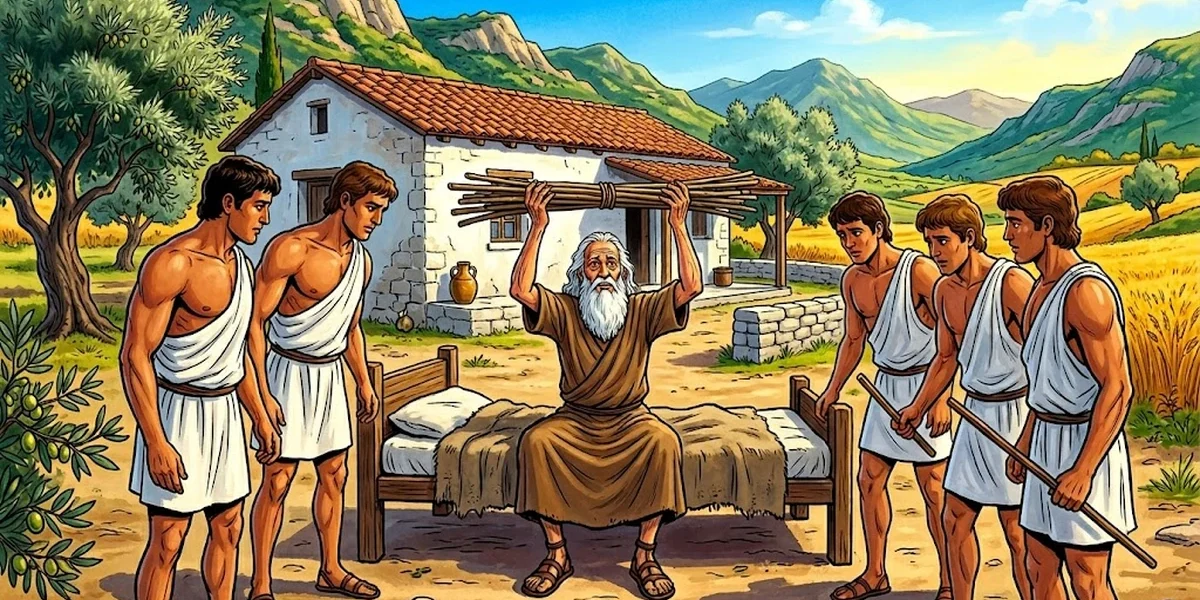
This is one of the simplest, most universally recognised, and most quietly powerful of all the fables in the Aesopic corpus — a small clear wordless gesture, performed by a dying farmer in front of his quarrelling sons, that has been retold in every century, in every language, in every culture, for two and a half thousand years, and is still — in some form — being told today by every parent who has ever watched siblings fight over an inheritance, by every coach who has ever spoken to a divided team, by every leader who has ever called a fractured group back to unity. The fable belongs to Aesop, the Greek storyteller of the sixth century BCE, in whose corpus it is catalogued as Perry 53 under the Greek title Geōrgos kai paides — “The Farmer and His Sons.”
The principal Greek source-form survives in the Augustana recension of the prose Aesopica (1st-2nd c. CE). It was retold in beautiful Greek choliambic verse by Babrius as Fable 47 in the second century CE. It came down through the medieval Romulus collections into modern English through William Caxton’s first printed Aesop in 1484, then Roger L’Estrange (1692), Samuel Croxall (1722), Thomas Bewick (1818), and Joseph Jacobs (1894). Jean de La Fontaine retold it as Book IV Fable 18 of his celebrated French Fables (1668) — Le Vieillard et ses Enfants, “The Old Man and His Children.” It is classified in the Aarne-Thompson-Uther index as motif J1021 — Strength in Union. Plutarch, in his Sayings of Kings and Commanders, attributes a closely parallel demonstration to the Scythian king Scilurus on his deathbed before his eighty sons — almost certainly the same fable in a Scythian historical setting.
This is the story.
The Quarrelling Sons
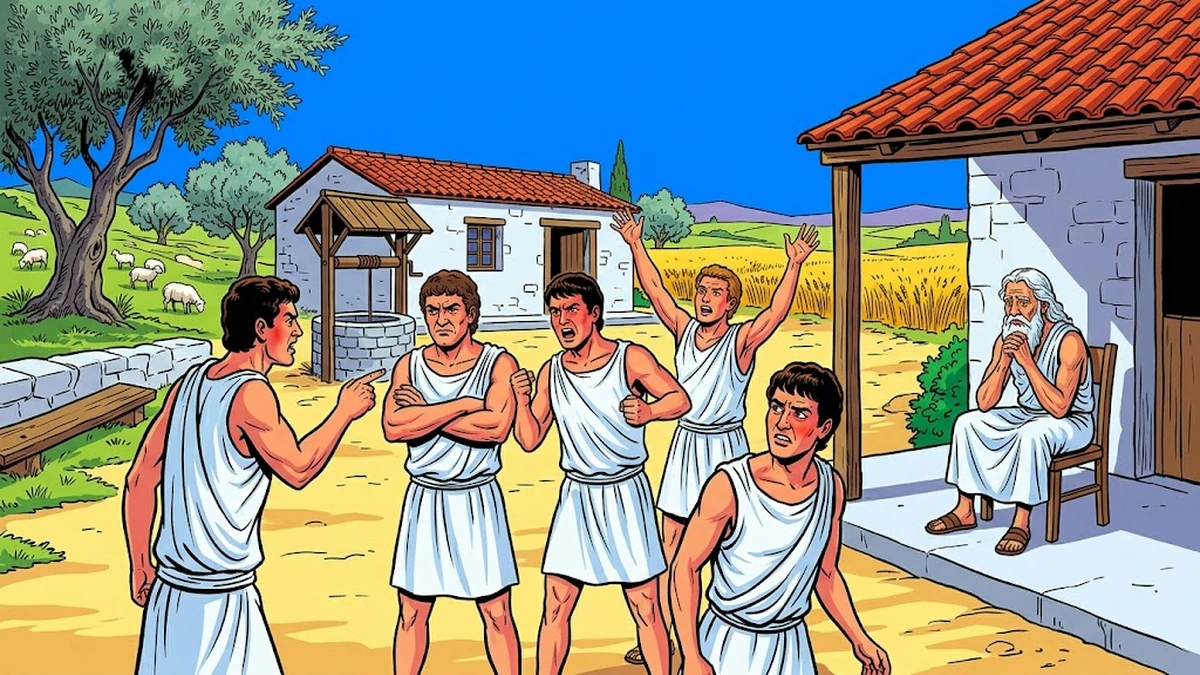
It happened, the old tellers said, on a small farm in a small valley in central Greece, in the long bright autumn of the sixth century BCE — the autumn, perhaps, of the very century in which Aesop himself was walking the dusty roads of Greece collecting the small clear teaching-stories he was famous for. On the farm lived a small family: an old farmer, lean and weather-beaten and bent with the long work of forty years of ploughing, and his five strong young sons, all grown to manhood, all working the same fields, all sharing the same low stone farmhouse and the same olive trees and the same small flock of grey-fleeced sheep on the hillside.
The five sons, the old tellers said, were each — separately — fine young men. They were strong. They were healthy. They were hard-working. Each of them, on his own, was the kind of son any father would be proud to have. But together — together they were a disaster. They could not, the five of them, agree on anything. They argued every morning about who had drawn more water from the well. They argued every noon about who was eating more bread than his fair share. They argued every evening about whose turn it was to bring the sheep down from the hillside. They argued, on rainy days, about which of them would go out and patch the leak in the barn roof. They argued, on dry days, about which of them would walk the longer dusty road to the market.
And the old farmer, watching his five strong sons quarrel from morning until evening every day of every season of every year — watched them with the slow patient sorrow of a father who knows, in his bones, that the moment he himself is gone, the five young men will tear each other and the small precious farm to pieces in their bitterness, and that the work of his forty years will be lost in a single quarrelling year.
The Old Farmer’s Plan
And one bright autumn afternoon, when the old farmer had grown so old and so weak that he knew — with the slow patient certainty of a man who has watched many old men die — that his own time was now very short, he called his five quarrelling sons in from the fields and told them — gently, with the small calm authority of a dying father — to gather around his low wooden bed in the small whitewashed room of the stone farmhouse.
The five sons came in, dusty and tired and faintly resentful at having been pulled from their work in the middle of a quarrel about whose turn it was to mend the broken plough, and stood in a half-circle around the old man’s bed.
The old farmer, smiling at them with the same weary fond smile he had been smiling at them for thirty quarrelling years, said: “My sons. I have, on the floor by the door, a small bundle of sticks. Bring it here. I want to show you something before I die.”
The eldest son fetched the bundle. It was a small ordinary bundle of perhaps a dozen long thin sticks of dry olive wood, tied tightly together with three or four wraps of strong leather cord. The old farmer took it from his eldest son’s hands, weighed it slowly in his own thin trembling hands, and said:
“My eldest. Take this bundle, in your strong young hands, and break it across your knee.”
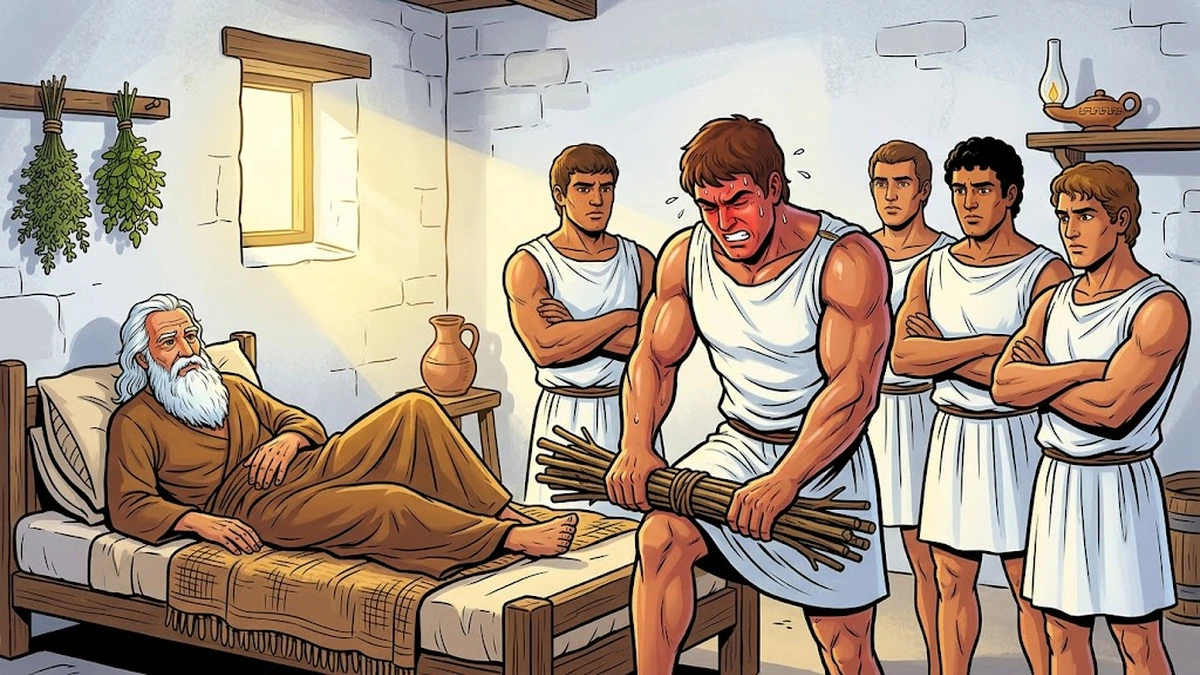
The eldest son, smiling — for he was a young man of unusual strength, broad in the shoulder and thick in the arm from forty harvests of working the heavy farm plough — took the bundle from his father, set the bundle across his strong young knee, and pressed down with all the power of his strong young arms.
The Bundle Will Not Break
The bundle, the old tellers said, did not break. The dry olive sticks bent — slightly. The leather cord stretched — slightly. But the bundle, as a whole, was so much stronger than any one stick that the eldest son’s strong young arms could find no way to crack it.
The eldest son, his face going slowly red with effort and embarrassment, pressed harder. The bundle did not break. He pressed harder still. The bundle did not break. He pressed with both arms, with all his weight, with everything he had — until the sweat ran down his brown forehead and into his beard. The bundle did not break.
The old farmer, watching from his bed, said gently: “Pass it to your brother.”
The eldest son passed the bundle, ashamed, to the second son, who was even broader in the shoulder and even thicker in the arm. The second son set the bundle across his knee, and pressed. The bundle did not break.
The bundle was passed, in turn, to the third son, who was the tallest of the five, with arms like young oak-trees. He pressed. The bundle did not break.
It was passed to the fourth son, a quick wiry young man of unusual strength for his size. He pressed. The bundle did not break.
It was passed to the fifth and youngest son, a lean handsome young man with the strongest hands of any of them. He pressed. The bundle did not break.
The five strong young sons stood, panting and ashamed and bewildered, around the old farmer’s bed, the bundle of sticks lying unbroken on the small wooden floor between them.
The Old Farmer Unties the Bundle
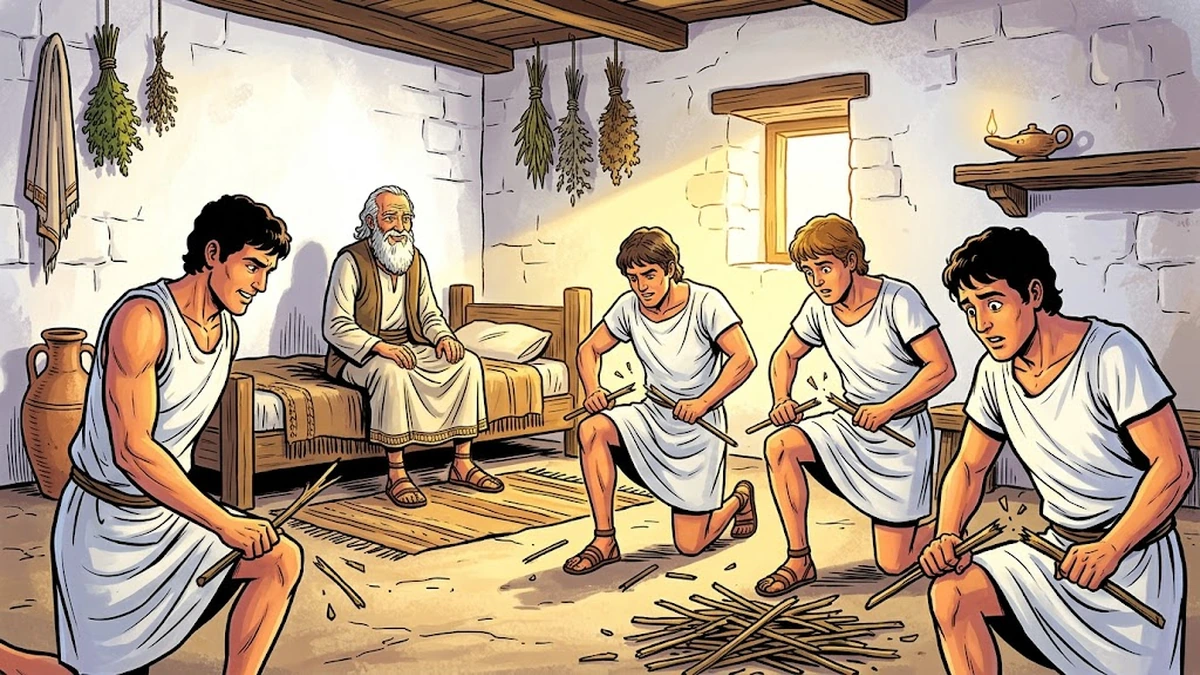
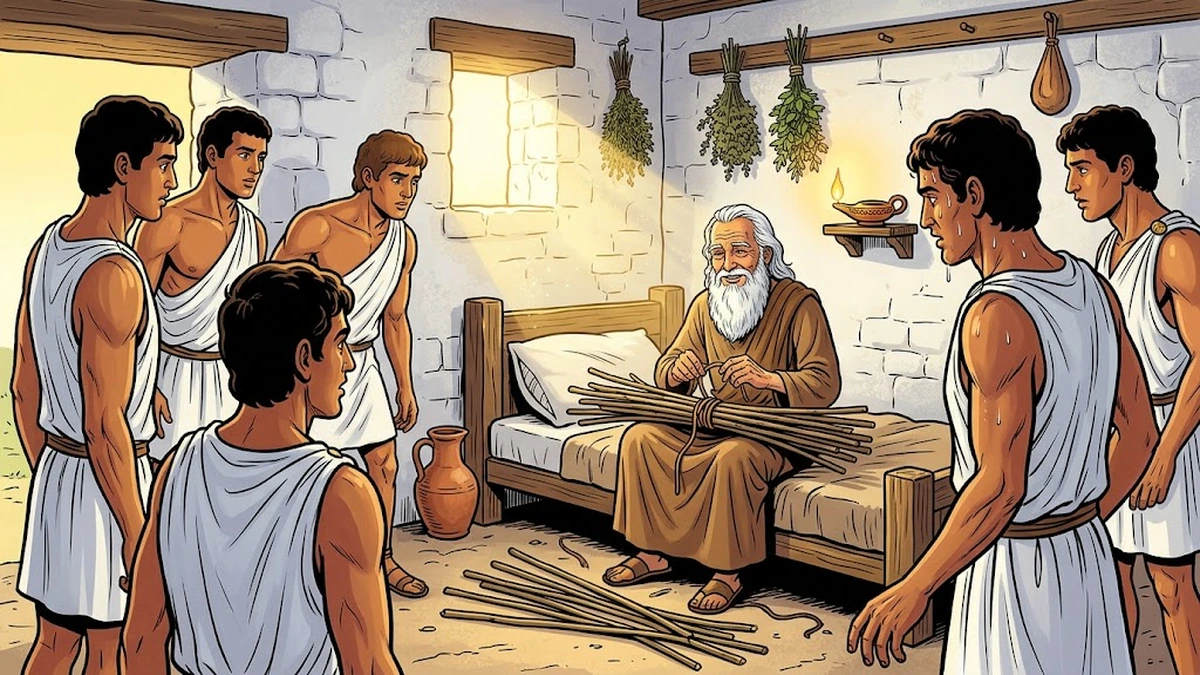
The old farmer, smiling the same weary fond smile, reached down with his thin trembling hands, untied the leather cord, and let the bundle of sticks fall apart into a small loose pile of perhaps a dozen single thin dry olive sticks on the floor by his bed. He picked up a single stick, in his thin old hands, and held it out to the eldest son.
“My eldest,” the old farmer said. “Now take this single stick, in your strong young hands, and break it.”
The eldest son took the single stick. He set it across his strong young knee. He pressed — and the stick snapped, with a small dry quiet crack, into two pieces.
The old farmer, slowly and patiently, handed each of his five sons a single stick from the broken bundle. Each of them, in his strong young hands, snapped the stick easily across his knee — crack, crack, crack, crack, crack. Five small dry sounds. Five broken sticks. The pile of broken sticks lay on the floor by the old farmer’s bed.
The old farmer, smiling now with the small clear quiet authority of a father who has just taught his sons the most important lesson of their lives, looked at the five strong young men one by one, and said in his weak old voice the words that have come down to us, in some form or other, in every retelling of this fable for two and a half thousand years:
“My sons. So long as the five of you stay bound together, like this bundle of sticks, no force on Earth — not poverty, not enemies, not bad weather, not bad fortune, not even the death of your father — will ever break you. But the moment you allow your quarrels to untie you from each other — the moment you let yourselves fall apart into single sticks, each of you alone — the smallest pressure of the smallest hand will snap each of you, in turn, with the small dry quiet crack you have just heard five times on the floor of this room. Stay tied together. That is my last lesson. That is my whole inheritance. And that is everything I have ever wanted to teach you.”
The old farmer, the old tellers said, lay back on his low wooden bed, smiled the same weary fond smile one last time at his five strong young sons, closed his eyes, and died — peacefully, in the quiet whitewashed room of the small stone farmhouse, on the bright autumn afternoon — with the small pile of five broken sticks lying on the floor beside him, and the unbroken bundle of his five strong sons standing tied around his bed.
The five sons, the old tellers said, never quarrelled again as long as they lived.
The Moral
The Greek prose Aesopica preserves the moral in this form:
“Ho mythos deloi hoti tosouton ischyroterai eisin hai homonoiai, hoson hai diaphorai astheneis.”
“The fable shows that concord is as strong as discord is weak.”
And La Fontaine, in his celebrated French verse Fable IV.18 (1668), preserves the same teaching in the closing line: “Toute puissance est faible à moins que d’être unie” — “All power is weak unless it is united.” The pithy modern English form, descending through Croxall and Jacobs and engraved on the seal of every nation that has ever called itself a federation:
“United we stand. Divided we fall.”
And the Sanskrit teachers in India, who taught the same teaching in the language of the Mahabharata and the Pancatantra, summed it up in three words: sanghe shaktih kalau yuge — “in the age of strife, the strength is in unity.”
Why This Story Has Lasted
It has lasted for two and a half thousand years because every parent who has ever watched siblings fight over an inheritance, every coach who has ever spoken to a divided team, every general who has ever rallied a fractured army, every teacher who has ever broken up a quarrelling classroom, every leader of every nation who has ever called a divided people back to common purpose — already knows, in his bones, the small dry quiet crack of the single stick breaking, and the slow patient strength of the bundle that will not break. The fable is not really about sticks. The fable is about families. The fable is about teams. The fable is about armies. The fable is about peoples. The fable is about every group of human beings who have ever, in all of history, stood together stronger than they ever stood alone.
Two and a half thousand years after Aesop, twenty-three hundred years after Babrius, three hundred and fifty years after La Fontaine, in our own age of factions and feuds and fractured nations and split families and broken teams and divided peoples — the small clear voice of the dying old farmer on his low wooden bed in the small whitewashed room of the stone farmhouse in central Greece is still telling us, in our own language and in every language on Earth, the same five-word lesson:
Stay tied together. Stay strong.
You May Also Like
 Aesop's Fables
Ages 3-5
Aesop's Fables
Ages 3-5
How Raja Rasalu Became A Jogi
How Raja Rasalu Became A Jogi: Then, after a time, Rasâlu went to Hodinagari. And when he reached the house of the beautiful far-famed Queen Sundrân, he saw an
 Aesop's Fables
Ages 3-5
Aesop's Fables
Ages 3-5
At The Airport Lounge
At The Airport Lounge: Her connecting flight to London was after six hours. Sia was sitting in Doha airport lounge, lazily watching the hustle-bustle of
 Aesop's Fables
Ages 3-5
Aesop's Fables
Ages 3-5
Internet- The life Saver
Internet- The life Saver: While friends of her age would throw out parties, hang on movie theaters, enjoy weekends in pubs and coffee shops, she would savor