The Ant and the Dove
The Ant and the Dove: On a warm and sunny morning, a tiny ant was making her way through the tall grass near the bank of a wide, sparkling river. The day was
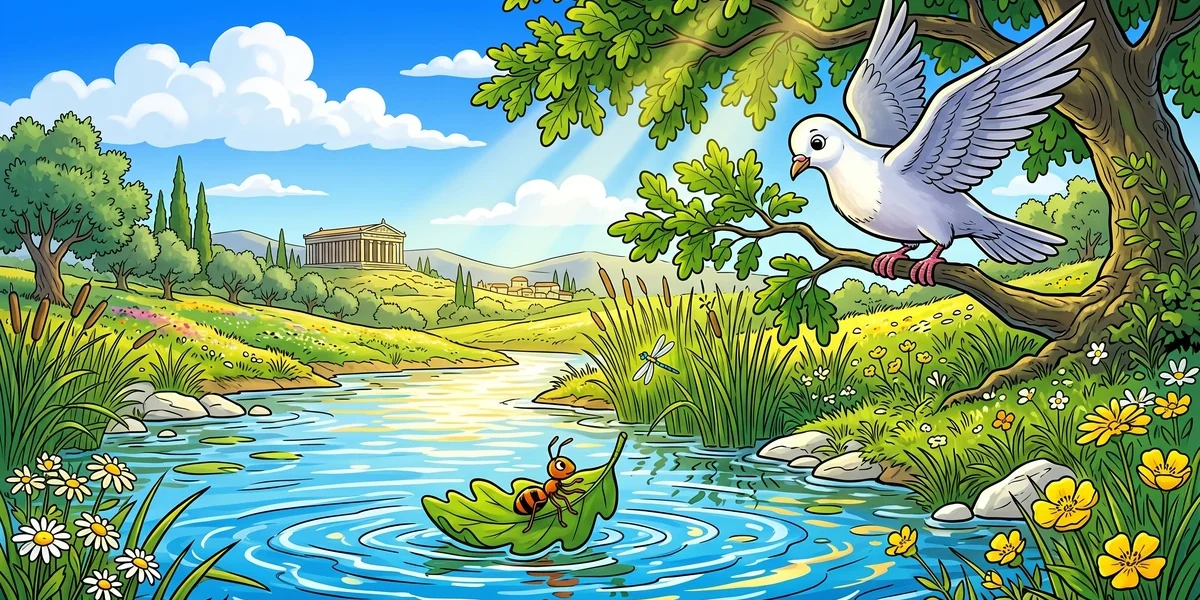
This is one of the simplest and most beloved of all the fables in the Aesopic corpus, and one of those rare teaching-tales that has spoken with equal clarity across every culture, every century, and every language it has ever entered. It is a story of two creatures so small and so different that, in the ordinary way of the world, they could never have anything to do with each other — and yet whose lives, by the smallest of accidents, are bound together for one bright afternoon in a way that has been remembered for two and a half thousand years. The fable belongs to Aesop, the Greek storyteller of the sixth century BCE, in whose corpus it is catalogued as Perry 235 under the Greek title Myrmex kai peristera — “The Ant and the Dove.”
The principal Greek source-form survives in the Augustana recension of the prose Aesopica (1st-2nd c. CE). It does not appear in the surviving books of Phaedrus, but enters Latin through the medieval Romulus collections (4th-10th c.) and is preserved in the verse-Aesop of Walter of England (12th c.) and the Ysopet of Marie de France. It came into modern English through William Caxton’s first printed Aesop in 1484, then Roger L’Estrange (1692), Samuel Croxall (1722), Thomas Bewick (1818), and Joseph Jacobs (1894). And most beautifully of all, Jean de La Fontaine retold it in his celebrated French Fables as Book II Fable 12 — La Colombe et la Fourmi — which has remained one of the most-anthologized French fables of all time. It is classified in the Aarne-Thompson-Uther index as type ATU 235, with the corresponding Stith Thompson motif B362 (Animal grateful for rescue from water) appearing in story-traditions from Greece to India to China to the Native peoples of North America.
This is the story.
The Thirsty Ant

It happened, the old tellers said, on a hot bright summer afternoon in the rolling green meadows of central Greece, perhaps in the foothills of Mount Olympus, perhaps in the gentler hills of Boeotia where Hesiod had sung his songs of farms and bees and seasons three centuries before Aesop. The sun was high. The cicadas were humming in the cypress trees. The grass was tall and dry and golden, and through the dry golden grass, in the slow patient steady way that ants have always moved, a small orange-and-black worker ant was making her way home with a single fat brown grain of wheat held between her small black jaws.
She had been at work since dawn. She had walked, by her own small ant-reckoning, perhaps three hundred ant-paces from the wheat-field where she had gathered the grain back toward her colony in the meadow. She had not eaten. She had not drunk. The afternoon sun beat down on her tiny shining black thorax, and the slow dryness that comes to all small creatures in the heat of a long Greek summer afternoon had begun, slowly, to spread through her tiny body.
And so when, at the bottom of a small slope in the meadow, she came upon a sparkling clear blue stream running down between green reeds and wild yellow flowers, she set her grain down carefully on the dry grass at the bank, and she crept down to the very edge of the cool clear water, and she bent her tiny head to drink.
The Slip

The water was beautiful. It was cool. It was clear. It tasted of the high white limestone of the mountains where it had begun. The ant drank in the slow grateful way of a creature who has been very thirsty for a very long time, and she felt the cool wet of it spread down through her small dry body and revive her.
And then, the way these things sometimes happen, she leaned just a little too far forward over the surface of the water — and the smooth wet stone under her front legs gave way beneath her — and the ant, with a single small thin cry that no creature larger than another ant could possibly have heard, slipped off the edge of the stream and tumbled into the cold rushing water.
The current took her at once. She was, as ants are, no heavier than a single drop of summer rain; she was, as ants are, no stronger against running water than a small fragment of dust. The cool clear stream, which a moment before had been her drink, was now an ocean. She kicked her six legs. She struggled. She rose to the surface and went under and rose again. The current spun her, swept her along the bank, dragged her past the reeds and the yellow flowers, carried her in a small black-and-orange tumble down the silver-blue rush of the stream.
And the ant, who had never imagined when she set out from her colony that morning that she would die today, understood with the small clear certainty of all dying creatures that she was about to die.
The Dove on the Branch
But there was, the old tellers said, on a low overhanging branch of a great green oak tree leaning out over the very same stream, perhaps thirty paces downriver from the place where the ant had fallen in, a beautiful white-and-grey dove.
The dove was a young one — perhaps a year and a half old — with the smooth white breast and pale grey wings of her kind, and bright pink feet that gripped the rough grey bark of the oak branch, and round black eyes set on either side of a small kind face. She had been sitting on the branch since shortly after noon, preening her white feathers in the warm summer sunlight, and watching, in the casual idle way of a dove who has nothing in particular to do on a hot summer afternoon, the bright sparkles of light moving on the surface of the stream below her.
It was her bright black eye that caught, perhaps a hundred paces upstream, the small black-and-orange shape struggling in the water.
The dove did not know, of course, what an ant was. The dove had never met an ant in her life. The dove only saw, in the small clear logic of a dove’s mind, that there was a small creature in the water who was struggling, and who would, in a few moments, be no longer struggling — would slip under the surface, would not rise again, would be carried into the silent silver-blue rush of the stream and disappear forever into wherever it is that small drowned creatures disappear into.
And the dove — although she could not have said why, although she did not even know what the small creature was — felt, in her own small kind dove-heart, the simple universal pull that one creature feels for another creature in trouble.
The Leaf

She moved without thinking. With her sharp grey beak she reached up to the green oak leaves that grew in clusters above her on the branch, and she gripped a single broad fresh green oak leaf at its small brown stem, and she snapped the stem cleanly off, and with a single small flick of her beak she dropped the leaf down through the warm summer air toward the rushing surface of the stream below.
The leaf turned once in the air. It caught the bright sunlight on its broad green top and on its pale silver-green underside. And it landed, with a soft small plot that the dove could not hear from her branch, on the surface of the water just three ant-lengths in front of the floundering ant.
The ant, with the last of her strength, with her six small legs flailing, with her small black-and-orange body half-submerged, with her tiny mouth open in something that was almost a final cry — saw the green leaf land on the water in front of her.
She kicked toward it. She caught at its near edge with one front leg. She caught at it with another. She pulled herself, with a strength she did not know she had, up out of the cold rushing water and onto the broad flat dry green surface of the leaf. And the leaf, in the gentle current of the stream, carried her — like a tiny green raft, like a small clear miracle, like the simplest answer to the most desperate prayer that a small creature has ever made — slowly and steadily across to the safe sun-warm grass of the riverbank.
The ant climbed, dripping wet and trembling, off the leaf and onto the dry grass. She stood very still. She was alive.
The Ant’s Silent Vow
She looked up. High above her on the oak branch, the white-and-grey dove was watching her with the round bright kind black eye of a creature who had no idea what she had just done but knew, in some small way, that the small black-and-orange shape on the bank was no longer in trouble, and that this was the way the world ought to be.
The ant could not speak. The ant could not, in any case, have spoken in the language of the dove. The ant could not bow. The ant could not raise a tiny hand in thanks. The ant could only look up at the dove on the branch with two bright small black eyes that, for one short moment in the long history of the world, contained the entire weight of a creature’s gratitude for a kindness done freely and asked of no one.
And the ant made, in her tiny ant-heart, a small silent vow. She did not know how. She did not know when. She did not know whether she would ever, in the long brief life of an ant, see the white-and-grey dove again. But she made, with the small clear certainty of her small bright mind, a single quiet promise: If ever, in any way, by any means, I can repay this kindness — I will.
She turned. She made her way back up the slope of the meadow, found her brown grain of wheat where she had left it, picked it up between her small black jaws, and walked, alive and grateful, back home through the long dry golden grass to her colony.
Some Days Later — The Hunter
Some days passed. Three, perhaps. Or five. The old tellers were never quite specific.
The ant returned to her gathering of grain in the meadow. The dove returned to her branch in the oak tree. The summer sun moved slowly across the sky as it has always moved. The cicadas hummed in the cypress trees. And the small kindness of the dropped leaf — which had been the largest event in the small life of the ant, but had been already half-forgotten in the small mind of the dove — settled, in the quiet way that small kindnesses always do, into the slow steady weave of the world.
And then, on an afternoon perhaps four days after the rescue, while the ant was once again gathering grain along the edge of the wheat-field, she happened to look up — and she saw, creeping through the dry summer grass with the slow careful tread of a man stalking his quarry, a tall lean weather-tanned hunter in a short brown leather tunic and red leather boots, carrying a long polished wooden bow in one hand and a single sharp bronze-tipped arrow in the other.
The hunter’s eyes were narrow. His face was set. He was, with the long patient practised grace of a Greek mountain-hunter, stalking something. The ant, who was small enough to be invisible to him, paused in her gathering of grain and turned to look in the direction of his careful steady approach.
And there on the same low overhanging branch of the same great green oak tree, preening her white-and-grey feathers in the warm summer sunlight, completely unaware of the man with the bow steadily advancing through the grass below — was the dove.
The Hunter’s Aim
The hunter stopped. He fitted the sharp bronze arrow to the long polished bow. He raised the bow. He drew the arrow back, slowly and steadily, fully to his weather-tanned cheek. His narrowed black eyes fixed on the white-and-grey shape of the dove on the branch. His breath steadied. His arms held the great wooden bow as still as the trunk of an oak tree. The arrow was an instant from flying.
And the ant — the tiny orange-and-black ant who weighed, on the grand scales of the world, no more than the smallest sliver of a grain of wheat — understood at once what was about to happen.
The Ant’s Bite
She did not hesitate.
She set down her grain. She crossed the dry grass at the very best speed an ant can manage, which is, by the standards of larger creatures, not very fast — but she crossed it, and she came to the lean brown bare ankle of the standing hunter just above the top of his red leather boot, and she climbed up the warm dry skin of his ankle in three quick scrambles, and she opened her tiny black ant-jaws as wide as she possibly could, and she bit him.
She bit him with everything she had. She bit him with all the small strength that a creature the size of a poppy-seed can summon. She bit him as if her bite were the only bite in the world.
The hunter cried out in pain.
His weather-tanned face winced. His drawn-back bow-arm wobbled. The sharp bronze arrow, which had been an instant from flying straight at the dove on the branch, flew wildly off-line — past the oak tree, past the dove, past everything it had been aimed at — and disappeared into the bushes thirty paces away with a small useless rustle.
And the dove — alerted by the sudden sharp human cry of pain at the foot of the oak tree — opened her white wings, lifted herself off the branch in a single startled beat, and flew up and up and up into the bright blue sky and away over the meadow toward the safety of the deep forest beyond.
The Last Words
The hunter rubbed his ankle. He muttered something. He looked at the bushes where his arrow had gone. He looked at the empty branch where the dove had been. He looked, although he never noticed her, down at the grass at his feet where the small orange-and-black ant — the small orange-and-black ant whose name no one had ever asked, whose existence no one had ever counted, whose life would have ended on no one’s calendar — was already slipping quietly back into the grass to retrieve her grain of wheat.
The hunter shook his head. He picked up his bow. He went off into the bushes to look for his arrow. He did not, in his whole long hunter’s life, ever quite work out what had happened to him on that warm afternoon at the edge of the meadow. He knew only that he had felt a sudden small sharp bite at his ankle, and the dove had flown away, and the day’s hunt had been spoiled by something that no one in the village would believe if he told them.
Up above, far away over the cypress trees, the white-and-grey dove circled once on her white wings, looked back down at the small green meadow she had once flown over so many times, and turned at last toward her safe high tree in the deep forest.
And down below, walking slowly through the dry golden grass with her single brown grain of wheat once more held safely between her small black jaws, the orange-and-black ant — who had repaid, exactly and completely, the kindness that had once been done for her — went home to her colony.
And the small clear teaching of the world had been completed.
The Moral
The Greek prose Aesopica preserves the moral in this form:
“Ho mythos deloi hoti he agathe praxis antididousa.”
“The fable shows that a good deed is repaid in kind.”
And La Fontaine, in his celebrated French verse Fable II.12 (1668), preserves the moral in two lines that have lived in French schoolrooms for three hundred and fifty years:
“Petit animal, mais qui sait à propos / Reconnaître son créancier.”
“A small creature, yet one who knows in due season how to repay her debt.”
The pithy modern English form, descending through Croxall and Jacobs, is the proverb every English-speaking child has heard:
“One good turn deserves another.”
And the Sanskrit teachers in India, who never heard of Aesop or La Fontaine, taught the same thing in two words: upakara-smaranam — “the remembering of a kindness received.” And the related virtue, kritajñata — gratitude — is one of the highest of all the virtues in the Indian wisdom tradition. It is the same teaching in a different tongue, on a different continent, in a different millennium. And the deepest teaching of the fable, perhaps, is simply this: that no one is ever too small to repay a kindness, and no kindness, given freely, is ever truly lost.
Why This Story Has Lasted
It has lasted for two and a half thousand years because it is one of those rare small teaching-tales that contains, in its quiet handful of lines, the entire deepest secret of how the social world actually works. The dove dropping the leaf does not know what she is doing. She does not calculate. She does not weigh the future return. She simply sees a small creature in trouble and does the one small thing that is in her power to do for that creature, and then forgets about it, and goes back to preening her feathers in the sun. The ant, days later, does not have to be reminded. She does not have to consult a ledger of small debts. She sees the hunter’s bow drawn back, and she remembers, in the small bright honest part of her ant-mind, the leaf that fell on the water, and she climbs the hunter’s ankle without hesitation and she bites him with everything she has.
This — this small unspoken web of remembered kindnesses, this is what holds the world together. Not laws. Not contracts. Not the careful weighing-up of debts at the end of each fiscal year. The world is held together, the fable tells us very quietly, by the small steady accumulating weight of every small good thing one creature ever did for another creature when no one else was looking, and by the small steady honourable returning of that small good thing back, in due season, when the chance comes. The ant cannot, by any honest reckoning, ever truly repay the dove. The dove gave the ant her whole life. The ant can only spoil one shot. But the ant gives what she has, and what she has is enough — because in the small bright clean economy of mutual kindness, what one gives is not measured by its size but by the wholeness with which it is given.
Two and a half thousand years after Aesop, three hundred and fifty years after La Fontaine, in our own age of contracts and metrics and loyalty programmes — the small clear voice of the ant and the dove is still telling us the same thing. Drop the leaf. Bite the ankle. Do not ask, when the chance comes to repay a kindness, whether the original kindness was greater than what you have to give. Give what you have. The world will hold itself together, slowly and patiently and one small returned kindness at a time, by exactly such small returns.
And no one — no one — is ever too small to repay a kindness.
Frequently Asked Questions
What is the moral of The Ant and the Dove?
Who wrote The Ant and the Dove?
What is the story of The Ant and the Dove?
What lesson does The Ant and the Dove teach kids?
Why is The Ant and the Dove a great bedtime story?
You May Also Like
 Aesop's Fables
Ages 3-5
Aesop's Fables
Ages 3-5
Aspirations A Tale Of Two Women
Aspirations A Tale Of Two Women: Ramya looked out of her window at the park below. It would be 4 years today since she entered her “new home”. Although she was
 Aesop's Fables
Ages 3-5
Aesop's Fables
Ages 3-5
The Magic Fiddle
The Magic Fiddle: Once upon a time there lived seven brothers and a sister. The brothers were married, but their wives did not do the cooking for the family.
 Aesop's Fables
Ages 3-5
Aesop's Fables
Ages 3-5
Re-uniting old friends through social media
Re-uniting old friends through social media: The air was very clear and the long morning shadows distinct through the windows. Rays of sun shining through them