The Fox and the Grapes: Pride, Desire, and Self-Deception
The Fox and the Grapes: Pride, Desire, and Self-Deception: Autumn had arrived in the woodland with a quiet intensity, painting the leaves in shades of amber

This is one of the oldest stories in the world. It comes to us from the Greek storyteller Aesop in the sixth century before Christ, was set down in Greek prose in the Augustana recension of the Aesopica around the second century after Christ, given a graceful Greek choliambic verse-form by Babrius as Fable 19, and was lifted into the Latin tradition by Phaedrus in his fourth book of Fabulae (poem III, De Vulpe et Uva) in the early first century. From there it travelled into the medieval West through the Romulus prose-collections, the verse-Aesop of Walter of England, and the Ysopet of Marie de France, into the first printed English Aesop by William Caxton in 1484, and into Jean de La Fontaine’s famous French Fables Book III fable 11 in 1668, where it received its most beloved modern form. Two and a half thousand years after Aesop first told it on a Greek hillside, the closing line of this fable has given English an idiom — sour grapes — that is now used a thousand times a day by people who have never even heard of the fox.
This is its story.
The Fox on a Hot Afternoon

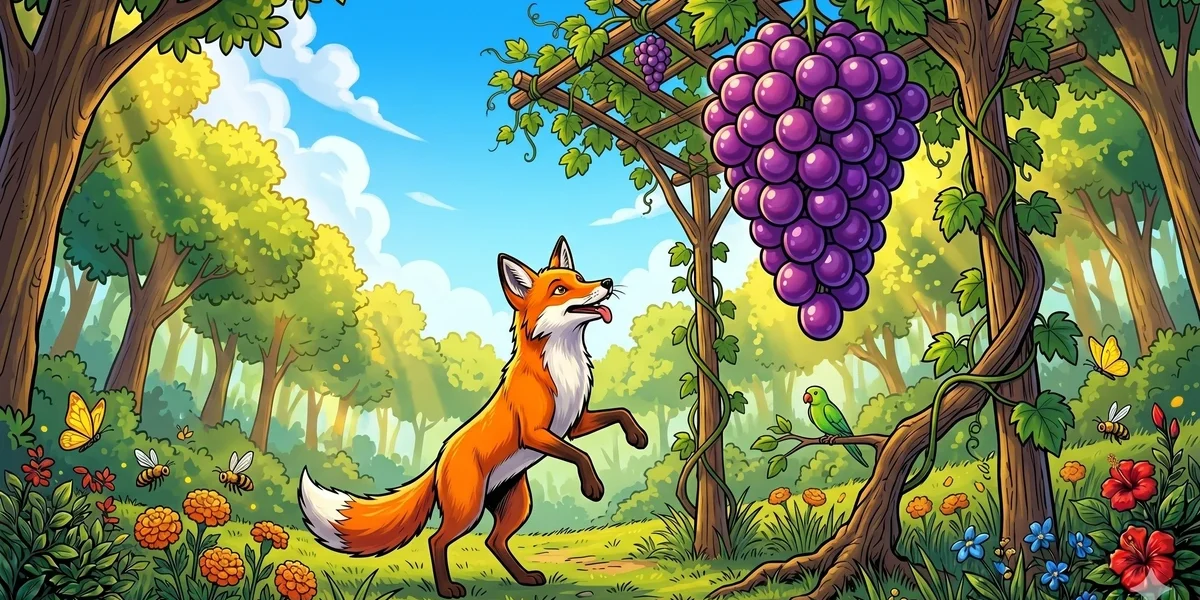
A long bright golden afternoon in the forest. The sun lay heavy and warm on the green leaves of the trellised vine, and a soft hum of bees rose from the marigolds along the forest path. Down this path, with his bright orange coat shining and his white-tipped tail held low, came a fox.
He was a young fox in the strength of his legs and the brightness of his eye, but on this afternoon he was hungry — hungry in the way that only a fox who has hunted all morning and caught nothing can be hungry. His belly was light and empty, and his sharp teeth ached for something sweet to bite into. He padded down the forest path with his ears pricked, and he was thinking, as foxes do, about food.
And then he stopped.
Above him, on a tall wooden trellis that climbed high into the branches of an old tree, hung a great cluster of grapes — deep purple grapes, fat and round and shining in the sunlight, each one the size of a small plum, gleaming as if it were polished. The cluster was huge. The fox stared up at it, and his pink tongue came out and licked his chops, and his bright dark eyes shone like wet stones.
“Now that,” he said softly to himself, “is what I have been looking for all morning.”
The First Leap

The fox crouched low on his haunches, gathering all the spring of his back legs into a coiled spring of muscle. His eyes never left the grape-cluster. He was a young fox and a strong fox, and he could leap, when he wanted to, the height of two grown men.
And then he leapt.
He flew straight up into the warm afternoon air, all four paws off the ground, his orange body stretched long and his pink tongue hanging out, his front paws reaching with their little black claws toward the purple cluster. The leaves of the trellis rustled. The bees rose in a startled hum. The fox’s claws clicked through the empty air just below the lowest grape — and he came down again, his paws thumping into the grass.
He looked up. The grapes were still there. They had not even moved.
“Hm,” said the fox, and he gathered himself again.
The Second Leap
This time he leapt harder. He pushed off with everything he had, and he flew higher than he had flown the first time. The forest spun for an instant around him. His front paws stretched and stretched, and one of his claws, just for an instant, brushed the very lowest stem of the grape-cluster — and then he was falling again, falling back to the warm grass with a thump that knocked the breath out of him.
He sat down in the grass, panting, his tongue hanging out long and pink, his sides heaving. He had nearly had them. Nearly.
Above him, the grapes shone in the sun, untouched.
The Third and Fourth Tries
He tried again. And again. And then again. He leapt and he leapt, four times, five times, six times, until the grass beneath the trellis was flattened in a wide green circle, until his orange coat was matted with sweat, until his bright dark eyes were dull with frustration, and until his strong young legs simply would not lift him another inch into the air.
The fox sat down hard in the grass. He was so tired he was trembling. He lifted his face one more time and looked up at the great cluster of purple grapes hanging above him in the sunlight, and the grapes hung where they had hung when he first walked down the path — quite still, quite untouched, quite uninterested in him.
And the fox understood, in that moment, that he was not going to get them.
The Walk Away

He sat there for a long minute in the warm green grass, panting, looking up at what he could not have. His mouth, which had watered all afternoon, watered no more. The grapes hung above him as out of reach as the moon. There was no leap left in his legs.
And then the fox did a curious thing — a thing that you and I have done a thousand times, though we may not always have known we were doing it.
He stood up. He brushed the green grass from his orange coat. He lifted his nose into the air with what he hoped was great dignity. And he turned to walk away down the forest path.
And as he walked, he said, in a voice meant to be carrying and confident and quite untroubled — meant to be heard by anyone who might be watching, and meant most of all to be heard by himself —
“Pah! They were probably sour anyway.”
What the Fox Knew

And here is the thing.
The fox had wanted those grapes. He had wanted them with every fibre of his orange coat. His mouth had watered for them. His legs had ached for them. He had thrown the whole strength of his young body into the air four times, five times, six times, just to get to them. He had wanted them more than he had wanted anything else that whole hot afternoon.
And yet, the moment he understood that he could not have them, the moment his pride stood in the grass and said no, I cannot reach, his story about the grapes changed. They were no longer the most desirable thing in the forest. They were no longer fat and round and shining like jewels. They were no longer worth any leap at all.
They were, suddenly, sour.
The fox walked away down the forest path with his nose held high, and as he walked he half-believed his own little speech. He had to. To admit that he had wanted what he could not have — to walk through the forest knowing that those bright sweet grapes had simply been beyond him — was a thing his fox-pride was not strong enough to bear.
So he gave himself a story instead. The grapes were sour. He had not really wanted them. He was glad to walk away.
And as he disappeared down the path, deep purple grapes still gleamed in the sun behind him, untasted, unsoured, still as sweet as any grapes anywhere in the world.
The Moral
The Greek prose Aesopica preserves the moral as: οὕτω καὶ τῶν ἀνθρώπων ἔνιοι τῶν πραγμάτων ἐφικέσθαι μὴ δυνάμενοι δι᾽ ἀσθένειαν τοὺς καιροὺς αἰτιῶνται — houto kai ton anthropon enioi ton pragmaton ephikesthai me dynamenoi di’ astheneian tous kairous aitiontai — “and so some people, when they cannot reach the things they want because of weakness, blame the circumstances.”
La Fontaine, two thousand years later, ended his French verse with the line that the world has remembered:
Fit-il pas mieux que de se plaindre?
Ils sont trop verts, dit-il, et bons pour des goujats.
“Did he not do better than to complain? — ‘They are too green,’ he said, ‘and good only for ruffians.'”
The pithy modern English schoolroom form, descending through Croxall and Jacobs, is even shorter:
It is easy to despise what you cannot get.
Why This Story Has Lasted
It has lasted for two and a half thousand years because it tells a perfectly true thing about the human heart in the disguise of a fox in a forest. We have all been the fox. We have all wanted something — a job, a friend, a love, a house, a life — that we could not, in the end, have. And we have all, in the moment we understood we could not have it, told ourselves the small bright lie that we did not really want it after all. We told ourselves the grapes were sour. We told ourselves we had walked away by choice. We told ourselves it was for the best. And sometimes, looking back, we even came to half-believe it.
This is not a wicked thing. The fox is not a wicked fox. He is a tired and hungry fox who has tried his best and failed, and who is doing the only thing his pride knows to do, which is to dress his disappointment in better clothes than it deserves. And we, who have all done the same, recognise him.
The fable is gentle with the fox. It does not call him a liar. It does not say he is bad. It only points, very quietly, at the small ordinary deception that follows ordinary disappointment everywhere — and it gives us, two and a half thousand years later, a name for it. Sour grapes. Two words that we still use every single day, two words that no other fable has given the language as cleanly, two words that say in a breath what would otherwise take a paragraph: I told myself I did not want it, but I did.
And that is why, of all the hundreds of fables in the Aesopic corpus, this is one of the small handful that the world has carried with it down the centuries — because it gave us not just a story but a way of seeing ourselves, and a phrase to see ourselves by. The fox is gone. The grapes are gone. The trellis is gone. But the words remain.
And every time we use them, the small orange fox is walking, just a little, in our forest.
Frequently Asked Questions
What is the moral of The Fox and the Grapes?
Who wrote The Fox and the Grapes?
What happens in The Fox and the Grapes?
What does 'sour grapes' mean and where does the phrase come from?
What lesson does The Fox and the Grapes teach kids?
You May Also Like
 Aesop's Fables
Ages 6-8
Aesop's Fables
Ages 6-8
Mr Mighty Of His Mouth
Mr Mighty Of His Mouth: In two adjoining villages there lived two famous men. The one was called Mr. Mighty-of-his-mouth - one that could accomplish wonders
 Aesop's Fables
Ages 3-5
Aesop's Fables
Ages 3-5
Infidelity – A Short Story
Infidelity – A Short Story: I looked through the partly opened door. I found her sliding through our old pictures. Her fingers paused on each one. Her light
 Aesop's Fables
Ages 3-5
Aesop's Fables
Ages 3-5
The Close Alliance A Tale Of Woe
A farmer’s bullocks lead him into a crocodile-infested river—a parable of how bad companions drag the virtuous toward ruin.