Red A Fairy Tale
Red A Fairy Tale: Not very long ago, there lived a girl called Red, with her brother, Chad, and her mother, in a small house in a very small town situated near
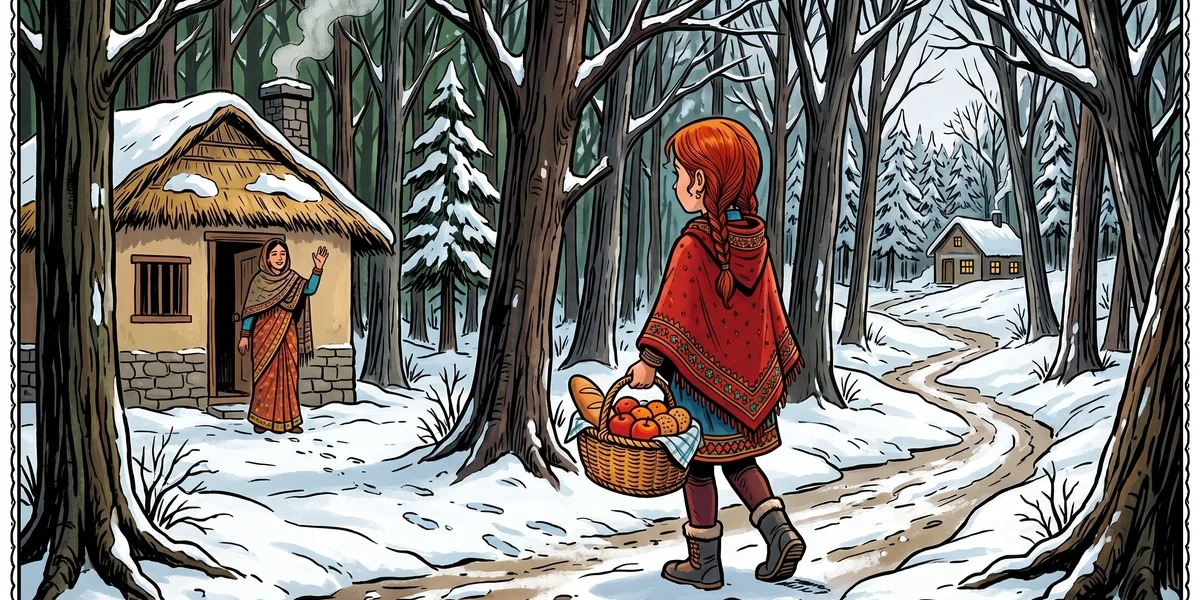
Red: A Fairy Tale — The Semiotics of Scarlet in Folk Narrative
Red in World Fairy Tale: A Colour That Carries Everything
No colour in the fairy tale tradition carries more freight than red. It is simultaneously the colour of blood and roses, danger and desire, the life-force and its violation. When Charles Perrault gave his 17th-century heroine a red hood, he was not making an arbitrary costume choice: he was investing his protagonist with a chromatic symbol that his audience would have recognised immediately as marking a threshold figure — someone poised between the safe and the dangerous, the domestic and the wild, the innocent and the knowing.
The semiotician Vladimir Propp observed that folk tale figures are defined by their attributes as much as by their actions — and the red-cloaked girl’s attribute is her most important narrative fact. Red in the European fairy tale tradition is the colour of the liminal: the hood marks its wearer as someone in transition, crossing from one state to another, on a journey between two worlds (the village and the forest, the domestic and the wild, childhood and sexual maturity, safety and danger). The colour does not define what the transition will be; it marks that a transition is underway.
In Chinese tradition, red is the colour of luck, celebration, and auspiciousness — worn at weddings and festivals, hung at doors to attract prosperity. In South Asian tradition, red sindoor marks the married woman; red kumkum adorns the deity; red is the colour of Shakti, the divine feminine power. In ancient Rome, red was the colour of military triumph and imperial authority — the general’s cloak, the emperor’s sandals. In each tradition, red is not merely decorative: it is semantically loaded, carrying a specific cultural payload that shapes how the red-marked figure is perceived and what is expected of them.
The Little Red Riding Hood Archetype: Desire, Danger, and the Forest
The tale that most fully exploits red’s symbolic density in world folk narrative is Little Red Riding Hood — known in French as Le Petit Chaperon Rouge (Perrault, 1697), in German as Rotkäppchen (Brothers Grimm, 1812), and in oral variants documented across European and Asian folk traditions. The tale’s core structure is deceptively simple: a girl in red travels through a forest, encounters a predator who disguises himself as her destination (grandmother), and is either consumed or rescued (the ending depends on the version).
The red hood is the tale’s central symbolic object. Perrault’s version makes the hood the girl’s defining attribute — it is literally her name, “Little Red Hood.” The hood was given to her (in most versions, by her mother or grandmother), which means the red mark was not chosen by the girl but conferred upon her. She is red-marked before she has done anything to earn the marking. This is important: the colour is not a badge of achievement or transgression but a symbol of a status she occupies before the story begins. She is already marked as a transitional figure before she sets foot in the forest.
What does the red mark? Different interpretative traditions have emphasized different readings. The psychoanalytic tradition (Bruno Bettelheim, in The Uses of Enchantment) read the red hood as a symbol of menstrual blood and the onset of sexuality — the girl is newly red-marked, newly entering the adult world, and the forest encounter with the wolf is the story of what happens to the unguarded young woman who does not yet understand the dangers her new status brings. The feminist retellings (Angela Carter’s The Company of Wolves, for instance) invert this: the red-cloaked girl is not merely vulnerable but also powerful, her redness a sign of vitality rather than only danger.
“She wore red because she was not yet afraid. She wore red because she was already brave. She wore red because the forest needed to know what was coming. The colour did not belong to danger — it belonged to her.”
The Retelling as Interpretive Act: Stripping and Reinvesting Red
Every retelling of a fairy tale is an interpretive act — a choice about which of the original’s semantic layers to preserve and which to strip away, and what new layers to add in their place. The tradition of fairy tale retellings is itself a form of cultural conversation: each era’s retellings reveal which aspects of the original story the new era finds resonant, troubling, insufficient, or in need of correction.
The retelling titled simply “Red” participates in this conversation by foregrounding the colour itself as the story’s subject rather than its incidental attribute. When the title is the colour, the retelling announces its intention: to examine what the colour means, to interrogate the symbolic freight that has been loaded onto this small chromatic fact across centuries of telling, and to arrive at a new relationship with what red means for the story’s protagonist.
In the most interesting retellings, red shifts from being a mark of vulnerability (the girl who does not know the forest, who can be preyed upon) to a mark of knowledge and power (the girl who knows the forest, who has claimed her redness rather than being assigned it). This shift is not merely feminist revision for its own sake: it is an engagement with the genuine ambiguity that the colour always carried. Red was never only danger. It was also fire, heart, and the life-force itself. The retellings that emphasise these aspects are not distorting the tradition; they are recovering one of its buried layers.
What Colour Does in Story: The Semiotics of Narrative Marking
The study of colour in narrative — what semioticians call chromatic symbolism — reveals that colours in folk tradition are not decorative but functional. They do work in the narrative: they pre-mark characters with symbolic meaning before the plot unfolds, so that the audience knows what to expect and what to attend to. The golden hair of the fairy tale princess signals her divine or royal nature; the black cloak of the villain signals his affiliation with the dark forces; the white of the swan maiden signals purity and transformation.
Red’s function in this system is specifically to mark the threshold: the figure in red is always crossing something, always between two states. The red of blood marks the crossing from life to death; the red of the wedding sari marks the crossing from maiden to wife; the red of the new year decoration marks the crossing from the old year to the new. The red-cloaked girl in the forest is crossing from the world she knows into one she does not — and the colour tells the audience that this crossing is the story.
For children hearing fairy tales, these chromatic cues are absorbed long before they can be articulated. The child who hears about the girl in the red hood knows, on some pre-verbal level, that this colour matters, that this figure is marked, that the forest holds something this colour is moving toward or away from. The colour carries meaning that the words have not yet assigned. This is what makes colour such a powerful vehicle in folk narrative — and what makes the retelling tradition’s engagement with specific colours such a productive site of cultural and moral reflection.
Why This Story Lasted
Fairy tales built around chromatic marking have lasted because they exploit one of the deepest structures of human meaning-making: the assignment of moral and existential significance to colour. Red has been a culturally loaded colour in virtually every human tradition, and the stories that use it most deliberately — that make it not merely a descriptive detail but a symbolic argument — tap into this deep reservoir of pre-verbal meaning. “Red: A Fairy Tale” lasts because it continues to ask what the colour means, and because that question — about the relationship between a mark and what it signifies, between a symbol and who controls its meaning — is genuinely inexhaustible.
Frequently Asked Questions
What does the colour red symbolise in fairy tales?
In fairy tale tradition, red is a threshold colour — it marks figures in transition, crossing between two states or two worlds. It carries simultaneous and apparently contradictory meanings: danger and desire, vitality and transgression, the life-force and its violation. The red-cloaked girl in Little Red Riding Hood is simultaneously marked as vulnerable (a target for the wolf) and as vital (alive, warm-blooded, in motion). Red in folk narrative is not a simple moral symbol pointing in one direction; it is an ambiguous chromatic mark that acknowledges the complexity of the transitional state it signals.
How does the meaning of red differ across world cultures?
Red’s symbolic meanings vary significantly across cultural contexts. In Chinese tradition, red is auspicious — the colour of luck, celebration, and festivals; red envelopes carry gifts; red decorations mark important celebrations. In South Asian tradition, red is the colour of auspiciousness and divine power — sindoor marks the married woman, kumkum adorns deities, and red is associated with Shakti (divine feminine power). In European folk tradition, red carries more ambiguous meanings — simultaneously the colour of danger, transgression, desire, and vitality. In ancient Rome, red was imperial and martial. These differences make the cross-cultural study of red in narrative particularly rich.
What is the history of the Little Red Riding Hood story?
Little Red Riding Hood has a complex history across oral and literary traditions. Charles Perrault published a literary version in 1697 (Le Petit Chaperon Rouge) in which the girl is eaten with no rescue. The Brothers Grimm published their version (Rotkäppchen) in 1812, in which a huntsman rescues the girl from the wolf’s belly. Researchers have identified related oral tale variants across Europe and Asia, suggesting an ancient oral tradition predating either literary version. The tale has been retold and reinterpreted continuously, with feminist retellings (notably Angela Carter’s The Company of Wolves, 1979) reinvesting the red-cloaked protagonist with agency and power rather than vulnerability.
What is “chromatic symbolism” in literary and folk narrative study?
Chromatic symbolism refers to the study of how colours function as carriers of meaning in narrative and other symbolic systems. In folk and fairy tale study, colours are understood not merely as descriptive details but as functional narrative markers: they pre-assign symbolic meaning to characters or objects before the plot reveals their significance, and they carry culturally specific associations that the audience brings to the story. The golden hair of the princess, the black cloak of the villain, the white of the swan maiden, and the red of the threshold figure all perform this pre-signifying function — telling the audience what to expect and how to interpret what follows.
Why do retellings of fairy tales focus on specific symbolic elements like colour?
Retellings that foreground specific symbolic elements — like colour — do so because those elements carry a compressed history of interpretation and cultural loading that makes them productive sites for examination and reinvestment. When a retelling is titled simply “Red,” it announces its intention to interrogate the symbolic weight that has been assigned to this colour in the tradition, to ask who assigned it and why, and to explore whether the meaning can be shifted, recovered, or complicated. This kind of retelling is both a literary act and a cultural conversation — an engagement with the accumulated history of a symbol and an attempt to renegotiate its meaning for a new audience and context.
Frequently Asked Questions
**Q: Why is this story important?**
You May Also Like
 Aesop's Fables
Ages 3-5
Aesop's Fables
Ages 3-5
The Wind and the Sun
The Wind and the Sun: There was once an argument between the wind and the sun about who was stronger than the other. They argued for a long time but neither of
 Aesop's Fables
Ages 9-12
Aesop's Fables
Ages 9-12
The Wolf in Sheep’s Clothing
The Wolf in Sheep's Clothing: In the rolling hills of ancient Macedonia, where olive groves stretched across sun-baked valleys and shepherds tended their
 Aesop's Fables
All Ages
Aesop's Fables
All Ages
The Boy Who Cried Wolf
The Boy Who Cried Wolf: Age Group: 0-5 years. Aesop’s fables are ideal for bedtime stories and moral stories to teach kids simple lessons. Once there was a boy