Of Men and their Bragging
Of Men and their Bragging: Vora is tall, fair, well-built, voluble, friendly, full of I-factor – in short a fine specimen of masculinity. Vora always walked a
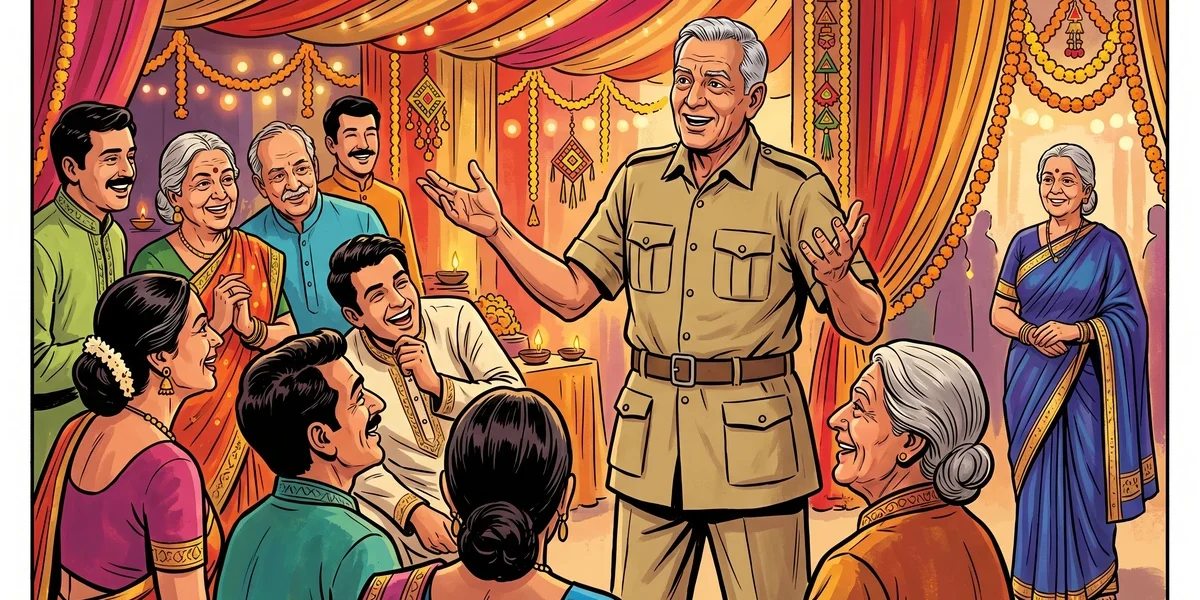
Of Men and Their Bragging: The Anthropology of Competitive Display
The Boast as Masculine Ritual: A Cross-Cultural Pattern
The folk tale tradition’s recurrent attention to “men and their bragging” is not accidental — it reflects a cross-culturally documented pattern in which competitive self-presentation is disproportionately characteristic of male social behaviour across many societies. Anthropologists, primatologists, and social psychologists have all noted that the display of status and capacity through verbal performance — through the boast, the claim, the narrative of one’s own achievements — is a recurring feature of male social interaction in a wide range of cultural contexts.
This does not mean that women do not boast (they do, though the social contexts and forms tend to differ), nor that all men brag (they do not). It means that the specific folk tale tradition of the humorous cautionary tale about boasting has, across many cultures, focused its satirical attention particularly on the male competitive display — because that form of display is socially visible, ritually important, and frequently excessive in ways that invite comic treatment.
The boast in its oldest forms — the Norse flyting, the Irish geilt, the Homeric warrior’s self-declaration before combat, the Vedic brahmodyā (philosophical disputation as competitive assertion) — was not merely vanity. It was a functional social mechanism: a way of establishing relative status without physical combat, of warning potential opponents of one’s capacity, of rallying allies by making one’s power known. In these contexts, the boast had a legitimate social function and was constrained by social norms that punished obvious exaggeration. The folk tale tradition’s laughter at bragging arises when that function has been detached from those constraints — when the claim has floated free of any capacity to ground it.
What Men Brag About: The Grammar of Male Competitive Display
Across the folk tale tradition, male bragging clusters reliably around a small number of domains: physical strength and prowess; hunting, combat, and the defeat of dangerous opponents; sexual or romantic conquest; wealth and material success; and, in more literate societies, intelligence and learning. These are the domains in which male status has historically been most competitively organised — the domains in which the gap between actual performance and social recognition is large enough to invite verbal bridging.
The folk tale tradition consistently satirises each of these domains with specific comic strategies. Bragging about physical strength meets the unexpected opponent who makes the claim look absurd. Bragging about combat exploits is deflated by a witness who was actually there. Bragging about wealth is exposed by a sudden reversal of fortune. Bragging about learning meets the genuinely learned person before whom the boaster is immediately revealed as superficial. In each case, the comic structure is the same: the verbal claim is brought into contact with reality, and reality wins.
What makes “Of Men and Their Bragging” narratively interesting is the way in which the folk tradition uses gender-specific satire to illuminate something about the particular social function of male boasting. The tales are not simply saying “boasting is bad” — they are saying something more precise: that the specific performance of masculine virtue through verbal self-promotion is structurally unstable, because genuine masculine virtue (courage, strength, competence, wisdom) is demonstrated through action rather than claimed through speech. The boast is always at risk of being tested — and the test is always more revealing than the claim.
“The man who speaks most of his courage is most often the first to run. The man who truly has it speaks little and acts much. This is the oldest joke and the oldest truth — and they are the same thing.”
The Social Function of Laughter: Why Communities Tell Bragging Tales
The folk tale about male bragging serves several distinct social functions beyond simple entertainment. First, it is a form of social regulation: the community uses laughter to penalise behaviour that is socially disruptive. Bragging is costly to social cohesion because it asserts hierarchy without the genuine capacity to underwrite it — it creates false precedence, resentful followers, and a climate of competitive insecurity. The tale that mocks the braggart is a low-cost mechanism for keeping this behaviour within acceptable limits.
Second, the bragging tale is a form of collective knowledge transmission: it encodes the community’s understanding that verbal assertion and actual capacity are distinct, that the gap between them is common, and that the community has ways of detecting and responding to the gap. Children hearing these tales absorb not just the moral (do not brag) but the epistemological lesson (do not believe the brag; wait for the test). This is socially valuable knowledge — the ability to distinguish performed from genuine competence is a fundamental skill in navigating social hierarchies.
Third, and perhaps most interestingly, the bragging tale serves as a form of democratic equalisation: in a culture where male status hierarchies are rigid and reinforced by many social mechanisms, the tale that makes the high-claiming man ridiculous levels the field, at least temporarily, in the imaginative space of narrative. The cowherd or the washerwoman in the audience who laughs at the bragging nobleman or the boastful warrior participates, in that laughter, in a brief inversion of the normal order. The tale gives the ordinary person something the hierarchy does not: the authority to see through the performance.
Performed and Actual Virtue: The Tale’s Deepest Argument
The deepest argument embedded in the tradition of “men and their bragging” tales is about the relationship between performed and actual virtue — between the social presentation of a quality and the quality itself. This distinction is not trivial: in every social system, there is some degree of gap between how people present themselves and who they actually are. Social life could not function without a degree of self-presentation. The question is always where the gap becomes a problem.
The folk tale tradition consistently identifies the specific problem with bragging: it claims virtues that are, by their nature, demonstrated in action rather than asserted in speech. Courage cannot be stated into existence; it must be shown in the moment of danger. Strength is not a matter of claim; it is a matter of what one can actually lift, carry, fight. Wisdom is not achieved by declaring oneself wise; it is recognised by others who watch one reason and decide. These virtues are aletheic — they belong to the truth of action rather than the performance of assertion.
When a man brags about courage, he is claiming an aletheic virtue through a non-aletheic means — through words rather than deeds. The folk tale knows this is structurally unstable: the claim will eventually be tested, and the test will not honour the claim. What the tale offers, implicitly, is a vision of genuine masculine virtue as quiet competence — demonstrated rather than announced, recognised by others rather than self-declared. This is not a comfortable message for those who rely on verbal performance to establish their status. It is, however, the message that folk traditions across cultures have consistently delivered.
For children, the story delivers this in its simplest form: actions speak louder than words; real bravery does not need an announcement; those who talk the most often do the least. For adult readers, the tale opens into a richer inquiry: about the social construction of masculine identity, the pressures that drive the boast, and what it would mean to measure human worth not by verbal claims but by the quality of one’s actual response when reality arrives.
Why This Story Lasted
Tales about men and their bragging have persisted across all cultures because the phenomenon they document — the gap between verbal self-presentation and actual capacity, particularly in the domain of socially valued male virtues — is genuinely and persistently human. Every generation must relearn the lesson: that the person who speaks loudest of their qualities is not necessarily the person who has them; that genuine competence tends not to announce itself; and that the test always reveals more than the claim. The laughter these tales generate is not merely entertainment — it is a form of collective intelligence, the community reminding itself of what it knows and what it should look for.
Frequently Asked Questions
Why do folk tales so often specifically satirise male bragging?
Folk tales focus on male bragging because competitive self-presentation through verbal performance has been, across many cultures and historical periods, a particularly visible feature of male social behaviour — rooted in the social function of male dominance hierarchy and the need to establish status relative to rivals. The boast about strength, courage, or achievement is a social claim to precedence, and the folk tale tradition satirises it because such claims are both common and often excessive. The laughter the tales generate serves a social regulation function: it penalises the over-claim and rewards the quietly competent. The gender specificity of the satire also reflects real gendered differences in the social organisation of status competition across many traditional societies.
What is “flyting” and how does it relate to bragging in folk tradition?
Flyting is a formalised verbal contest of insults and boasts practiced in Norse, Old English, and Scottish traditions, in which two opponents exchange increasingly elaborate self-glorifications and insults in a structured competitive format. The Norse Lokasenna (in which Loki insults the gods) and the exchanges in Beowulf are examples. Flyting represents the ritualised, socially approved form of the boast — competitive self-assertion constrained by formal rules and serving a legitimate social function (establishing relative status). The folk tale tradition’s bragging tales mock the informal, unregulated version: the braggart who claims without the formal context that would either validate or penalise the claim appropriately.
Are bragging tales found in Indian folk traditions specifically?
Yes, extensively. The Panchatantra includes multiple tales featuring characters who over-claim and are exposed — the donkey who roars to pretend he is a tiger, the jackal who falsely claims great powers. The Birbal tales (set in the Mughal court of Akbar) feature courtiers who make excessive claims of wisdom or skill and are exposed by Birbal’s sharper intelligence. Regional folk traditions across South Asia feature the stock character of the “village hero” whose exaggerated claims of combat prowess or strength are regularly and comically deflated. Sanskrit drama’s stock character of the vita (the hollow braggart who haunts taverns claiming noble connections) is a direct literary counterpart of the folk tradition’s verbal braggart.
What does research say about bragging and social perception?
Social psychology research consistently finds that self-promotion backfires when it exceeds credibility thresholds — audiences respond positively to modest self-presentation that matches observable evidence, and negatively to claims they cannot verify or that seem excessive. Studies on “backlash effects” find that aggressive self-promotion — particularly for traits like competence and dominance — tends to undermine the very respect it seeks to command, because it signals insecurity rather than genuine confidence. Observers also tend to distinguish between “earned” self-presentation (reporting achievements others already know about) and “unearned” boasting (claiming achievements that cannot be verified), rewarding the former and penalising the latter. The folk wisdom is confirmed: real competence does not need loud announcement.
How should children respond to bragging from peers without being unkind?
Folk tales about bragging implicitly teach children a pragmatic social response: maintain your own assessment independently, do not be swayed by verbal claims, and wait for evidence. More interpersonally, children can learn to respond to bragging peers with calm non-reinforcement — neither enthusiastically affirming the claim nor openly mocking it, but simply not providing the admiring audience the braggart seeks. Research on reducing attention-seeking behaviour suggests that removing the social reward (admiration, attention) is more effective than direct confrontation. Stories like these help children understand the braggart’s underlying need for recognition — which makes a compassionate rather than contemptuous response possible.
Frequently Asked Questions
**Q: Why is this story important?**
You May Also Like
 Aesop's Fables
Ages 3-5
Aesop's Fables
Ages 3-5
The Magic Shoes And Staff
The Magic Shoes And Staff: Far, far away in a town of India called Chinchini, where in days long gone by the ancient gods in whom the people believed are said
 Aesop's Fables
Ages 3-5
Aesop's Fables
Ages 3-5
The Girl Who Married A Snake
The Girl Who Married A Snake: Long ago, a Brahmin lived with his wife, in a village. Both of them led a very simple and happy life. Their only concern was that
 Aesop's Fables
Ages 3-5
Aesop's Fables
Ages 3-5
The Hare and the Tortoise
The Hare and the Tortoise: Original Story from Aesop’s fables, told with a twist. Age group: 1 – 100 years. There was once a Hare who always bragged about how