The Girl Who Married A Snake
The Girl Who Married A Snake: Long ago, a Brahmin lived with his wife, in a village. Both of them led a very simple and happy life. Their only concern was that
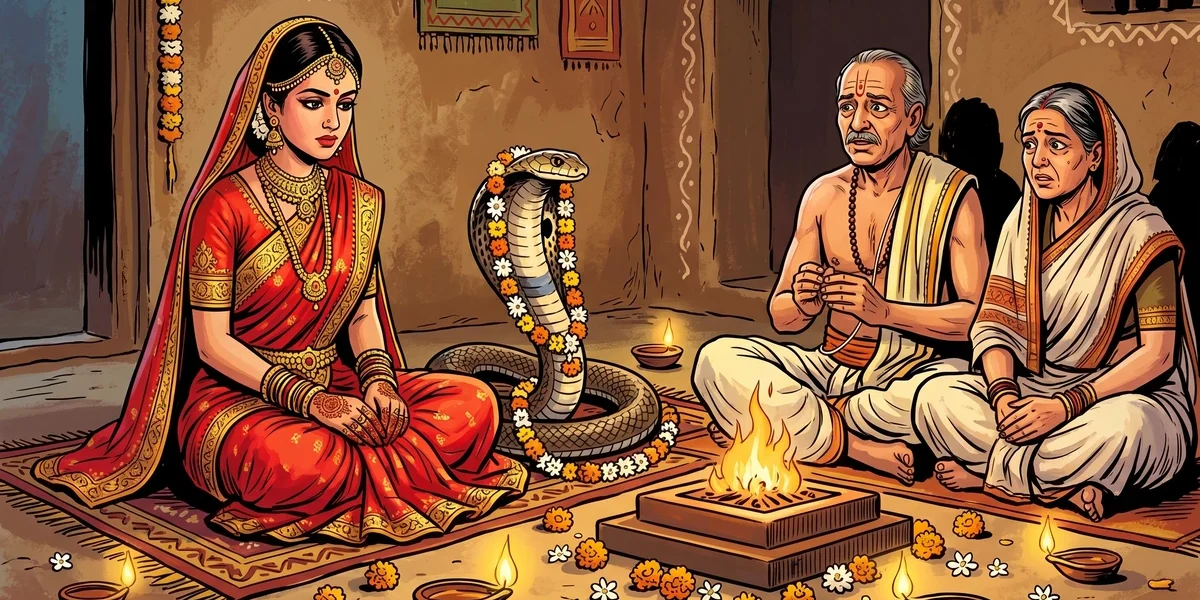
The Girl Who Married a Snake: Naga-Vivaha and the Dharma of Acceptance
The Nagas: India’s Most Ambivalent Sacred Beings
No creature in the Indian cosmological imagination occupies as complex and contradictory a position as the naga — the divine serpent. In Vedic literature, serpents appear as both dangerous enemies (Vritra, the serpent of drought, defeated by Indra) and as sacred beings associated with fertility, water, and the underworld. In Puranic mythology, the nagas are a distinct race of semi-divine beings who inhabit the underground realm of Patala, the depths of rivers and oceans, and the roots of sacred trees. They are ruled by Shesha (who forms the cosmic bed on which Vishnu rests), Vasuki (who served as the rope in the churning of the cosmic ocean), and Takshaka. They can take both serpent and human form, are associated with rain and agricultural fertility, and receive worship across the Indian subcontinent in the form of naga stones, naga festivals, and naga shrines.
The ambivalence of the naga is precisely its narrative richness: it is simultaneously deadly and life-giving, earthly and divine, terrifying and beautiful. The cobra that can kill with a single bite is also the hood of Shesha that shelters the supreme deity. The king cobra at the root of the ashvattha tree is worshipped for fertility. Nagaraja (the serpent king) is petitioned for children, rain, and prosperity. This ambivalence — power that could destroy but chooses to protect, danger that has been domesticated into divinity — is the theological substrate of the naga-marriage tale.
When a girl marries a serpent in Indian folk narrative, the marriage is never merely strange or troubling: it is also sacred, because the naga is never merely a snake. The true form beneath the serpent exterior is divine, royal, or at least supernaturally potent. The story of the girl who marries a snake is a story about the relationship between appearance and essence, between what one accepts and what one receives, between the courage to honour an unexpected form of grace and the grace that reveals itself to those who do.
The Marriage and Its Test: Unconditional Acceptance as Sacred Dharma
In the Panchatantra version and its many regional relatives, the structural framework is as follows: a pious brahmin family, typically without sons, prays for a child. A son is born — but in the form of a serpent. The parents, particularly the mother, accept this child with complete love and devote themselves to his care, raising him as they would any son. When he reaches marriageable age, they seek a wife for him. Most families refuse, horrified. But one family — usually described as particularly pious, or particularly loving, or unusually possessed of spiritual discernment — agrees to the marriage.
The girl who accepts the serpent-husband is not presented as passive or weak. She brings to the marriage a quality that the story identifies, explicitly or implicitly, as the operative virtue: acceptance without condition, love without visible return, devotion to the husband she has been given rather than the husband she might have desired. This is the dharmic test at the heart of the story. Every other potential bride failed the test by refusing on grounds of appearance. This bride passes it by proceeding on grounds of commitment.
The transformation — the serpent shedding his skin to reveal a handsome young man, or the husband emerging each night in human form, or the spell being broken by the wife’s absolute trust — is the story’s climactic reward. But the Panchatantra tradition is careful not to make the transformation the point. The transformation is the consequence; the dharma of acceptance is the cause. The girl did not accept the serpent because she anticipated a handsome man beneath the scales. She accepted him because acceptance was her duty, her commitment, her love. The man is the gift; the acceptance was the virtue.
“She did not love him because he was beautiful. He became beautiful because she loved him. This is the oldest truth about acceptance: it does not wait for worthiness — it creates it.”
The Enchantment-Release Structure: A Global Pattern with Indian Depths
The enchantment-release tale — in which a being in animal or monstrous form is revealed as human or divine when treated with unconditional love or acceptance — is one of the most widely distributed narrative structures in world folk literature. Beauty and the Beast in European tradition, the Frog Prince in German folklore, the Swan Maiden in Celtic and Slavic traditions, the Crane Wife in Japan — all are variants of the same structural movement: disguised or cursed being; unconditional acceptance or love; transformation; true form revealed.
What gives the Indian naga-vivaha tales their specific depth and texture is the religious context that the naga brings. In European enchantment tales, the beast is typically a prince cursed by a witch — the transformation is a rescue from an unjust external imposition. In the Indian naga-marriage tales, the serpent form may not be a curse at all: it may be the naga’s natural and sacred form, chosen or given by the divine order, and the story may be less about releasing an enchantment than about the human protagonist coming to perceive the sacred within the apparently frightening.
This is a theologically richer and more demanding story. In the European version, love reveals that the beast was always really a human prince — the animal form was a temporary overlay on the “true” human form. In the Indian version, love reveals that the serpent was always also a divine being — the serpent form is not less real, not a disguise over a “true” form, but one aspect of a being that includes both the serpent’s power and the man’s capacity. The girl who marries the snake does not merely remove a curse; she perceives divinity in a form that others found only threatening. This is darshan — the auspicious sight of the sacred — in narrative form.
The Moral Architecture: Appearance, Essence, and the Wisdom of Acceptance
The naga-vivaha tale makes several intersecting moral arguments. The first concerns the relationship between appearance and essence: the serpent’s appearance is frightening, but his essence — divine, fertile, powerful, ultimately beneficent — is auspicious. The story repeatedly insists that the judgment based on surface appearance alone is not wisdom but a failure of perception. The families that refuse the match are not presented as unreasonable by normal social standards; they are presented as lacking the depth of vision that would allow them to see what the accepting family sees.
The second argument concerns the social construction of the marriage bargain. The Panchatantra is throughout a practical manual for navigating social life, and its inclusion of the naga-vivaha tale reflects a real social reality: arranged marriages in the tradition could produce unexpected unions, and the virtue the tale valorises — accepting the husband or wife one is given rather than demanding a predetermined ideal — was a socially functional norm as well as a narrative ideal. The tale both reflects and reinforces this norm, wrapping it in the prestige of divine narrative.
The third argument — the deepest — concerns the relationship between acceptance and transformation. The tale insists that the wife’s acceptance is not merely passive endurance but an active force: it is because she accepts completely that the transformation occurs, whether the transformation is the serpent shedding his skin, the curse being broken, or simply the marriage becoming a genuinely good life rather than an endured one. Acceptance in this sense is creative: it does not merely receive what is given but actively participates in bringing out the best of what is given. This is the story’s highest teaching, and the reason it has outlasted the social conditions that originally produced it.
Why This Story Lasted
The Girl Who Married a Snake has endured across two millennia because it speaks to one of the most universal and persistent human anxieties: the encounter with the other-than-expected, the life that does not match the image, the love that requires accepting something other than what one would have chosen. Every generation faces versions of this challenge, and the naga-vivaha tale keeps alive the possibility that unconditional acceptance — rather than insistence on a predetermined form — is the posture that reveals hidden grace. The naga shedding his skin has been read as a metaphor for so many forms of transformation across so many cultural contexts that the tale has accumulated resonance far beyond its original religious specificity. It remains alive because the acceptance it champions remains both difficult and necessary.
Frequently Asked Questions
What are nagas in Hindu mythology?
Nagas (Sanskrit: नाग) are semi-divine serpent beings in Hindu, Buddhist, and Jain mythology. They are typically depicted as having human upper bodies and serpent lower bodies, or as able to shift between fully serpentine and fully human forms. They inhabit the underground realm of Patala and the depths of bodies of water. Famous nagas include Shesha (on whom Vishnu rests), Vasuki (used as a rope in the churning of the cosmic ocean), and Manasa (goddess of serpents, widely worshipped in Bengal). Nagas are associated with water, fertility, and the earth’s riches; they are worshipped across South and Southeast Asia, and naga stone shrines (nagakals) are found throughout rural South India for fertility and protection.
Is the “Girl Who Married a Snake” tale found only in the Panchatantra?
No. Naga-marriage tales are found across the Indian subcontinent in a wide variety of regional forms. In South India, tales of women who marry nagas and are rewarded with prosperity and fertility are associated with the Naga Panchami festival. In Bengal, the Manasa Mangal literature includes stories of serpent-husbands. In Maharashtra, folk narratives of women whose acceptance of a serpent-son or serpent-husband leads to divine reward are widespread. The Panchatantra version is one of the most structured and widely translated, but the underlying narrative pattern is a living tradition across multiple regional cultures with their own specific naga-worship contexts.
How does the Indian naga-marriage tale compare to Beauty and the Beast?
Both tales belong to the enchantment-release narrative type and share the core structure: a woman accepts marriage with a creature in frightening non-human form; her acceptance leads to transformation revealing a hidden human or divine nature. The key difference is theological context. In Beauty and the Beast, the beast is a human prince cursed into animal form — the human is the “true” form, and love removes an unjust overlay. In the Indian naga-vivaha, the serpent may be genuinely divine in his serpent form — the transformation reveals that he is also human, not that he was “really” human all along. The Indian tale is more comfortable with the sacred having a monstrous or frightening form, reflecting the broader Hindu theological tradition of the terrifying and the auspicious coexisting in the same divine being.
What is Naga Panchami and how does it relate to serpent marriage tales?
Naga Panchami is a Hindu festival observed on the fifth day (panchami) of the bright half of the lunar month of Shravana (July-August). On this day, nagas (serpents) are worshipped with offerings of milk, flowers, and prayers, and representations of snakes are venerated at shrines, temples, and anthills (believed to be naga dwellings). The festival is particularly important for women, who pray for the welfare of their brothers and family members, and for fertility. The naga-marriage narrative tradition is closely connected to the ritual context of Naga Panchami — both reflect the long history of serpent veneration in South Asia as beings of great power whose goodwill must be cultivated through respectful relationship.
What does this story teach children about judging by appearances?
The naga-vivaha tale offers children one of the folk tradition’s most memorable teachings about the limits of surface judgment: that what appears frightening or undesirable may conceal something valuable or even divine; that the families who refused the serpent-husband on grounds of his appearance made a judgment that was socially understandable but ultimately wrong; and that the courage to look beyond the surface — to commit to acceptance before transformation is guaranteed — is rewarded in ways that the surface-judger cannot access. The story does not ask children to ignore genuine danger; rather, it asks them to consider whether what frightens them is genuinely dangerous or merely unfamiliar, and to leave room for the possibility that the unfamiliar may be auspicious.
Frequently Asked Questions
**Q: Why is this story important?**
You May Also Like
 Aesop's Fables
Ages 9-12
Aesop's Fables
Ages 9-12
The Town Mouse and the Country Mouse
The Town Mouse and the Country Mouse: In an age when mice still ventured freely between wild and cultivated lands, there existed two cousins as different as
 Aesop's Fables
Ages 3-5
Aesop's Fables
Ages 3-5
The Monkey and the Crocodile: A Panchatantra Fable
A clever monkey and a crocodile become friends, but greed and betrayal test their bond in this Panchatantra tale.
 Aesop's Fables
Ages 3-5
Aesop's Fables
Ages 3-5
A Story Weaver By Chance Meet Vani Balaraman Of Cuddles And Reads
A Story Weaver By Chance Meet Vani Balaraman Of Cuddles And Reads: Somethings happen by chance. For Vani Balaraman, it was storytelling. Founder of Cuddles and