The Town Mouse and the Country Mouse
The Town Mouse and the Country Mouse: In an age when mice still ventured freely between wild and cultivated lands, there existed two cousins as different as
This is one of the very few Aesopic fables that achieved its greatest literary fame not through Aesop himself but through one of the greatest poets of the Roman world. The fable belongs to Aesop, the Greek storyteller of the sixth century BCE, in whose corpus it is catalogued as Perry 352 under the Greek title Mys arouraios kai mys astikos — “The Field Mouse and the City Mouse.” But it is in the Latin verse of Quintus Horatius Flaccus — Horace, the great lyric poet of Augustan Rome — that the tale found its definitive form. In Book II of his Satires, written around 30 BCE, Horace devoted thirty-eight beautiful hexameter lines (Satire 6, lines 79-117) to the story of mus rusticus et urbanus, the country mouse and the town mouse, and made of it a small masterpiece of Roman pastoral poetry — a meditation on the quiet life, the simple meal, the refusal of luxury, and the rare and precious gift of otium, peaceful leisure on one’s own terms.
The principal Greek source-form survives in the Augustana recension of the prose Aesopica (1st-2nd c. CE). Phaedrus retold it in Book III Fable 7 of his Latin verse Aesop, and it entered medieval Europe through the Romulus collections and the verse-Aesop of Walter of England (12th c.). It came into modern English through William Caxton’s first printed Aesop in 1484, then Roger L’Estrange (1692), Samuel Croxall (1722), Thomas Bewick (1818), and Joseph Jacobs (1894). Most famously of all, Jean de La Fontaine opened Book I of his celebrated French Fables (1668) with this tale as the ninth poem — Le Rat de Ville et le Rat des Champs — and the great Scottish poet Robert Burns recast it in 1786 as The Twa Mice. The fable is classified in the Aarne-Thompson-Uther index as type ATU 112.
This is the story.
The Country Mouse’s Home

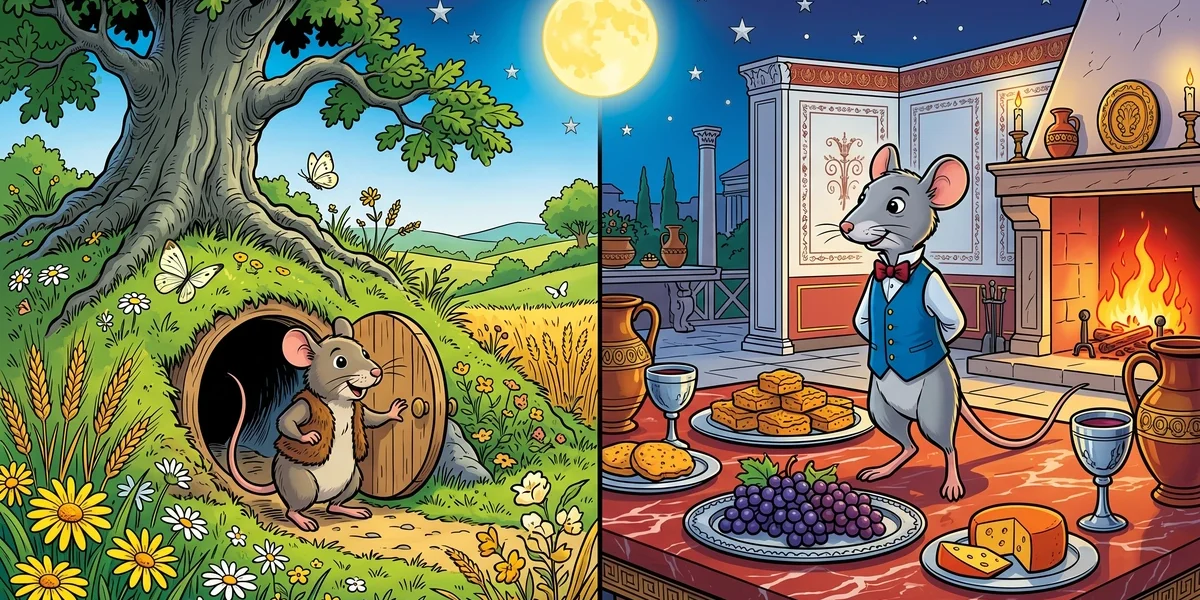
The country mouse lived, the old tellers said, in a small cosy burrow dug deep under the roots of a great old oak tree on the edge of a sunny green meadow somewhere in the Sabine hills outside Rome. He had built the burrow himself, with patience and labour, over the better part of three summers. The walls were lined with soft dry brown grass that he had carried in stalk by stalk over many afternoons. The floor was packed-down clay, swept clean every morning. The single round wooden door, which he had carved himself from a flat piece of oak-bark, fitted snugly in its small round opening between two great gnarled grey roots. And inside, the country mouse had made for himself a single small chamber that contained everything he needed for a quiet contented life: a thick bed of moss, a wooden bowl made from half a walnut shell, a tiny wooden table no bigger than a chestnut, and a small store-room at the back where he kept the steady provisions of his simple country diet — wheat-grains, dried red berries, sunflower-seeds, a small piece of black bread, a half-acorn of pure rainwater.
It was, by any honest reckoning, a poor mouse’s home. The country mouse himself was a small creature of plain grey-brown fur with bright black eyes and a thin pink tail, and he wore, when he was at home, a brown homespun vest of woven thistle-down. He had nothing fine. He had nothing rich. But he had — and this was something he understood, perhaps without quite knowing that he understood it — three things that no rich mouse anywhere in the city of Rome could buy at any price: he had the green meadow and the blue sky and the warm sun streaming through his door every morning. He had no enemies that he could not see coming a hundred paces off. And he had, every night when he closed his small wooden door and curled up in his moss-bed, the long quiet untroubled sleep of a creature who has nothing in the world to be afraid of.
For three full summers he had lived alone there, and three full summers had passed without anything happening to disturb his quiet. He worked his small fields of wild wheat in the sun, gathered his seeds and berries before winter, kept his burrow swept clean. He sang to himself, sometimes, when the light fell golden through the oak leaves at the end of the day. He was, although he could not have said the word, a contented mouse. The Sanskrit teachers half a world to the east, who had never heard of him, would have called what he had santosha — contentment, the highest of the virtues, the only one that no king and no thief can ever take away.
The Town Mouse Arrives
It was on a bright morning in the middle of summer, with the meadow grass green and tall and the cicadas humming in the oak tree, that the country mouse heard a soft knocking at his small round wooden door.
He opened it.
And on the doorstep, blinking in the bright country sunlight, stood a slim and well-dressed grey mouse in a fine blue silk waistcoat with tiny gold buttons, a small red bow-tie of crimson velvet at his throat, and a thin gold watch-chain looped between two of the buttons of his waistcoat. He carried a tiny leather travelling-bag in one paw. He had pomaded the silver-grey fur on the top of his head into a small neat fashionable wave. And he was — although it took the country mouse a moment of staring to recognise him — none other than his own first cousin, the town mouse, who had moved to Rome three summers ago in search of his fortune and had not been seen in the country since.
The country mouse cried out with delight. He embraced his cousin. He pulled him in through the door and sat him down at the tiny wooden table and at once, in the proud and pleased manner of a country host who has not had a visitor for three years, set about preparing the very finest meal his small store-room could provide.
The Country Meal
He brought out his best wheat-grain — the plump golden kind that he had gathered from the wild stalks at the edge of the meadow, husked and sun-dried and stored carefully in his store-room for festival days. He brought out three of his finest dried red elderberries, wrinkled and sweet. He brought out a small round of crumbled black bread that the village baker had dropped on the road two weeks ago and that the country mouse had carried home in triumph. He brought out a half-acorn of cool clear rainwater. And he laid all of it out on his tiny wooden table with the simple pride of a host who has no luxuries to offer but is offering, with his whole heart, the very best he has.
“Eat, dear cousin,” the country mouse said. “Eat. You are home.”
The town mouse sat down at the tiny wooden table. He looked at the wheat-grains. He looked at the wrinkled red berries. He looked at the crumbled black bread. He looked at the half-acorn of rainwater. And although he was, in his own way, a kindly creature and not a cruel one, he could not quite hide the look that passed across his small grey face — a look of polite, gentle, but unmistakable pity.
He picked up a single wheat-grain. He nibbled the edge of it. He set it down. He picked up half a dried red berry. He nibbled. He set it down. He took a small careful sip of the rainwater. He set down the half-acorn.
And he looked at his country cousin across the tiny table.
The Town Mouse’s Pity
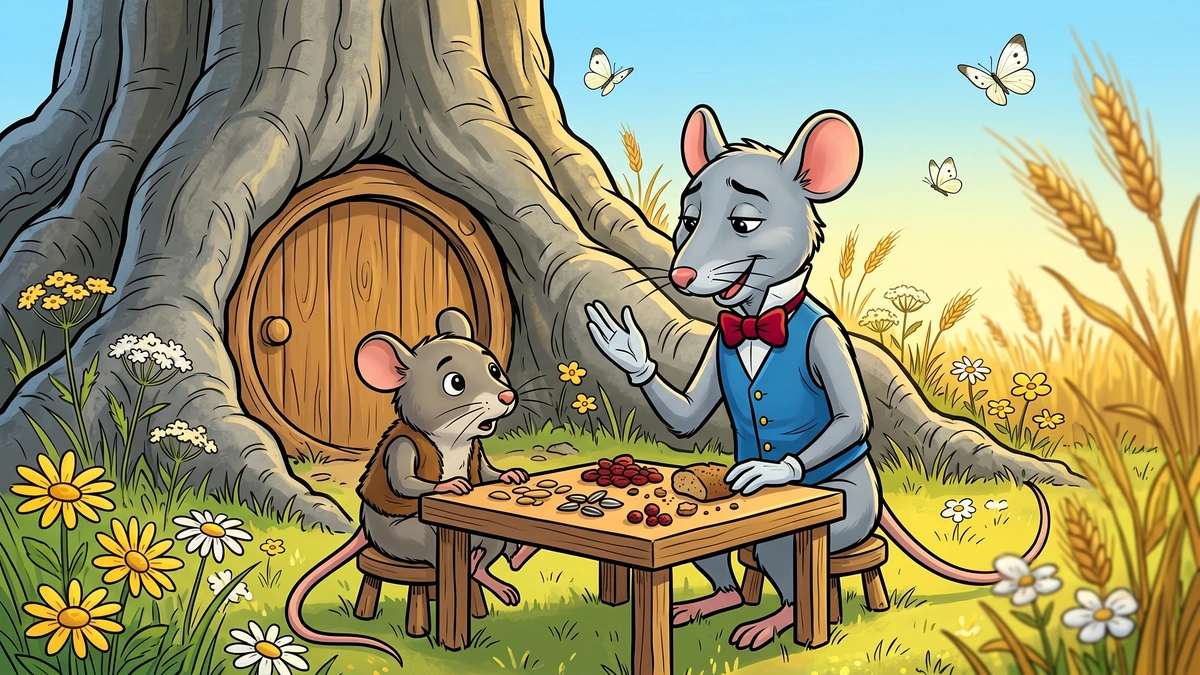
“Cousin,” the town mouse said gently. “May I speak frankly?”
“Of course.”
“This is — well — I do not wish to give offence. You have welcomed me with everything you have, and I am grateful. But — well — but you cannot really live like this, you know. You really cannot. Look at you. Look at this little burrow. Look at this — this — wheat-grain. Look at the dried berry. My dear cousin, do you know what I had for breakfast this morning, in my apartment in Rome? I had a fragment of honey-cake from the master’s kitchen. I had a slice of imported cheese from the island of Sicily. I had a single grape, dark purple, full of juice. I had a sip of the master’s red wine from a silver cup. And that, dear cousin, was just my breakfast. You should see the dinners. You should see the feasts. The food the rich men of Rome put on their tables, and that is left over for those of us who know how to find it — it is beyond anything you can imagine. You are not living down here, cousin. You are merely subsisting. Come back to the city with me. Tonight. Come and see how a mouse really ought to live.”
The country mouse looked at his half-eaten wheat-grain. He looked at his cousin’s fine blue silk waistcoat and the small gold watch-chain. He looked at the bright meadow visible through his open door. And he hesitated.
“Just to see?” he asked.
“Just to see.”
“And then I can come home?”
“And then you can come home. Of course.”
The country mouse — who was, after all, a curious mouse and not yet so old that he could not be tempted by the promise of something he had never tasted — pulled on his second-best brown homespun jacket, swung the door of his burrow shut behind him, and set off with his elegant cousin down the long dusty road toward the great walls of Rome.
The Town Banquet

They walked the whole long afternoon. They crossed three meadows, climbed two stone walls, and crept along a Roman road past two carts and a slow-moving farm-ox, until at sunset they came to the high cream-stone walls of a grand Roman villa. The town mouse, who knew this villa as well as the country mouse knew his oak tree, led his cousin in through a small crack at the base of the kitchen wall, along a dim corridor between two bricks, up a narrow space behind a stone column, and out at last — onto the polished red-marble surface of a long banquet table in the master’s great frescoed dining-hall.
The country mouse stopped. He stared.
For there before him, stretched out across the polished red marble in the warm light of a dozen tall white wax candles, were the remains of a banquet such as he had never in his country life imagined could exist. Golden honey-cakes glistening with thick yellow honey. Whole black figs split open to show their bright red insides. A great cluster of dark purple grapes, each one as big as the country mouse’s head. Slices of orange-yellow cheese, soft and creamy. Slabs of dark roast meat with brown crisp edges. A silver bowl of green olives. Half a loaf of fine white bread. A small dish of yellow saffron rice. Almonds and walnuts in a polished wooden bowl. A tall crystal carafe of red wine catching the candlelight in a thousand glittering ruby reflections.
“Cousin,” the town mouse said, with a small graceful wave of his paw. “Welcome to Rome.”
The country mouse could not speak. The country mouse had not known, until this moment, that food on this scale existed in the world.
The First Bites
They began to eat.
The town mouse, with the practised manner of a connoisseur, led his cousin first to the honey-cakes — light as air, sweet as the morning sun, fragrant with cinnamon — and the country mouse, biting in, made a small sound of astonishment that he was not aware he had made. He had never tasted honey before. He had never tasted cinnamon before. He had not, until that moment, even known that the world contained anything as fine as a honey-cake.
The town mouse led him next to the grapes. They climbed up onto a great purple cluster, and the country mouse bit through the soft tight skin of one grape and a flood of cool sweet juice burst into his mouth — sweeter than any berry, cleaner than any rainwater, with the small fresh tang of the Sicilian summer in it. He bit a second. He bit a third. He could not stop.
The town mouse led him to the cheese. The country mouse had never tasted cheese. The town mouse led him to the figs. The country mouse had never tasted figs. The town mouse led him to the rice with saffron. The country mouse had never imagined there could be such a thing as yellow rice. The town mouse led him to a single drop of red wine that had spilled in a small ruby pool on the marble surface, and the country mouse — who had never tasted wine — touched his pink tongue to it and felt the dark warm flame of it run down through his small chest, and he sat down on the red marble of the banquet table and laughed aloud at the wonder of the world.
“You see, cousin?” the town mouse said, smiling. “You see what I meant?”
“I see,” said the country mouse. “I see, I see, I see.”
The Sudden Terror
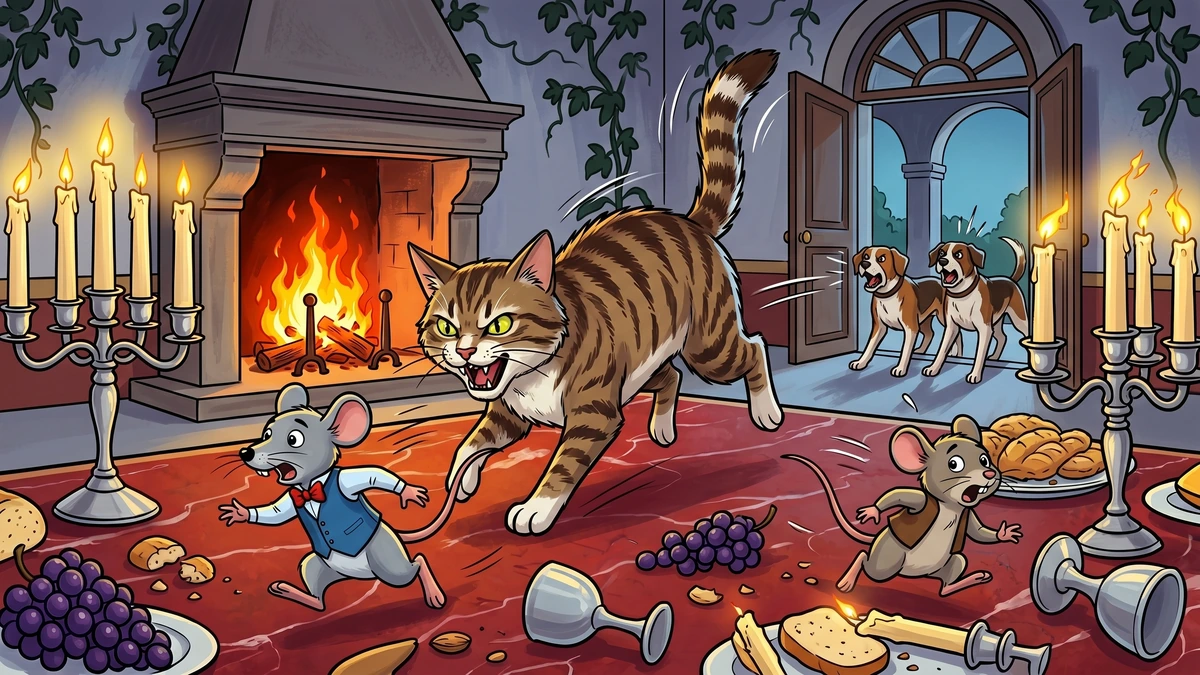
It was at that moment, the old tellers said, that the great wooden door of the dining-hall burst open.
It burst open with a slam that shook every candle on the table. Through the doorway came, in a single great rush of noise and movement, two enormous brown-and-white hunting dogs barking at the tops of their lungs, and behind them — with bared white teeth and yellow-green glowing eyes and a tail held high — a great striped tabby house-cat, springing onto the banquet table itself and scattering grapes and overturning a silver goblet and lunging directly at the two small grey mice who had a single instant before been laughing on the polished red marble.
The country mouse did not, in that single instant, quite understand what was happening. The town mouse — who knew exactly what was happening — had already grabbed his cousin’s paw and was already running, and so the country mouse ran. They sprinted across the red marble, past the silver bowl of olives, past the cheese, past the wine, leaped down off the table, hit the cold stone floor of the dining-hall at a full run, and fled through a narrow black crack between two paving-stones into the dusty cool dark space behind the wall, where they pressed themselves flat against the rough mortar and held their breath, and where the country mouse, in the absolute silence of his fear, could hear only one sound — the wild thudding of his own small heart against the inside of his small chest.
Outside in the dining-hall the cat hissed. The dogs barked. The cat hissed again. The dogs whimpered and ran out through a side door. The cat — having lost its quarry — paced once or twice along the table, leaped down with a small soft thud, and padded, slow and dangerous, away into the corridor.
The country mouse and the town mouse waited, pressed flat in the dark, until they had counted three hundred heartbeats. Four hundred. Five hundred. The dining-hall was silent again. The candles burned. The banquet was untouched.
“Come,” the town mouse whispered. “It’s safe now.”
And they crept back out onto the polished red marble, and they began to eat again — and an instant later, before the country mouse had taken even his second bite of honey-cake, the door burst open again, and there was the cat again, and they fled again, and pressed themselves flat in the dusty dark again, and waited again. And again. And again.
By the third time the country mouse had stopped feeling delight in any of it. By the fourth time he had stopped feeling hunger. By the fifth time he had stopped, even, feeling the specific terror of the cat — there was simply, at the bottom of his small chest, a steady cold dread that did not go away even in the dusty dark behind the wall, that sat there waiting, that ate away the taste of honey and grapes and wine and cheese and replaced it with the constant low hum of fear.
The Country Mouse’s Decision
It was at perhaps the sixth interruption — or perhaps the seventh, the country mouse had stopped counting — that he turned to his cousin in the dark behind the wall, and he said, very quietly, in a voice that was no longer the voice of a delighted guest but the voice of a creature who has finally understood what he is looking at:
“Cousin. I am going home.”
“What?”
“I am going home. Tonight. Now.”
“But — but the feast — the honey-cakes — the wine — “
“Cousin.” The country mouse looked at his elegant well-dressed cousin in the dark behind the wall, and his bright black eyes were level and steady, and he spoke with the quiet certainty of a creature who has at last understood the small clear truth at the centre of his life. “Cousin. I would rather have my plain wheat-grain on my own tiny table in my own quiet burrow under the roots of my own oak tree, alone in the silence of my green meadow at the end of a long peaceful day, than the most magnificent banquet in the most magnificent dining-hall in the most magnificent villa in Rome — if every bite of it must be eaten in fear. Goodbye, cousin. Come and visit me again any time you like. But I am going home.”
And the country mouse, with the simple sure dignity of a creature who has found his answer, slipped out of the dusty dark behind the wall, found the small crack at the base of the kitchen wall, slipped out into the cool starlit Roman night, and set off, walking alone under a sky full of bright silver stars, back toward the long road that led home to his oak tree and his meadow.
The Last Words
He arrived at his small burrow under the roots of the oak tree just as the first grey light of dawn was beginning to come up over the meadow.
He pushed open his small round wooden door. He stepped inside. He looked at his moss-bed, his tiny wooden table, his store-room with its small stocks of wheat-grain and seeds and dried berries. And he sat down on the moss, and he ate a single wheat-grain, and he drank a single sip of cool rainwater from his half-acorn, and he closed his small wooden door, and he curled up in his moss-bed in the warm safe quiet of his own home, and he slept the long quiet untroubled sleep that he had slept every night of his country life — and that he had not, he now understood, slept once in all the long sleepless terror of the night just ended in the great Roman villa.
And the old tellers said: he never again, for the rest of his country life, envied any town mouse anywhere.
The Moral
The Greek prose Aesopica preserves the moral in this form:
“Ho mythos deloi hoti kreisson litos diagein kai zen adeos e tryphan en phobo.”
“The fable shows that it is better to live simply and without fear than to feast in dread.”
And Horace, in his celebrated Latin verse retelling (Satires II.6, c. 30 BCE), preserves the moral in two beautiful lines:
“Vivamus parvo contenti.”
“Let us live, content with little.”
The pithy modern English form, descending through Croxall and Jacobs, is the proverb every English-speaking child has heard:
“A crust of bread eaten in peace is better than a banquet eaten in apprehension.”
And the Sanskrit teachers in India, who never heard of Aesop or Horace or La Fontaine, taught the same thing in three syllables: santushtah sarvada sukhi — “the contented man is always happy.” It is the same teaching in a different tongue. And the deepest teaching of the fable, perhaps, is simply this: that it does not matter how much you have, if every bite you take must be taken in fear.
Why This Story Has Lasted
It has lasted for two and a half thousand years because every adult who has ever traded a quiet life for a glamorous one already knows, somewhere in his small grey heart, the exact truth of what the country mouse discovered behind the wall in the master’s villa. We have all eaten the honey-cakes. We have all heard the door burst open. We have all pressed ourselves flat in the dusty dark with our hearts thudding, and we have all wondered — for one small honest moment, before the cat passed and we crept out for one more bite — whether perhaps it might not be better to go home.
The fable does not tell us that we are foolish to want the honey-cakes. It does not tell us that the town mouse is bad and the country mouse good. It only tells us, gently and patiently, what every wise teacher in every tradition has always tried to tell us — that santosha, contentment, is worth more than any honey-cake; that the simple peace of one’s own home, however small, is the rarest and most precious thing in the world; and that the wealth that comes with constant fear is no wealth at all.
Two and a half thousand years after Aesop, two thousand years after Horace, three hundred and fifty years after La Fontaine, in our own age of hustle and metrics and the constant glittering promise of a richer life if we will only run a little faster — the small clear voice of the country mouse is still telling us the same thing, in his own tiny burrow under his own old oak tree, at the end of his own long peaceful day:
I would rather have my plain wheat-grain in peace than your honey-cakes in fear.
It is, perhaps, the simplest of all the morals in all of Aesop. And it is, perhaps, the hardest of all of them to actually live by.
You May Also Like
 Aesop's Fables
Ages 3-5
Aesop's Fables
Ages 3-5
The Lost Camel
The Lost Camel: There was a city called Alakapuri, famous for all the riches that sea and land can yield, and inhabited by people speaking different languages.
 Aesop's Fables
Ages 3-5
Aesop's Fables
Ages 3-5
The Five Wise Words Of The Guru
The Five Wise Words Of The Guru: Once there lived a handsome young man named Ram Singh, who, though a favourite with everyone, was unhappy because he had a
 Aesop's Fables
Ages 3-5
Aesop's Fables
Ages 3-5
A New Discovery
A New Discovery: Deep under the ocean, there lived mermaids and mermen who loved to read. They had a library full of books written in special waterproof ink.