A Long Bow Story
A Long Bow Story: One day a bunniah, [1] or banker, was walking along a country road when he over took a farmer going in the same direction. Now the bunniah
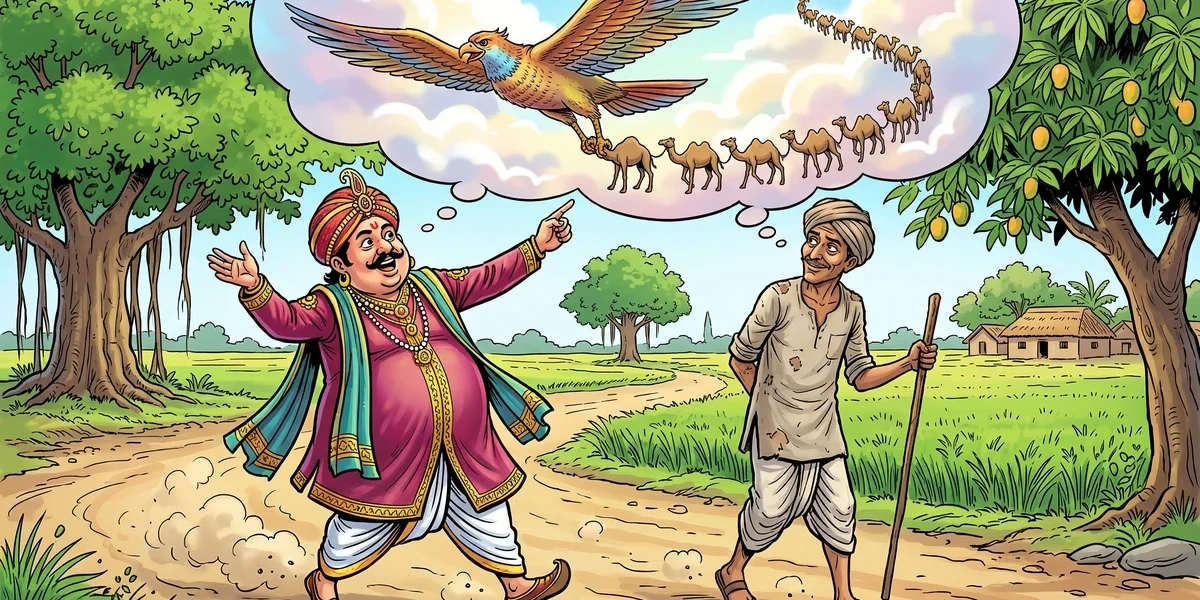
A Long Bow Story: The Braggart, the Audience, and the Social Cost of Competitive Untruth
Among the shorter pieces in the Aesopic tradition is the tale sometimes called “The Braggart” or “A Long Bow Story” — a fable about a man who boasts of a leap he made on the island of Rhodes, claiming witnesses would confirm it. When someone tells him to prove it here and now, the brag collapses: the same leap that supposedly happened in Rhodes cannot apparently be reproduced in the present company. The fable’s famous moral — Hic Rhodus, hic salta (“Here is Rhodes, here jump!”) — became one of the most cited aphorisms in Western intellectual history, taken up by Hegel, Marx, and countless others to mean: stop pointing to past or distant achievements; demonstrate what you claim in the present conditions available to you.
The tale’s governing concept is iactantia sine probatione—boasting without proof—and its argument is precise: claims that cannot be demonstrated in present conditions are not worth the social credit their maker claims for them. The braggart’s audience is implicitly invited to apply this standard not just to athletic feats but to any assertion of capability, virtue, or experience that conveniently requires witnesses who are not present to confirm it.
“If you really leapt that far in Rhodes, then Rhodes is here. Jump.”
Beat I — The Claim and Its Convenience
The braggart describes his extraordinary leap with complete confidence: on Rhodes, before many witnesses, he jumped a distance no other man could match. The claim is structured for irrefutability — the witnesses are on Rhodes, the leap happened in the past, the conditions are unverifiable here and now. This structure is the fable’s first diagnosis: the boast is positioned precisely to maximise social benefit while minimising the risk of challenge. It invokes witnesses who cannot speak, a place that cannot be visited for verification, and a moment that cannot be re-run. The braggart has found the optimal geometry of undemonstrable assertion.
Beat II — The Challenge: Hic Rhodus, Hic Salta
A member of the audience cuts through the structure with elegant simplicity: “If you can do what you say, we don’t need witnesses or Rhodes. Pretend this place is Rhodes. Jump now.” The genius of this response is its refusal to argue about whether the original leap happened. It simply relocates the test to the present. If the capability exists, it exists now; if it cannot be demonstrated now, the claim to it is not a past fact but a present fiction. The challenge assumes that genuine capability is not geographically or temporally locked—that what a person can truly do, they can generally do in multiple places at multiple times, and certainly here, and certainly now.
Beat III — The Silence That Answers
The fable does not record what the braggart says in response. The silence, or the embarrassed retreat, is the answer. He cannot jump the claimed distance — not because his legs have weakened since Rhodes, but because the leap never happened. The audience now holds the information that the brag was constructed. What the braggart loses is not just credibility about this particular leap, but the social credibility of all future claims. The “Hic Rhodus” standard, once applied, permanently changes how this speaker’s assertions will be received. The fable thus demonstrates the long-run cost of single short-run deceptions.
Famous formulation: Hic Rhodus, hic salta — “Here is Rhodes, here jump!” (also rendered as Hic Rhodus, hic saltus)
Later uses: Hegel’s Philosophy of Right (1820); Marx’s The Eighteenth Brumaire (1852); widely cited in philosophy, political theory, and rhetoric
Themes: Iactantia (boasting), the present as the only locus of proof, the social cost of competitive untruth
Beat IV — The Philosophical Afterlife of the Challenge
Hegel used “Hic Rhodus, hic salta” in the preface to his Philosophy of Right to argue that philosophy must understand its own time rather than projecting ideals onto a distant elsewhere. Marx used it to challenge political dreamers who located revolutionary possibility in some future or foreign condition rather than the actual material present. Both uses preserve the fable’s core insistence: that genuine capacity is demonstrable in the conditions actually available. The leap that requires Rhodes to work is not a leap at all; the philosophy that requires a better world to function is not philosophy but fantasy; the revolution that awaits ideal conditions awaits forever. The “Long Bow Story” is, improbably, a foundational text of realist thinking in philosophy and politics.
Why This Story Lasted
The tale of the braggart and his Rhodian leap has lasted because Hic Rhodus, hic salta solves a perennial rhetorical problem: how do you respond to an unverifiable boast? The answer the fable provides is both polite and devastating — it does not accuse the speaker of lying, it simply moves the test to the present. This is a portable intellectual tool that works in any domain where claims are made about capability, achievement, or character that cannot be independently verified. The person who claims they could have done something, would have done something, did something far away that no one present can confirm — all of them can be met with the same invitation: here is your opportunity; demonstrate it now.
Frequently Asked Questions
What does “Hic Rhodus, hic salta” mean exactly?
The Latin phrase translates as “Here is Rhodes, here jump!” — meaning: if you claim you could do something in Rhodes, demonstrate it here. Rhodes was a famous island in ancient Greece known for athletic games and competitions. The phrase is sometimes rendered as Hic Rhodus, hic saltus — “Here is Rhodes, here is the leap” — treating the leap itself as the proof rather than the command to jump.
How did Hegel use this fable?
In the preface to his Philosophy of Right (1820), Hegel wrote that philosophy must understand its own time and cannot escape into idealized alternatives. He cited Hic Rhodus, hic salta to mean: the task of philosophy is to comprehend what is actual, not to imagine what ought to be somewhere else. “Here is the rose, here dance” is his variant formulation.
How did Marx use it?
In The Eighteenth Brumaire of Louis Bonaparte (1852), Marx used the phrase to challenge those who invoked past revolutionary models (the French Revolution, ancient Rome) as templates for present action. His point was that conditions must be understood as they actually are, not as analogies to historical precedents. The true revolutionary leap happens here and now, not by imitating Rhodes.
Is this tale specifically about athletic boasting?
The athletic frame is the vehicle, not the message. The fable works for any assertion of capability, achievement, or virtue that is positioned to be unverifiable — past experiences, distant contexts, missing witnesses. The “Hic Rhodus” challenge is applicable wherever someone claims an ability they cannot demonstrate in the present situation.
What is the moral lesson for everyday life?
Two lessons, actually — one for the braggart and one for the audience. For the braggart: claims that can only be substantiated in conditions that cannot be reproduced are indistinguishable from fictions, and are eventually treated as such. For the audience: the most effective response to an unverifiable boast is not argument but invitation — “here is your opportunity; we are waiting.”
Frequently Asked Questions
**Q: Why is this story important?**
You May Also Like
 Aesop's Fables
Ages 3-5
Aesop's Fables
Ages 3-5
The Story of Eklavya and Dronacharya – Stories from Indian Mythology
<p>Eklavya’s devotion to his teacher Dronacharya leads him to make a sacrifice that tests the meaning of loyalty and the price of mastery.</p>
 Aesop's Fables
Ages 3-5
Aesop's Fables
Ages 3-5
Network of Hope
Network of Hope: Nidhi peered closely for a blinking green light on the Wi-Fi modem, hoping there was a connection. She reloaded the Internet browser and
 Aesop's Fables
Ages 3-5
Aesop's Fables
Ages 3-5
The Mother In Law Became An Ass
The Mother In Law Became An Ass: Little by little the mother-in-law became an ass - vara vara mâmi kaludai pôl ânâl̤, is a proverb among the Tamil̤s, applied