The Soothsayer’s Son
Left nothing but a gloomy horoscope by his father, young Gangazara sets out to meet his fate, helped by a tiger, a snake and a rat he saved from a well.
There was once a soothsayer, a man who could read the future in the stars. When he knew he was dying, he left his house, his land and all his money to his elder son. To his younger son, Gangazara, he left only one thing: a horoscope he had written out himself, telling what the stars said about the boy’s life.
Gangazara sat down and read it, and his heart sank.
“Is this all the world holds for me?” he said to himself. “My father’s predictions never failed. Everything he foretold came true, down to the last word. And look what he has written for me! First: ‘From birth, poverty.’ Then, worse still: ‘Ten years in prison.’ After that: ‘Death on the seashore,’ which must mean I shall die far from home and family, beside some distant sea. And last of all, strangest of all: ‘Afterwards, some happiness.’ What that can mean, I have no idea.”
When the funeral ceremonies were over, he said goodbye to his brother and set off for the holy city of Benares. To keep well away from the sea, he travelled straight up through the middle of the Deccan, avoiding both coasts. For weeks and months he walked, until he reached the Vindhya mountains. There he had to cross a sandy wasteland where nothing lived and nothing grew. His food ran out. His chombu, the little brass water pot he always kept filled from streams and pools, was empty, dried out by the burning heat. Wherever he looked there was only sand.
Yet he did not give up. “My father’s words never failed,” he told himself. “I am meant to die by the sea, so I cannot die here in the desert.” That thought gave him the strength to keep walking and searching for water.
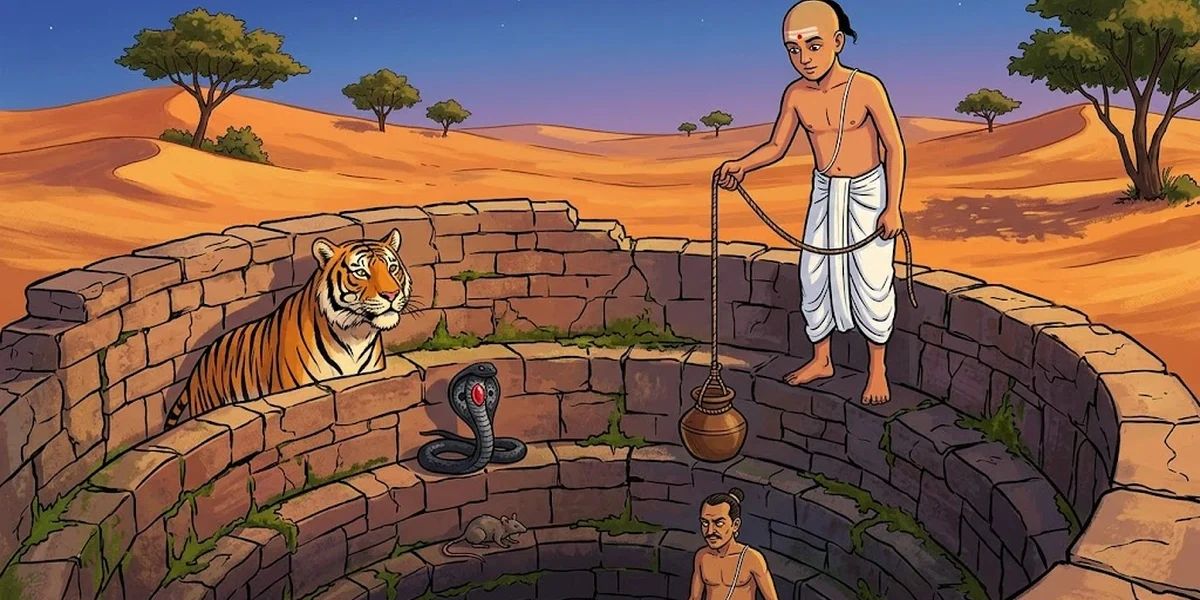
At last he came upon an old, broken-down well. He tied a string to the neck of his chombu, as he always did, and lowered it in. It went part of the way and then stopped, and a voice came up out of the darkness.
“Help me, please! I am the king of the tigers, and I am starving down here. I have not eaten for three days. Lift me out, and you will have a friend you can count on for the rest of your life. Do not be afraid that I will eat you. I would never harm the one who saved me.”
Gangazara thought hard. “If I pull him up, he may gobble me up the minute he is out. But no, he will not. My father’s words always came true, and I am to die on a seashore, not in a tiger’s jaws.” So he told the tiger to hold on tightly to the pot, and slowly, slowly, he hauled the great animal up.
The tiger kept his word. He walked three times around Gangazara as a sign of respect, then stood before him and bowed his head.
“You have given me back my life, and I will never forget it,” he said. “I swear to stand by you in every trouble. Whenever you need me, just think of me, and I will come. Now let me tell you how I came to be in this well. Three days ago I chased a goldsmith through the forest. He could not outrun me, so he jumped into the well, and he is still down there on the lowest ledge, the fourth. I leapt in after him, but I landed on the first ledge. On the second ledge there is a hungry snake, and on the third a hungry rat. If you lower your pot again, they will beg you to save them, and so will the goldsmith. Help the snake and the rat if you like. But I beg you, as your true friend, do not help that man. I know he is one of your own kind, but he cannot be trusted. You would do better to trust me, though I am a tiger, or a snake with its deadly bite, or a rat that gets up to mischief in every house. Leave him where he is, or one day you will be sorry.”
And with that the tiger padded away without waiting for an answer.
Gangazara marvelled at how well the tiger spoke, but he was still terribly thirsty. He lowered his pot again, and this time the snake caught hold of it.
“Save me, kind friend!” it hissed. “I am the king of the snakes, son of the great serpent Adisesha, who is grieving for me even now. Lift me out and I will be your servant all my life. I am dying!”
Once more Gangazara thought of the words “death on the seashore,” and he pulled the snake up. Like the tiger, it circled him three times and bowed low before him.
“You have given me a second life, so I shall call you my father,” said the snake. “Three days ago I was warming myself in the morning sun when I saw a rat and chased it, and it fell into this well. I followed, but instead of landing on the third ledge, where the rat is, I landed on the second. Now I must go to my father. If you are ever in trouble, think of me, and I will be at your side.” And it slid away in long curves and was gone.
By now Gangazara could hardly stand for thirst. He let down the pot a third time, and the rat seized it. Without stopping to think, he lifted it out at once.
“My benefactor!” squeaked the rat. “I am the king of the rats. Whenever you need help, think of me and I shall come. My sharp ears heard everything the tiger told you about the man on the bottom ledge, and every word is true. Do not help him as you helped us, or you will suffer for it. Now I am hungry, so goodbye for the present.” And off it ran.
Gangazara stood by the well and wondered. The tiger and the rat had both warned him about the man below. “But what harm could there be in helping him too?” he thought. “Why should I leave a man to starve?”
So he let the pot down again. The goldsmith grabbed it and shouted for help, and Gangazara, who had no time to waste, pulled him up. The goldsmith began talking straight away, but Gangazara held up his hand. “Wait,” he said. He lowered the pot a fifth time and at long last drank his fill of water, still half afraid that someone else might call to him from the bottom of the well.
Then the goldsmith went on. “My dear friend, my rescuer, what nonsense those beasts were talking about me! I am so glad you paid no attention. I am faint with hunger, so I must go. My name is Manikkasari, and I live in the East Main Street of Ujjaini, a little way south of here, on the road you will take home from Benares. Be sure to visit me on your way back, and I will show you how grateful I am.” Then he hurried off, and Gangazara went on his way north.
He reached Benares and stayed there for more than ten years, living a life of prayer, and in all that time he forgot about the tiger, the snake, the rat and the goldsmith. But one day he began to think of home and of his brother. “I have prayed and studied long enough,” he said. “It is time to go back.” Because of his father’s warning about the sea, he took the very same road he had come by.
In time he came to the broken well, and suddenly it all came back to him. He decided to test the tiger’s promise, so he thought of the tiger-king. In a moment the tiger came bounding up with a great crown in his mouth. Its diamonds flashed so brightly that for a moment they outshone the sun. The tiger laid it at Gangazara’s feet and rubbed against him like a pet cat.
“My dear friend, why have you forgotten me for so long?” he purred. “I am glad you still think of me sometimes. I have many jewels of little value, but this crown is the best of them. Take it with you and sell it in your own country.”
Gangazara turned the crown over and over, counting the gems, and thought that if he separated the gold from the diamonds and sold them at home, he would be the richest man alive. He thanked the tiger, who went away. Then he thought of the snake-king and the rat-king, and each of them came with gifts of their own, greeted him warmly and went on their way.
Gangazara walked south, very pleased. “If the animals are so loyal,” he thought, “surely the goldsmith will be even more so. I do not want anything from him. But this crown takes up too much room in my bundle, and it might tempt robbers. Manikkasari can melt it down for me and separate the gold from the diamonds. He will surely do me that one kindness. Then I can roll everything up in my old clothes and go home.”
So he went to Ujjaini, asked for the goldsmith’s house and found it easily. Manikkasari was delighted to see him. Gangazara showed him the crown, explained how he had got it and asked for his help. The goldsmith said he would gladly do it, and suggested that his guest go and bathe and rest before the meal. Gangazara, who never missed his prayers, went straight down to the river.
Now, how had the tiger come by that crown? Only a week before, the king of Ujjaini had gone hunting with all his huntsmen, and the tiger-king had sprung out of the forest, seized the king and vanished. The king’s son had wept bitterly, and he had promised half the kingdom to anyone who could tell him who had killed his father.
The goldsmith knew perfectly well that a tiger had killed the old king, for Gangazara had just told him the whole story of the crown. But he wanted that reward. He hid the crown under his clothes and rushed to the palace.
“Prince,” he said, “I have caught your father’s killer!” And he set the crown in front of him.
The prince looked at it, recognised it and at once gave half his kingdom to the goldsmith. “And where is the murderer?”
“He is bathing in the river. He looks like this, and like that.”
Four armed soldiers ran down to the river and tied up Gangazara as he sat deep in prayer, with no idea of what was happening. They dragged him before the prince, who would not even look at him. “Throw him into the dungeon,” he ordered. And within minutes, without knowing why, Gangazara found himself in the dark.
It was a deep cellar under the ground, with thick stone walls. It was where the worst criminals were sent, and they were given no food or water at all. Sitting in the blackness, Gangazara thought: “There is no use blaming the goldsmith or the prince. Fate rules us all. This is only the first day of the ten years in prison that my father foretold. But how can I live ten years here, with nothing to eat or drink? I shall be dead in a day or two. Before that happens, let me think of my faithful animal friends.”
The moment he thought of them, the tiger-king, the snake-king and the rat-king gathered with their armies in a garden close to the prison. They held a council and decided to dig a tunnel from an old well to the dungeon. The rat-king gave the order, and his rats burrowed a long way through the earth until they reached the prison walls. Their teeth could not cut the hard stone, so the bandicoots, big rats with very strong teeth, were called in. They gnawed a narrow gap in the wall, just wide enough for a rat to slip through.
The rat-king came in first to comfort his friend and promised to feed him. Then he gave orders to all his subjects. “Whenever bread or sweets are made in any house, bring whatever you can carry to our friend. Wherever clothes are hanging up to dry, nibble off a piece, soak it in water and bring it here, so that he can squeeze it out and drink.” From then on the rats kept Gangazara supplied with food and water.
Then the snake-king came. “We are all sorry for your trouble,” he said. “The tiger-king is too big to squeeze through this tunnel, but he sends his sympathy. Now we will work to set you free. From today our armies will trouble this kingdom, and they will not stop until you are released. Whenever you hear people near the prison, call out as loudly as you can: ‘The prince locked me up for killing his father, but it was a tiger that killed him. That is why all these troubles have come upon the land. Let me out and I will heal all the bites and wounds.’ Someone will tell the king, and you will be freed.”
So it was. Tigers and snakes began to attack people and cattle all over the kingdom, and months turned into years. Gangazara sat in the dark cellar and lived on the bread and sweets the rats brought him. The years underground changed his appearance, and his hair grew so long it hid his face. And so ten full years went by, exactly as his father had foretold.
On the very last evening of the tenth year, a snake crept into the bedroom of the princess, the young king’s only daughter, and bit her, and she died. The king was beside himself. He sent for everyone who knew how to cure snakebite, and he promised half his kingdom and his daughter’s hand to whoever could bring her back to life.
Then one of his servants, who had often heard the prisoner shouting, told the king what he had heard. The king ordered the cell to be opened, and there sat the prisoner, alive after ten years. People whispered that he must be some kind of god. He was brought to the king, and he looked so strange and so grand that the king threw himself on the ground before him. Gangazara’s hair had to be cut before anyone could see his face. The king begged his forgiveness and asked him to save his daughter.
Gangazara said only this: “Within one hour, bring me every man and animal in your kingdom who has been killed by a tiger or a snake and has not yet been buried or burned. I will bring them all back to life.”
Cart after cart arrived. When they were all gathered, Gangazara took a pot of water, thought of the snake-king and the tiger-king, and sprinkled the water over them. One by one they all sat up as if waking from a deep sleep, and went home. The princess, too, opened her eyes.
The king was overjoyed. He was ashamed that he had imprisoned an innocent man on the word of a goldsmith, and he offered Gangazara his daughter and the whole of his kingdom, not just half. But Gangazara would accept nothing. Instead he asked the king to bring all the people of the city to a wood nearby. “There I will call the tigers and snakes, and give them their orders.”
At dusk the whole city gathered in the wood. Gangazara sat silent for a moment and thought of the tiger-king and the snake-king, and they came with all their armies. People started to run at the sight of so many tigers, but Gangazara told them they were safe, and they stopped.
In the grey evening light, with holy ash smeared over his body and tigers and snakes bowing at his feet, he looked like the very god whose name he bore, the god Gangazara. “Who else could command armies of tigers and snakes with one word?” some people said. “That could be magic,” said others. “But only a god could bring the dead back to life.”
“My children,” said Gangazara to the animals, “why do you trouble the people of Ujjaini? Answer me, and then stop.”
The tiger-king replied, “Why did this foolish king lock you up, just because a goldsmith said you killed his father? All his huntsmen told him that a tiger took the old king. It was I who did it, and I gave the crown to you. Yet he asked no questions and threw you into prison. How can anyone expect justice from such a king? Unless he learns to judge more wisely, we will go on.”
When the king heard this, he wept, beat his head and begged a thousand pardons, and he swore that from then on he would rule justly. The tiger-king and the snake-king promised to keep the peace as long as there was justice in the land, and they left. The goldsmith tried to run away, but the soldiers caught him. Gangazara, whose word was now law, forgave him and let him go. Then everyone went home.
The king begged Gangazara again to marry his daughter. Gangazara agreed, but not yet. First he wanted to see his brother, and then he would come back for the wedding. The king agreed, and Gangazara set out that same day.
But without realising it, he took the wrong road, and it led him along the seashore. Now, at that very time his elder brother was travelling up the same road on his way to Benares. They saw each other and knew each other even from far off. They ran and threw their arms around each other and stood holding on, almost faint with happiness. Gangazara’s joy was so great that his heart gave way, and he died there by the sea.
His brother was a faithful worshipper of Ganesha, the elephant-headed god, and that day was a Friday, treated in this telling as a special day for his worship of Ganesha. So he carried Gangazara’s body to the nearest Ganesha temple and called on the god, and Ganesha appeared.
“My poor brother is dead,” said the elder brother. “Please look after his body while I perform your worship. If I leave him anywhere else, evil spirits may carry him off while I am praying. When the ceremony is over, I shall give him a proper funeral.”
Ganesha agreed, and handed the body to his attendants, the Ganas, telling them to guard it carefully. But the careless Ganas did not keep watch, and by the time the worship was finished the body had disappeared.
The elder brother asked for his brother’s body, and Ganesha called his Ganas. They came forward blinking and trembling, and the god was very angry with them. The elder brother was angry too. “Is this how you reward my faith?” he cried. “You cannot even give me back my brother’s body!”
Ganesha was deeply ashamed. So, by his divine power, he gave the elder brother not a lifeless body, but Gangazara himself, alive and well.
The two brothers talked for hours about everything that had happened to them. Then they travelled together to Ujjaini, where Gangazara married the princess and in time became king. He ruled for many years and was generous to his brother all his life. And so every line of the soothsayer’s horoscope came true: poverty, ten years in prison, death on the seashore, and happiness afterwards.
About this telling
This tale is from Indian Fairy Tales, edited by Joseph Jacobs (London: David Nutt, 1892). Jacobs took it from Mrs. Kingscote’s Tales of the Sun, which in turn drew on Pandit Natesa Sastri’s Folk-Lore of Southern India, and he says he “considerably condensed and modified” the English of the original. His notes compare the grateful-animal and ungrateful-human plot with Jataka tales and European versions, including a story attributed to Richard the Lionheart. These are the collection’s comparative notes; they do not establish a complete, certain route of transmission.
Some things are told more gently here. In the original the animals warn that all goldsmiths are untrustworthy; here the warning is about this one man. The original says the rescued corpses were dug up from graves and that the Ganas ate Gangazara’s body; here the dead are simply brought by cart, and the careless Ganas lose the body.
Read the original: Joseph Jacobs, Indian Fairy Tales (Project Gutenberg #7128, The Soothsayer’s Son)
Reading guidance: for mature readers. The tale includes attempted starvation in prison, ten years of confinement, repeated animal attacks and deaths, and several magical restorations of the dead.
A closer reading
The horoscope works twice on Gangazara: it makes him avoid the coast, yet gives him confidence to face dangers inland. Thus the same prediction narrows one choice and enlarges another. The ending fulfills its words by changing what ‘afterwards’ can mean in a world where a god restores life. That is a narrative surprise within the tale, not evidence that forecasts reliably describe real lives.
The crown is both a gift of gratitude and evidence of another person’s death. The goldsmith supplies a false explanation for how Gangazara obtained it, and the prince punishes him without asking the huntsmen or hearing his account. The tiger later insists on a public explanation, exposing the difference between possessing an object and committing the crime connected with it.
The animal friends sustain Gangazara, but their attacks also make uninvolved people suffer for the ruler’s injustice. The eventual restoration is magical and does not make retaliating against a whole population fair. Likewise, rescuing the goldsmith is not the act that makes imprisonment deserved: the betrayal and the ruler’s failure to investigate remain their own choices.
Try this with the story
Divide a page into the horoscope’s four phrases. Under each, record what Gangazara first expects and what actually fulfills it. Separately explain the evidence about the crown that the prince ignores; this keeps the story’s fate pattern distinct from the human decisions that cause injustice.
Think about it
- What four things did the horoscope foretell for Gangazara?
- Why did Gangazara rescue the goldsmith when the animals told him not to?
- How did the rats, snakes and tigers help their friend in prison?
- Do you think the young king deserved to be forgiven? Why?
- How did the horoscope come true in an unexpected way at the end?
More stories like this
- The Tiger, the Brahman, and the Jackal — another Indian tale about gratitude and ingratitude
- Story Of The Faithless Wife And The Ungrateful Blind Man — another ungrateful rescue from Tales of the Sun
- The Prince and the Fakir — another Indian Fairy Tales hero helped by animals
Frequently Asked Questions
What does the horoscope predict?
Who warns Gangazara against the goldsmith?
Why is Gangazara imprisoned?
How do the animals help, and what problem does their response create?
You May Also Like
 Indian Folk Tales
Raja Rasalu
A guide to eight linked Raja Rasalu episodes, their reading order, source versions and recurring questions about strength, help and responsibility.
 Indian Folk Tales
Ages 9-12
Indian Folk Tales
Ages 9-12
How Raja Rasalu Swung the Seventy Fair Maidens, Daughters of the King
A rescued cricket helps Rasalu separate millet from sand. His next encounter with Sarkap's daughters turns violent before poisoned food reveals the king's treachery.
 Indian Folk Tales
The Magic Fiddle
Jealous wives drown a cooking sister with a spirit's help; she returns via a bamboo fiddle, marries a chief's son, and faces her brothers.