Raṇavîrasiṅg
Raṇavîrasiṅg: Once upon a time in the town of Vañjaimânagar there ruled a king, named Śivâchâr, under whom peace and prosperity reigned throughout the land.
Raṇavîrasiṅg is one of the great faithful-servant tales of South Indian folk literature. The hero’s name — Sanskrit Raṇa-vîra-siṅg (रणवीरसिंह), “Battle-Hero-Lion”, from raṇa (battle), vîra (hero), and siṅg/siṃha (lion) — is the kind of warrior epithet a Tamil king might bestow on a particularly valiant trooper of his bodyguard. The tale was first recorded for English readers by the pioneering Tamil folklorist Pandit S. M. Natêsa Śâstrî (Sangendi Mahalinga Natesa Sastri, 1859–1906), Tahsildar of Kovilpatti and one of the very first Indian scholars to collect his own people’s oral tradition for the modern reading public. He published it in Folklore in Southern India, Part I (Bombay Education Society’s Press, 1884), the foundational volume of a four-part series that would appear over the next decade (Parts II 1886, III 1888, IV 1893). The same tale was later anthologised, in a lightly Anglicised version edited by Mrs. Howard Kingscote (Georgina Wolff Kingscote), in Tales of the Sun, or, Folklore of Southern India (W. H. Allen & Co., London, 1890), where it was set as the opening story of the volume because the editors considered it — rightly — the finest of Natêsa Śâstrî’s collection. Folklorists classify the tale within the Aarne-Thompson-Uther type ATU 516 “Faithful John” (the South Asian “loyal-servant” sub-type), with motif clusters P361 (faithful servant), P14.15 (king’s son entrusted to a servant), K2247 (treacherous councillor), K1810 (deception by disguise), K512 (compassionate executioner), L52 (abused or threatened heir), and W34 (loyalty unto death) — a constellation that recurs from the Grimms’ Der treue Johannes (KHM 6) to the Tibetan Vetâlapañcaviṃśati to the Persian Tutinama.
I. The Just King of Vañjaimânagar and His Long-Awaited Son
The story opens in a city the Tamil storytellers Natêsa Śâstrî interviewed called Vañjaimânagar — Vañji-mâ-nagar, “the great city of Vanji”. This is not the medieval Vijayanagara of Krishnadevarâya (a confusion sometimes made by careless modern editors); it is the much older Vanji, the legendary capital of the early Chera dynasty of Tamilakam, repeatedly named in the Sangam-period Ettuttokai anthologies and in the second-century Cilappatikâram as the seat of Cheran Senguttuvan. Modern archaeologists locate it at Karûr in the Amaravati valley of inland Tamil Nadu, though some Kerala scholars argue for the coastal Tiruvanchikkulam near Kodungallur. Either way the storytellers were invoking a city that had vanished from the map by the time their grandfathers were children — a properly mythic stage on which to set a properly archetypal tale.
The king of Vañjaimânagar is named Śivâchâr (Sanskrit Śivâcâra, “he whose conduct is that of Shiva”), and Natêsa Śâstrî describes him with a string of formulaic blessings drawn directly from Tamil oral idiom: under his rule, “no stone thrown up fell down, no crow pecked at the new-drawn milk, the lion and the bull drank water from the same pond.” These are stock images of Tamil utopia, equivalent to the Sanskrit Râma-râjya formulae of the Râmâyaṇa: when the king is just, even gravity is suspended in his favour. Yet a single shadow lay across his face. He had no putra — no son. The Tamil and Sanskrit texts both insist on the technical reason for his anxiety: a sonless father, the Manusmṛti declares, falls after death into a hell called Put, from which he can be rescued only by the śrâddha rites of a male heir; the very word putra is folk-etymologised as put-tra, “he who saves from Put”. The king prayed under aśvattha trees (Ficus religiosa, the sacred peepal of Shiva), surrounded peepal groves with chanting Brâhmaṇas, and swallowed without complaint whatever bitter medicine his doctors prescribed. “Eat even dung to get a son,” runs the proverb Natêsa Śâstrî records, and Śivâchâr lived by it.
The king had a minister, Kharavadana (khara “harsh, donkey-like” + vadana “face” — a name that sounds in Tamil ear like a curse muttered through clenched teeth). The minister had been waiting all his life for the throne to fall to his own family in default of an heir. Śivâchâr knew this and prayed all the harder. In his sixtieth year the prayer was answered. A son was born, and the king named him Sundara (“the Beautiful” — one of the oldest royal-praise epithets in Tamil, dating back to the Pâṇḍya king Sundara of the Sangam corpus). The kingdom rejoiced; great feasts (Putrôtsavam) were held; the prison gates were thrown open, an Indic gesture of royal joy older than the Arthaśâstra. Only the minister did not rejoice. He simply began to make a longer plan.
II. The King’s Deathbed: A Trust Placed in a Servant
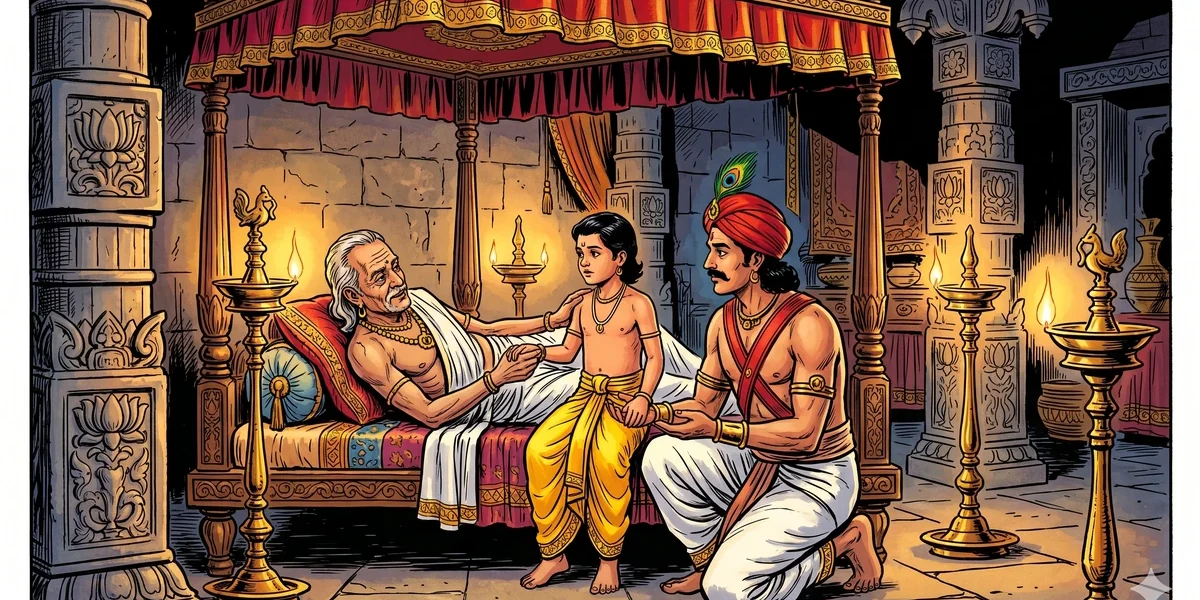
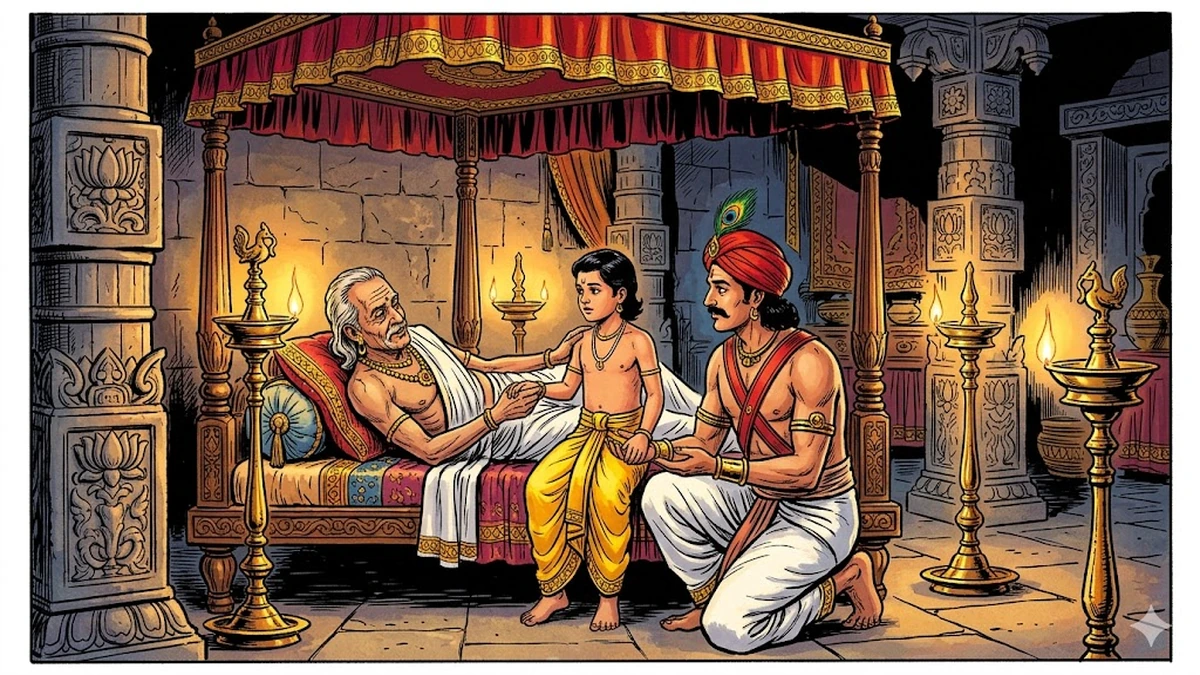
Ten years passed. Sundara grew up bright, accomplished, and visibly intelligent — everything the kingdom had hoped for. But just after his tenth birthday, Śivâchâr fell mortally ill, and the political crisis the storytellers had been quietly preparing now broke. On his deathbed the king did something that breaks all the conventions of South Asian dynastic politics. Instead of summoning his minister, he summoned a man of much lower rank: a personal servant whom he had watched all his adult life and judged simply, honest. The servant’s name was Raṇavîrasiṅg. The king cleared the room of every other person except the weeping ten-year-old prince, and spoke to his servant the speech that gives the tale its ethical centre.
It is worth quoting Natêsa Śâstrî’s record of the deathbed words almost verbatim, because the moral architecture of the entire tale rests on them: “My dear Raṇavîrasiṅg! I have only a few ghaṭikâs before me. There is one God above us all, who will punish or reward us according to our bad or good acts. If by avarice or greed of money you ever play false to the trust I am going to repose in you, that God will surely punish you. Care not if my son does not get the kingdom. If you only preserve him from the wicked hands of the minister… you will do a great work for your old master.” The king then took the boy’s hand, kissed it, and placed it in Raṇavîrasiṅg’s. From that minute, he said, “you are father, mother, brother, servant, and everything to my son.” Then, as a separate and almost cynical diplomatic act, he summoned Kharavadana, took off his signet-ring (mudrikâ), and gave it to him as regent — with the instruction that on Sundara’s sixteenth birthday the throne was to be returned. The king died. The minister mounted the throne. The faithful servant took the prince into the inner palace and shut the door.
The genius of this opening is that the tale does not pretend the king is being clever. He is being desperate. He knows the regent will not return the throne. He knows Sundara is too young to rule. He knows the only thing he can buy with his death is time, and the only person he can trust to spend that time well is a man with no political ambition of his own. The Tamil storytellers Natêsa Śâstrî interviewed had a phrase for this kind of trust — they called it tâlikkattu, “the marriage-thread tied” — meaning a bond stronger than blood and tighter than law, formed by the spoken word of a dying man. The same idea, in Sanskrit, is maraṇa-pratijñâ, “the deathbed-promise”. Across the Indo-European folk corpus this is the moment that unlocks ATU type 516: a great trust between unequals, sealed by mortality. Grimm’s Der treue Johannes opens at exactly the same scene; so does the Persian frame of the Tutinama; so does the Tibetan Vetâlapañcaviṃśati; so does the Russian The Soldier’s Son in Afanasyev. Only the costume changes.
III. The Locked Palace: Tutors, Twenty Companions, and a Suspicious Bride
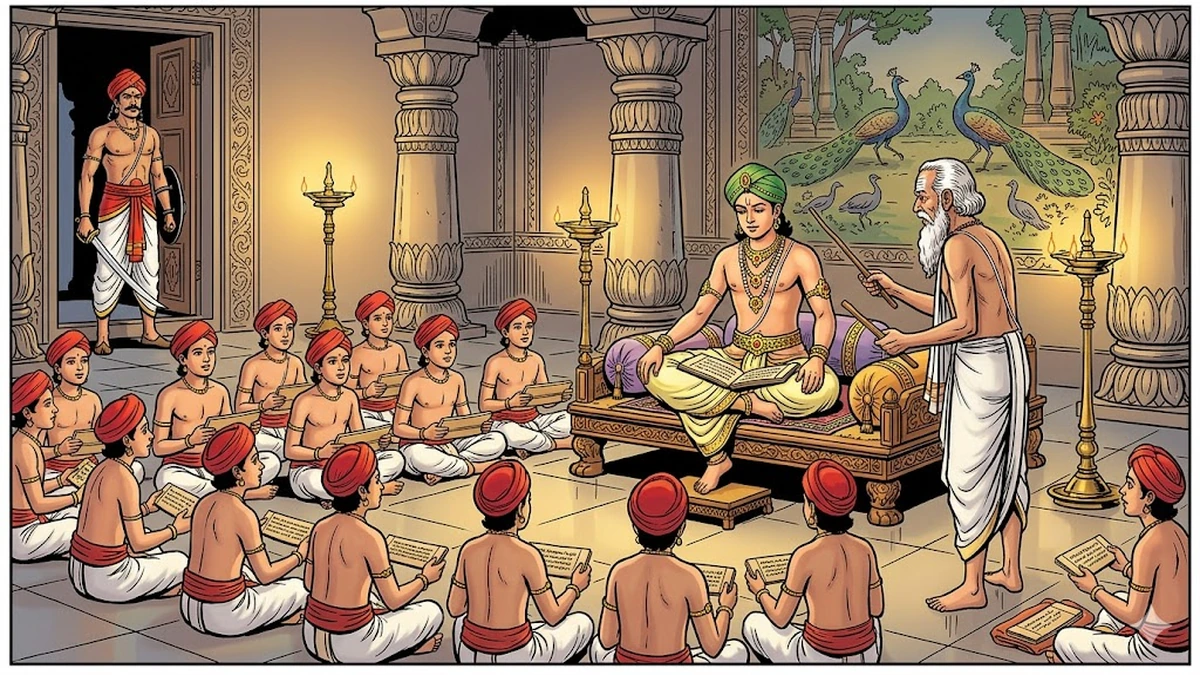
Raṇavîrasiṅg, having received the trust, set about discharging it with the systematic thoroughness of an old soldier. The first thing he did was to make sure the prince did not become lonely, melancholy, or odd from confinement — a real risk, then as now, for a boy raised in a single room. He brought to the palace twenty boys of good families, well-conducted and well-spoken, and made them Sundara’s permanent companions. He hired professors of every branch of learning: vyâkaraṇa (grammar), jyotiṣa (astronomy), dhanurveda (archery), arthaśâstra (statecraft), nâṭyaśâstra (the dramatic arts), and the courtly disciplines of riding, swimming, and the playing of the vîṇâ. Sundara grew up, in other words, in something close to the curriculum of a Sangam-era prince; only the streets and the public square were missing.
The reason Raṇavîrasiṅg never let him into the streets was excellent. As soon as Kharavadana had sat firmly on the throne, the regent had quietly issued a public proclamation: anyone who brought him the head of Sundara would receive a karôr of mohurs — a crore (ten million) gold pieces, the largest reward ever pledged in the kingdom’s history. The bounty did its work. Half the desperate men of Vañjaimânagar were now hoping to glimpse the prince, and Raṇavîrasiṅg, whose own life was forfeit if Sundara died, kept him invisible. Even before the proclamation, the minister had taken the precaution of arranging Sundara’s marriage himself. He had chosen a young woman whose family owed him a long political debt, married her to the prince in a state ceremony that the boy was too young to understand, and installed her in the inner palace. Raṇavîrasiṅg accepted her presence because he had no choice, but he watched her with the unsleeping suspicion of a man who has known too many palace coups. He told the prince, in private and repeatedly, never to accept so much as a betel-leaf (tâmbûla) from her hand — a warning whose specificity Tamil readers would have understood at once, since every Indic court tradition since the Arthaśâstra has recorded poison being administered in the lime paste that holds the betel together. The prince obeyed the order, but he resented it; the bride, sensing the resentment, kept watch in her own way; the minister waited.
IV. The Mansion Window: A Sentence of Shame Falls on the Prince
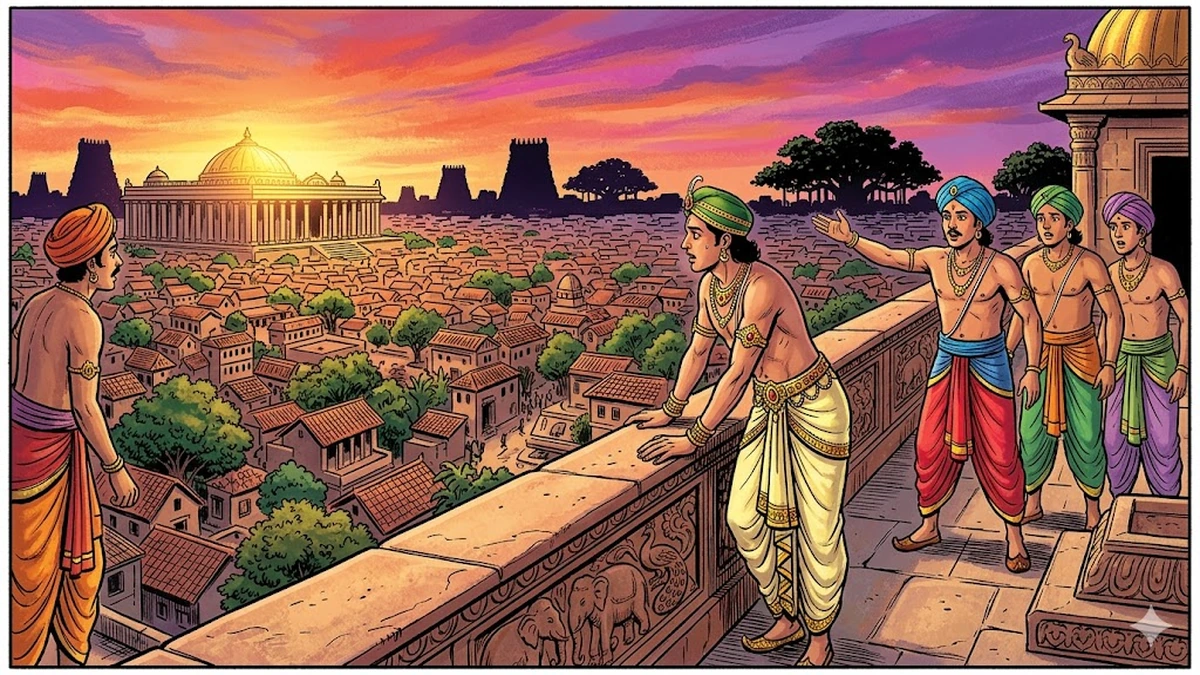
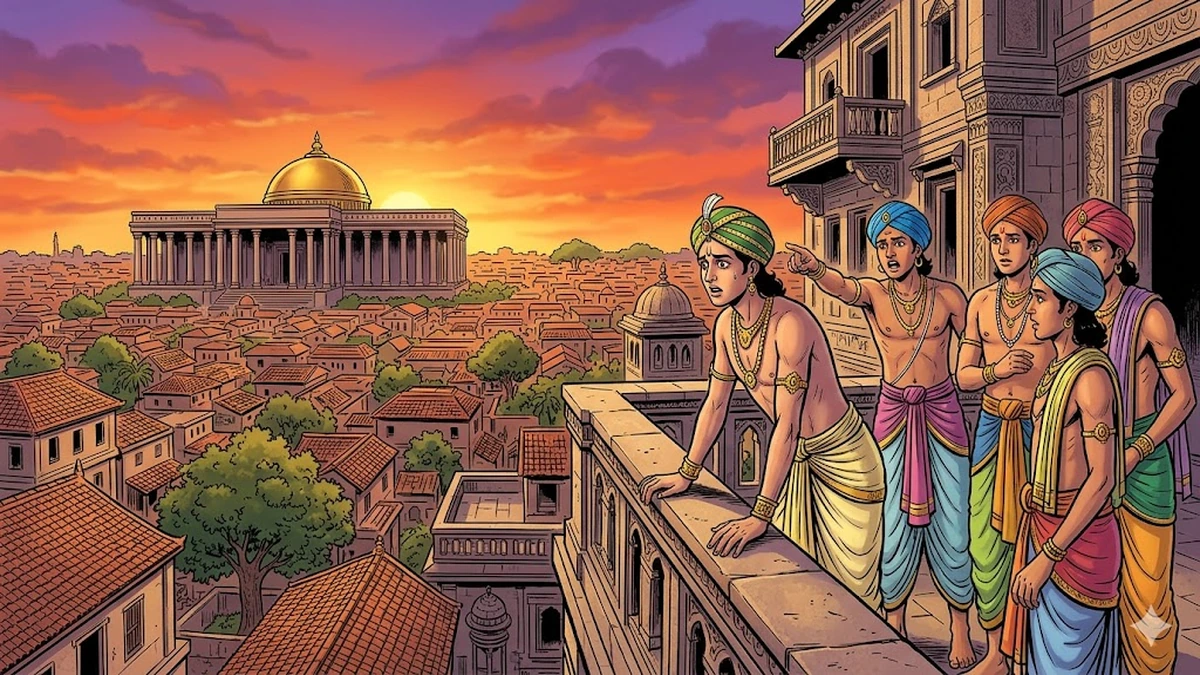
Eight years passed. Sundara reached his sixteenth birthday, and the throne was not returned. Raṇavîrasiṅg, calculating that the boy was not yet ready to govern, said nothing. Two more years passed; Sundara was now eighteen; still nothing. The faithful servant’s reasons for waiting were reasonable, but he had not understood that to a young prince delay itself is humiliation. The crisis came on a fixed and very specific date in the Tamil ritual calendar: “the fourteenth day of the dark half of the month of Vaiśâkha of the Vasanta season”, that is, the night before Amâvâsyâ in late April or early May, when the sun is at its hottest in inland Tamilakam and the evenings draw the city up to its rooftops for relief. Sundara and his twenty companions were sitting on the seventh storey of his palace mansion, watching the dusk soften the city.
One of the boys pointed across the rooftops to a great building in the eastern quarter and said, in the cool tone of a friend who has been bottling something up for years: “That is the Râjasthânik Kachêri, the king’s court — a place you ought to have been sitting in for the last two years. The wretched minister Kharavadana has already usurped your seat. If he had ever intended to give you back the kingdom he would have done it two years ago. Let us console ourselves that God has spared your life till now, despite the rewards he has promised for your head.” The words fell, says Natêsa Śâstrî, “like arrows in the ear of Sundara”. He did not blush; he changed colour. The companions saw it and were sorry they had spoken. The prince — with the small, precise dignity of an eighteen-year-old who has just realised he is being pitied — pretended his cheerfulness back into his face, changed the subject, and at the end of the long evening said only: “Be ready in the durbâr hall at first light. We ride out together.” He sent for Raṇavîrasiṅg and asked him, for the first time in eight years, to saddle horses for a public ride through the streets of Vañjaimânagar.
The faithful servant’s reply, recorded by Natêsa Śâstrî, is a small masterpiece of Tamil-courtly Sanskrit. “Mâi Bâb Chakravartî,” he said — “my darling sovereign-emperor” — “I was only waiting to hear such an order from your own mouth. From your retired disposition I had begun to think you were not an energetic man. The horses shall be ready.” In one sentence the old servant managed to forgive the boy his eight years of resentment, to acknowledge that the long confinement had been the wrong shape for a young man, and to give back to the prince, with a single courtly title, the kingship of Vañjaimânagar that Kharavadana had stolen. The horses were saddled. The companions came in formal dress. And before sunrise the next morning the locked palace at last opened its doors.
V. The Long Tail of the Tale: The Faithful Servant’s Final Trick
Natêsa Śâstrî’s full text continues for several more chapters into a long and intricately plotted second half — too long to retell here in full, but worth summarising for the reader who will go on to Folklore in Southern India for the rest. After the morning ride reveals the prince to the city (and to the bounty-hunters), Raṇavîrasiṅg orchestrates a complicated counter-plot. He confronts Kharavadana publicly, demands the throne in Sundara’s name, is refused, and is then given the classic ATU 516 ordeal: kill the prince and bring back the head, or be executed himself. Raṇavîrasiṅg, like the “compassionate executioner” of motif K512 (the same role played by the huntsman in Snow White, by Faithful John before the dragons in KHM 6, and by the loyal vizier in countless tales of the Tutinama), agrees in public, hides the prince in a forest âśrama, kills a deer, and brings the deer’s heart back as if it were the prince’s. The deception holds long enough for him to assemble loyal troops in the surrounding districts, to expose the queen-bride’s collaboration with Kharavadana, and finally to march back into Vañjaimânagar at the head of a counter-army. Sundara is restored to the throne. Kharavadana is executed in the same place where Sundara’s father had died. Raṇavîrasiṅg, who refused all rewards, is given the only thing he ever wanted: to retire as keeper of the dead king’s memorial shrine, where for the rest of his life he kept a single oil-lamp burning before the image of Śivâchâr.
The closing detail is one Natêsa Śâstrî recorded with care because his Tamil informants insisted on it. The lamp Raṇavîrasiṅg lit was a nilavilakku, the standing brass lamp that is still the central object of every Kerala and Tamil household shrine. The word in Sangam Tamil is kuttuviḷakku; in Sanskrit, dîpa-stambha. It burns coconut oil, and when properly tended it can stay alight for years. The image of an old soldier sitting beside such a lamp until his own death — never asking for the kingdom he saved, never claiming the gold he was offered, just keeping the flame — is the story’s final distillation of the meaning of vîra-bhakti, the heroic loyalty that the Sanskrit aestheticians from Bharata onward identified as one of the eight permanent emotional states (sthâyibhâva) of South Asian narrative.
The Moral: The Quiet Power of the Kept Word
Natêsa Śâstrî, who never sentimentalised his materials, ends the tale with a single Tamil proverbial couplet which his nineteenth-century English version renders only loosely. The original, in Tamil and in his own Roman transliteration, runs:
Vâkku tappâta vîranukku
Râjyam vandu kâl kazhuvi nirpa.“Before the warrior who never breaks his word,
the kingdom itself shall come and stand washing his feet.”— Tamil closing couplet to Raṇavîrasiṅg, in S. M. Natêsa Śâstrî, Folklore in Southern India, Part I (Bombay, 1884), p. 22.
The image of the kingdom “washing the feet” (kâl kazhuvi) of the loyal warrior is taken from the South Indian household ritual of pâda-pûjâ, in which a guest’s feet are bathed by the host as the highest gesture of reverence. In the proverb, the abstract noun râjya (kingdom) takes on the role of the host. The point is exact: it is not the king who rewards loyalty, and not even the gods — it is the kingdom itself. Where there is one truly loyal man, the political community gathers itself around him in something like religious reverence. This is, finally, the difference between a folk-tale and a political fable. A political fable would have ended with Sundara crowning Raṇavîrasiṅg; the folk-tale ends with Raṇavîrasiṅg keeping a lamp. The first ending is about reward; the second is about character.
Why It Lasted: An Indian Faithful John in a World of Faithful Johns
The placement of Raṇavîrasiṅg within ATU 516 puts it in one of the great trans-continental folk-tale families. Hans-Jörg Uther’s revised Types of International Folktales (FFC 284–286, Helsinki, 2004) records over 250 attestations of the “Faithful John” type from across Europe, the Caucasus, Iran, India, Tibet, Mongolia, China, and Korea. The closest European cognate is the Brothers Grimm’s Der treue Johannes (KHM 6, in Kinder- und Hausmärchen, 1812; the Grimms collected it from Dortchen Wild in Kassel in 1810), in which Faithful John saves the young king of his deceased master from three magical dangers and is, in the end, turned to stone for his pains. The closest Indic cognate is the framework story of the Vetâlapañcaviṃśati, the “Twenty-Five Tales of the Vetâla”, transmitted through Somadeva’s eleventh-century Kathâsaritsâgara and Kṣemendra’s Bṛhatkathâmañjarî, in which a yogin entrusts King Trivikramasena with a perilous quest. The closest Persian cognate is the framing tale of the Tutinama or “Tales of a Parrot”, in which a merchant’s loyal parrot saves his master’s honour through nightly storytelling. The closest Tibetan cognate is the Sgrung tale of Dpal-mgon, the loyal page who saves the king’s son from the regent’s sorcery.
What makes the Tamil version distinctive within this enormous family is the entire absence of magic. Raṇavîrasiṅg saves the prince by sheer competence: by selecting good companions, by hiring good professors, by warning against poisoned betel-leaves, by reading the political weather, by lying convincingly to a tyrant, by riding faster than a bounty hunter. There are no dragons, no enchanted ravens, no statues that turn to stone. The Tamil storyteller’s point is that loyalty needs no enchantment. It is itself the magic. A. K. Ramanujan, in his introduction to Folktales from India (Pantheon, 1991), called this kind of South Indian tale a “tale of vîra-bhakti” — the bhakti of the warrior. The bhakti of the saint, he wrote, is shown by what one is willing to give up; the bhakti of the warrior is shown by what one is willing to keep.
Iconography: The Dying King, the Prince Behind the Curtain, the Old Soldier’s Lamp
The three iconic visual scenes of the tale — the deathbed of Śivâchâr with the boy’s hand placed in the soldier’s, the locked palace where the prince and his twenty companions study under tutors, and the rooftop conversation at sunset on the seventh storey when the truth at last comes out — entered Tamil popular iconography through the Madras Mail’s 1885 illustrated reprint of Natêsa Śâstrî’s text, and from there into the Telugu-language adaptations of the early twentieth century. The Tanjore-school painter C. Kondiah Râju made a celebrated calendar print of the deathbed scene around 1948, in the saturated reds and golds that Tanjore tradition reserved for moments of vîra-rasa. The Amar Chitra Katha series gave the tale its widest twentieth-century circulation in its 1981 issue “Tales of the Dakshin”, where Pratap Mulick’s pen-and-ink rendering of Raṇavîrasiṅg lighting his lamp at the dead king’s shrine remains, for many Tamil and Malayali readers, the indelible image of the story.
Reading with Children
For parents, teachers, and storytellers reading Raṇavîrasiṅg aloud to younger listeners, three details from Natêsa Śâstrî’s text repay slowing down for. First, the deathbed promise. Children grasp at once the moral weight of a hand placed in another hand by a dying father; it is the kind of image they have already absorbed from their own experience of grandparents and pet animals. Pause and let them feel it. Second, the betel-leaf warning. Younger children may need an explanation of tâmbûla, the leaf-and-lime parcel still chewed at South Indian weddings; once they have it, they will understand instantly why never accepting one from a suspicious hand is a meaningful piece of advice. The lesson generalises easily — do not eat what someone with reason to dislike you has prepared in private. Third, the lamp at the end. Children love rewards, and they will be surprised that the hero of the story refuses every offer. Point out that the lamp is, in its quiet way, the largest reward of all: it means the old soldier’s work is not finished, only changed. He is now keeping his master alive in a different form. That is a transferable idea, and worth teaching.
A Note on Sources
The version preserved on this page is the standard text of Pandit S. M. Natêsa Śâstrî’s Folklore in Southern India, Part I (Bombay Education Society’s Press, 1884), pages 1–22, the lead story of the volume, and is reprinted with minor Anglicisations as the opening tale in Mrs. Howard Kingscote and Pandit Natêsa Śâstrî, Tales of the Sun, or, Folklore of Southern India (W. H. Allen & Co., London, 1890), pages 1–30. Both volumes are in the public domain and the 1890 edition is freely available at the Internet Archive (identifier talesofsunorfolk00king). For the comparative folklore, the standard reference remains Stith Thompson’s Motif-Index of Folk-Literature (revised edition, Indiana University Press, 1955–58); for the Indian motif inventory, Stith Thompson and Jonas Balys, The Oral Tales of India (Indiana University Press, 1958); for the modern South Asian classification, Heda Jason, Types of Indic Oral Tales (FFC 242, Helsinki, 1989). For the Sangam and post-Sangam context of Vañjaimânagar, the indispensable reference is K. A. Nilakanta Sastri, A History of South India (Oxford University Press, 1955), chapter VI; for the Chera capital question (Karûr versus Tiruvanchikkulam), see R. Nagaswamy, Roman Karur (Brahad Prakashan, 1995). Above all the retellings stands Natêsa Śâstrî’s own first edition of 1884, the foundational document of modern Tamil folkloristics, written by an Indian about Indian stories for the first time.
Read time: about 10 minutes. Suitable for ages 8 and up; suitable for read-aloud from age 6 with the regent’s bounty on the prince’s head described, in Natêsa Śâstrî’s gentler phrase, simply as “the wicked minister’s offered reward.”
Frequently Asked Questions
**Q: Why is this story important?**
You May Also Like
 Indian Folk Tales
Ages 9-12
Indian Folk Tales
Ages 9-12
Dark Original Stories Behind 5 Disney Movies
Five Disney films rest on older, darker sources—Andersen’s mermaid, Grimm Rapunzel and Snow White, Barrie’s Peter Pan, and the real Pocahontas. Honest contrasts for readers 12+.
 Indian Folk Tales
Ages 12+ / YA
Indian Folk Tales
Ages 12+ / YA
The Disconnect | Modern Indian Wedding Satire Poem (12+)
A modern satire on lavish weddings, debt, and the quiet rebellion of simple marriages — Kabir’s wisdom in a new key.
 Indian Folk Tales
All Ages
Indian Folk Tales
All Ages
The Brahman Priest Who Became An Amildar
The Brahma 's Priest Who Became An Amildar: In a bustling town in ancient India, A poor Brahmin priest, tired of performing rituals for meager donations