If Only Fairy Tales Could Be Like This
If Only Fairy Tales Could Be Like This: Often people get carried away by looks. We are still living in a world which gives first preference to how we look.
![If Only Fairy Tales Could Be Like This [POEM] - Cover - Amar Chitra Katha Style](https://indianfolktales.com/wp-content/uploads/2026/04/473_cover_gemini-1200x600.webp)
Often people get carried away by looks. Why not? We are still living in a world which gives first preference to how we look. But is Beauty all about that? Who do we think is really beautiful?
The fairy tale of “Cinderella” presented as a ‘story poem’ best depicts the modern world and how people appear to be beautiful.
No sigh, no cry in the dungeon as she lie But is she a beast or a beauty or turned witch in its booty “Help me dear Fairy, she prayed, from the world, that may turn me into an ugly witch So my prince would choose my sisters instead of me But I know he would find me, Sure he would recognise what real beauty is”
Ever since the search began, never looked back as he ran But soon prince charming found the answer “What kind of beauty is that of those sisters i had met They shed their mud on other(s) so they looked prettier But that isn’t what real beauty is It is that look which you make others feel from inside” Thus the prince chose her as she appe ared indomitably beautiful to him
On International Women’s Day today, we celebrate every woman, because every woman deserves it.
The original Cinderella, when told by Charles Perrault centuries ago, was a story about transformation and kindness. A young girl, treated poorly and dressed in rags, attended a royal ball thanks to magical intervention. But the magic in that story was not meant to last forever – it came with a deadline, a pumpkin that would return to its true form, a coach that would become what it truly was. The magic was temporary, ephemeral, a teaching that even our grandest moments are fleeting if we do not build something real beneath them.
In modern retellings, Cinderella has been flattened. She is shown primarily as a girl who longed to be beautiful, who needed external transformation to become worthy. The glass slipper, that impossible standard of perfection, has become the symbol of the story instead of the clock’s midnight chime. We have lost the deeper narrative: that Cinderella’s true beauty was her resilience, her capacity to maintain kindness even in hardship. The magic was never what made her valuable – her character was.
This is the tragedy of modern fairy tales. We have traded the interior journey for the exterior one. We teach young people that transformation comes from without – a perfect appearance, a perfect prince, the right circumstances – when the real transformation that matters comes from within. We have made our tales about looking beautiful when they should be about becoming brave.
The fairy tales that truly endure are those that understand this distinction. They show us characters who must learn, grow, and choose – not simply appear different. Real transformation is never instant, never magical in the literal sense. It requires patience, endurance, and the quiet daily work of becoming who we wish to be.
The poem captures a longing that resonates across centuries – a yearning for stories where justice is swift, where goodness is always rewarded, where villains receive immediate consequences for their cruelty. In the realm of fairy tales, the wicked witch crumbles to dust, the prince awakens his true love with a single kiss, and the poor maiden becomes a princess through virtue alone. These narratives have comforted countless souls, especially those who have suffered in a world far less orderly than the enchanted kingdoms of our imagination.
Yet the poem’s true power lies in its gentle recognition of reality’s complexity. It whispers the question that every adult who loved fairy tales must eventually ask: “What if life could actually work that way?” Not with bitterness, but with a bittersweet acknowledgment that the world operates according to different rules than those that govern the tales of our childhood. Still, the poem suggests, perhaps there is wisdom in remembering the moral clarity of those stories – the importance of kindness, courage, and perseverance – even if their resolutions remain firmly in the realm of fantasy.

Moral
True friendship persists through separation and hardship, while superficial bonds dissolve under pressure. The poem critiques the modern tendency to value convenience over genuine connection.

Historical & Cultural Context
India’s regional folk tale tradition is a vast oral inheritance carried by grandmothers, wandering bards and village storytellers, preserving moral wisdom, social commentary and cultural memory long before any of it was written down.
This lyrical meditation on friendship echoes the bhakti poetry tradition of emotional and spiritual devotion found in Tamil, Hindi, and Punjabi literature. The poem structure and emotional tone resemble contemporary adaptations of classical themes. It critiques modern isolation while honouring the ancient Indian value of satsang (spiritual companionship) and the Upanishadic ideal of lasting bonds.

Reflection & Discussion
- What makes some friendships last and others fade away?
- Can fairy tales teach us more than real life about true love?
- Why do we often choose easy friendships over true ones?

Did You Know?
- India has one of the richest oral storytelling traditions in the world, with tales dating back thousands of years.
- Many Indian folk tales were passed down through generations before being written down.
- Indian folk tales often blend real-life wisdom with magical elements to teach moral lessons.
What This Tale Teaches Us Today
Old stories keep their power because their lessons never stop being useful. Here is how this one still applies:
- Traditional stories remind us that wisdom belongs to many cultures. No single tradition holds all the answers.
- Folk tales teach ethics without lecturing. A good story can reshape a mind more powerfully than any rule.
- Stories that have survived for centuries have done so because their lessons still work.
Why This Story Still Matters
If Only Fairy Tales Could Be Like This joins a vast global library of folk tales that human beings have been telling one another for thousands of years. Every culture has produced its own stories, but the deepest themes – courage, kindness, cleverness, loyalty, the cost of greed – appear again and again in different clothes. Modern readers who spend time with folk tales inherit something precious: a sense that people have always wrestled with the same basic questions, and that good stories can still help us find good answers. That is why these tales persist. Each one is a small tool for living, handed down quietly through generations.
Cultural Context and Continuing Influence
Folk tales like this one survived for hundreds of years through oral storytelling before any scholar thought to write them down. Grandparents told them to grandchildren, travelers traded them along roads and rivers, and mothers repeated them to babies who would one day repeat them to their own children. Each small retelling sharpened the story, discarded unnecessary parts, and polished the essential lesson. That long process of refinement is why a good folk tale feels so weighty – it has been shaped by thousands of listeners across generations, each contributing something small to the story we read today.
Modern readers sometimes wonder whether folk tales are still relevant in an age of apps and smartphones. The answer is yes, perhaps more than ever. The technology changes, but the underlying questions – about kindness, courage, loyalty, greed, family, fear, love – do not. These are the same questions that children asked around a fire in ancient India, around a hearth in medieval Ireland, around a campfire in 19th-century Korea. And they are the same questions children ask their parents today, just phrased differently. That is why a family that reads folk tales together is doing real cultural and emotional work, not simply entertaining itself.
Reading Folk Tales With Children
Reading folk tales aloud to children is one of the oldest and most effective forms of moral education. Unlike a lecture or a rule, a story slides past a child’s natural resistance and plants its lesson in the imagination, where it quietly grows. Years later, when the child meets a real situation that resembles the story – a bully at school, a dishonest coworker, a moment of temptation – the old tale rises to the surface of memory and offers guidance. That is why parents and teachers across every culture have trusted stories to do the work of raising good humans, long before formal schools or textbooks existed.
When reading this story with a young listener, try pausing at key moments and asking what the child thinks will happen next. Let them guess, even if they are wrong. That small act of prediction turns a passive listener into an active thinker. After the story ends, a simple open question – “What would you have done?” or “Who do you think was the smartest character?” – invites the child to connect the tale to their own life. Those conversations are where real learning happens, not during the reading itself but in the quiet moments that follow.
Older children and teenagers sometimes think they have outgrown folk tales. In reality, the best tales only deepen with age. A ten-year-old hears the surface plot; a fifteen-year-old notices the irony; a twenty-year-old sees the economic and political pressures on the characters; a forty-year-old understands the parents in the story for the first time. A good folk tale is a gift that keeps unfolding for decades. Families who read and reread the same stories across the years discover this naturally, and pass the discovery down.
A Final Word
Every folk tale carries within it the accumulated judgment of thousands of listeners across many generations. When a story has been told for a thousand years and still moves children today, that is not an accident. It is proof that the story is saying something true about the human condition. The wiser the listener, the more they see in a tale they have heard a hundred times before. Reading these stories slowly, out loud, with children beside us, we are joining the longest conversation our species has ever had with itself. Every tale we share is a quiet vote for patience, for meaning, and for the old idea that a good story is one of the finest things one generation can hand down to the next.
We hope this telling gave you something worth carrying into your day – a small lesson, a useful image, a question to ask your child at dinner. Folk tales do their best work in the hours and years after the reading ends, quietly shaping how we see the world and each other. Thank you for spending time with this story, and for keeping the old tradition of careful listening and thoughtful retelling alive.
Frequently Asked Questions
**Q: Why is this story important?**
You May Also Like
 Indian Folk Tales
Ages 3-5
Indian Folk Tales
Ages 3-5
The Lambikin 2
The Lambikin 2: Once upon a time there was a wee wee Lambikin, who frolicked about on his little tottery legs, and enjoyed himself amazingly. Now one day he
 Indian Folk Tales
Ages 6-8
Indian Folk Tales
Ages 6-8
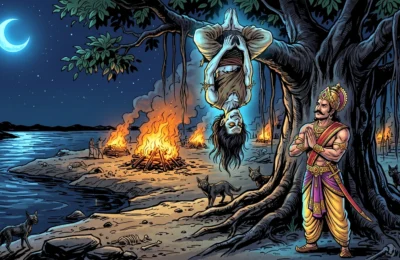
Vikram and the Vampire: The King’s Ultimate Test
Vikram and the Vampire: The King's Ultimate Test: The Night of Impossible Riddles In the ancient kingdom of Ujjain, there ruled a king named Vikramaditya
 Indian Folk Tales
Ages 9-12
Indian Folk Tales
Ages 9-12
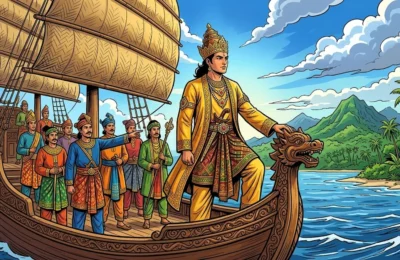
The Legend of the Merlion
The Legend of the Merlion: In the days when the seas between lands were still being charted by explorers and when magic and reality existed in closer proximity