Jwaala Ghat
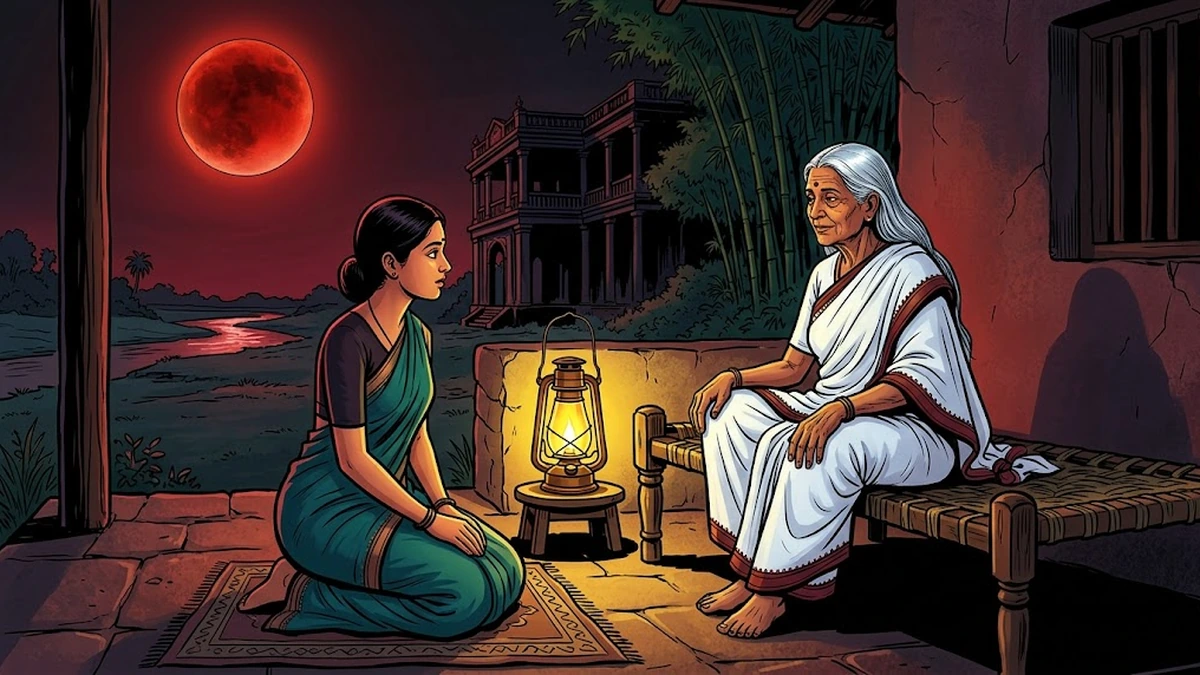
The night was eerie and the eclipse cast shadows of terror. Jwaala, a young girl, gathered her village and taught them the science of celestial events.
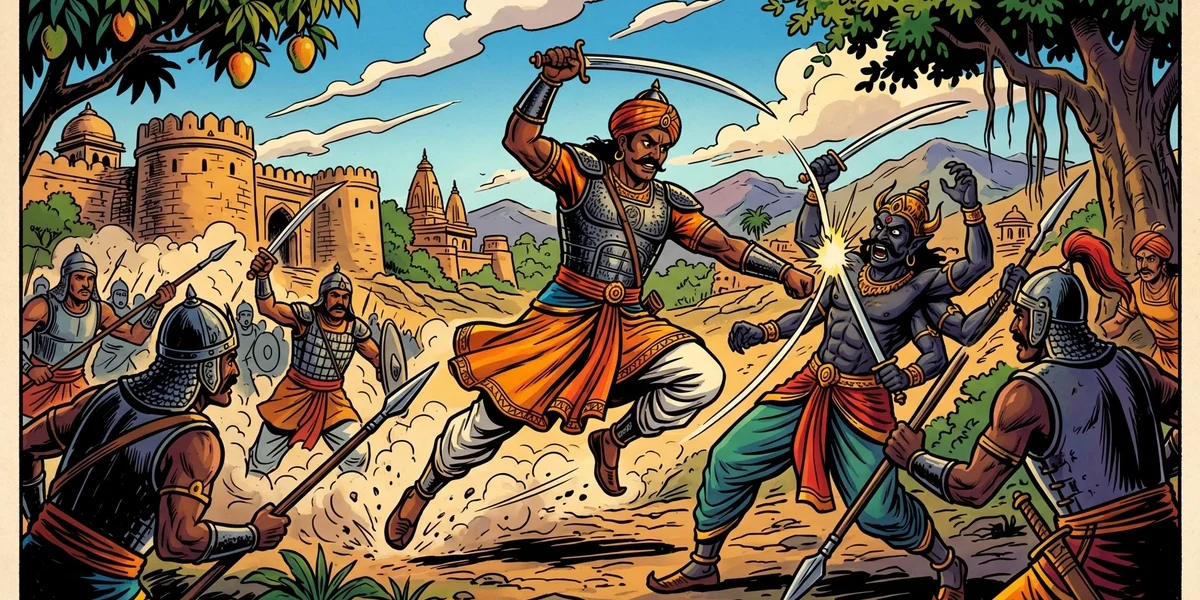
Origin & Tradition. A modern Indian short story in the folk-revivalist register, set in a fictional Deccan village called Jwaala Ghat (“the flame-lit ferry”). It draws on living oral memory of the Devadasi–Jogini institution of Karnataka, Andhra Pradesh and Maharashtra (the Yellamma cult of Saundatti, Belgaum district), and on the period of post-independence administrative reform that produced the Madras Devadasis (Prevention of Dedication) Act, 1947, the Karnataka Devadasis (Prohibition of Dedication) Act, 1982, and the Andhra Pradesh Devadasis (Prohibiting Dedication) Act, 1988.
Folk-narrative type. It blends two long-standing Indian narrative motifs: the haunted-bungalow (the unappeased female pretam returning to claim justice, common in Bengali Mangal-Kāvya and Marathi bhutkathā) with the reformer-collector tale (the urban-trained official restoring dharma to a village — a frame familiar from R. K. Narayan, Mahasweta Devi and the “Indian Pen” genre of the 1950s).
Lineage & recorders. The Yellamma narrative complex is preserved in the Renukā Mahātmya (a regional Sthala-purāṇa), in the Skanda Purāṇa‘s account of Renuka-Yellamma, and in the field-recorded songs collected by Volga, A. Kumarasamy, Anveshi and the SAMATA scholars. Aarne–Thompson–Uther parallels: ATU 326 (the boy who learns fear, here inverted — a girl who acts inside fear), ATU 956 (clever girl rescues captives), and the mātṛkā-deity narrative complex of the Indian sub-continent. Read time: 11 minutes.
Beat I — Three Days Before the Eclipse
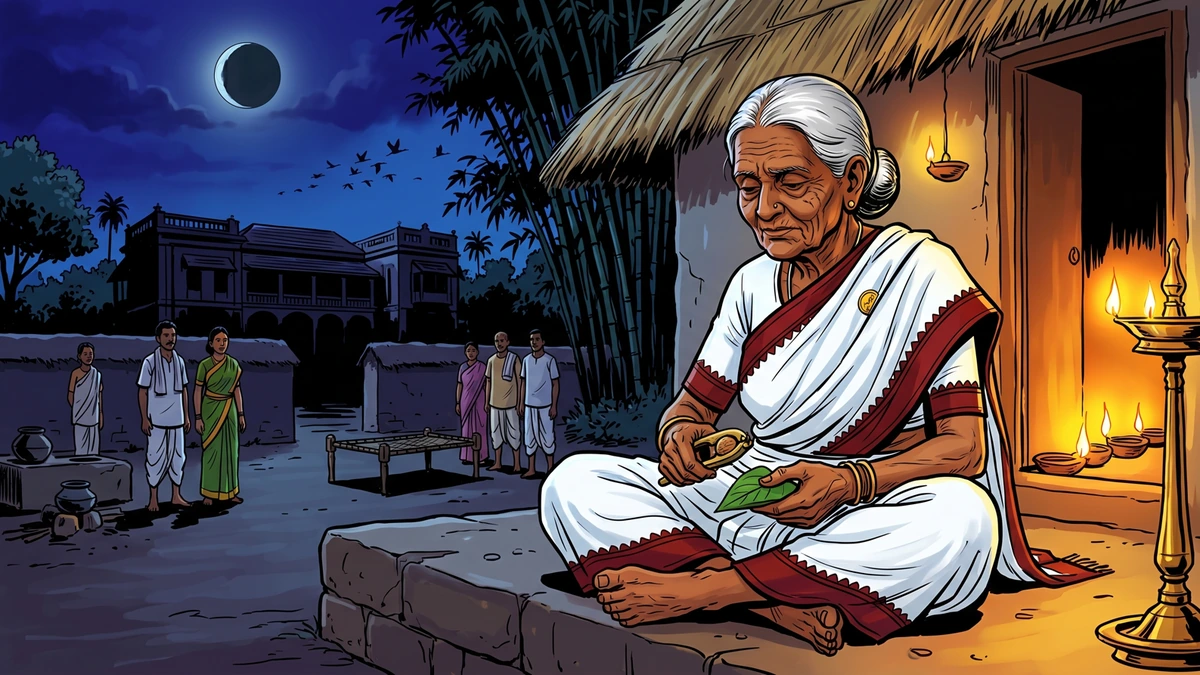
The night was eerie and the eclipse was three days away. Across the village of Jwaala Ghat — a flame-lit landing on the Shreni river, where it bends west to join the Dananjayee — oil lamps burned but no one slept. The screams from the bamboo grove behind the headman’s old bungalow had begun a week earlier and grown each night. The village waited in stillness, that particular Deccan stillness in which fear arrives wearing politeness, and people speak only in whispers so as not to give it a name.
Mallamma was the oldest living Devadasi at the ghat. She had crossed her hundredth year and lost count of the rest, and she sat now on a low stone porch that smelt of cow-dung wash and tulsi smoke, working a folded betel leaf between two fingers. She placed it carefully against her left jaw, struck the brass nutcracker once against an areca nut, and began to chew. As her mouth filled with the slow red of pān, she sang. Her song was not a temple bhajan and not a film tune; it was a Devadasi kāvya-padam, an extemporised praise-poem of the kind that women like her once carried for the temples of Saundatti and Yellampura, before the Acts came down and the temples closed their doors to her caste:
“The bungalow was the sign of prosperity. All the festivities of Kambala began in its front yard. The headman was wealthy, the famine never crossed his fields, the people loved him because he loved them. He was childless — his consort Leeladevi could not bear him a child — yet that grief never bent his kindness toward her. They served the village together, and the village ate from their plate.”
“Stop your grave-song, old woman,” her daughter-in-law cut in from the courtyard, scrubbing rice with too much force. “You always praise that wretched house. The lawn of that bungalow is now the lawn of our death.”
Mallamma did not stop. The young woman did not understand: the song was not praise. It was a caraka — a remembrance — sung so the village might recall what the house had once been, before its rooms were emptied and its garden became a place of unburied things. Three adolescent girls had gone missing in the past nine nights. Two milch cows had collapsed on the threshing floor with their tongues blue. The villagers were certain that Yellamma, the goddess of fertility whom they called Renuka in the older books, was displeased: the Devadasi rite had been stopped, the marriages to the deity had been halted, the Jogini procession had not gone out at the last full moon. The goddess wanted what was hers.
The howling foxes started up again behind the cremation ground. Inside her ribs Mallamma’s heart turned over like a clay pot. She knew, with a certainty older than reasoning, that the village would soon be wiped off the map — unless the Matsya Nārāyaṇa idol of the bungalow shrine, missing now for thirty years, was found and restored. And no man in the village would step past that bungalow gate. The soul of Tara would not let them.
Beat II — The House and the Ghost
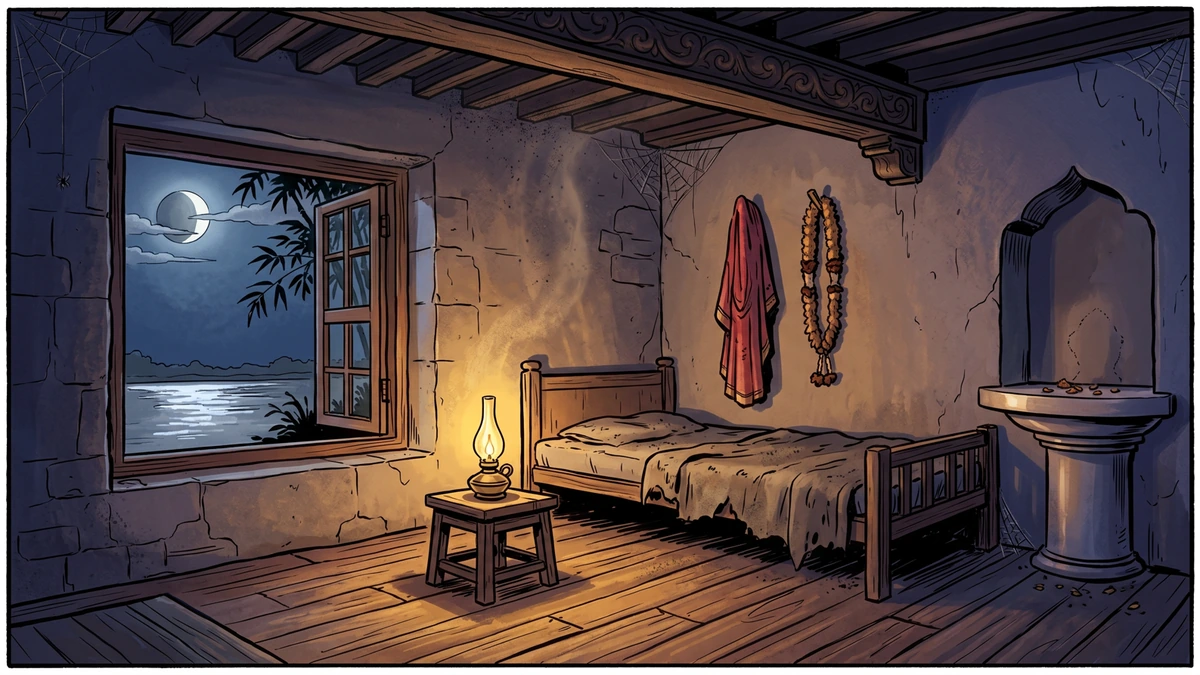
The bungalow had been Tara’s. She had been Leeladevi’s adopted daughter — rescued, in the only act of mercy the headman ever truly allowed himself, from the Devadasi-dedication queue at the Saundatti fair. The headman raised her like his own. When she came of age her marriage was set with great pomp, and on the night before the wedding the bridegroom’s elder brother — drunk, jealous, certain of his impunity — entered her room. By the next dawn Tara was hanging from the carved teak rafter of her own bedroom, and the engagement was burning to ash in the courtyard fire. The headman never spoke again. His widow Leeladevi locked the doors of the bungalow with her own hand, walked into the river Shreni at the next eclipse, and did not come back. The Matsya Nārāyaṇa idol — the brass household deity of Vishnu’s fish-avatar, who in Indian story rescues the world at the time of pralaya — vanished from the household shrine the same night.
What was left was the house, and Tara inside it. Every man who tried to enter died within the year — some by snake, some by the river, one by his own rope. The villagers built a stone bench outside the gate, posted a single guard, and spoke of the bungalow in the third person, as if it were a relative of theirs who had committed a shameful act and could no longer be named in company.
The current guard was Ramappa: orphan, stick-thin, kept on the village rolls only because the panchayat could find no one else to do it. Ramappa had once been convicted of a rape in the next district and exiled. Jwaala Ghat had taken him on the condition that he would sleep at the bungalow gate every night until he died, and that he would never again touch a woman of the village. He sat there now in the moon-shadow of the gulmohar tree, lighting a thin cigar with hands that would not steady, his lower lip chattering as if it were cold. He glanced once toward the dark verandah, then turned his head sharply away. The stone bench was the safest spot in the village. Beyond the gate, no one had ever come back.
Inside, the house held its breath. The teak rafters were still strong. Tara’s wedding garland, dry as a husk, still hung from a hook above the bed. And in the inner shrine room, behind a curtain that no one had moved in three decades, sat a small empty pedestal where the Matsya Nārāyaṇa once had been — and three living girls, mouths bound, waiting to be remembered.
Beat III — Shuddhi at the River
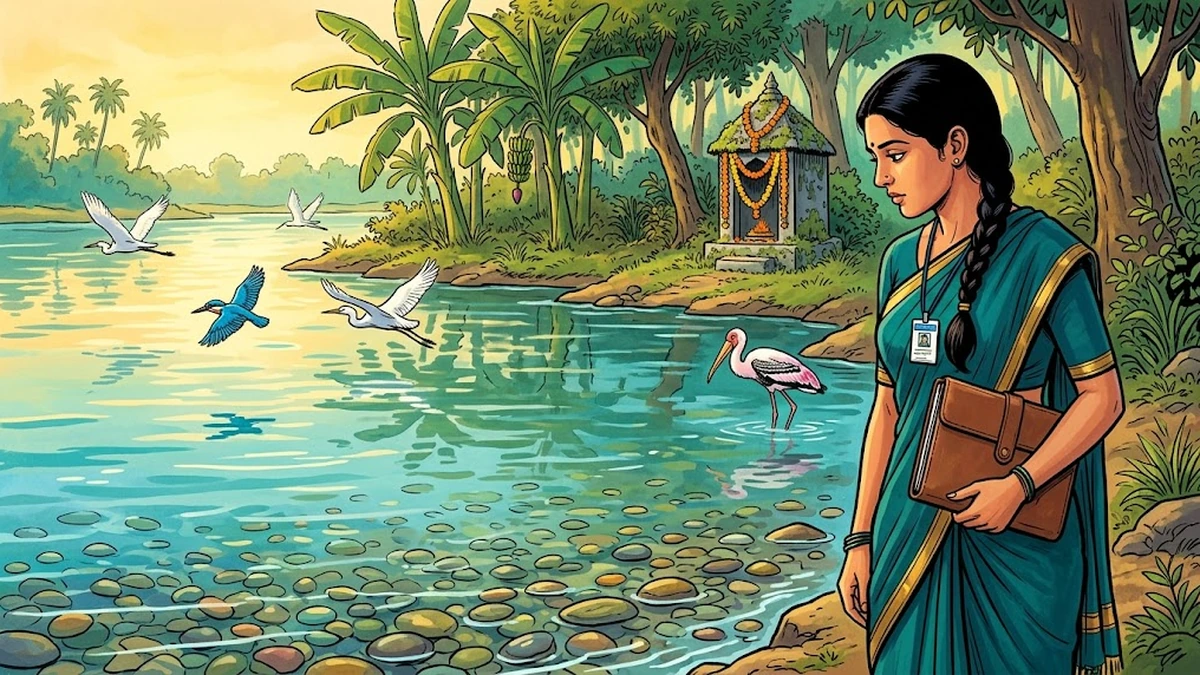
The river Shreni runs only a short distance through Jwaala Ghat before she meets the Dananjayee. Her water is so clear that pebbles look like polished coins on the bottom, and the village has always believed that her current cures skin disease — a belief which is in fact an old folk-memory of the iron and sulphur springs that feed her. She is the natural home of egrets, kingfishers and the rare painted stork. The villagers call her a celestial dancer who came down to earth to bring water to the dry plain.
That morning, on the bank of the Shreni, a young woman in a starched cotton sari stood with her bare feet in the cold water. Shuddhi — the name in Sanskrit means “purification” — was the new sub-collector. She was an orphan, raised in Pune by an honest sub-inspector of police, trained at the Lal Bahadur Shastri National Academy at Mussoorie, and posted, on her first independent charge, to Jwaala Ghat with a single mandate from the Collector: end the Devadasi practice in this revenue circle. She had read the law before she read the village. She knew the Karnataka Act of 1982 and the Andhra Act of 1988 by heart. She knew the case-law on bonded labour, the 1993 Andhra report on Joginis, the unpublished Anveshi field-notes on the Saundatti Jātre. She had come prepared to be hated, and she had been hated, exactly as expected.
In her first ninety days she had stopped a goddess-marriage in mid-rite, lifted a fourteen-year-old girl named Gowri out of the bridegroom’s house, arrested the panchayat president and two priests, frozen the temple lands under the Endowments Act and released them to a women’s cooperative. She had broken something the village had built for two hundred years. The men met her arrival now with locked shop-shutters; the women met her in private, with shy gratitude that they did not dare to repeat in their own kitchens.
Then the girls had begun to disappear. Three of them, all between eleven and thirteen, all from families of the old Devadasi caste. The villagers said Yellamma had taken them as compensation for the marriages she had been denied. The District Magistrate, in his weekly call, said Shuddhi had nine days — until the eclipse, when monsoon papers and the press would arrive — to find them or to be transferred out as a failure.
“Madam, oho madam, lunch is ready!” called Gowri from the verandah of the rest-house, the same Gowri whose wedding to the goddess Shuddhi had stopped — now in school uniform, hair in two plaits, learning to read. Shuddhi turned her face from the water. She had nine days. She had no leads. She had only the law, an old Devadasi who would not stop singing, a haunted house no man would enter, and the slow, river-cold certainty that the case would be solved in that house or not at all.
Beat IV — The Eclipse Hour
On the night of the eclipse Shuddhi went to Mallamma’s porch alone. She did not bring her constables, who would not have followed her in any case. She brought only a kerosene torch, a service revolver she had never fired in anger, and the official sub-collector’s seal in her sari-blouse pocket. Mallamma was waiting. The old woman had bathed, oiled her hair, fastened a fresh white cotton sari with the dark-red Devadasi border, and tied her last gold coin into the corner of her pallu — the offering she had been keeping for her own funeral.
“Take me,” she said. “Tara will let me in. She knew me when she was alive. The men cannot enter that house, and the constables will not. The two of us — one Devadasi who lived past her time, and one collector who came in time — we two can.”
Above them the moon dimmed at its first contact with the umbra; the village dogs went quiet, all at once, as dogs do at totality. The two women walked together past Ramappa’s bench (he kept his eyes on the ground), through the rusted iron gate, across the courtyard where the wedding fire had burned itself out thirty years before, and onto the dark teak verandah of the bungalow. The door, locked for three decades, opened to Mallamma’s hand at the first push. The house knew her.
What they found in the inner shrine room was not the supernatural that the village had promised; it was something older and uglier, the form which evil prefers when it has the cover of superstition. The three missing girls were alive, bound, in the curtained alcove where the Matsya Nārāyaṇa had once stood. Behind them, in a teak chest, sat the missing brass idol — oiled, garlanded, polished. The man who had taken them, and who had stolen the idol thirty years before to lay the foundation of his secret cult of private dedications, was not a stranger from another district. He was the panchayat president’s nephew, a temple accountant the village had trusted for twenty years, who had used the village’s fear of Tara’s ghost as the lock on his own private prison. He had fled the moment the eclipse began — and ran straight into the constables Shuddhi had quietly stationed at every road out of the ghat.
By dawn the girls were home, the idol was back on its proper pedestal in the village temple (not the bungalow shrine; that house was bolted again, and would stay bolted), the accountant was in the district lock-up, and Mallamma had died on Shuddhi’s lap, peacefully, without finishing her last betel-leaf. The villagers, gathered in the temple square at sunrise, saw what they had refused to see for three decades: the ghost had been a story the men had told about themselves to keep the women obedient. The true Tara — the unappeased dignity of a girl who had been failed — was finally laid to rest, not by exorcism, but by another woman acting where the village would not.
Moral — Šakti acts because no one else will
“yā devī sarvabhūteṣu mātṛrūpeṇa saṃsthitā / namastasyai namastasyai namastasyai namo namaḥ.”
— Devī-Māhātmya 5.43
“The Goddess who abides in every being in the form of the Mother — to her, salutation; to her, salutation; to her, salutation, salutation, salutation.”
The classical hymn of the Devī-Māhātmya — sung at every village Navarātri across the Deccan — insists that śakti (sacred power) lives in every woman, not only the Goddess on the high pedestal. The story of Jwaala Ghat is the same theology spelled out in social form: a young collector and an old Devadasi together do what the village’s institutional men — the priests, the panchayat, the temple accountants, the police constables — refuse to do. The moral is not “women are stronger than men” nor “modern law is wiser than tradition”; it is the older Indian moral that dharma is whoever picks it up when it has been dropped. Mallamma picks it up by remembering. Shuddhi picks it up by walking through a gate. Each acts inside her fear, not after it has gone.
Historical & Cultural Context
The Devadasi (literally “servant of the deity”, Sanskrit deva-dāsī) institution is recorded in South India from at least the seventh century CE, in inscriptions of the Pāṇḍya, Coḷa and Rāṣṭrakūṭa courts. In its classical form, women were dedicated as ritual dancers and singers attached to a particular temple; many Devadasis became literate in Sanskrit and Tamil, owned property in their own names (a rare right for women in pre-modern India), and were the principal carriers of the Bharatanāṭyam, Kuchipuḍi and Mohiniyāṭṭam traditions that today fill concert halls.
What broke the institution — long before any reformer touched it — was colonial-era land settlement. When the British dismantled temple endowments in the nineteenth century, Devadasi families lost their inherited paddy-fields and ritual stipends in a single generation. Many were reduced to poverty; some communities, especially the Yellamma-Renuka cult around Saundatti in present-day Belgaum (Karnataka), drifted into a degraded form in which the dedication became a cover for debt-bondage and sexual exploitation. By the time Muthulakshmi Reddy, India’s first woman legislator, introduced the Madras Devadasis (Prevention of Dedication) Bill in 1927, the institution that needed to be ended bore little resemblance to the artistic profession of the Cōḷa court inscriptions.
Three legislative milestones shaped the world of the story: the Madras Act of 1947, passed weeks after independence; the Karnataka Act of 1982, which targeted the Saundatti Jātre directly; and the Andhra Pradesh Act of 1988, which extended the prohibition to the Jogini, Mathamma and Basavi sub-cults. Implementation, however, depended entirely on local administrators willing to absorb village hostility — women like the fictional Shuddhi, modelled on real IAS and IPS officers such as Ms. Renuka Viswanathan in Karnataka and Dr. Sunitha Krishnan of Prajwala in Hyderabad, whose names recur in the field-reports.
Why This Tale Endures
Indian folk literature has always preferred the composite plot — one that wraps a piece of social commentary inside a piece of supernatural suspense. Audiences sit through the ghost because they came for the ghost; they leave with the social lesson because the storyteller put it there. The Mangal-Kāvya cycles of medieval Bengal worked the same way: the goddess Manasā or Caṇḍī takes vengeance on a wealthy merchant, and what looks like a horror tale turns into a critique of caste pride. The Marathi bharuḍ tradition, the Telugu burra-katha, the Tamil villu-pāṭṭu — each carries the same structural trick. Jwaala Ghat stands in that line. Its haunted bungalow is a narrative wrapper around the Devadasi reform; the wrapper is the reason the lesson reaches the listener at all.
It also endures because it is rare. Most Indian folk tales told to children are sanitised, set in palaces, and resolved by clever animals. A tale that names the institutional violence done to women in the name of religion — and that allows two women, one of them old, one of them young, one inside the tradition and one outside it, to resolve the plot together — is a tale modern Indian classrooms increasingly need. It is what the Telugu writer Volga calls strī-vyathaartha-katha, “the women’s set-right story.”
Reflection & Discussion
- Why does Mallamma’s song matter? In a community that has “moved on” from a painful institution, what is the role of the elder who insists on remembering?
- Shuddhi enters the bungalow because the law sent her, but she succeeds because Mallamma walks in with her. What does the story say about the limits of the modern state when it acts without the village’s own moral authority?
- The villain is not a stranger from outside — he is a trusted village accountant. Why does the story make this choice instead of the easier one of an outside oppressor?
- The ghost of Tara is finally revealed to be (in the older sense) a true ghost — the unredressed dignity of a wronged girl — and (in the newer sense) a useful fiction that the men of the village exploited. How can a single image be both real and a cover-story at the same time?
- The story ends with the idol returned to the village temple, not to the bungalow. What do you make of the choice to leave the bungalow bolted forever?
Did You Know?
- The Yellamma temple at Saundatti, Karnataka — the historical centre of the Jogini practice — still hosts an annual Jātre attended by an estimated 500,000 pilgrims; since 1982 the dedication-rite is illegal there, and large NGO and police presence on the festival nights enforces the law.
- The Devadasi institution produced India’s classical dance: when temple women were forced out of the temple in the early twentieth century, the dance survived because Rukmini Devi Arundale and E. Krishna Iyer rebuilt it for the concert stage as Bharatanāṭyam.
- Matsya Nārāyaṇa — the fish avatar of Vishnu — is said in the Matsya Purāṇa to have rescued the first man, Manu, from the great flood by towing his boat with a horn. He is the deity invoked at every eclipse for protection of women, children, cattle and household idols.
- The name Jwaala means “flame” in Sanskrit and is also one of the 108 names of the goddess Durga; Ghat means “the steps down to a river” or “the river-landing.” A flame at the river-landing is a classical image of the soul about to cross.
- The 2007 Indian census of Devadasis (last published count) recorded 44,189 women living in Karnataka, Andhra Pradesh and Maharashtra who had been dedicated under the practice. As of 2024, more than 90 percent are formally enrolled in the state pension and rehabilitation schemes that grew out of the legislation referenced in this story.
Modern Applications — What This Tale Teaches Us Today
- Reform without memory hardens into another injustice. Shuddhi could enforce the law, but she could not heal the village without Mallamma’s song. Modern policy that ignores the elders it is correcting tends to produce new wounds in place of old ones.
- Fear is a tool of bad institutions. The bungalow ghost served the panchayat’s silence for thirty years. Most communities harbour at least one “haunted” corner — a topic, a family, a building — whose taboo serves someone’s interest. Identifying that corner is often the first administrative act.
- Solidarity across generations is the strongest reform unit. The young trained collector and the old Devadasi succeed together where each alone would have failed. This is the operating model behind every successful Indian SHG (Self-Help Group) movement of the last forty years.
- Names matter. Restoring the Matsya Nārāyaṇa to the village temple was symbolically essential: the idol was returned to the public, not kept by a private cult. Reform succeeds when it returns shared things to the commons.
- The smallest act, done in time, alters history. One walk through a gate. One refusal to let an old woman go unaccompanied. The story trusts this miniature theory of change.
Why This Story Still Matters
Jwaala Ghat belongs to a young, growing layer of Indian folk literature: the reform-tale in folk dress. It uses the inherited grammar of village storytelling — eclipse, omen, ghost, river, deity — not to escape modern questions but to carry them. Modern readers who spend time with such tales inherit a double gift: the older pleasure of the supernatural plot, and the newer responsibility of the social reading underneath it. That is why versions of this story now appear in tenth-standard Telugu and Kannada readers, in NGO training manuals on Devadasi rehabilitation, and in postgraduate courses on subaltern literature at Hyderabad University and EFL University.
The story also matters because it refuses a clean victory. The accountant is arrested, but the court case will take years. The idol is restored, but the bungalow stays bolted. Mallamma dies. Tara is not avenged in any operatic sense. What is offered, in the place of triumph, is a quieter Indian moral: rita, the cosmic order, has been put back into one of its small grooves. The river continues. The eclipse passes. Gowri learns to read. That is enough.
Reading This Story With Children & Young Adults
This tale is intended for older children (ages twelve and up) and for young adult readers. The Devadasi institution is part of Indian history that young readers will encounter sooner or later, and there is real value in their first encounter happening through a story in which a girl is rescued, an institution is named, a law is shown to work, and an old woman dies with dignity. Younger children should hear the story without the historical background section, and with the haunted-bungalow framing softened. Older readers can be invited into the historical material, the legislative timeline, and the discussion questions; many teachers report that the conversation about “why was the villain a trusted accountant rather than an outsider?” is the single most productive classroom moment the tale produces.
For families who read aloud, the story works best in two sittings — Beats I–II on the first night, Beats III–IV on the second, with the moral and the historical sections kept for daytime conversation. The closing line of Beat IV — “The river continues. The eclipse passes. Gowri learns to read.” — is a deliberate landing-place for a child’s mind, and a parent who pauses there for a moment, and asks “why does the story end with a girl learning to read?”, will discover what the tale was always about.
Frequently Asked Questions
What is the historical Devadasi institution that the story Jwaala Ghat is set against?
The Devadasi (Sanskrit deva-dāsī, “servant of the deity”) is a South Indian temple-dedication institution attested in inscriptions of the Pāṇḍya, Cōḻa and Rāṣṭrakūṭa courts from the seventh century CE. In its classical form, women dedicated to a temple were the principal carriers of Bharatanāṭyam, Kuchipuḍi and Mohiniyāṭṭam. After colonial-era land reform stripped temple endowments in the nineteenth century, many Devadasi families lost their stipends and the institution drifted into a degraded form, especially in the Yellamma-Renuka cult around Saundatti in present-day Belgaum, Karnataka. The Madras Devadasis (Prevention of Dedication) Act, 1947, the Karnataka Devadasis (Prohibition of Dedication) Act, 1982, and the Andhra Pradesh Devadasis (Prohibiting Dedication) Act, 1988 are the three modern statutes the story takes as its administrative backdrop.
Why is the missing Matsya Nārāyaṇa idol so important to the story?
Matsya is the first of the ten avatāras of Vishnu and, in the Bhāgavata Purāṇa and the Matsya Purāṇa, rescues the Vedas and the seed of life at the time of the cosmic flood (pralaya). A household brass Matsya-Narayana idol therefore stands for the survival of dharma across catastrophe. In Jwaala Ghat the idol disappears the same night Tara dies and Leeladevi walks into the river, and its restoration to the village temple at the end of the story is the literal restoration of dharma the village had let slip — the small ritual gesture that completes the larger social repair.
Who is Yellamma, and why do the villagers blame her for the disappearances?
Yellamma (also Renukā or Ellamma) is a fierce mother-goddess of the Deccan, identified in the Mahābhārata and the Skanda Purāṇa with Renuka, the wife of the sage Jamadagni and the mother of Paraśurāma. Her principal shrine is at Saundatti in Belgaum district, Karnataka, and she is the goddess to whom Devadasis and Joginis are traditionally dedicated. When the modern Acts halted the dedications, popular village theology in parts of Karnataka and Andhra Pradesh feared that the goddess would withdraw her protection or “take what was hers,” and that fear is what the antagonist in the story exploits as cover for an entirely human crime.
What Aarne–Thompson–Uther tale-types does Jwaala Ghat draw on?
Jwaala Ghat blends two motifs already catalogued in the Aarne–Thompson–Uther index. ATU 326 is “the youth who wanted to learn what fear is” — the story inverts this by giving us a girl, Shuddhi, who must act inside her fear rather than after it has gone. ATU 956 is “the clever girl who rescues the captives,” which closely matches the recovery of the three bound girls from the inner shrine room. Around these two tale-types the narrative threads the older Indian motif-complex of the unappeased pretam (returning female ghost) familiar from Marathi bhutkathā and Bengali Mangal-Kāvya, and the post-Independence “reformer collector” frame familiar from R. K. Narayan and Mahasweta Devi.
What does the moral verse from the Devī-Māhātmya mean in the context of this story?
The closing benediction — yā devī sarvabhūteṣu mātṛrūpeṇa saṃsthitā / namastasyai namastasyai namastasyai namo namaḥ (Devī-Māhātmya 5.43, sung at every Deccan Navarātri) — affirms that the Goddess abides as the Mother in every being. Jwaala Ghat translates that liturgical claim into social form: a young collector and an old Devadasi together do what the village’s institutional men refuse to do. The moral is the older Indian moral that dharma is whoever picks it up when it has been dropped — Mallamma picks it up by remembering, Shuddhi picks it up by walking through a gate.
Frequently Asked Questions
**Q: Why is this story important?**
You May Also Like
 Indian Folk Tales
Ages 9-12
Indian Folk Tales
Ages 9-12
The Princess of Mount Kinabalu
The Princess of Mount Kinabalu: On the northern coast of Borneo, where the island rises dramatically from the South China Sea, there stands Mount Kinabalu - a
 Indian Folk Tales
Ages 3-5
Indian Folk Tales
Ages 3-5
Prince Wicked And The Grateful Animals
Prince Wicked And The Grateful Animals: Once upon a time a king had a son named Prince Wicked. He was fierce and cruel, and he spoke to nobody without abuse
 Indian Folk Tales
Ages 3-5
Indian Folk Tales
Ages 3-5
Mr. Bunny’s Carrot Soup
Mr. Bunny’s Carrot Soup: Once upon a time Mr. Bunny picked four carrots. I will make carrot soup, he thought. Rat asked, “May I have a carrot please?” Mr.