Loving Laili
Laili searches for Majnun through years of enchantment, then repeatedly rescues him when he dismisses her warnings; their reunion ends in a palace they cannot leave.
There was once a king called King Dantal, who had a great many rupees, soldiers and horses. He also had one son, Prince Majnun, a boy who loved playing outdoors. Majnun loved to play with Husain Mahamat, the son of the king’s chief minister, in King Dantal’s great garden, which was full of delicious fruit, flowers and trees. The two boys used to take their little knives into the garden, cut the fruit and eat it. King Dantal hired a teacher to teach them both to read and write.
When they had grown into two fine young men, Prince Majnun said to his father one day, “Husain Mahamat and I would like to go hunting.” His father agreed, so they got their horses and everything else they needed and rode off to the Phalana country, hunting all the way, though they found nothing but jackals and birds.
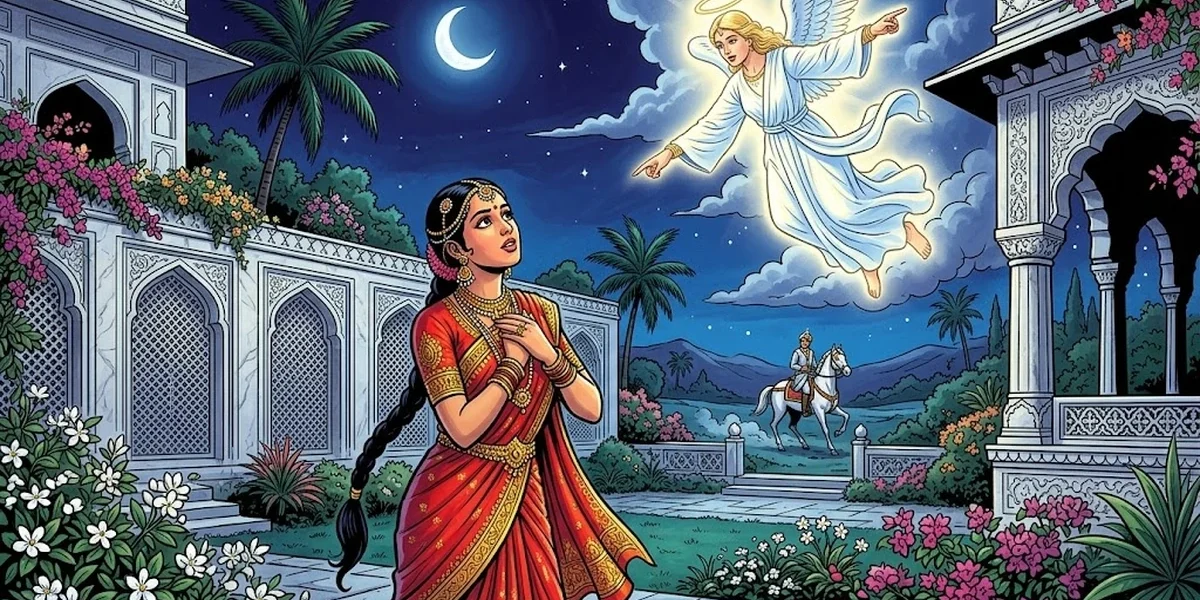
The ruler of the Phalana country was Munsuk Raja, and he had a very beautiful daughter called Laili, with brown eyes and black hair. Some time before Prince Majnun came to her father’s land, Khuda sent an angel to Laili in her sleep, in the form of a man. The angel told her that she must marry Prince Majnun and nobody else, for that was Khuda’s command. When Laili woke, she told her father about the angel’s visit, but he took no notice. From then on she kept saying, “Majnun, Majnun; I want Majnun,” and nothing else. Even while she ate her meals she kept on saying it. Her father grew quite cross. “Who is this Majnun?” he would say. “Who ever heard of him?”
“He is the man I am to marry,” said Laili. “Khuda has told me to marry nobody but Majnun.” Her longing occupied all her thoughts.
Meanwhile, Majnun and Husain Mahamat came hunting in the Phalana country. As they rode about, Laili came out on her horse to take the air and rode along behind them, still saying, “Majnun, Majnun; I want Majnun.” The prince heard her and turned around. “Who is calling me?” he asked. Laili looked at him, and the moment she saw him she fell deeply in love. “I am sure that is the Prince Majnun whom Khuda says I am to marry,” she said to herself. She went home and told her father, “Father, a prince has come into your kingdom, and I wish to be his wife, because I know he is the very Majnun I was promised.”
“Very well, you shall have him,” said Munsuk Raja. “We will ask him tomorrow.” Laili agreed to wait, though she was very impatient. But as it happened, the prince left the Phalana kingdom that night. When Laili heard he had gone, she went completely wild with grief. She would not listen to her father, her mother or her servants, but ran off into the jungle and wandered from one jungle to the next, farther and farther from home, saying all the while, “Majnun, Majnun; I want Majnun.” She wandered like that for twelve years.
At the end of the twelve years she met a fakir, who was really an angel, though she did not know it. “Why do you keep saying, ‘Majnun, Majnun; I want Majnun’?” he asked her.
“I am the daughter of the king of the Phalana country,” she said, “and I want to find Prince Majnun. Tell me where his kingdom is.”
“I don’t think you will ever get there,” said the fakir. “It is very far away, and you must cross many rivers to reach it.” But Laili said she did not care; she had to see Prince Majnun. “Then listen,” said the fakir. “At the Bhagirathi river you will find a huge fish called a Rohu. You must get it to carry you to Prince Majnun’s country, or you will never reach it.”
On and on she went, until at last she came to the Bhagirathi river, and there was a huge Rohu fish. It happened to yawn just as she reached it, and in she jumped, straight down its throat and into its stomach, still saying, “Majnun, Majnun.” The Rohu was terrified and swam down the river as fast as it could. Little by little it grew tired and slowed down, and a crow flew over and perched on its back, calling, “Caw, caw.”
“Oh, Mr. Crow,” said the poor fish, “please see what is in my stomach making such a noise.”
“All right,” said the crow. “Open your mouth wide and I’ll fly down and look.” The Rohu opened its jaws and the crow flew in, but it came out again very fast. “You have a Rakshas, a demon, in your stomach!” it cried, and flew away.
That was no comfort to the poor Rohu, and it swam on and on until it reached Prince Majnun’s country, where it stopped. A jackal came down to the river to drink. “Oh, jackal,” said the Rohu, “please tell me what I have inside me.”
“How can I tell without going in to look?” said the jackal. So the Rohu opened its mouth, and the jackal jumped down its throat, but it came back out very quickly, looking scared. “You have a Rakshas in your stomach, and if I don’t run, I’m afraid it will eat me!” And off it ran.
After the jackal came an enormous snake. “Oh,” said the fish, “please tell me what is in my stomach, for it rattles about and keeps saying, ‘Majnun, Majnun; I want Majnun.’”
“Open wide, and I’ll go down and see,” said the snake. When it came back up, it said, “You have a Rakshas in your stomach. But if you let me cut you open, it will come out.”
“If you do that, I shall die,” said the Rohu.
“Oh no, you won’t,” said the snake. “I will give you a medicine that will make you perfectly well.” So the fish agreed, and the snake made a cut in its side, and out jumped Laili.
By now she was very old. She had wandered twelve years in the jungle and lived twelve years inside the Rohu, and her beauty was gone and her teeth had fallen out. The snake carried her on its back into the country and set her down, and she wandered on until she came to the court where Majnun was sitting as king. Some men heard her crying, “Majnun, Majnun; I want Majnun,” and asked her what she wanted.
“I want King Majnun,” she said.
So they went in and told the prince, “There is an old woman outside who says she wants you.”
“I can’t leave my seat,” he said. “Send her in.” When she came in, he asked her what she wanted.
“To be your wife,” she replied. “Twenty-four years have passed since you rode into my father’s country, the land of the Phalana Raja, and I wanted to marry you then. But you went away without marrying me, and I went out of my mind and have wandered all these years looking for you.”
“Very good,” said Prince Majnun.
“Pray to Khuda to make us both young,” said Laili, “and then we can be married.” So the prince prayed, and Khuda told him, “Touch Laili’s clothes and they will catch fire, and when they burn, you will both become young.” When he touched her clothes, they burst into flame, and both of them were young once more. There were great feasts, and they were married, and then they travelled to the Phalana country to see her father and mother.
Laili’s parents had cried so much for her that they had gone blind, and her father did nothing but repeat, “Laili, Laili, Laili.” When Laili saw that they were blind, she prayed to Khuda to give them back their sight, and he did. As soon as they could see her, they hugged and kissed her, and the wedding was held a second time with great rejoicing. Prince Majnun and Laili stayed with Munsuk Raja and his wife for three years. Then they went home to King Dantal and lived happily with him for a while. They often went hunting and travelled from country to country to take the air and enjoy themselves.
One day Prince Majnun said, “Let’s go through this jungle.”
“No, no,” said Laili. “If we go through this jungle, something bad will happen to me.” But the prince laughed and rode in.
As they went through it, Khuda thought, “I would like to know how much Prince Majnun loves his wife. Would he be very sad if she died? Would he marry somebody else? I will find out.” So he sent one of his angels into the jungle disguised as a fakir. The angel went up to Laili and threw some powder in her face, and at once she fell to the ground as a heap of ashes.
Prince Majnun was overcome with grief to see his dear Laili turned into a little heap of ashes. He went straight home to his father, and for a long, long time nothing could comfort him. After many years he grew more cheerful and began walking in his father’s garden with Husain Mahamat as he used to. King Dantal wanted him to marry again.
“I will have no wife but Laili,” said the prince. “I will not marry anyone else.”
“How can you marry Laili? She is dead. She will never come back to you,” said his father.
“Then I will have no wife at all,” said Prince Majnun.
But in the jungle where her husband had left her, Laili was not gone. As soon as Majnun had ridden away, the fakir had gathered up her ashes and cleaned them, mixed them with clay and water and shaped them into the figure of a woman. So Laili had her human form back, and Khuda breathed life into it. But her appearance had changed: she was now an old woman with a very long nose and teeth like tusks. She lived in the jungle, eating and drinking nothing, and kept on saying, “Majnun, Majnun; I want Majnun.”
At last the angel who had thrown the powder said to Khuda, “What is the use of leaving this woman in the jungle, crying for ever, ‘Majnun, Majnun; I want Majnun,’ and never eating or drinking? Let me take her to Prince Majnun.”
“Very well,” said Khuda. “But tell her that if Majnun is afraid of her when he sees her, she must not speak to him, and the next day she will turn into a little white dog. Then she must go to the palace, and she will get her human shape back only when Prince Majnun loves her, feeds her from his own plate and lets her sleep on his bed.”
So the angel, disguised as a fakir, carried Laili to King Dantal’s garden. “It is Khuda’s command that you stay here until Prince Majnun comes to walk in the garden,” he said. “Then you may let him see you. But if he is afraid of you, you must not speak to him, and the next day you will become a little white dog.” And he told her what she must do as a little dog to become a woman.
Laili hid in the tall grass of the garden until Prince Majnun and Husain Mahamat came walking there. King Dantal was very old by now, and Husain Mahamat, though no older than the prince, looked much older, because Majnun had been made young when he married Laili. The two friends picked fruit as they had done when they were boys, only now they bit into it instead of cutting it. As Majnun was eating a fruit and talking, he turned towards his friend and saw Laili walking behind him.
“Look, look!” he cried. “See what’s following you! It’s a Rakshas, a demon, and I’m sure it’s going to eat us!” Laili gazed at him pleadingly, trembling with age and longing, but that only frightened him more. “It’s a Rakshas, a Rakshas!” he shouted, and he ran to the palace with Husain Mahamat, while Laili slipped away into the jungle.
They ran to King Dantal, and Majnun told him there was a demon in the garden that had come to eat them.
“What nonsense!” said his father. “Two grown men frightened by an old nursemaid or a beggar! And even if it was a Rakshas, it wouldn’t have eaten you.” He did not believe Majnun had seen anything at all, until Husain Mahamat said the prince was telling the exact truth. Servants hunted all through the garden for the old woman they feared, but there was no sign of her, and the king called his son a great baby for being so scared. All the same, the prince refused to set foot in the garden after that.
The following day Laili became a pretty little dog, and in that shape she came into the palace, and Prince Majnun soon grew very fond of her. She followed him everywhere, went hunting with him and helped him catch his game. He fed her milk, bread and whatever else he was eating, and at night the little dog slept on his bed.
But one night the little dog vanished, and in its place lay the little old woman who had scared him so badly in the garden. Prince Majnun was certain now that she was a demon come to eat him, and he cried out in terror, “What do you want? Oh, don’t eat me, don’t eat me!”
“Don’t you know me?” said poor Laili. “I am your wife, Laili, and I want to marry you. Think back to the day you insisted on going through that jungle, though I begged you not to and told you something bad would happen to me. A fakir threw powder in my face and I became a heap of ashes. But Khuda gave me life and brought me here, after I had cried for you in the jungle for a long, long time. Now I have to be a little dog, but if you will marry me, I won’t be a dog any longer.”
But Majnun said, “How can I marry an old woman like you? How can you be Laili? I’m sure you are a demon come to eat me.” And he was terribly frightened.
In the morning the old woman had turned back into the little dog, and the prince went to his father and told him everything. “An old woman, an old woman, always an old woman!” said King Dantal. “You think of nothing but old women. How can a strong man like you be so easily scared?” But when he saw that his son really was terrified and truly believed the old woman would come back that night, he advised him to tell her, “Turn yourself into a young girl, and then I will marry you. How could I wed someone so old?”
That night, as Majnun lay trembling in bed, the little old woman appeared in place of the dog. “Majnun, Majnun, I want to marry you,” she cried. “I have loved you all these long years. When I was a young girl in my father’s kingdom, I knew about you, though you knew nothing about me. We would have been married then if you had not gone away so suddenly, and for years and years I followed you.”
“Well,” said Majnun, “if you can make yourself a young girl, I will marry you.”
“Oh, that’s easy,” said Laili. “Khuda will make me young. In two days you must go into the garden, and you will see a beautiful fruit. Pick it, take it to your room and cut it open very gently yourself. Do not open it when your father or anyone else is with you, only when you are quite alone, for I shall be inside the fruit with no clothes to wear.” In the morning she turned into a little dog and disappeared into the garden.
Prince Majnun told his father all this, and the king told him to do exactly as the old woman had said. Two days later Majnun and Husain Mahamat walked in the garden and saw a large, lovely red fruit. “I wonder if I shall find my wife in that fruit,” said the prince. Husain Mahamat wanted him to pick it straight away and see, but Majnun would not until he had told his father.
“That must be the fruit,” said the king. “Go and pick it.” So Majnun went and broke it off its stalk. “Come to my room with me while I open it,” he begged his father. “I’m afraid to do it alone, in case there is a demon inside that will eat me.”
“No,” said King Dantal. “Laili will have nothing to wear, so you must go in by yourself. But don’t be afraid. If there is a demon in the fruit after all, I will be waiting outside the door. You have only to shout, and I will come, and the demon will not be able to eat you.”
So Majnun took the fruit and began to cut it open, shaking with fear. As soon as it was cut, out stepped Laili, young and far more beautiful than she had ever been. Her beauty was so dazzling that Majnun fainted and fell back onto the floor.
Laili took off his turban and wrapped it around herself like a sari, since she had nothing else to wear. Then she called King Dantal and asked him sadly, “Why has Majnun fallen down like this? Why won’t he speak to me? He was never afraid of me; he has seen me so many, many times.”
“It is because you are so beautiful,” said King Dantal. “You are far, far lovelier than you ever were. But he will be very happy in a moment.” The king fetched some water, and they bathed Majnun’s face and gave him a drink, and he sat up.
“Why did you faint?” asked Laili. “Didn’t you see that it was me?”
“Oh,” said Prince Majnun, “I can see you are my Laili come home, but your eyes are now so marvellously lovely that the sight of them knocked me senseless.”
Then everyone was very happy. King Dantal had every drum in the place beaten and every instrument played, and they held a grand wedding feast. They gave presents to the servants and rice and heaps of rupees to the fakirs.
Some happy time went by, and then one day Prince Majnun and his wife rode out to take the air, both on the same horse, with only a groom to attend them. They came to another kingdom and a beautiful garden. “We must go in and see that garden,” said Majnun.
“No, no,” said Laili. “It belongs to a bad Raja called Chumman Basa, a very wicked man.” But Majnun insisted, and in spite of all she could say, he got off the horse to look at the flowers. While he admired them, Laili spotted Chumman Basa approaching, and one look at his eyes told her that he planned to murder her husband and steal her away.
“Come, come, let’s go!” she said. “Don’t go near that bad man. I can see in his eyes and feel in my heart that he will kill you to take me.”
“What nonsense,” said Majnun. “I think he is a very good Raja. Anyway, he is so close now that I couldn’t get away.”
“Well,” said Laili, “it is better that you should be killed than me. If I were killed a second time, Khuda would not give me life again, but I can bring you back to life if you are killed.”
By now Chumman Basa was quite close, and he seemed very pleasant, or so Prince Majnun thought. But while he was talking to Majnun, he drew his curved sword and struck him dead with a single blow.
Laili did not move from her saddle. As the Raja approached, she asked him, “What made you kill my husband?”
“I mean to have you for myself,” he replied.
“You cannot,” said Laili.
“Yes, I can,” said the Raja.
“Then take me,” said Laili. He came close and reached out his hand to lift her down from her horse. But she slipped her hand into her pocket and pulled out a tiny knife, no longer than her hand was wide. In an instant it unfolded itself until it was enormously long, and with one great sweep of her arm Laili struck the wicked Raja down.
Then she slid off her horse and went to Majnun. She wounded her finger, and her blood had a magical healing power. She set her husband’s wound right, smeared her healing blood over it, and Majnun woke up. “What a lovely sleep I’ve had!” he said. “I feel as if I had slept for years!” Then he got up and saw the Raja lying beside Laili’s horse.
“What’s that?” he asked.
“That is the wicked Raja who killed you to take me, just as I said he would.”
“Who killed him?” asked Majnun.
“I did,” said Laili. “And it was I who brought you back to life.”
“Please bring the poor man back to life too, if you know how,” said Majnun.
“No,” said Laili. “He is a wicked man, and he will try to harm you.” But Majnun begged her so long and so earnestly that at last she said, “Then jump on the horse and go far away with the groom.”
“What will you do if I leave you?” said Majnun. “I can’t leave you.”
“I can look after myself,” said Laili. “But this man is so wicked that he may kill you a second time if you are near him.” So Majnun got on the horse and rode a long way off with the groom to wait for her.
Then Laili squeezed the cut on her finger until a little of the healing blood came out and smeared it over the Raja’s wound. The moment she saw him open his eyes, she ran, and she ran so fast that the Raja could not catch her, though he tried. She sprang up onto the horse behind her husband, and they galloped and galloped until they reached King Dantal’s palace.
There Prince Majnun told his father everything, and the king was horrified and angry. “How lucky you are to have such a wife!” he said. “Why didn’t you do as she told you? If it weren’t for her, you would be dead.” He held a great feast to give thanks that his son was safe and gave many, many rupees to the fakirs. He made a great deal of Laili, loved her dearly and could not do enough for her.
He built a splendid palace for her and his son, surrounded by wide grounds and lovely gardens, and gave them great wealth and crowds of servants. But he let nobody except their servants into the palace and gardens, and he would not let Majnun or Laili go outside them. “For Laili is so beautiful,” said King Dantal, “that someone may kill my son to take her away.”
About this telling
Joseph Jacobs reprinted this story in Indian Fairy Tales (1892) from Miss Stokes’s collection of the same name. In his notes he explains that Majnun and Laili are traditional names for a pair of lovers, the “Romeo and Juliet of Hindostan,” and that people living inside animals and beauty restored by fire turn up in other Indian tales as well.
The book describes the two beheadings in the garden outright; here the blows are told without detail, and the healing is just as magical. Jacobs says plainly that Laili steps out of the fruit naked, which is given here as having “no clothes to wear.” This long romance includes repeated death, magical restoration, coercion and confinement, and calls for mature discussion.
Read the original: Joseph Jacobs, Indian Fairy Tales (Project Gutenberg #7128, Loving Laili)
Reading guidance: Older teen and adult readers; includes repeated killings and transformations, self-wounding for magical healing, attempted abduction, prolonged distress and confinement within marriage.
A closer reading
Laili’s certainty and Majnun’s uncertainty are strikingly unequal. She spends years searching for him and repeatedly explains who she is; he often trusts appearances more than her account. The dog receives affection that the older woman is denied. Restoration of beauty resolves his fear in the plot, but readers can question why recognition depends on becoming young and attractive again.
The two dangerous outings repeat the same failure of listening. Laili warns Majnun about the jungle and later about Chumman Basa’s garden, but he dismisses both warnings. The final demand to revive the violent Raja puts her at risk again. Calling Majnun merciful would be incomplete without noticing that Laili must do the dangerous work and arrange the escape.
The divine test measures Majnun’s love by imposing much of its suffering on Laili. That is the tale’s supernatural design, not a model for testing a partner. The repeated transformations preserve her identity through changes of body, age and status, while other characters struggle to see that continuity.
The last palace offers wealth and protection at the cost of freedom: neither Laili nor Majnun may leave. King Dantal praises her resourcefulness, then limits her movements because he fears another man’s violence. The ending therefore raises a question the celebrations cannot settle: does safety achieved through confinement answer the injustice that made protection necessary?
Try this with the story
Track three warnings or explanations Laili gives and Majnun’s response to each. Add the consequence and who repairs the damage. Then write two possible readings of the final palace—security and confinement—and support each with a detail from the ending.
Think about it
- What remains constant about Laili through her transformations?
- Why is Majnun kinder to the dog than to the older woman?
- Who bears the risk of Majnun’s decision to revive the Raja?
- How does the final palace protect the couple, and how does it restrict them?
More stories like this
- How the Raja’s Son Won the Princess Labam — another long romance from Jacobs’s Indian Fairy Tales
- Dorani — another Indian story of a bride with a magical secret
- The Ivory City And Its Fairy Princess — another Indian tale of a long and difficult search for love
Also known as: Laila Majnun
Frequently Asked Questions
Why does Laili begin her search?
Who is Husain Mahamat?
Does the ending restore complete freedom?
What does Jacobs compare with Romeo and Juliet?
You May Also Like
 Indian Folk Tales
Ages 9-12
Indian Folk Tales
Ages 9-12
The Magic Shoes and Staff
Putraka, a generous young king whose own father plots his murder, tricks two brothers out of flying shoes, a wishing staff and a magic bowl.
 Indian Folk Tales
Ages 9-12
Indian Folk Tales
Ages 9-12
The Mother and the Daughter Who Worshipped the Sun
Sent from home after giving half her mother’s cake to a hungry priest, a poor girl marries a prince and begs the Sun to help when her secret comes out.
 Indian Folk Tales
Ages 9-12
Indian Folk Tales
Ages 9-12
The Brahman Priest Who Became an Amildar
A king makes his household priest a district governor and gives him three pieces of advice, which the priest follows word for word, with ridiculous results.