The Two Brothers Indian Folktale
The Two Brothers Indian Folktale: Once upon a time there lived a King who had two young sons; they were good boys, and sat in school learning all that kings’
The Two Brothers is a Punjabi folk tale collected at the close of the nineteenth century in the villages of the Bari Doab — the fertile spit of land between the Beas and the Ravi where the storyteller’s craft was still as common as the spinning of cotton. Flora Annie Steel and Richard Carnac Temple recorded it directly from village reciters and published it in Tales of the Punjab Told by the People (Macmillan, 1894), with John Lockwood Kipling — father of Rudyard — supplying the line illustrations that turned the volume into a treasured colonial-era keepsake. The story belongs to the great migratory family that Hans-Jörg Uther catalogues as ATU 567, “The Magic Bird-Heart,” which travels under different feathers from the Sanskrit Pancatantra through the Pali Jatakas, the Persian Tutinama, the Grimm Kinder- und Hausmärchen, and the Buddhist Burmese tale-cycles. Two motherless princes, an envious queen, two boastful birds, a vanished pony-whip and a sacred temple-elephant — these are the small ingredients out of which the Punjabi tellers wove a quiet defence of brotherly loyalty and patient wisdom.
The Stepmother’s Hand
Once, in a small kingdom that the storytellers placed somewhere along the old caravan road from Sialkot to Lahore, there ruled a king whose two young sons sat in the palace school each morning learning all that princes ought to know — the use of the bow, the verses of the gurus, the recitation of grants and revenues. Their mother had loved them tenderly; their tutor had loved them too; and the elder boy and the younger boy loved each other with a devotion that the village women said was rare in the homes of the great. But the queen-mother died one cold winter while the boys were still small, and within a season the king had married again. The new queen, beautiful as a hill-stream and twice as cold, looked at the two young princes and saw only a future that did not belong to her own children, who were not yet born.
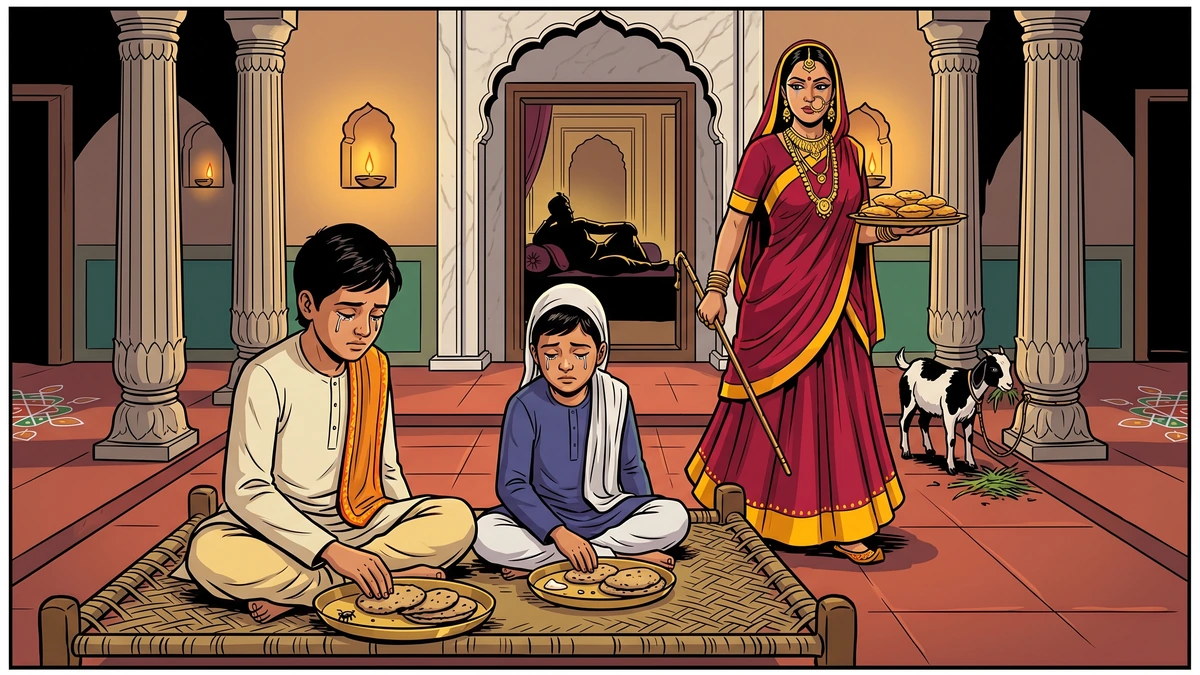
So matters drifted, as they do in stories and as they did in the houses of real Punjabi rajas. First the princes’ wheaten cakes were exchanged for coarse barley meal, the kind eaten by the village servants. Then the salt was forgotten, and the boys ate dry barley as if it were the leavings of a fast. Then the meal grew sour and weevil-eaten, and the boys still ate it, because they had been taught that the king’s son does not complain of his portion. At last the queen began to beat them when their father was away on hunts, and to complain to him on his return that they were peevish and undutiful, so that he too would beat them, and the elder prince’s pride and the younger prince’s gentleness were both wounded together. One evening, sitting on the parapet of the inner courtyard, the elder said, very low, that he could bear it no longer.
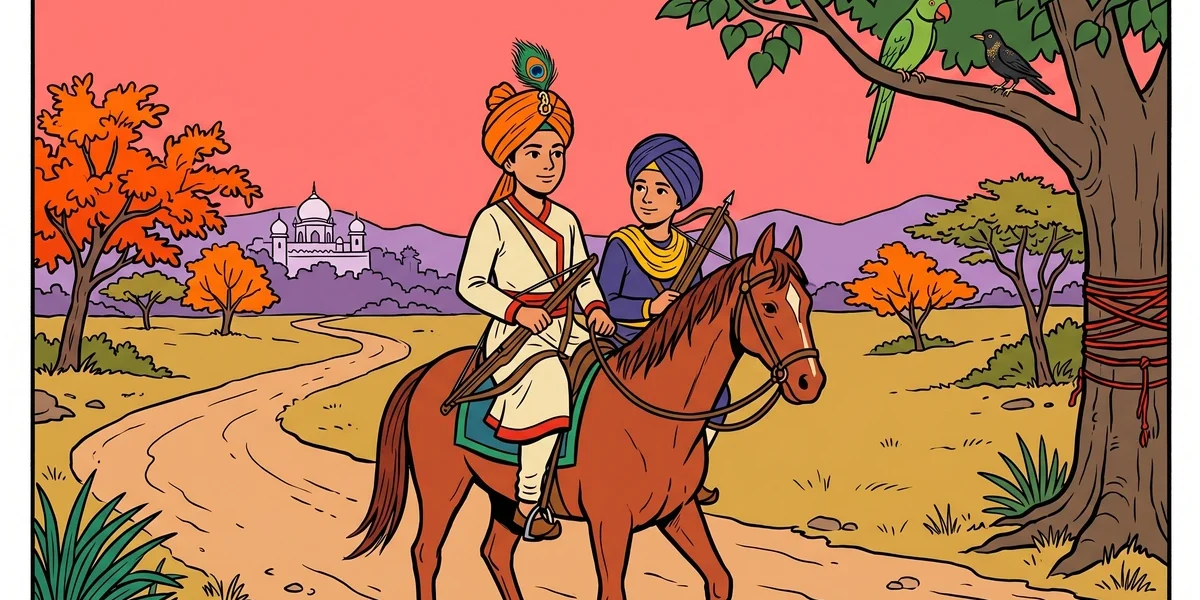
“Let us go into the world, brother,” he said, “and earn our own bread. There is no shame in honest work, and there is much shame in being beaten under our father’s roof.” The younger prince was silent for a long moment. He was the more thoughtful of the two, and the village proverbs his old nurse had taught him sat closer in his memory than they did in his brother’s. At last he answered with one of those proverbs: khaali pet musafir mat ho — do not travel on an empty stomach, neither in December nor in May. So they ate their sour barley one last time, packed nothing but a single bow each, mounted together on one slender pony, and rode out before sunrise through the postern gate where the gardener slept.
The Parrot and the Starling
For a day and a night they rode through the dust of the cold-weather plain. Beyond the cultivated fields the country grew thirsty and broken, with kikar-thorn bushes and patches of dhak with their flame-orange blossoms; only the occasional shrine of a Sufi pir or the bleached stones of an old well marked that travellers had passed before. At last, at the height of the second day’s heat, they came to a great peepal tree standing alone in a stretch of empty grazing-land — a sacred tree, by the look of the red mauli threads tied around its trunk and the small stone Ganesha tucked among its roots. The brothers slipped from their pony, watered it from the leather bag, and stretched themselves in the shade with their bows beside them.
They had not been resting long when there came a clatter of wings, and two birds settled on the upper branches of the peepal — a green parrot with a coral beak, and a small black starling with a dust of gold on its throat. They did not see the boys below, and at once they fell to quarrelling about which was the better bird. The starling pushed forward and perched higher. “Make way,” it cried. “I am no common bird. Whoever among men should chance to eat me will most certainly become the prime minister of a great kingdom — that is my virtue, and that is the gift my mother carried in her shell.” The parrot ruffled his green feathers and pushed back. “Move aside, little soot-feather,” he said. “Whoever eats me will not be a prime minister but a king — a king with a white umbrella and a temple-elephant of his own. That is the prophecy I carry in my crop.”
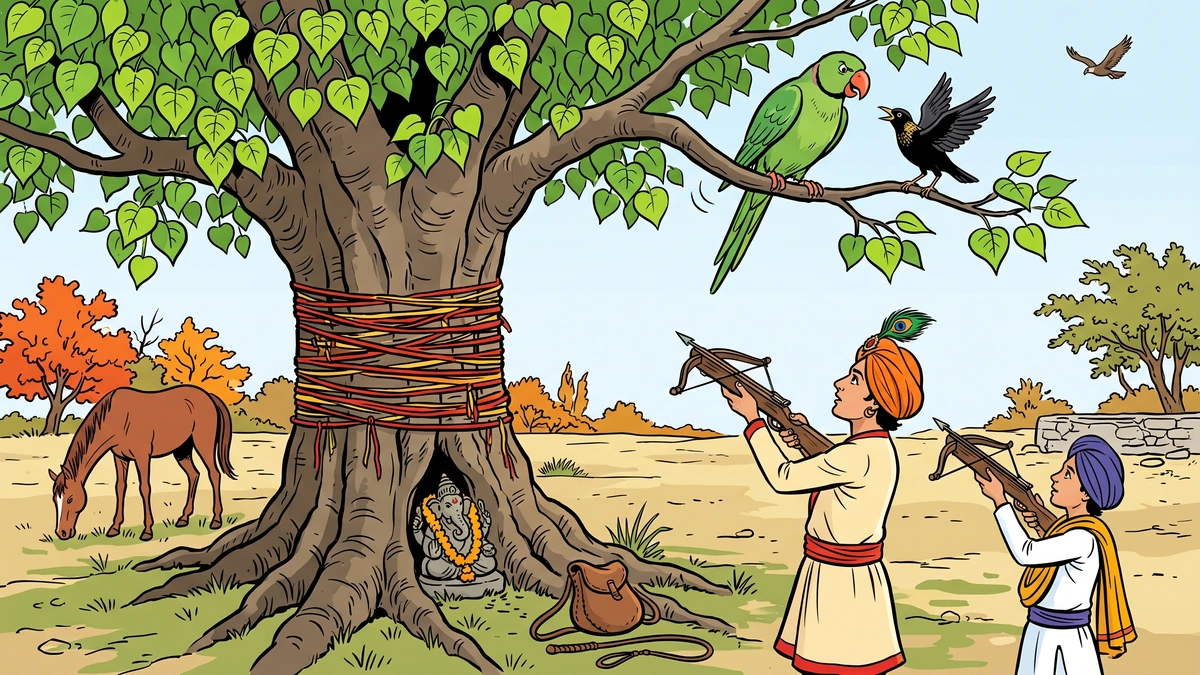
Both brothers heard them clearly. Without a word — and almost in the same breath — they raised their crossbows and let fly, each at the bird he thought his brother would not dare to claim. Both birds fell together at the foot of the peepal. And then began an argument of a kind that only happens between brothers who love each other better than themselves. The elder pushed the parrot toward the younger; the younger pushed it back. “You eat the parrot, brother — you must be the king.” “No, brother, the kingdom belongs to you, who are the elder; I have only a starling’s share to give.” They argued in this fashion until the small evening fire had nearly burned out, and the cold dew began to fall on the grass.
At last the younger prince — for he was the wiser, and the wise know when to yield — said, “Dearest brother, we are wasting the hour. You are the elder, and to be born first is itself a kind of fate; that fate must take its right.” So the elder prince ate the parrot quietly, with the small lump in the throat that fortune sometimes gives even to those who deserve it; and the younger prince ate the starling, and the two of them mounted their slender pony again and rode on toward the eastern hills, neither knowing what the prophecies would do with them.
The Lost Whip
They rode for some hours through the failing light. Then the elder prince put his hand to his belt and could not find his pony-whip, and recollected with a sigh that he had laid it under the peepal during their meal. “I will go back for it,” he said. “Wait at the next caravan-well; I shall return before the moon is high.” The younger prince begged him not to go. “Brother, leave the whip; we will buy another. Do not turn back into night-country alone.” But the elder, who could be obstinate as well as kind, laughed and turned the pony’s head, and the younger watched him until his shape was lost in the dust beyond the dhak trees.
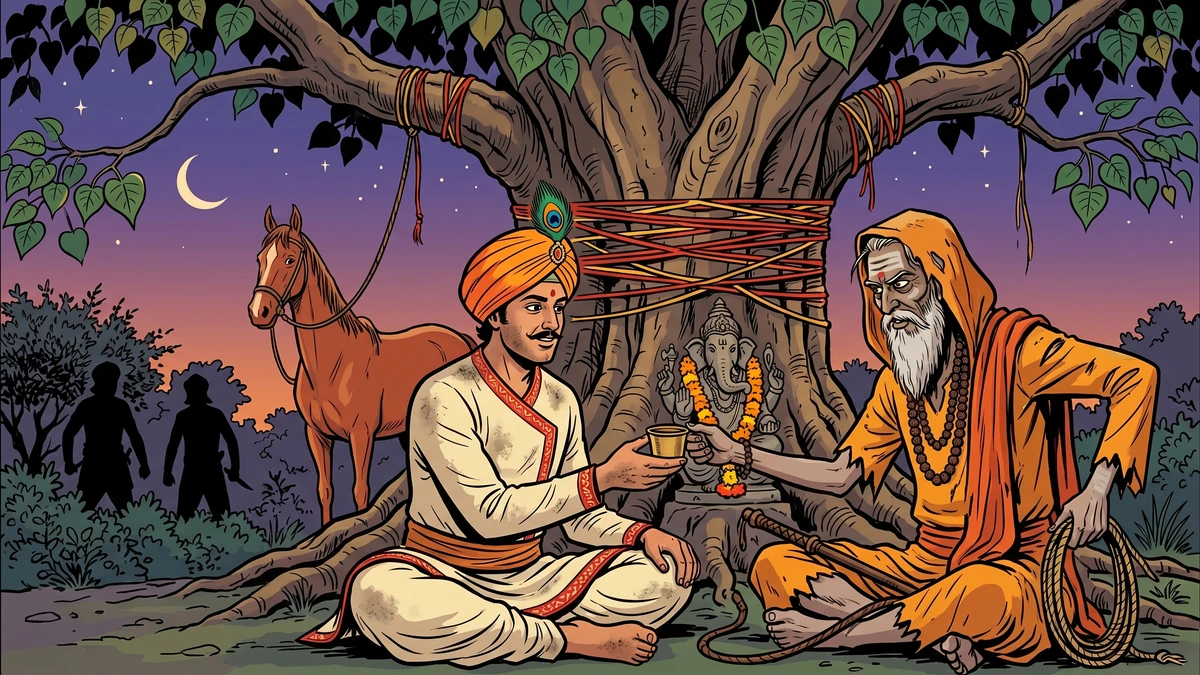
The story, like most stories, did not let the elder prince find his whip and ride simply home. As he came again to the great peepal, an old fakir was sitting where the boys had eaten — a man in saffron rags with a brass begging-bowl and a long white beard. He had picked up the whip and was rolling it in his hands. The fakir asked the elder prince his story; the elder, who was raw and hungry and unguarded, told him everything — the queen, the cakes, the parrot, the prophecy. The fakir’s eyes sharpened. “Then,” he said softly, “you are the rightful king somewhere. But the road is long, and the night is full of robbers, and a young raja without a vizier is only meat for the wolves. Sit with me till morning, and I will set you on the proper road.”
The elder prince trusted him, as innocent princes do. The fakir gave him a cup of warm broth that smelled of cardamom and turmeric and something else; and within a few breaths the elder prince was sleeping deeply at the foot of the peepal tree, and the fakir had bound his hands and feet with cord. For the fakir was no holy man at all but the chief of a band of cattle-thieves who lived in the broken country east of the Ravi, and he knew a price could be had for a king’s son in the slave-bazaars of the upper hills. He hid the elder prince in a cave and went off to fetch his men.
The Sacred Elephant
While the elder slept his unhappy sleep, the younger prince waited at the caravan-well as he had promised, and waited, and waited. He waited the whole night, and half the next day, and then — as a younger brother will when his older brother is missing — he went back along the road to find him. He found the peepal empty, a small pool of cold broth beside the roots, and his brother gone, with no track but the print of many sandals in the dust. He sat for a long time in the dust and wept; then he wiped his face on the saffron edge of his uttariya, mounted the pony, and rode east in search of any caravan that might have heard news.
For three days he rode and asked, and met no good word. On the fourth evening he came to the gates of a great walled city, white with lime-wash, with towers that flew the saffron banners of mourning. The old raja of the city, the people told him, had died with no son to follow him; and the chief priests had decided to settle the question of succession in the ancient way. The temple elephant — a great tusker named Lakshmi-prasad, sacred to the goddess of fortune — had been bathed in turmeric water and garlanded with marigolds and a heavy chain of fresh jasmine. At dawn the gates of his enclosure would be opened, and he would walk out among the people of the city, and the man on whose neck he laid his trunk and his garland would be carried at once to the throne. So the gods, said the priests, would themselves choose the next king of that country.
The younger prince, a stranger and tired, did not even know of the contest. He rode his pony in among the press of merchants and water-carriers and curious children at the city’s edge, only because he was hungry and meant to find a sweet-shop where someone might have heard of a captured prince. He had not gone twenty paces when there was a great roar from the crowd, and the gates of the temple yard burst open, and Lakshmi-prasad came out at a measured walk, his small eyes glittering, the marigold chain heavy on his tusks. He passed the merchants. He passed the priests. He passed the lean rajputs and the fat moneylenders. He came straight to the young dust-stained traveller on the slender pony, and very gently he lifted the marigold chain and dropped it over the younger prince’s neck. Then he kneeled, and laid his trunk on the prince’s foot.
And so the prophecy of the parrot — the bird the elder had eaten — fell upon the head of the younger, who had eaten only the starling. The storytellers laughed when they reached this part. “Look you, friends,” they would say, “fate is a clever cook. She does not always serve the dish in the bowl you expect.”
The Brother Restored
The younger prince was made king, but he did not feast that night, and he did not feast for many nights after. He sent out riders in every direction with the description of his elder brother, and he set a price on the head of every cattle-thief and false fakir in the new kingdom. Within the month, a herdsman walking near the broken country east of the Ravi heard the cries of a young man tied in a cave; and the herdsman, knowing the new king’s promised reward, fetched him out and brought him in safety to the white-walled city.
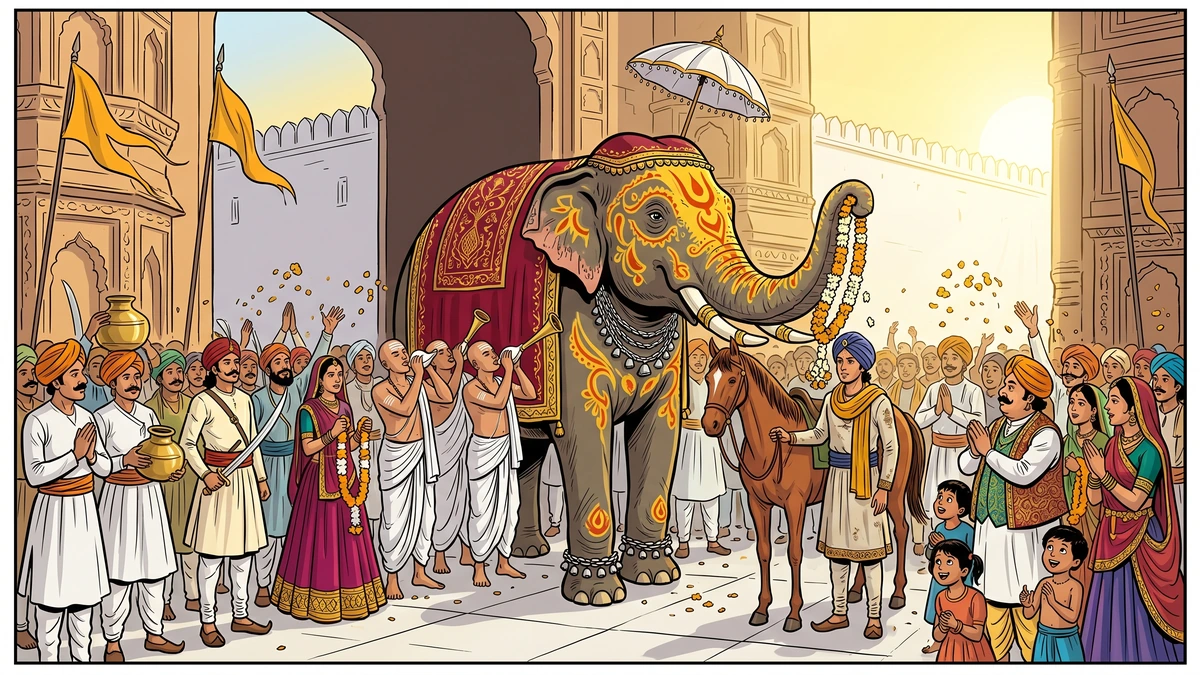
When the elder prince was led into the marble audience-hall, thin and bearded and still in his dirty travel-clothes, he did not at first know the young raja in white silk and saffron turban who sat on the peacock throne. But the king came down from the throne, and embraced him in front of the whole court, and seated him at his own right hand on a cushion of crimson velvet — the cushion of a chief minister, the highest seat after the throne itself. “Brother,” said the young king, “the parrot’s word and the starling’s word were both true, but the dishes were exchanged. You shall be the prime minister, and I shall be the king, and between us we shall rule justly, and never shall a queen’s hand starve another woman’s children in this kingdom while I live.” And he kept that word: from that day, no orphan child went hungry in the white-walled city, and the elder brother proved as wise a vizier as the younger proved a king.
Moral
The deepest moral of The Two Brothers is that fate is not the rigid thing the boastful birds claimed it was — that virtue, patience, and brotherly love are not decorations on top of destiny but the very thread out of which destiny is woven. The Punjabi villagers who told the tale around their winter fires would press home the lesson with the old proverb that Steel records in her notebooks, and that the older nurses still mutter when a child grasps for too much:
“Bhai bhai banj gaye, par bhai bhai hi rahe.”
— Punjabi village proverb
“Brothers may be divided by fate, but brothers remain brothers.”
The elder ate the king-bird and was made vizier; the younger ate the vizier-bird and was crowned king. The reversal is the whole point. The bird-flesh was only a hint. What actually decided the kingdom was the younger prince’s refusal to forget his brother — his willingness to ride three days through dust and dhak-trees instead of climbing easily onto an offered throne. In the moral economy of the Punjabi tale, that act of loyalty is what turned a homeless wanderer into a raja. The starling’s promise was kept, but the parrot’s promise needed a kinder heart to land it.
Historical & Cultural Context
The version translated above follows Flora Annie Steel and Richard Carnac Temple, Tales of the Punjab Told by the People, Tale XXVI (Macmillan and Company, London, 1894), with the line illustrations supplied by John Lockwood Kipling of the Mayo School of Industrial Art at Lahore. Steel had collected the story (along with most of the rest of the volume) between 1882 and 1888 from village women and professional marasi bards in the Bari Doab and around the cantonment city of Sialkot, where her husband Henry William Steel served as a senior officer in the colonial administration. Joseph Jacobs reprinted a shortened version in his Indian Fairy Tales (David Nutt, London, 1892) under the title “The Lad Who Knew Best,” which is the form in which most English-speaking children eventually met the parrot and the starling.
The international tale-type is registered as ATU 567, “The Magic Bird-Heart,” in Hans-Jörg Uther’s The Types of International Folktales (FF Communications 284–286, Helsinki, 2004), with subtype ATU 567A “The Magic Bird-Heart and the Separated Brothers” applying with particular accuracy to the Punjabi telling. Stith Thompson’s Motif-Index of Folk-Literature (Bloomington, 1955–1958) catalogues the central narrative elements as B143.1.1 “Bird whose flesh confers kingship,” D1331 “Magic object affects fortune,” N825.3 “Old man helper,” K1840 “Deception by substitution” (the false fakir), and H171.2 “Animal indicates election of ruler” (the temple elephant). The motif of an elephant choosing a king reaches back at least to the Mahavamsa of Sri Lanka and the Buddhist Sasa Jataka, and survives in the medieval Sanskrit succession-narratives of the Sailodbhava and Western Ganga dynasties of Odisha and Karnataka.
Within the Indian tradition, the magic-bird-flesh motif appears in the Pancatantra of Vishnu Sharman (book III, “Kakolukiyam,” in Franklin Edgerton’s 1924 reconstruction and Arthur W. Ryder’s 1925 translation), in the Pali Tittira Jataka (no. 319 in E. B. Cowell’s Jataka or Stories of the Buddha’s Former Births, Cambridge, 1895–1907), in Somadeva’s Kathasaritsagara (Taranga 65, in C. H. Tawney’s translation), and in the Tamil Vidushaka Tantra. The same motif crossed into Persian via the eighth-century Pahlavi Karirak ud Damanak, into Arabic through Ibn al-Muqaffa’s Kalila wa Dimna, and into Latin Europe through John of Capua’s Directorium Humanae Vitae (c. 1270). The Brothers Grimm preserved a more elaborate German cousin as KHM 60, “Die zwei Brüder” (Kinder- und Hausmärchen, 1812–1857), with the bird-flesh inheritance handed not to princes but to the sons of a poor broom-maker. La Fontaine compressed a related version in his “Le Chartreux et le Sénéchal” (Fables, book IX). The deep age of the type is suggested by Vladimir Propp’s structural-morphological analysis (Morphology of the Folktale, 1928), in which the Punjabi version’s separation, donor-deception and supernatural recognition exactly fit functions VIII, X, XII and XXVII of his canonical sequence.
The cultural texture of the Punjabi telling — the peepal tree as a sacred resting place, the saffron-clad fakir as an ambiguous figure who may be holy or false, the temple-elephant garlanding the new king, the brothers reunited on a peacock throne — is drawn directly from late-nineteenth-century village life in the Bari Doab. Steel’s footnotes record that her chief informant for this tale was an elderly Sikh nurse from Pasrur, who insisted that the kingdom in which the elephant chose the new king lay “somewhere east of Jhelum, near where the hills begin.” The figure of the wicked stepmother (maa-anti), the conviction that loyalty between brothers will outweigh any prophecy, and the proverb bhai bhai banj gaye, par bhai bhai hi rahe are still repeated in Punjabi households on both sides of the border today. The tale’s quiet refusal to make a tragedy out of jealousy, and its insistence that wisdom and tenderness can outwit even the boasting of birds, has carried it forward across more than a hundred and thirty years of retellings, from Anant Pai’s Amar Chitra Katha illustrated booklets of the 1970s to the bilingual Punjabi-English readers issued by the Children’s Book Trust in New Delhi.
Reflection & Discussion
- The elder prince trusts the fakir at the peepal tree very quickly. What in his upbringing or his hunger might have made him drop his guard, and what could he have done differently?
- The younger prince could have ridden into his new kingship without ever looking back. Why does the storyteller make him ride three days and three nights to find his brother first?
- The boastful birds promised one thing each, but fate exchanged the dishes. What is the folk-tale teller saying about prophecies and predictions?
- If the wicked stepmother had not starved and beaten the brothers, the prophecy of the birds would never have been heard. Does the story think she is wholly to blame, or does it leave space for a more complicated reading?
- Across the Indian, German, Persian and Arabic versions of this tale-type, the bird-heart almost always belongs to a poor or wronged child. Why do you think the storytellers gave that gift specifically to the powerless?
Did You Know?
- Flora Annie Steel learnt fluent Punjabi during the seventeen years she lived in the upper Punjab, and unlike most colonial collectors she insisted on transcribing each tale from a named female informant rather than rewriting it in her own English.
- The temple elephant who garlands the next king is a real historical custom from the southern and eastern Indian kingdoms — the chronicles of the Hoysala and Eastern Chalukya dynasties record at least four successions decided this way between the eleventh and fourteenth centuries.
- The Punjabi proverb in the moral, bhai bhai banj gaye, par bhai bhai hi rahe, is still used in everyday village speech, particularly at weddings and at the festival of Raksha Bandhan, when sisters tie protective threads on their brothers’ wrists.
- The Grimms’ German cousin to this tale, KHM 60 Die zwei Brüder, is the longest single story in the entire Kinder- und Hausmärchen — over forty pages — and it merges the bird-heart motif with three or four other tale-types in a single narrative arc.
- John Lockwood Kipling, who illustrated Steel’s volume, was the curator of the Lahore Museum that his son Rudyard later memorialised as the “Wonder House” in the opening chapter of Kim.
Why This Tale Still Matters
The Two Brothers Indian Folktale belongs to a small family of stories that contemporary Indian parents reach for when they wish, very gently, to teach their children the difference between birth-order and worth. The tale does not punish the elder brother for being elder, and it does not crown the younger for being younger; it simply watches what each of them does with his hour of misfortune, and lets the village’s quiet judgment speak for itself. That moral economy — the deep Punjabi conviction that loyalty and patience are themselves a form of fortune — sits at the heart of the tale’s appeal across more than a hundred and thirty years. Children today who read the story in a glossy ACK panel or hear it from a grandmother in Sialkot or Ludhiana are tuning into the same wavelength as a Sikh nurse in 1880s Pasrur, and as the Sanskrit and Pali storytellers a thousand years before her.
It is also a tale that teaches, very softly, the ethics of speaking one’s own truth in the presence of an older sibling. The younger prince corrects his brother twice in this story — once over the timing of their flight (“not on an empty stomach”), and once over the eating of the parrot (“you are the elder; the kingdom is yours”) — and in both cases his courteous insistence is rewarded. That is a delicate piece of pedagogical wisdom for cultures, like the Punjabi, where seniority is taken seriously and where the confident voice of a younger child is not always made welcome at the table. The folk tale offers a quiet escape valve: speak up gently, and the world may listen even when the elders frown.
Finally, The Two Brothers is one of the simplest and clearest defences of brotherly love in the entire South Asian repertoire. There are richer treatments — the Ramayana’s portrait of Rama and Bharata, the Mahabharata’s tortured fraternal pairs — but for a five-minute tale read at bedtime, this small Punjabi gem is hard to beat. Its insistence that a younger brother who refuses to climb to the throne over a missing elder is the truest king is, in its quiet way, a more radical political statement than the kingdom in which it is set. That is why grandmothers go on telling it, and why each new generation of Indian children seems to remember the parrot and the starling long after they have forgotten harder lessons.
Frequently Asked Questions
**Q: Why is this story important?**
You May Also Like
 Indian Folk Tales
Ages 3-5
Indian Folk Tales
Ages 3-5
The Jackal And The Partridge
The Jackal And The Partridge: A Jackal and a Partridge swore eternal friendship; but the Jackal was very exacting and jealous. You don’t do half as much for me
 Indian Folk Tales
All Ages
Indian Folk Tales
All Ages
The Brahmi ‘s Girl That Married A Tiger
The Brahmi 's Girl That Married A Tiger: In a small village nestled between the rolling hills of Tamil Nadu, there lived a learned Brahmin who had a beautiful
 Indian Folk Tales
Ages 9-12
Indian Folk Tales
Ages 9-12
How Raja Rasalu Was Born
How Raja Rasalu Was Born: Once there lived a great Raja, whose name was Sâlbâhan, and he had two Queens. Now the elder, by name Queen Achhrâ, had a fair young