A Traveler’s Tale from India
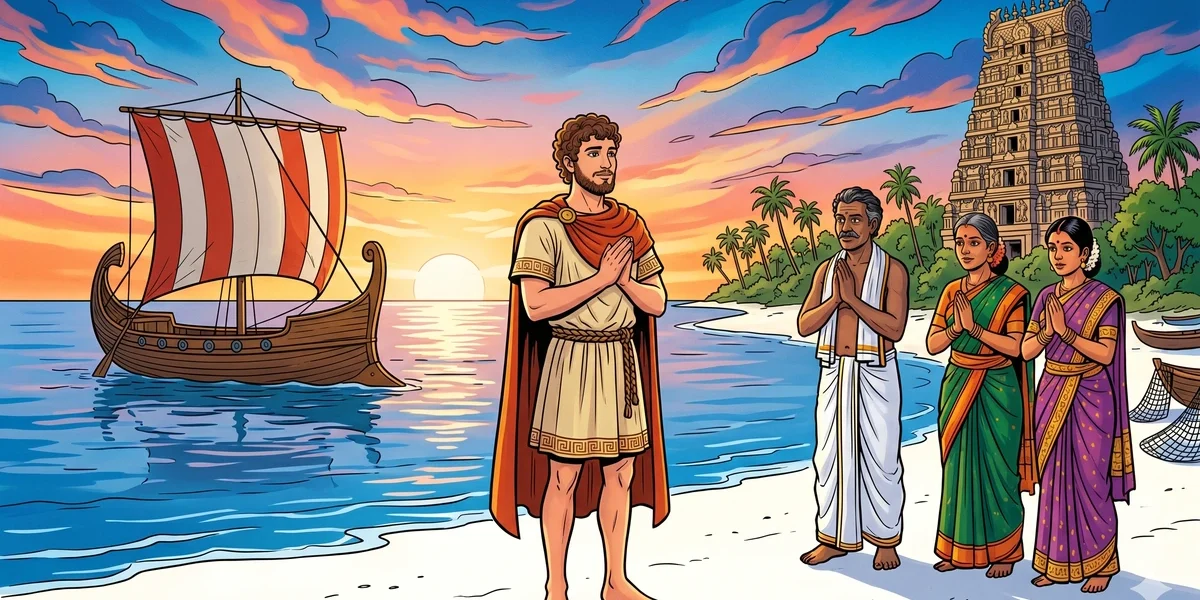
A Traveler's Tale from India: Once upon a time, in a country called India, on the coast of Nagapattinam far south, there landed a large vessel on the shores of
Tradition: Indian Folk Tale · Tamil/Coromandel cycle · Yavana (Greek/Roman) traveler motif
Setting: Coromandel coast, Nagapattinam port, the Cauvery delta, and the Chola capital Thanjavur (Tanjore), c. 9th–11th century CE
Recorded sources cited in this retelling: the Periplus Maris Erythraei (Periplus of the Erythraean Sea), an anonymous Greek-language merchant handbook of the 1st century CE; the Aham and Puram poems of the Sangam corpus, which name the Yavana as merchants and craftsmen on Tamil shores; and the Tirumurukaṛruṛppaḍai and Paṭṭinaṭṭuppaṭai, which preserve sea-port and pilgrimage geography of early Tamilakam
Tale type: Aarne–Thompson–Uther ATU 681 family of “voyage and recognition” wonder tales; closer in feel to the older Tamil Paṭṭinaṭṭuppaṭai arrival songs than to a single classified motif
Original language fragment retained: Tamil — “Vaaṇam ariñda Yavaṇar”, “the Yavanas, who knew the open sea”
Prologue: A Ship Called Argyra
Before maps had names for everything, ships carried their own. Argyra — “the silver one,” from the Greek ἄργυρος (argyros) — was the kind of round-hulled merchantman the Greek-speaking sailors of the eastern Mediterranean had sent out for centuries: heavy on amphorae of olive oil and wine, lighter on coin once a season’s pepper trade had been settled. The Periplus of the Erythraean Sea, a 1st-century CE handbook compiled by an anonymous Greco-Egyptian merchant, names this very route — from the Red Sea ports of Myos Hormos and Berenike, across the monsoon-driven Indian Ocean, to “the markets of Limyrike and Damirica” along what we now call the Coromandel and Malabar coasts. The Tamil shore was not a rumor to such captains; it was a recurring entry in their account books.
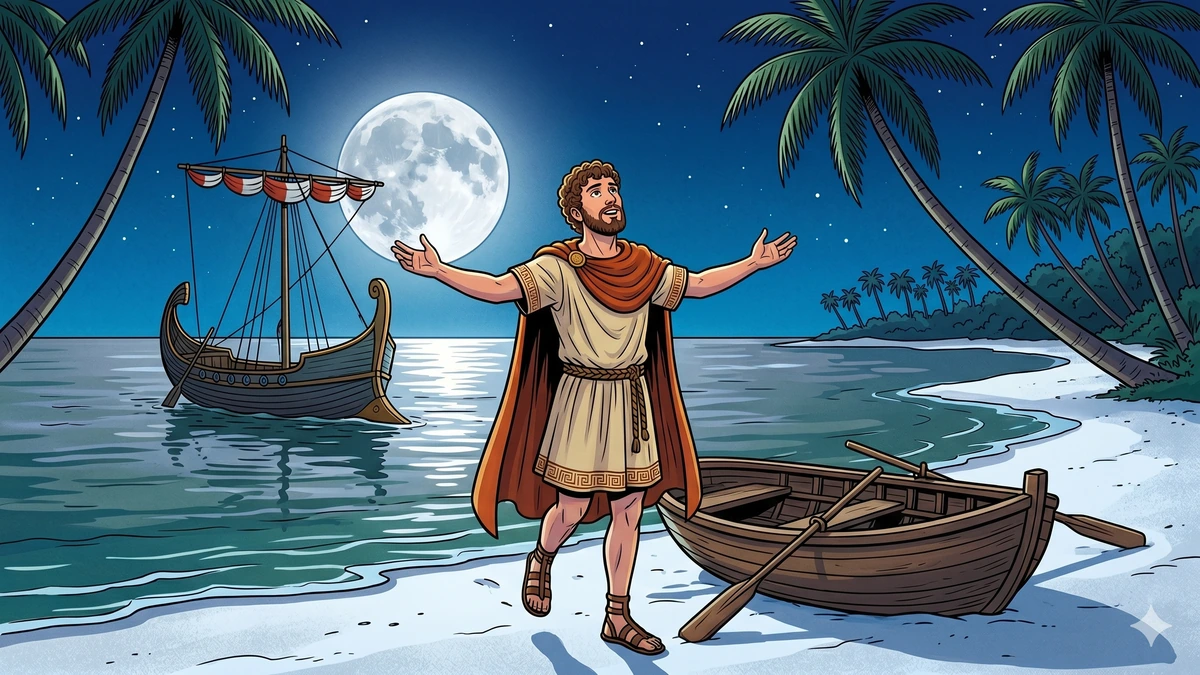
And so when Nicholas, twenty years old and so full of the future that he barely felt the salt sting in his eyes, leaned over the rail of Argyra and saw the long line of palms blackening into shape against the moon, he was joining a movement already old. Greek and Roman sailors had been beaching at Nagapattinam, Kaveripattinam, and Arikamedu for the better part of a thousand years before him. Sangam-period poets had a name for them: Yavanar. The word would in time stretch to mean any westerner, but it began as a Tamil mouthful for “Ionian” — the Greek of the islands.
The boy did not yet know the songs that would gather around men like him. He only knew that the air smelled of salt, sandalwood, and something he could not name, and that the moon laid a path of beaten silver from the ship to the shore. He took it as an invitation.
Beat One: Landfall at Nagapattinam
The Coromandel surf is a rough host. Anyone who has watched the modern fishing catamarans — kattumaram, “tied logs,” another Tamil word the world borrowed — ride those breakers will know why ancient ships preferred to anchor offshore and let smaller boats ferry crew and cargo in. Argyra would have done the same. Nicholas waded the last few yards through warm water, and when his sandals struck dry sand he felt — the storyteller’s instinct insists on this — a quiet, bodily certainty that he had landed somewhere whose calendar moved differently from his own.
Nagapattinam in the Chola period was already an old port. By the 9th century CE, when Vijayalaya re-founded the imperial line of the Cholas with Thanjavur as his capital, the town was a long-running entrepôt for Buddhist pilgrims bound for Sumatra and Sri Lanka, for Arab and Persian dhows running the Manar route, and for the residual community of Greco-Roman traders whose grandfathers had taught their grandsons enough Tamil to bargain. Excavations at nearby Arikamedu, identified by some scholars with the Periplus’s Poduke, recovered Roman amphora sherds, terra sigillata pottery, and a stylus or two — small evidence of a long, ordinary intimacy between two seas.
The story keeps Nicholas’s first night on the beach. He sleeps under what the retelling calls “a silver silk moon” — a phrasing that rhymes, perhaps not by accident, with the vel-nilavu (“white moonlight”) of the Sangam love-poems. The morning wakes him in the only way a Coromandel morning can: a wash of pale orange, the fisherwomen already calling out the night’s catch in a singing language he does not yet understand, and the smell of fresh kerai (greens) being chopped for the day’s first meal.
Beat Two: Up the Kaveri to Thanjavur
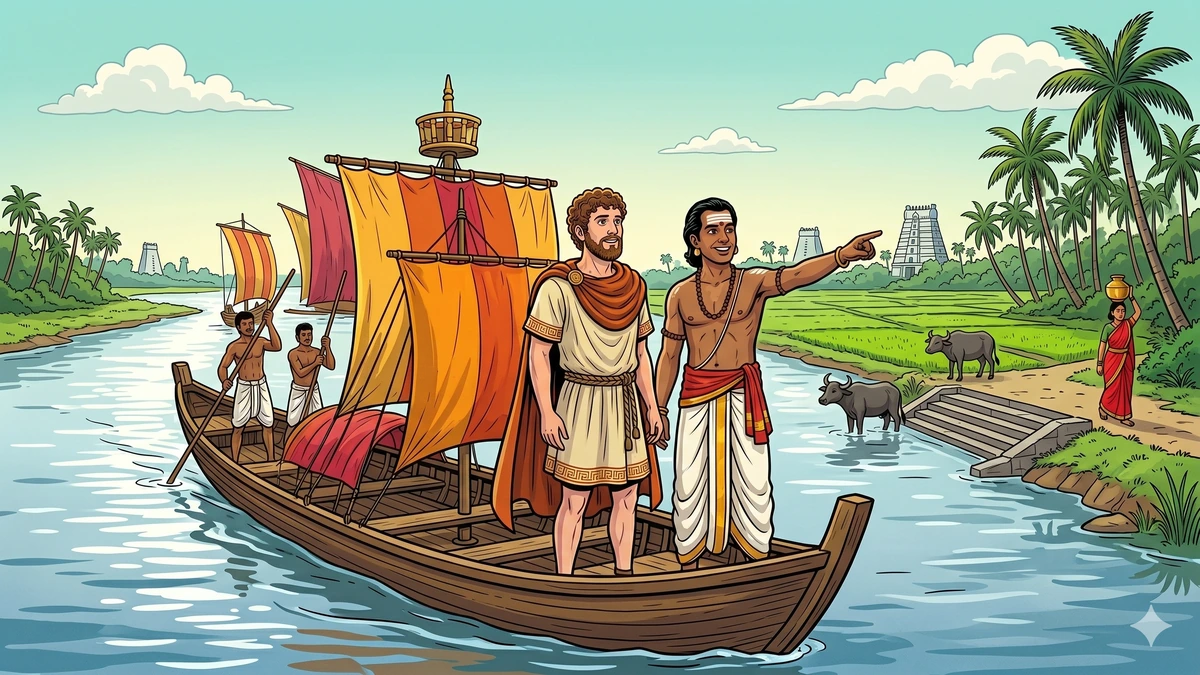
From the Bay of Bengal, the most graceful way inland was by water. The retelling names the boat the parti — a transliteration of Tamil paṭagu or paṭṭar, the kind of long, shallow river-craft still seen on the Cauvery’s quieter stretches. In the storyteller’s hand it becomes a vessel “with sails of silk and masts of gold,” and the listener will forgive the embellishment because the Cholas really did own merchant guilds — the Aiññuṛruvar and the Maṇigrāmam — whose flotillas were so wealthy that the line between trade and pageantry simply blurred.
The Cauvery (Tamil Kāvēri) is the south’s Ganga. It is born in the Brahmagiri hills of Karnataka, breaks through the Eastern Ghats, fans into a delta so old that Karikalan Chola is said to have built a stone dam across it — the Kallanai, second century CE, still in use today — and finally surrenders to the sea at the very port where Nicholas had landed. Going upriver, our traveler would have passed the rice country: the green-on-green chequerboards that gave the Chola heartland its surplus and its empire. He would have heard tāḷam from temple courtyards, watched water-buffalo being washed at the bathing ghats, and noticed that the river itself was treated as a mother — Kāvēriyamma, the goddess approached with folded hands.
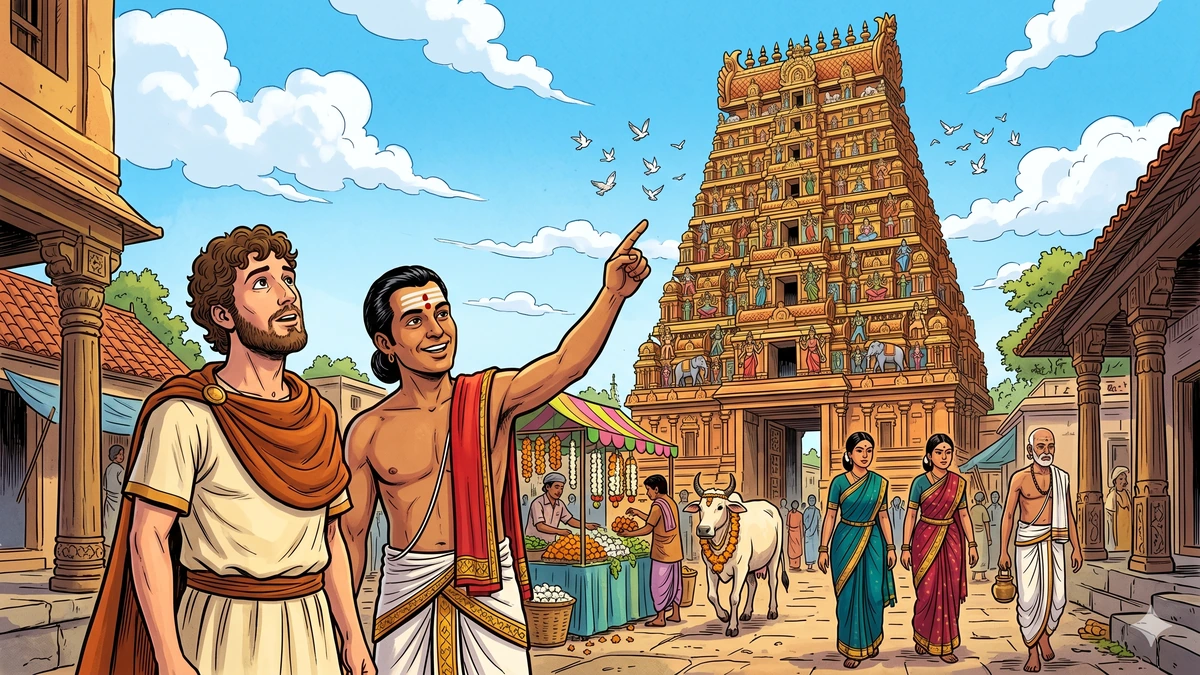
And then, around a final bend, Thanjavur. The skyline of the Chola capital was punctuated by towers the local guides called kopuram — from Sanskrit gopura, “city gate” — rising in tier upon carved tier, populated by a riot of stone gods, demons, dancers, lions and elephants. To a young man whose home temples were the white-marble austerities of Aegean Hellenism, this was a different theory of the sacred altogether: not the empty quiet of a Greek naos, but a stone forest in which every surface had something to say.
Beat Three: A City That Spoke in Sculpture
In the retelling Nicholas wanders the city with a local named Veeraiyan — a fine Tamil name, “the brave one” (vīra + the agent suffix). The two cannot share a tongue. They share the streets instead. Veeraiyan points at things; Nicholas asks the same question over and over with his hands; both laugh; both are paid in the only currency a foreign city ever offers a young traveler — the slow dawn of competence.
What he sees, in the chronology of the tale, sounds very like the Brḥadīśvara temple, which Rajaraja Chola I would consecrate in 1010 CE and which still stands. Its vimana climbs to roughly sixty meters; its central linga is one of the largest in any working temple in India; the Nandi bull at the entrance is carved from a single block of stone almost six meters long. Around the sanctum runs an outer corridor of frescoes — among the earliest surviving Chola murals — in which dancers, ministers, and Shiva himself perform Tripurantaka, the destruction of the three demon cities. Sangam tradition tells us that Tamil kings sometimes employed Yavanar as palace gate-guards and as engineers of mechanical devices: there is a long memory, in the Coromandel, of foreigners who proved themselves useful and were absorbed.
The retelling lists what enchants Nicholas. Music in the lanes. Prayer drifting from fifty courtyards. Singing, dancing, even argument — “people busy as bees.” The detail that the locals greet one another with both hands joined, palms together, was new to him. The Greek world had its chairein — “rejoice” — a word; the Tamil world offered a gesture, and the gesture said something the word could not: that the meeting itself was the small holy thing.
Beat Four: The Country That Gets Into the Heart
“India, once visited, will get into your heart and soul, and will keep on lingering in the mind.” The line has been said in some shape by every traveler who has ever come up the Cauvery in the right season, and it is not, in the end, a sentimental line. It is an observation about how the senses work. South India, then as now, did not arrive in single notes; it arrived in chords. The midday smell of asafoetida frying in ghee. The slap of a washerwoman’s cloth on river-stone, repeating in time with chants from the temple bells. The cool of a stone floor at noon. The way ginger and pepper and tamarind and coconut, separately ordinary, become together something the rest of the world has spent two thousand years trying to copy.
What Nicholas was experiencing, in technical terms, was the cosmopolis of the Chola maritime world — what the historian Sheldon Pollock once called the “Sanskrit cosmopolis,” extended outward into a Tamil-speaking sphere whose merchant guilds and Buddhist monks and Shaiva preachers had stitched the eastern Indian Ocean into a single conversational room. Korean envoys sent letters through Thanjavur. Chinese silver shows up in Coromandel hoards. Sumatran kings wrote, in elegant Sanskrit, to the Chola court asking permission to fund a vihara at Nagapattinam — the famed Cūḍamaṇivarmavihāra, built around 1006 CE and standing into the colonial era. To wander Thanjavur in the early eleventh century was, in a real sense, to wander the headquarters of the open Indian Ocean.
And here, perhaps, is where the retelling’s lone sour note — the line about a “merchant’s honest confession,” obviously borrowed from another tale — can quietly be set aside. The actual arc of “A Traveler’s Tale from India” is not a confession story. It is an arrival story. Its moral is in the marrow of the journey itself: that the world is more various, more generous, and more competent than any one harbor’s gossip allowed; and that the proper response to encountering this is not to compete, but to learn.
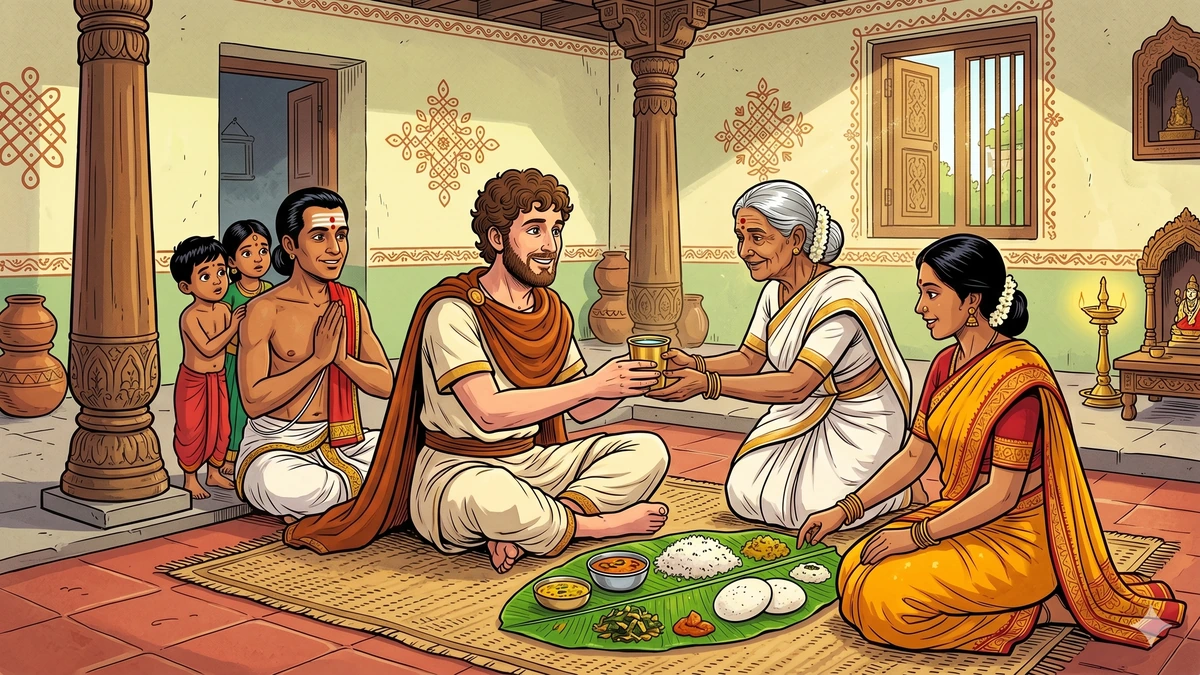
Moral — Athithi Devo Bhava
The Tamil and Sanskrit traditions converge on a single, very old principle of hospitality. From the Taittirīya Upaniṣad, recited in southern temple schools for at least two and a half millennia:
अतिथि देवो भवः — Atithi devo bhavaḥ
“Let the guest be unto you as a god.”
The instruction is not picturesque. It is structural. A society on a busy coastline survives only if the stranger who walks ashore is treated, by default, as someone whose presence might be sacred. The Coromandel ports practiced this for a thousand years before Nicholas arrived and for a thousand years after he left. In every century the names of the strangers changed — Yavanar, Tajik, Cīna, Faranji, Olandakāran, Inglīsh — and in every century the principle held: the guest gets the cool drink first, the seat closest to the fan, the warmest meal. What Nicholas learns at Thanjavur, and what every reader is invited to learn from his story, is that hospitality is not a manner. It is an ethic that knows the world is large and chooses to be generous to it anyway.
Why This Tale Has Lasted
“A Traveler’s Tale from India” is, on its surface, a small thing — a young Greek lands at Nagapattinam, sails up the Cauvery, falls in love with Thanjavur, and goes home changed. It has lasted because it preserves, in the shape of a single biography, a piece of historical truth that older history books often forgot: the Indian Ocean was not a barrier. It was a road. For more than a thousand years before the European age of sail, ships from the Red Sea, the Persian Gulf, the Malabar pepper coast, the Coromandel rice country, the Andaman crossroads, and the South China Sea moved on the same monsoon clock and met one another in the same harbors. Every coastline learned a few words of every other coastline’s tongue. Sangam Tamil borrowed kappal for “ship” from a Mediterranean root; Greek borrowed oryza, “rice,” from southern India; Latin borrowed piper from the Tamil pippali; the world ate, in the kitchens of the rich and eventually the poor, the spice-and-salt diet that the Indian Ocean had quietly trained it into.
The tale lasts, too, because it is a counter-story to the more familiar one in which “East” and “West” are taught as fixed categories that only ever meet under conditions of conquest or curiosity. Nicholas conquers nothing. He is not a missionary. He is not even a buyer of pepper, particularly. He is twenty, and he is awake, and the country awakes him further, and that is enough. The deepest reason the story still matters in 2026 is that it remembers a moment when meeting was its own reward — when a coastline could be a shore and not a frontier, and a guest could be a god.
Did You Know?
- The Tamil word Yavana — used in Sangam poems for Greek and Roman traders — survives into modern Indian languages as Yavan, a generic term for “westerner,” via Sanskrit Yavana derived from Old Persian Yauna, “Ionian.”
- The Periplus of the Erythraean Sea (c. 50–90 CE) lists at least eight named Tamil ports, including Mouziris (Muziris/Pattanam in Kerala), Nelkynda, Bakare, Kamara, Poduke (probably Arikamedu), and Sopatma.
- The Brḥadīśvara temple at Thanjavur, completed in 1010 CE under Rajaraja Chola I, was the tallest building in India for nearly nine centuries.
- Roman gold coins, struck under emperors Augustus and Tiberius, have been excavated as far inland as the Coimbatore plateau, evidence of how deep Indo-Roman trade penetrated south India.
- The Aiññuṛruvar (“the Five Hundred”), a medieval Chola merchant guild, left bilingual Tamil-Sanskrit inscriptions across Sri Lanka, Sumatra, and the Malay peninsula.
Reflection & Discussion
- What does Nicholas’s silence in his first hours on Indian soil — lying on the sand, simply smelling the wind — tell us about the right way to enter a new country?
- The retelling makes much of the gesture of greeting with both palms joined. What is the difference between a culture that greets with a word and one that greets with a gesture, and what does each ask of the greeter?
- If the moral of this story is hospitality, who in the story is the host and who is the guest — and at what points do those roles trade places?
- How does the figure of the Yavana, half-foreign and half-absorbed, sit alongside other “outsider absorbed” figures in Indian story tradition (the wandering ascetic, the trader prince, the prince in disguise)?
- Why might a tale like this have been told and retold along the Coromandel coast for so many centuries when no famous king is named in it and no battle is fought?
Frequently Asked Questions
Who were the Yavanas in Tamil tradition, and is Nicholas’s voyage in ‘A Traveler’s Tale from India’ historically plausible?
The Tamil word ‘Yavana’ (derived via Sanskrit ‘Yavana’ from Old Persian ‘Yauna’, literally ‘Ionian’) was used in Sangam poetry from at least the 3rd century BCE for Greek and Roman seafarers on Tamil shores. Sangam works like the ‘Pattinappalai’ and ‘Akananuru’ describe Yavana ships unloading wine and gold at Tamil ports and even mention Yavana bodyguards in royal courts. The 1st-century CE ‘Periplus of the Erythraean Sea’ independently confirms this Greek-speaking merchant traffic to Tamilakam. So a Greek youth named Nicholas arriving at a Coromandel port and traveling inland to Thanjavur is well within documented historical reality, especially during the Chola revival of maritime trade between the 9th and 11th centuries CE.
Why does the story focus on Nagapattinam, Thanjavur and the Cauvery river?
Nagapattinam was one of the principal foreign-trade ports of the Coromandel coast under the Cholas, with documented Buddhist viharas funded by Sumatran kings (the Chudamanivarmavihara of c. 1006 CE) and a continuous Roman, Arab, Persian and Chinese merchant presence. Thanjavur, refounded as the Chola capital around 850 CE by Vijayalaya, was the political and ceremonial heart of the dynasty and the site of the Brihadishvara temple completed by Rajaraja I in 1010 CE. The Cauvery river physically connects the two: a traveler landing at Nagapattinam could be poled upriver into the Chola heartland in days. The geography is not a literary flourish; it is the actual itinerary of an 11th-century maritime visitor.
What is the ‘gopuram’ Nicholas sees, and how is it different from a Greek temple?
The gopuram (Tamil ‘kopuram’, from Sanskrit ‘gopura’, ‘city gate’) is the tall, tiered, sculpted entrance tower of a South Indian Dravidian-style temple complex. By the late Chola period, gopurams were carved from base to crown with figures of gods, demons, dancers, animals and ornamental motifs, narrating mythological cycles in stone. A classical Greek temple, by contrast, is built around an austere rectangular cella (‘naos’) with a colonnaded surround, and its sculpted ornament is concentrated on pediments and friezes rather than spread across every surface. The contrast Nicholas notices is real: Greek sacred architecture organizes silence, while Chola sacred architecture organizes density.
What is the moral of this story when the obvious ‘merchant confession’ line in the original retelling does not fit?
The ‘merchant’s honest confession’ line that appears in some online versions is a copy-paste from an unrelated tale and does not match the actual narrative, which never involves a confession or wrongdoing. The true moral is the South Asian principle of hospitality summarized in the Taittiriya Upanishad as ‘Atithi devo bhava’ — ‘Let the guest be unto you as a god’. Nicholas’s transformation from foreign sailor to grateful guest, and the Coromandel community’s quiet absorption of him, embody this ethic. The story teaches that a coastline survives and prospers when the stranger is treated as potentially sacred rather than potentially dangerous.
Why has ‘A Traveler’s Tale from India’ lasted, given that it has no king, no battle and no magical creature?
The tale has lasted precisely because it is a quieter kind of folk memory: not a hero-tale but an arrival-tale. It preserves, in the shape of a single young Greek’s journey, the lived reality of the Indian Ocean as a unified maritime world for over a thousand years before European colonialism. It records the courtesy that real coastlines extended to real strangers, and it offers each generation of readers a counter-narrative to the assumption that East and West only meet under conditions of conquest. In an age of suspicious frontiers, the story remains valuable because it remembers a centuries-long stretch of history in which a shore could simply be a shore.
You May Also Like
 Indian Folk Tales
Ages 9-12
Indian Folk Tales
Ages 9-12
The Blind Men and the Elephant
The Blind Men and the Elephant: In a city famous for its universities and temples, there lived six blind men who were considered among the most learned in the
 Indian Folk Tales
Ages 9-12
Indian Folk Tales
Ages 9-12
The Four Brahmins and the Lion
The Four Brahmins and the Lion: In the city of Vikramapura, not far from the banks of the Godavari River, there lived four Brahmin scholars who had been
 Indian Folk Tales
All Ages
Indian Folk Tales
All Ages
The Cat, the Mouse, the Lizard, and the Owl
The Cat, the Mouse, the Lizard, and the Owl: This is the story of four creatures, none of whom loved each other, who lived in the same banyan tree in a forest