The Wrestlers
The Wrestlers: There was, once upon a time, long ago, a wrestler living in a far country, who, hearing there was a mighty man in India, determined to have a
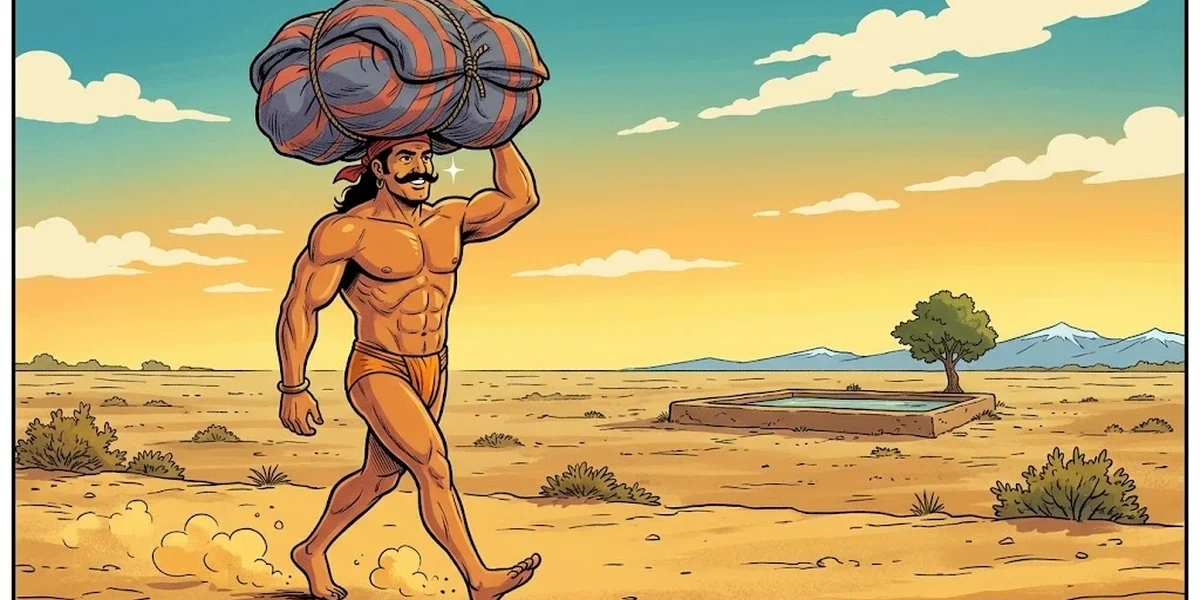
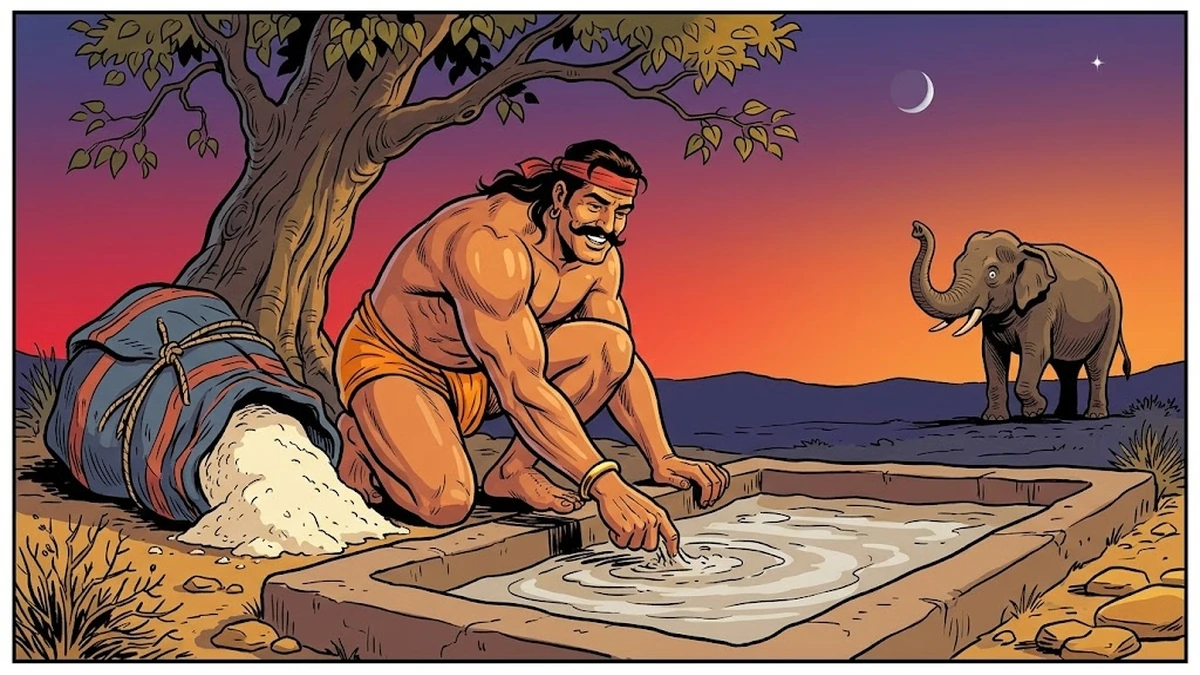
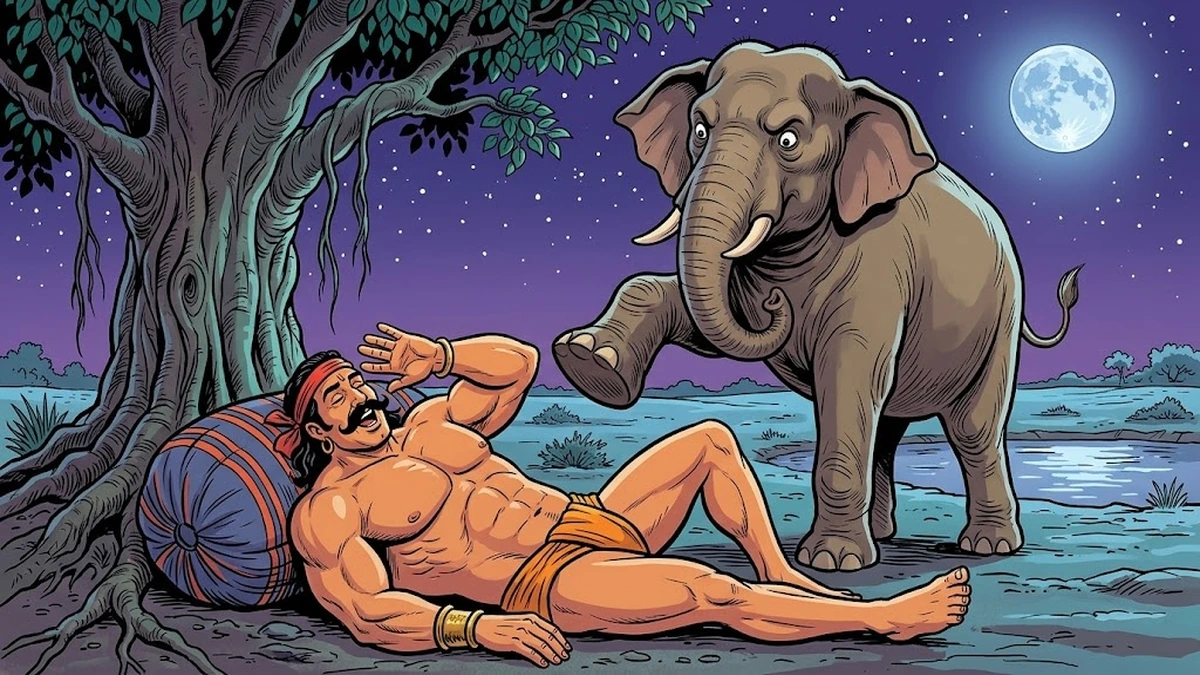
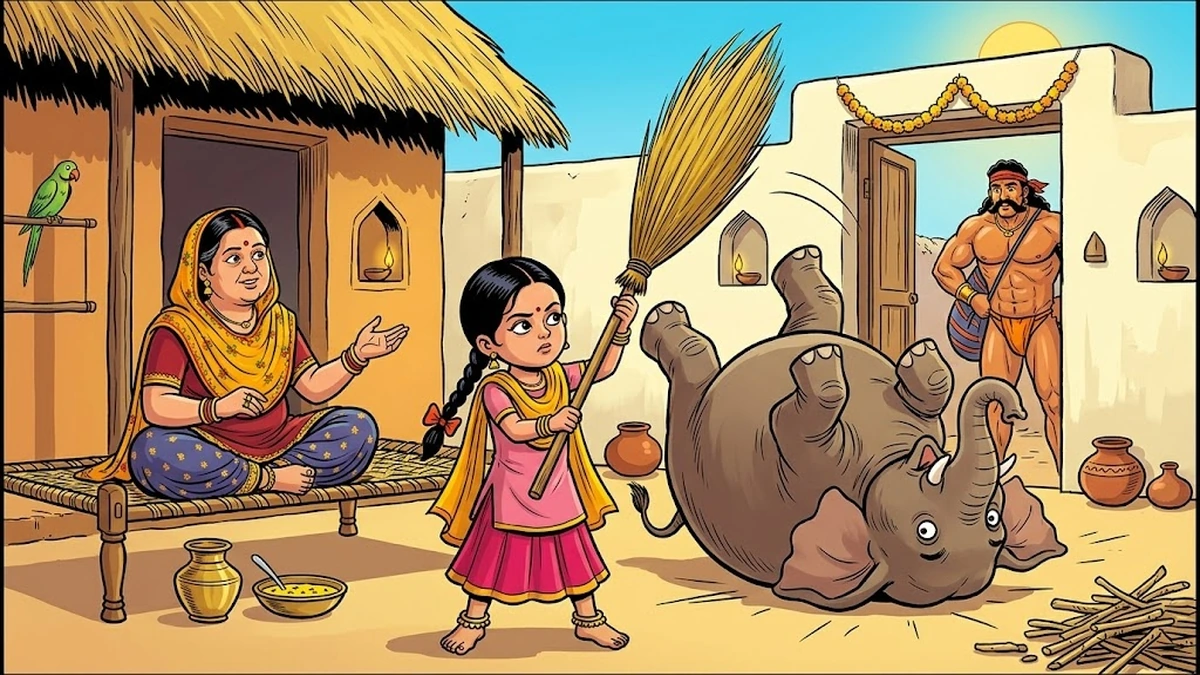
There was, once upon a time, long ago, a wrestler living in a far country, who, hearing there was a mighty man in India, determined to have a fall with him; so, tying up ten thousand pounds weight of flour in his blanket, he put the bundle on his head and set off jauntily. Towards evening he came to a little pond in the middle of the desert, and sat down to eat his dinner. First, he stooped down and took a good long drink of the water; then, emptying his flour into the remainder of the pond, stirred it into good thick brose, off which he made a hearty meal, and lying down under a tree, soon fell fast asleep. Now, for many years an elephant had drunk daily at the pond, and, coming as usual that evening for its draught, was surprised to find nothing but a little mud and flour at the bottom. ‘What shall I do?’ it said to itself, ‘for there is no more water to be found for twenty miles!’ Going away disconsolate, it espied the wrestler sleeping placidly under the tree, and at once made sure he was the author of the mischief; so, galloping up to the sleeping man, it stamped on his head in a furious rage, determined to crush him. But, to his astonishment, the wrestler only stirred a little, and said sleepily, ‘What is the matter? what is the matter? If you want to shampoo my head, why the plague don’t you do it properly? What’s worth doing at all is worth doing well; so put a little of your weight into it, my friend!’ The elephant stared, and left off stamping; but, nothing daunted, seized the wrestler round the waist with its trunk, intending to heave him up and dash him to pieces on the ground. ‘Ho! ho! my little friend! — that is your plan, is it?’ quoth the wrestler, with a yawn; and catching hold of the elephant’s tail, and swinging the monster over his shoulder, he continued his journey jauntily. By and by he reached his destination, and, standing outside the Indian wrestler’s house, cried out, ‘Ho! my friend! Come out and try a fall!’ ‘My husband’s not at home to-day,’ answered the wrestler’s wife from inside; ‘he has gone into the wood to cut pea-sticks.’ ‘Well, well! when he returns give him this, with my compliments, and tell him the owner has come from far to challenge him.’ So saying, he chucked the elephant clean over the courtyard wall. ‘Oh, mamma! mamma!’ cried a treble voice from within, ‘I declare that nasty man has thrown a mouse over the wall into my lap! What shall I do to him?’ ‘Never mind, little daughter!’ answered the wrestler’s wife; ‘papa will teach him better manners. Take the grass broom and sweep the mouse away.’
A Boast Carried Across the Border
The opening of The Wrestlers sets a tone the rest of the tale will preserve to the last syllable: cheerful, swaggering, and entirely unbothered by the laws of physics. The unnamed foreign wrestler — called only pahalwān, the Punjabi-Persian word for a champion of the wrestling pit, the akhārā — hears that an even mightier man lives in Hind, the great river-plain across the Indus, and at once decides to walk there and challenge him. The detail that he packs ten thousand pounds of flour for the road is the storyteller’s opening salvo of comic exaggeration: half a ton of atta rolled into a single blanket, balanced on a single head, treated as a single picnic lunch. The Punjabi audience, weighing their own grain in seers and maunds at the village shop, would have laughed before the elephant ever appeared.
The hero’s costume is implied rather than described, but Flora Annie Steel’s Punjabi narrators heard him in the trade-dress of the wrestling akhārā: a saffron-orange langot loincloth, oiled bare chest, a heavy striped jholī blanket of camel-hair cloth bundled into a sack, broad shoulders darkened by sun. The route he walks is the same one Punjabi soldiers, traders and pilgrims had walked for two thousand years — from the high passes of the Khyber and the dry Pothohar plateau down through the Salt Range, across the five rivers (Jhelum, Chenab, Ravi, Beas, Sutlej), and out onto the dusty Doaba farmland of the eastern Punjab. The detail of a single small talāb (pond) twenty miles from any other water is itself a piece of folk geography: the lone desert pond, the elephant’s daily drinking-spot, is a real feature of the dry Bar lands between the Chenab and the Ravi where this story would have been told around the fire after the cattle had been brought home.
Flour, Brose and the Elephant’s Anger
The pivot of the whole tale is one of those moments where folk humour turns physics into mathematics: the wrestler drinks half the pond, dumps his flour into the rest, stirs the result into brose (a thick gruel of grain stirred with hot water, the Lowland Scots word that Flora Annie Steel imported from her Scottish-Anglo-Indian household into her translation), and eats the lot. The pond, we are told, was the only water for twenty miles. The elephant, returning at evening as he had returned daily for years, finds nothing but the muddy floury slurry the wrestler has left behind. Steel’s storyteller carefully refuses to make the elephant a comic figure: the great animal is genuinely thirsty, genuinely frightened (“What shall I do?”), and genuinely furious when he sees the cause of his ruin sleeping placidly under a tree.
The elephant stamps. The wrestler, half-asleep, mistakes the stamping for champī — the leisurely Indian head-massage offered at every barbershop and bath-house in the Punjab — and grumbles only that the masseur should put some weight behind it. Steel’s English “shampoo my head” is not the modern hair-product but the original Hindi-Urdu loanword chāmpnā, “to press, knead, massage,” which entered English in the 1760s through Anglo-Indian usage and only later narrowed to mean hair-washing. To the Punjabi listener of 1880, the joke would have been instant: the elephant’s full-bodied stamp is, to the Pahalwān, less than the morning massage of an idle barber. The story is doing a careful piece of comic mathematics — an elephant’s tonnage is being measured against a wrestler’s morning routine, and the elephant is being found wanting.

The Elephant Slung Over the Shoulder
The elephant, refused as a masseur, tries to lift the wrestler with its trunk. The wrestler, equally undisturbed, takes hold of the elephant’s tail and slings the entire animal over his shoulder — not as a trophy, not as an angry retaliation, but as one might tuck a stray cat under one’s arm before walking on. The yawn (‘Ho! ho! my little friend!’) is the storyteller’s key gesture. Punjabi folk humour, particularly of the kind Major Richard Carnac Temple recorded in his three-volume Legends of the Panjāb (Bombay & London, 1884–1900), almost always works through this kind of casual understatement: the hero never strains, never sweats, never even fully wakes up. The elephant is “little.” The journey continues “jauntily.” The whole tonnage of the encounter has been deflated into a single playful epithet.
The image is also a deliberate visual quotation. Punjabi audiences would recognise the shape of the strong hero carrying a giant beast on his shoulder from a long iconographic tradition: from the Sanskrit Rāmāyaṇa, where Hanumān carries the Droṇagiri mountain back across the sea; from the Mahābhārata, where the Pāṇḍava prince Bhīma slings the demon Baṃkāsura over his shoulder before snapping his back; and from the wider Indo-Persian Pahalwān stories of warriors like Rustam in the Shāhnāmeh, who fights the white div Dīv-e Sepīd bare-handed and slings whole armies aside. The folk-tale wrestler is a comic miniature of the same heroic body. Where Hanumān carries a mountain in earnest, the Pahalwān carries an elephant for a laugh.
The Wife, the Daughter, and the “Mouse”
The punchline arrives at the door of the Indian wrestler’s house, and it arrives without the Indian wrestler. The visitor calls out his challenge across the mud-and-thatch courtyard wall; the wife answers from inside that her husband is out cutting pea-sticks. The visitor cheerfully tosses the elephant over the wall as a calling-card. From the inner courtyard a small treble voice complains that “a nasty man” has thrown a mouse into her lap. The mother’s reply — that papa will teach the visitor better manners on his return, and that meanwhile the daughter should pick up the grass broom and sweep the mouse away — is the moment the whole tale has been quietly walking towards.
It is a subtle, wholly Punjabi piece of one-upmanship. The visiting wrestler has spent the whole story performing his strength: the half-ton flour bundle, the elephant tail, the casual chuck over the wall. The Indian household answers without performing anything at all. The wife does not come out to look. The daughter does not even rise from her play. The elephant, the visitor’s greatest feat, is reclassified as vermin and assigned to the housework. We never meet the Indian wrestler in person, and we do not need to: the story has told us, by the size of his daughter’s grass broom, exactly how he will receive the challenge. The foreign Pahalwān has walked a thousand miles only to discover that he is the smallest visitor of the day.
Moral
The wisdom of The Wrestlers is the wisdom every Punjabi grandmother has whispered into a grandchild’s ear at the akhārā on the morning of a wrestling-match: no matter how mighty you are, there is always someone mightier — and the truly strong have no need to advertise. Strength that boasts is small strength. The visiting wrestler, weighed against an elephant, is a giant; weighed against a household that treats elephants as mice, he is a child. The folk proverb the storyteller leaves unspoken is the old Punjabi saying:
“Ātā guṇdhṇā ātā hai, par jis-dā guṇdhiā ūs-ne khādhā hai — vaḍḍā pahalwān ūs-ne hai jo guḍ-paḍ-ke chup rave.”
— Punjabi folk proverb, eastern Doaba, c. 1880
(“Many a man can knead the dough, but only the one who has eaten it knows its weight; the truly great wrestler is the one who has wrestled and stays silent.”)
The visitor never stops talking. The household never starts. That, in the Punjabi reckoning, is who has won the bout.
Origin, Transmission and Canonical Sources
The version reproduced above is the standard Anglo-Punjabi text recorded by Flora Annie Webster Steel (1847–1929) and her collaborator Major Richard Carnac Temple (1850–1931) in Tales of the Punjab Told by the People, Macmillan and Co., London, 1894 (an expanded re-issue of Wide-Awake Stories, Bombay/London 1884), Project Gutenberg ebook #6145. The book was illustrated by John Lockwood Kipling (1837–1911), Principal of the Mayo School of Art at Lahore and Curator of the Lahore Museum, whose pen-and-ink Pahalwān — bare-chested, oiled, with the elephant slung over one shoulder — is the iconic late-Victorian image of the Punjabi strong-hero. Steel collected the tales in eastern Punjab between 1867 and 1884, chiefly in Kasur and the Patiala State, working through Punjabi-speaking nurses, milkmen and village schoolmasters; Temple supplied the comparative folkloric apparatus. The collection is the single most-cited English-language source for nineteenth-century Punjabi oral folklore.
In folkloric type-and-motif terms, the tale is classed under Hans-Jörg Uther’s Types of International Folktales (FFC 284–286, Helsinki 2004) as ATU 650A “Strong John” — the comic strong-man whose feats dwarf nature — with subsidiary elements of ATU 1640 “The Brave Tailor” (the boasting outsider who reaches a household stronger still). Stith Thompson’s Motif-Index of Folk-Literature (Bloomington 1955–58, 6 vols.) records the relevant motifs as F624 “Mighty lifter”, F624.0.1 “Mighty hero throws great weight”, F628.1 “Strong man kills wild beast bare-handed”, F636 “Mighty wrestler”, J1881 “Animal mistaken for something else” (here, an elephant taken for a mouse), and X940 “Lie: remarkable strength of man”. The Indic parallels gathered by W. Norman Brown, The Indian and Christian Miracles of Walking on the Water (Chicago 1928), and by Heda Jason, Studies in Indic Mythology (Helsinki 1972), align the Pahalwān type with Sanskrit Bhīma, Persian Rustam, Tibetan Gesar and the Punjabi epic Rājā Rasālū cycle.
The story’s closest collected parallels are recorded in Charles Swynnerton, Romantic Tales from the Panjab (Westminster, 1903), tale XXII (“The Boastful Pahalwān”); in J. Hinton Knowles, Folk-Tales of Kashmir (London 1888), pp. 56–59; and in the Pashto cycle “Rustam aw Fīl” (Rustam and the Elephant) from Aurel Stein’s Pashto Texts (Calcutta, 1929). The motif of the elephant flung over the courtyard wall and mistaken for a mouse is local to the Punjabi-Pashto borderland; the closest non-Indic cousin is the medieval Persian Dāstān-e Amīr Ḥamzeh, in which the hero Amīr Ḥamzeh slings the white elephant of the king of Sarandīp over his shoulder and walks home to dinner. Through the Mughal court, that Hamzeh-cycle iconography became the preferred subject of seventeenth-century Indian miniature painting, which is one of the visual reasons the Punjabi storyteller of 1880 could use “wrestler-with-elephant” as ready-made shorthand for “impossibly strong man.”
Why This Tale Has Lasted
The Wrestlers has lasted because it does what the best comic folk-tales always do: it lets the listener feel the pleasure of size, strength and showing-off — and then quietly takes that pleasure back. For the first three quarters of the story we are inside the foreign wrestler’s head. We enjoy his ten-thousand-pound flour, his half-pond brose, his elephant-as-broomhandle. We are on his side. Then, in twenty seconds at the courtyard wall, the storyteller flips the lens. The voice we have been laughing with becomes the voice the household is laughing at. The elephant we have been admiring is a mouse to be swept away. Without ever lifting a finger, the unseen Indian wrestler — and, more importantly, his nameless wife and daughter — have made the Pahalwān the smallest character on the stage.
That reversal is the engine of the tale’s long life. It rewards the listener for paying attention, it rewards humility over swagger, and it does both without a single line of overt moralising. Children love the surface absurdity (an elephant! over a wall!); teenagers begin to notice the female household’s composure; adults recognise themselves in the visitor and resolve, quietly, to be more like the wife. A folk-tale that can teach the same lesson at three different ages is the sort that survives, and The Wrestlers has been retold in Punjabi village courtyards, in Lahore school readers, in Anglo-Indian nurseries, and on Bombay bazaar puppet-stages for at least one hundred and forty years.
It also lasts because it is a tale about strength told by people who knew strength well. The Punjabi akhārā — the earthen wrestling-pit of the village or city muḥalla — was, throughout the nineteenth century and well into the twentieth, the central daily-fitness institution of north-Indian male life. Boys oiled their bodies, ate prodigious diets of milk, ghee, almonds and chick-pea atta, and watched older Pahalwāns like the legendary Ghūlām Muḥammad “Gama” Pahalwān (1878–1960), the “Lion of the Punjab,” train and compete. The folk-tale’s wisdom — that the loudest wrestler is rarely the truest one — was, for that audience, a piece of professional ethics, not just a children’s moral. The akhārā proverb still quoted at Punjabi village fairs is “jo bole so korā, jo na bole so sona” (“he who boasts is hollow; he who keeps silent is gold”). The Wrestlers is that proverb stretched into a story.
Reflection & Discussion
- Why does the storyteller never let us meet the Indian wrestler in person? What does his absence add to the story?
- The visiting wrestler performs all his feats publicly. The household responds privately, from inside the courtyard. What is the tale saying about public versus private strength?
- Why does the daughter call the elephant a “mouse”? Is she joking, mistaken, or making a quiet boast?
- Comic exaggeration (a half-ton of flour, an elephant flung like a kitten) is the engine of this tale. When does exaggeration become a serious moral tool, and when does it become mere boasting?
- The mother tells the daughter to “sweep the mouse away.” What does that domestic, almost dismissive instruction reveal about how the household measures strength?
Did You Know?
- Flora Annie Steel, the collector of this tale, lived in the Punjab from 1867 to 1889 as the wife of an Indian Civil Service officer and learnt Punjabi well enough to take down stories directly from village storytellers without an interpreter.
- The Project Gutenberg edition of Tales of the Punjab (ebook #6145) preserves John Lockwood Kipling’s original 1894 line-drawings, including the famous illustration of the wrestler walking with the elephant slung over his shoulder by its tail.
- The English word shampoo, used in the wrestler’s drowsy complaint, comes from Hindi-Urdu chāmpnā, “to press, to knead, to massage,” and entered English from Anglo-Indian usage in the 1760s.
- The legendary Punjabi wrestler Ghūlām Muḥammad “Gama” Pahalwān (1878–1960), undefeated world champion for fifty-two years, is said to have lifted a 1,200 kg stone in Baroda in 1902 — a real-world feat that reads like a sober draft of this folk-tale.
- The motif “elephant flung over a wall” appears in seventeenth-century Mughal miniature paintings of the Hamzanāma, where the hero Amīr Ḥamzeh tosses the white elephant of Sarandīp over a city wall — a likely visual source for the Punjabi storyteller’s image.
Reading The Wrestlers with Children
This is one of the easiest Punjabi folk-tales to read aloud to a young listener, because every escalation is loud, visual and physical. Pause at the half-ton of flour and ask the child to picture how big a sack that would be. Pause again at the “shampoo my head” and explain that this is what an elephant’s stamp feels like to the Pahalwān. Pause a third time at the courtyard wall, before turning the page, and ask the child to guess what the household will say when an elephant lands in the daughter’s lap. Their answers will almost always be wrong — they will expect screaming, broken pottery, an angry mother — and the storyteller’s real punchline (the grass broom, the word “mouse”) will land harder for the surprise.
For older children, the conversation can move to the absent wrestler. Why does the wife not call her husband home? Why does she not raise her voice, send for help, or even step outside to look? The answer the tale wants the older listener to find is that the household has nothing to prove. Confidence so complete that it does not bother to perform itself is a difficult idea for a teenager to articulate, but The Wrestlers hands them a perfectly memorable image of it: a small girl with a grass broom, sweeping an elephant out of her courtyard, while her mother, unbothered, calls her back to her play.
You May Also Like
 Indian Folk Tales
Ages 3-5
Indian Folk Tales
Ages 3-5
Jackal Or Tiger
Jackal Or Tiger: One hot night, in Hindustan, a king and queen lay awake in the palace in the midst of the city. Every now and then a faint air blew through
 Indian Folk Tales
Ages 3-5
Indian Folk Tales
Ages 3-5
Kaliya Daman – Krishna Tames The Serpent Kaliya – Indian Mythological Story
Kaliya Daman – Krishna Tames The Serpent Kaliya – Indian Mythologica: In the Dvapara Yuga, Krishna lived in Vrindavan as an incarnation of Vishnu, born to
 Indian Folk Tales
Ages 9-12
Indian Folk Tales
Ages 9-12
The Four Brahmins and the Lion
The Four Brahmins and the Lion: In the city of Vikramapura, not far from the banks of the Godavari River, there lived four Brahmin scholars who had been