The Charmed Ring
The Charmed Ring: In a remote village at the foot of the Himalayan mountains, there lived a poor but honest widow and her only son, Ramu. They owned nothing
“Bahá-i-tum yor í gachhem phíraunúy.” — “Even the smallest creature you spare may turn round and save your life.” A Kashmiri household saying traditionally cited as the moral of this tale.
“The Charmed Ring” is one of the great Indian magic-ring stories, told for at least a century along the willow-fringed lakes and saffron fields of Kashmir, and widely known across northern India before that. In folkloristic catalogues it sits at the head of the international tale-type cluster ATU 560 – The Magic Ring, and it is structurally the parent of the most famous Eastern magic-object tale of all: Aladdin and the Wonderful Lamp from the Arabian Nights. Its proper Indian setting, however, is not a desert palace but the underground emerald kingdom of Raja Indrasha, the king of serpents — and its true heroes are not princes at all, but a faithful cat and dog who would sooner cross a river of fishes than abandon the master who once paid a hundred rupees to spare each of their lives.
Origin and Source
The earliest printed text of “The Charmed Ring” comes from the Reverend James Hinton Knowles, a missionary of the Church Missionary Society who served at Srinagar in Kashmir between 1876 and 1894. Knowles spent his evenings collecting tales told to him by Kashmiri Pandits, boatmen, and the household women whose oral traditions had transmitted these stories for generations in the Kashmiri language. He published the collection as Folk-Tales of Kashmir (Kegan Paul, Trench, Trübner & Co., London, 1888) in W. R. S. Ralston’s “Trübner’s Oriental Series.” “The Charmed Ring” appears as the third tale in that volume, on pages 20–28, with extensive comparative footnotes pointing to parallel versions across Persia, Arabia, and Europe.
Four years later Joseph Jacobs selected the story for his anthology Indian Fairy Tales (David Nutt, London, 1892), where it appears as Tale XII, illustrated by John D. Batten with the celebrated full-page drawing of the cat and dog crossing the river with the ring. Jacobs’s Notes and References for the book (p. 244) name Knowles’s Kashmiri text as the direct source, and add an important comparative observation borrowed from the French folklorist Emmanuel Cosquin’s Contes populaires de Lorraine (1886): the peculiar episode of the rat thrusting its tail up the sleeping ogress’s nose to make her cough up the swallowed ring — a vivid, almost slapstick detail — recurs in tales told by Arabs, Albanians, Bretons, and Russians, an unmistakable family resemblance that, in Jacobs’s words, “could not have been invented twice.” For Jacobs, this rat-and-ring sequence was one of his strongest pieces of evidence that the European magic-ring tradition was carried out of India along the trade routes of Central Asia.
Within the standard tale-type and motif indices the story bears a rich apparatus of identifiers: ATU 560 (“The Magic Ring”), with companion clusters ATU 554 (“The Grateful Animals”) and ATU 561 (“Aladdin”). The Stith Thompson Motif-Index of Folk-Literature tags B313 (Helpful animals as reincarnated relatives), B331.2 (Faithful animals freed from captivity), B548.2.1 (Animal recovers lost ring from sea), D861.2 (Magic ring stolen by ogress), D882.1.1 (Stolen ring found by helpful mouse/rat), D1470.1.15 (Magic wishing-ring), and N271 (Murder will out). The Indian wisdom tradition itself anticipates the moral framework: the Pañcatantra Book III (“Kakolukiyam”) teaches that a friend rescued from danger becomes a permanent ally, the Hitopadeça Mitralábha section opens with the same teaching in verse, and the Mahábhárata Anuçásana Parva states “sa kim sakhá yo na rakshati” — “what kind of friend is one who does not protect?” The dog, the cat, and the snake of the Kashmiri tale are precisely such friends.
The Story
1. Three Hundred Rupees and Three Saved Lives
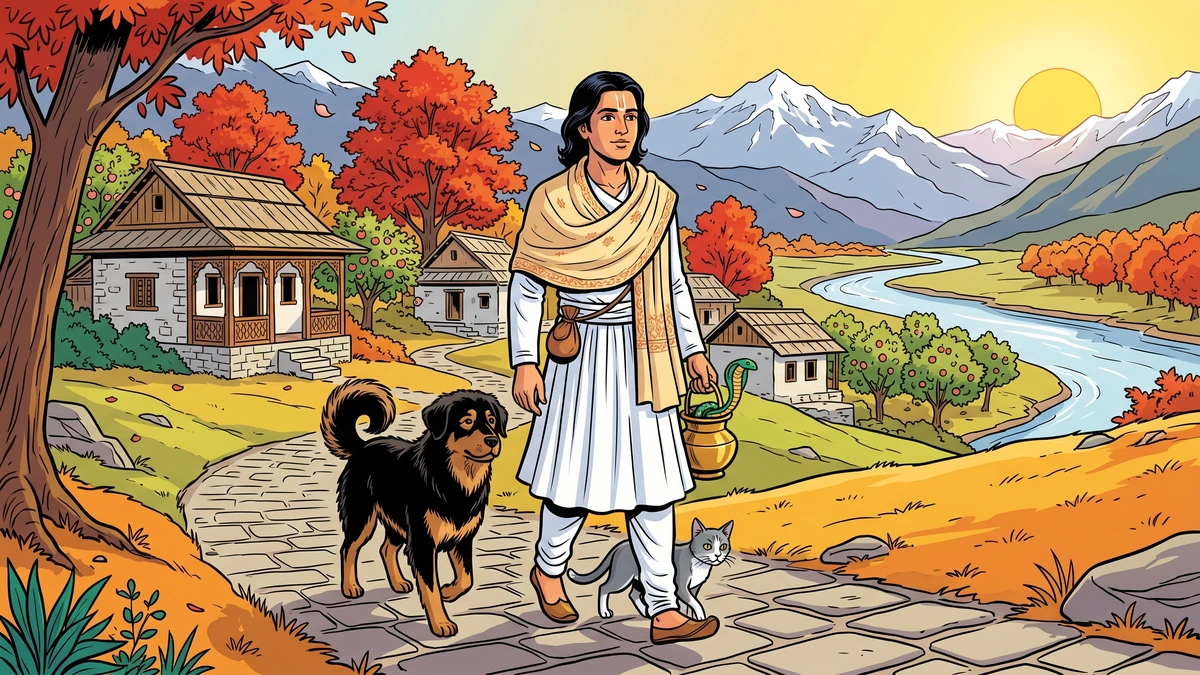
In a small white-walled town beneath the Pir Panjal range, where the chinar trees turned red in autumn and the apple orchards perfumed the lanes in spring, there lived a Kashmiri merchant who had reached the age of grey hair and folded shoulders. One morning he called his only son before him, weighed out three hundred silver rupees in a leather pouch, and said: “My son, my fortunes are smaller than my hopes for you. Take this money, cross into the Punjab, and try your luck in trade. Buy wisely, sell wiser, and remember that the merchant who keeps his hands clean keeps his name clean.” The son tied the pouch into the fold of his sash, touched his father’s feet for the journey-blessing, and set out down the Jhelum valley with a heart far lighter than his purse.
Before he had walked half a day, he came to a meeting of three roads where a knot of herdsmen were quarrelling beside a bound and bleeding dog. Some wished to club the creature to death; others were trying to hold them back. The young man could not bear it. “Do not kill the dog,” he said. “I will give you a hundred rupees to spare its life.” The bargain was struck; the dog was untied; and the merchant’s son, now poorer by a third of his patrimony, walked on with the dog padding silently at his heel.
An hour later he found a similar quarrel in a roadside village — this time over a slim grey cat who had been caught raiding a tradesman’s larder. Again the young man could not bear it. He paid out a second hundred rupees for her release and watched her stretch and yawn beside his ankle as though she had always belonged there. Toward sunset, in a third hamlet near the Jhelum’s bend, he found yet another fight, this one over a bright-banded snake the villagers were trying to behead with a bamboo pole. He paid the last hundred rupees of his journey-money, scooped the wounded snake into his water-pot, and slept that night in an empty cattle-stable with the dog at his head, the cat curled warm at his feet, and the snake coiled gently across his chest, its head hanging on one side and its tail on the other.
2. Beneath the Sacred Spring: The Naga Kingdom of Raja Indrasha
For seven days the young man laboured in the village — carrying water, threshing rice, splitting kindling — and the three creatures grew tame and devoted. On the seventh evening the snake spoke to him in the soft hiss of running water. “My master and saviour, I am no common snake. I am the only son of Raja Indrasha, sovereign of the Nága kingdom that lies beneath the Pir Panjal. I had come up to drink the air on a midsummer morning when those villagers seized me. Had you not arrived I should have been dead before noon. Now hear me. At the foot of yonder mountain there is a sacred spring whose surface is cold as glass and whose depth is cold as memory. Dive into it with me, and we shall walk together into my father’s hall. He will reward you, and reward you well. But if he asks what gift you would have, do not ask for gold — ask for the ring on his right little finger, and for the brass pot and the brass spoon that stand always at his throne. With those three gifts in your hands, you will never know want again.”
The four companions came to the spring. The cat and dog crouched on the bank and would not enter the water; “We will guard the threshold,” the cat said with calm yellow eyes, “and we will be here when you return.” The young man nodded, took a last breath of the apple-scented Kashmir air, and dived.
The water was bright as molten silver. He passed through it without drowning, and emerged into a cavern that had no roof he could see and a floor of polished green serpentine. Pillars of uncut emerald held up a vault studded with sapphires and moonstones. At the far end, on a throne of beaten gold patterned with snake-coils, sat Raja Indrasha himself — a tall, grave figure wearing a silken robe the colour of running rivers, with a hood of seven cobras spread behind his head like a fan of green and gold. When the young snake glided to its father’s feet and told the story of its rescue, the Raja descended his throne, embraced the merchant’s son, and seated him at his right hand. The hospitality of the Nága court flowed for three days — bowls of pomegranate wine, plates of saffron rice with raisins and almonds, music from a lute strung with snake-skin — and on the fourth morning the Raja said: “Ask, my friend. Ask whatever you wish, and it shall be set in your hand.”
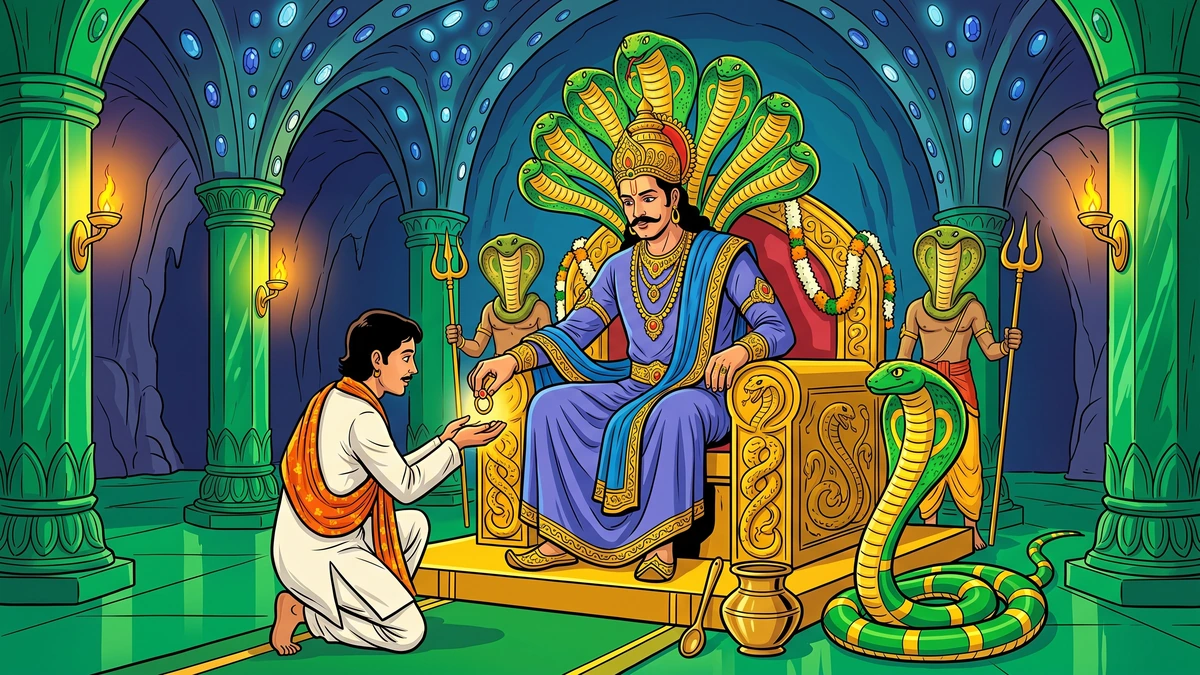
The merchant’s son remembered the snake’s whispered counsel. He bowed his head and said quietly, “Great Raja, I ask for the ring on your right little finger, and for the brass pot and the brass spoon that stand at the foot of your throne.” The Raja’s eyebrows lifted. He looked at his son the snake, and his son the snake nodded once, gravely. Then Indrasha drew the ring from his finger, lifted the pot and the spoon with his own hand, and laid them in the young man’s palm.
“This ring,” he said, “is the Charmed Ring, the wishing-ring of my house. Speak to it, and the desire of your heart will appear before you. This brass pot and spoon have a humbler magic but a kindlier one: dip the spoon in the pot, and the rarest food of any land you can name will fill it to the brim. Use the three together and you will eat as a king, sleep as a king, and need beg of no man so long as you live. But hold them lightly. The wishes of magic rings have a habit of running back to the giver.”
3. The Princess With the Golden Hair, and the Ogress in the Form of a Bee
The young man rose to the surface of the spring with the ring on his finger and the pot and spoon under his arm. The faithful cat and dog, who had not stirred from the bank, leapt at him with wagging tail and arched back, and the four companions walked together to a clearing on the bank of the river. There the merchant’s son raised the ring and made his first wish.
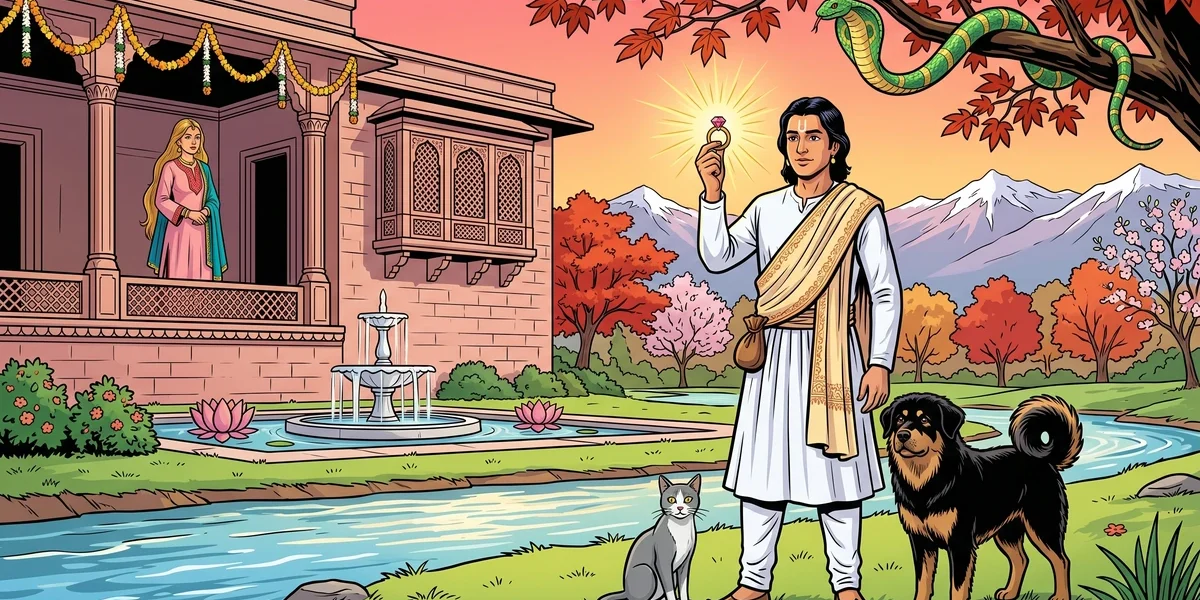
The air shimmered as if the sun had been pulled up to the earth, and a palace rose before him on the meadow — a Kashmiri pleasure-house of carved deodar wood and pale rose stone, with latticed jharokha balconies, a courtyard of fountains, and beds of lotus floating in marble tanks. From the upper veranda there stepped a princess with hair the colour of wheat at harvest and eyes the colour of melted honey. She smiled at the young man as if she had been waiting for him a thousand years, and said simply, “I am yours, husband, by the gift of the ring.”
For four happy years the merchant’s son and the golden-haired princess lived together in that palace. The brass pot and spoon furnished their table; the cat and dog patrolled the gates; the deodar walls breathed of cedar and snow. Then one summer morning, while the princess sat at her dressing-mirror combing her long hair, she pulled out a few loose strands and, idly, tucked them into a hollow reed and dropped the reed into the river that ran beneath her window. The current bore the reed downstream past three valleys, four mountain bends, and at last to the marble ghat of a great king’s palace, where the king’s only son had gone down to bathe at dawn.
The prince picked up the reed, opened it, and saw the gleam of golden hair within. He held the strands up to the rising sun and lost his heart on the spot. He returned to his rooms, locked the doors, refused food and drink, and lay down with his face to the wall, swearing that he would die if the woman whose hair this was were not brought to him. His father, half mad with worry, sent for his old aunt, a withered ogress whose powers were known across three kingdoms. The ogress listened, smiled a slow ogress smile, and said, “Be at ease, brother-king. I shall fetch the woman.”
She turned herself into a bee — small, golden-furred, droning — and flew up the river, scenting the perfume of the princess’s hair across forty miles of valley. She lit on the sill of the latticed window, slipped inside, and resumed her form as a bent old hag leaning on a stick. “My darling niece,” she crooned, embracing the startled princess, “I am your mother’s sister whom you have never seen. I have come at last to know you.” The princess, who had no one in this conjured palace but her husband and his animals, was charmed. She invited the old woman to stay; she fed her on saffron rice and lamb pulao; she let her sit beside the dressing-mirror and braid her golden hair.
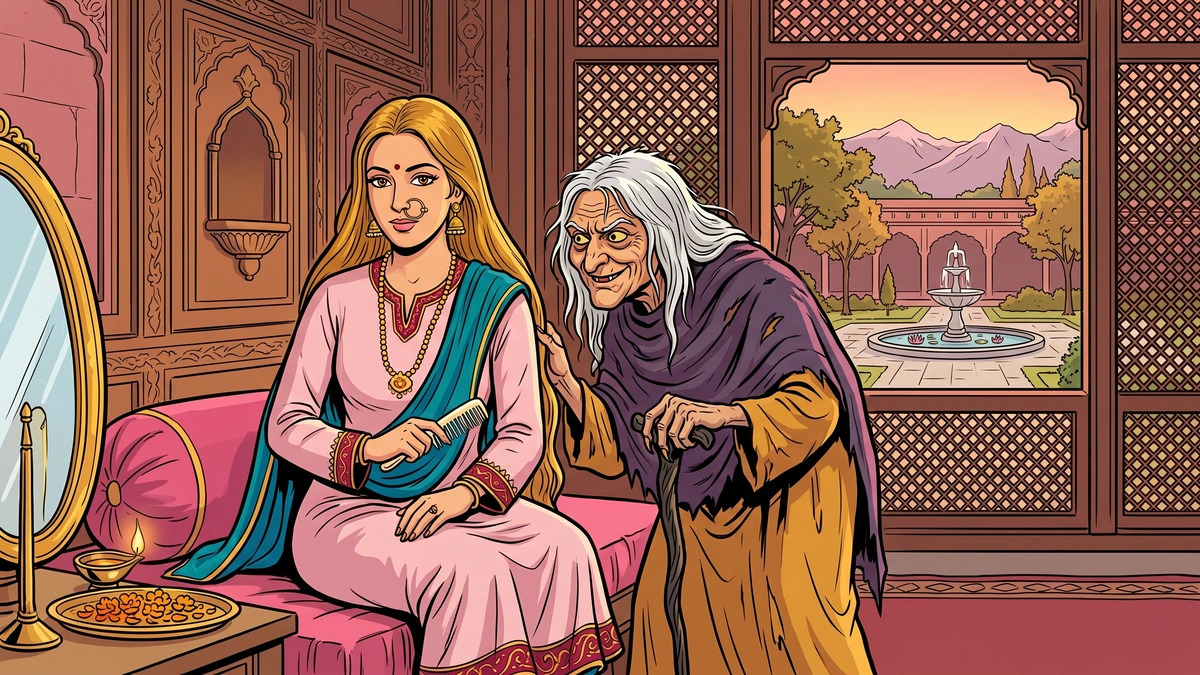
On the third evening the ogress turned the conversation cunningly. “Niece,” she said, “is it not foolish that your husband carries the wishing-ring with him every day to the hunt? What if a thorn pulls it from his finger? What if it slips into a stream while he washes? Far better that you keep it on yours; then no harm can come to it.” The princess, suspecting nothing, asked her husband for the ring that night, and he — gentle, trusting, in love — gave it to her without a thought. The next afternoon, while her husband was out hunting deer in the chinar woods, the ogress asked sweetly to “see the precious thing one moment in the light.” The instant the princess laid it on her open palm the old woman snatched it, swallowed it whole, became a bee again, and roared away through the lattice window with a buzzing like a falling drum.
By sunset the wishing-ring had been spoken once, and the rose-stone palace, the latticed balconies, the marble fountains, and the golden-haired princess herself were lifted out of the meadow by the river and set down in the courtyard of the lovesick prince’s father.
4. The Faithful Cat and Dog: Rats, Fishes, and the Nadhar Bird
The merchant’s son returned at dusk to find only the meadow he had first wished upon — the same grass, the same stones, the same indifferent river. His ring was gone, his palace was gone, his wife was gone. He sat on a fallen chinar log and wept. Then he drew his hunting-knife and laid it across his knee, ready to end his life rather than live without his princess.
The cat and dog, who had been chasing a partridge in the brush, came bounding back, saw their master’s face, and threw themselves down before him. “Stay your hand, master!” the cat cried. “What can be lost can be found. Give us a single month and we will bring back the ring, the palace, and your wife. If we fail, then choose your knife as you wish. But not yet. Not yet.” The young man looked into the cat’s level yellow eyes and the dog’s earnest brown ones, and slowly slid the knife back into its sheath. “Go,” he said. “I will wait.”
The cat and dog set out together at a steady trot. They followed the river, then the trade-road, then the king’s highway, asking news of golden-haired princesses at every village pump, and on the eleventh day they reached the tall walls of the lovesick prince’s palace. They circled the gates twice. “I will go in,” the cat said. “I am quieter than you, and a cat is invisible at twilight.” She slipped through the lattice of an upper window and found the princess sitting alone at her mirror, weeping into her own gold hair.
The princess told the cat the whole story — how the ogress had stolen the ring, swallowed it, and now slept each night curled on a divan at the door of her chamber to make sure the princess could not escape. “If you can fetch the ring from the ogress’s stomach,” the princess whispered, “you may yet save us all.” The cat purred, descended the wall, and found a deep rat-hole running under the palace garden. By great good luck a rat wedding was in full swing in the chambers below: the eldest son of the rat-king was that very night to be married, and the procession was already issuing through the mouth of the hole in cheerful squealing ranks.
The cat pounced. She seized the bridegroom-rat by the scruff of his neck and held him pinned beneath one paw. “Listen!” she announced to the squealing wedding-party. “An ogress sleeps in the prince’s palace tonight with a charmed ring inside her stomach. Bring me that ring before dawn, or your prince dies under my paw.” There was a moment of squealing despair. Then the rat-king himself bowed low in his red-thread coronet and said, “It shall be done. The honour of our house is on the line.” A brave young rat was chosen, anointed in oil, and sent at midnight to the ogress’s bedside. He climbed her shoulder, crept along her neck, and gently inserted the very tip of his tail into her left nostril. The ogress sneezed; she coughed; she gagged; and out across the marble floor rolled the bright gold of the Charmed Ring. The rat seized it in his teeth, scampered home, laid it at the cat’s feet, and the cat, with a single gracious nod, released the bridegroom in time for his wedding.
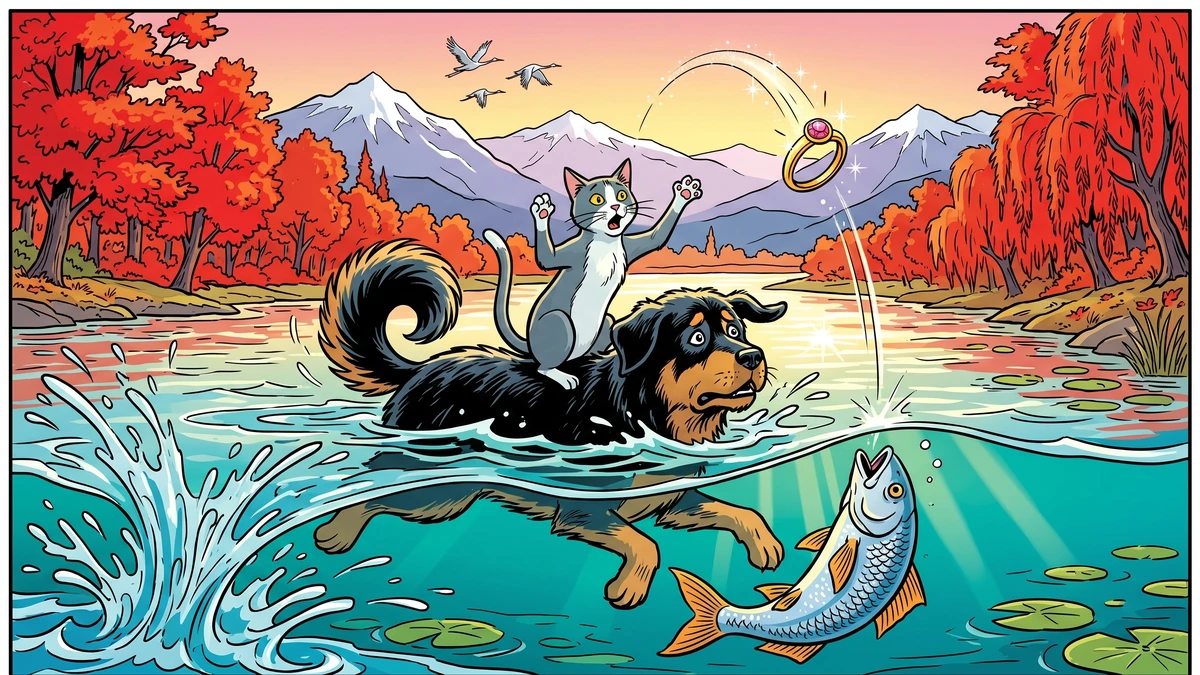
Now came the hardest part of the journey: the road home. The cat and the dog walked side by side through forest and field, the ring safe in the cat’s mouth, until they came to a wide, flashing river. The cat could not swim. “Climb on my back,” said the dog generously, and the cat did, ring and all. Halfway across the dog grew jealous — for cat and dog were great friends but had a small old quarrel about which of them was their master’s favourite. “Give me the ring,” the dog said. “I am the one carrying you. I should be the one who delivers it.” The cat hesitated, then opened her mouth to argue, and the ring fell — plop — into the river. A passing fish swallowed it.
The dog froze with horror. The cat said, “What is done is done. We must mend it. Go and kill me a young lamb and bring it here whole.” The dog ran, and returned an hour later with a small lamb. The cat slipped inside the carcass and lay still as a corpse on the riverbank. Within the hour a great nadhar — a Kashmiri legendary bird whose look alone can break the bones of a fish — circled overhead, stooped, and pounced on the lamb. The cat erupted from inside, claws first, and pinned the nadhar’s neck under her paw. “Recover for me a gold ring swallowed by a fish in this river by sunrise,” she said, “or you die under my claws.” The nadhar swore by the snowy peaks of Harmukh that she would obey. She summoned the king of the fishes; the king of the fishes summoned every fish in the river; and within an hour the offending fish was found, the ring was disgorged into the cat’s paw, and the cat released the nadhar.
The dog, ashamed, asked once more to carry the ring, and once more dropped it — this time picked up by a kite. The cat, with the patience of the truly competent, recovered it from the kite by the same method she had used with the nadhar, and from then on carried the ring herself in her mouth without further negotiation. The two faithful animals returned at last to the merchant’s son. He spoke to the ring; the rose-stone palace returned to its meadow; and the golden-haired princess, who had been weeping into her own hair for a month, came running across the marble courtyard into his arms. The merchant’s son spent the rest of his days in honourable trade and honourable friendship; the cat slept always at his feet and the dog at his head; and the snake, when it visited from the underground kingdom of its father, coiled across his chest exactly as it had once done in the empty cattle-stable when the three of them had nothing in the world but each other.
Moral
“Kritátá satám karyám na vihaniyate kadáchana.”
“The kindness of a good man is never wasted; it returns, in time, by paths he could not foresee.” — Sanskrit verse, Mahábhárata Anuçásana Parva 165.
The moral of “The Charmed Ring” is finer than its surface promises. It is not “buy magical animals when you can afford them.” It is the principle, fundamental to South Asian ethics, that kindness sown into the world keeps growing roots underground long after we have forgotten the seed. Three hundred rupees were the merchant’s son’s whole inheritance, and he gave them away to spare three lives that were nothing to him. Years later, when his palace had been stolen and his wife enchanted away and he sat down on a chinar log to die, it was those very three lives — the snake’s gift, the cat’s wit, the dog’s loyalty — that brought him back to himself. Kashmir grandmothers did not tell this story to teach children that magic exists. They told it to teach children that compassion is not a luxury, but a long-term investment in the surface tension of the world.
Historical and Cultural Context
“The Charmed Ring” was collected from Kashmiri Pandits in the late 1880s, in the same decade that the British colonial administration was reorganising the entire Vale of Kashmir under the dual influence of Maharaja Pratap Singh’s durbar and the Resident at Srinagar. Knowles’s parishioners and informants — Hindu Pandits in their long çeç-coloured pherans, Muslim boatmen on the Dal Lake, the household women of the Brahmin mohallas — were drawn from a community that had told tales like this one for hundreds of years in winter kangírs beside the charcoal-warmed brazier. The tale’s deepest features are recognisably Kashmiri. The Nága king’s underground kingdom of emerald and gold matches the ancient Kashmiri reverence for the Nágas as guardians of the springs of the Vale; the Nilamata Purana, the medieval Sanskrit chronicle of Kashmir, devotes long sections to Nága rituals and to the worship of the great springs of Verinag and Anantnag, both of which are said to be entrances to Nága palaces.
The cat-and-dog rivalry that nearly costs the heroes their reward is also a piece of indigenous Indian folk-zoology. In Sanskrit literature the márjára (cat) is wise, watchful, and slightly devious, while the kukkura (dog) is loyal, generous, and a little dim-witted — a contrast as old as the Pañcatantra. The tale’s joke at the dog’s expense (he twice drops the ring into water out of jealousy) is a thousand-year-old joke. So is the tale’s praise of the cat’s plan. Indian storytelling tradition reserves a particular admiration for the kind of slow-burning intelligence that solves a problem by acting helpless — the cat playing dead inside the lamb is a direct descendant of the jackal-tactics of the Pañcatantra and the Hitopadeça.
Comparative folklore scholarship has placed “The Charmed Ring” at the centre of one of the great migration debates of the field. The story-pattern — rescued snake, magic ring, theft by a witch, recovery by faithful animals — appears in The Arabian Nights as the tale of Ma’aruf the Cobbler (Burton’s translation, Volume X), in nineteenth-century Russian as The Magic Ring (Afanasyev No. 190), in Breton oral tradition as L’Anneau Magique, in Albanian as Unaza e Magjepsur, in English Romany as Jack and his Golden Snuff-Box (collected by John Sampson and reprinted by Jacobs as Tale XVII of his English Fairy Tales), and most famously, with the lamp substituted for the ring, as Ala’ al-Din wa’l-Mishab al-Sihr — Aladdin and the Wonderful Lamp. The French folklorist Emmanuel Cosquin argued in 1886 that the rat-and-nostril episode, identical in all these variants, was unmistakable evidence that the Indian text was the source from which all the others descend. Joseph Jacobs accepted Cosquin’s argument and used “The Charmed Ring” as one of the cornerstones of his case that the European fairy-tale stock is overwhelmingly Indian in origin.
Comparative Versions
“The Charmed Ring” has at least five widely-told relatives that any serious reader will want to compare:
- The Knowles 1888 Kashmiri text — the source of all subsequent printings — preserves the most detail, including the names of the Naga court officials and a long sequence of Persian-style proverbs spoken by Raja Indrasha that Jacobs trimmed for English readers.
- Steel and Temple, Wideawake Stories (Trübner, London, 1884), pp. 196–206 — “The Wonderful Ring.” A Punjabi Mirzapur version in which the merchant’s son is replaced by a poor weaver’s son, the snake is replaced by a frog, and the ogress is replaced by a sorceress’s apprentice. The rat-and-nostril episode is identical.
- Maive Stokes, Indian Fairy Tales (Ellis & White, London, 1880), No. xxiv, pp. 168–177 — “Phulmati Rani.” A Bengali household variant where the magic object is a casket rather than a ring, but the structure is the same: faithful animals recover a stolen wonder by means of a willing rat.
- The Arabian Nights, “Aladdin and the Wonderful Lamp.” A descendant rather than a parallel: the magic object has become a lamp, the faithful animals have disappeared, but the kernel of the plot — magic giver, conjured palace, theft by a sorcerer, recovery — remains.
- “Jack and his Golden Snuff-Box,” from John Sampson’s collection of English Gypsy tales, reprinted by Jacobs as Tale XVII of English Fairy Tales (1890). The English Romany variant carries the story westward; the magic ring has become a snuff-box, but the same rat-and-nostril rescue appears almost verbatim.
Reflection & Discussion
- What does the merchant’s son’s choice to spend his entire patrimony on three suffering animals tell us about how the Kashmiri storyteller wanted us to understand “wealth”? Is the moral that good people are rewarded, or that good people would do the same thing whether or not a reward was coming?
- The princess gives away the ring out of trust in an old woman she has never met. Is the story blaming her, or the husband for handing it over so easily, or the ogress for being an ogress?
- The dog’s two moments of jealousy nearly cost the heroes their happy ending. What does the storyteller seem to be saying about the difference between loyalty and ego?
- “The Charmed Ring” and “Aladdin” share more than a plot. What is gained, and what is lost, when the magic ring is replaced by a magic lamp and the faithful cat and dog are replaced by a slave-of-the-lamp?
- Is the cat the real hero of this story? If so, why does Indian tradition usually award narrative heroism to humans even when an animal does the actual saving?
Why It Has Lasted
“The Charmed Ring” has lasted, and travelled from Kashmir to Cornwall, because it stitches three universal pleasures together with unusual neatness: the pleasure of a rags-to-riches reversal, the pleasure of a dazzling lost-and-found object, and the pleasure of competent, loyal animal helpers solving a human’s problem. The tale is also, quietly, a study in trust. It rewards the trust the young man places in three suffering creatures by a roadside; it punishes the trust the princess places in a smooth-tongued stranger; it tests and finally validates the trust master and animals place in each other across forty miles of forest and a river full of fishes. A tale that knows so much about how trust is built and broken does not need magic to remain in print — though it has plenty of magic to spare. It travels because it tells the truth, in the inexpensive but durable currency of a small kindness, paid forward, returning home.
Canonical source: Rev. J. Hinton Knowles, Folk-Tales of Kashmir (Kegan Paul, Trench, Trübner & Co., London, 1888), pp. 20–28; reprinted in Joseph Jacobs (ed.), Indian Fairy Tales (David Nutt, London, 1892), Tale XII, illustrated by John D. Batten. Tale-type: ATU 560 ‘The Magic Ring’ (companion clusters ATU 554 ‘Grateful Animals’ and ATU 561 ‘Aladdin’). Stith Thompson motifs: B313, B331.2, B548.2.1, D861.2, D882.1.1, D1470.1.15, N271. Comparative analysis after Emmanuel Cosquin, Contes populaires de Lorraine (Paris, 1886). The kingdom of Raja Indrasha and his Nāga court is traceable in Kashmiri Sanskrit tradition to the Nilamata Purana.
You May Also Like
 Indian Folk Tales
Ages 3-5
Indian Folk Tales
Ages 3-5
Peasie And Beansie
Peasie worked steadily in her garden while Beansie sought shortcuts. When harvest came, Peasie's patience yielded abundance; Beansie reaped only regret.
 Indian Folk Tales
Ages 3-5
Indian Folk Tales
Ages 3-5
The Farmer And The Money Lender 2
The Farmer And The Money Lender 2: There was once a farmer who suffered much at the hands of a money-lender. Good harvests, or bad, the farmer was always poor
 Indian Folk Tales
All Ages
Indian Folk Tales
All Ages
A Lac of Rupees for a Piece of Advice
A Lac of Rupees for a Piece of Advice: In a bustling town in ancient India, A merchant paid an enormous sum for a single piece of advice that saved his life.