The Beetle And The Silken Thread
The Beetle And The Silken Thread: In a bustling town in ancient India, A tiny beetle accomplished what seemed impossible by following a silken thread. The
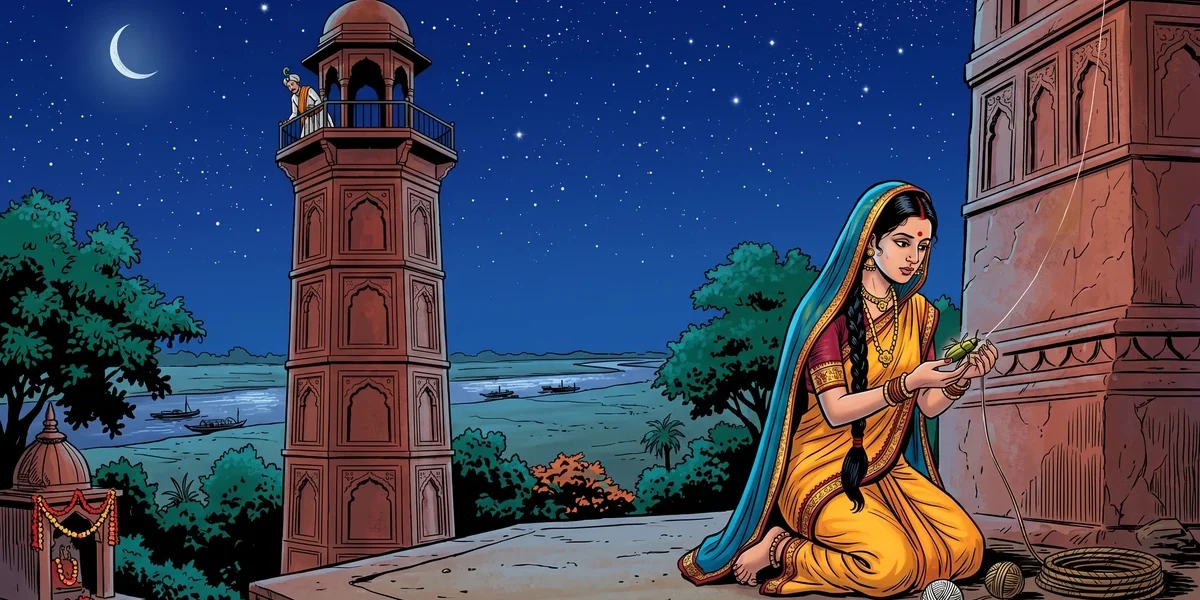
The Beetle and the Silken Thread is the sixth story in Hindu Tales from the Sanskrit, translated by Siddha Mohana Mitra and adapted into English by Mrs. Arthur Bell (Nancy R. E. Meugens Bell, writing as N. D’Anvers) in 1919. Set in Allahabad — the ancient Prayāga, “City of God,” at the sacred confluence of the Gaṅgā and the Yamunā — the tale unfolds within the spired sandstone walls of the city Akbar fortified in 1583, with the Triveṇī Saṅgam glittering like beaten silver beneath the parapets and the long-shadowed kos-minars of the Mughal road running away into the Doab. Three named characters carry the action: the hot-tempered Rājā Sūrya Pratāp (“Powerful as the Sun”), his loyal mantri Dhairya-Śīla (“the Patient One”), and the mantri’s clever wife Buddhi-Matī (“the Sensible One”). Their names are not decoration — they are the moral skeleton of the tale. Sūrya Pratāp’s pride scorches everything it touches; Dhairya-Śīla’s patience does not break under it; Buddhi-Matī’s intellect threads, almost literally, the impossible passage between sun-blasted wall and cool earth. The motif of escape by ascending thread — silk, then cotton, then twine, then rope, drawn upward by a beetle baited with a single drop of honey — was beloved enough in Sanskrit oral tradition that the editor N. D’Anvers placed it among the nine “typical Hindu Tales” she selected as illustrating “the philosophy of self-realisation which lies at the root of Hindu culture.”
Folklorists classify the tale under Aarne–Thompson–Uther ATU 967 (“The Hero Saved by Thread Spun by Animal”) in its escape-from-tower variant, with strong affinity to ATU 875 (“The Clever Farm-Girl”) for the wifely intelligence that saves the husband. The Stith-Thompson motif index records the underlying patterns precisely: R211.4 (escape by climbing knotted thread or rope), R215 (escape from tower), B481.3 (helpful insect), K640 (escape by use of contrivance), J1117 (animal as adviser), H561.6 (clever wife outwits king), and P14.15.2 (king imprisons faithful minister). The “ascending thread upgraded by stages from gossamer to rope” is a remarkably stable folk-engineering motif: it surfaces in the Persian Tūṭī-Nāmā attributed to Ziyā’ al-Dīn Nakhshabī (c. 1330), in the legend-cycle of the Rajput hero Mahārāṇā Pratāp‘s lieutenants escaping Akbari fortresses, in the Bhūtanese cycle of Druk-pa Kun-legs (c. 1500), and — most surprisingly — in colonial-era prison-break ballads of seventeenth-century Ireland. The Sanskrit imagination, however, gives the motif its most pointed moral form: the smallest creature, harnessed to the smallest possible filament, breaks the largest tyranny.
Surya Pratap’s Wrath and the Tower at Allahabad
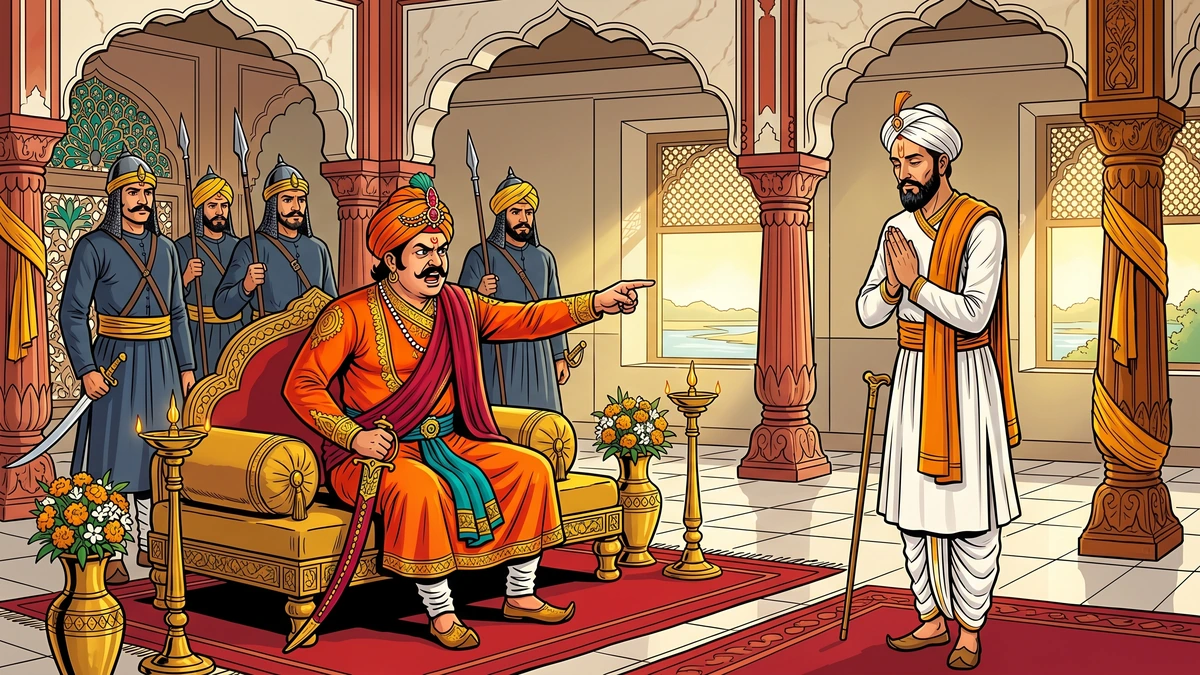
The Rājā Sūrya Pratāp ruled Allahabad from a sandstone audience-hall whose cusped arches looked out across the meeting-place of the rivers — Mother Gaṅgā with her milk-jade water rolling down from Hardwar, and the Yamunā darker, slower, threaded with silt from Mathurā. He was, the tale says without softening it, “very selfish and hot-tempered” — the kind of king who expected obedience before a sentence was finished, who would never own a mistake, whose chief vizier Dhairya-Śīla had been chosen for the one quality that could survive him: imperturbable patience. The vizier had everything a Mughal-era favourite could be granted — a marble-fronted haveli with carved jharokā lattices on the river side, brass-shod carriages with silken curtains, Marwarī horses, retainers in saffron-and-vermilion liveries, jewels and money — but what he loved best, the storyteller pauses to say, was his wife Buddhi-Matī, “who would have died for him.”
One ordinary day Sūrya Pratāp ordered Dhairya-Śīla to do a “shameful deed” — the tale leaves the deed unnamed, as folk tales do when the moral matters more than the particular — and the vizier did the one thing a tyrant cannot bear. He refused, plainly. He told his master that he was wrong. He did not soften it; he did not retreat into flattery. “All your life long,” he said, “you will wish you had listened to me; for your conscience will never let you rest.” The Rājā’s rage came down like a thrown brazier. He summoned guards and ordered the vizier taken outside the city to “a very lofty tower,” set on the open plain beyond the walls, and there left him at the top — without shelter from the sun, without food, without water. It was a slow execution dressed up as banishment, the kind that lets the killer pretend he did not kill.
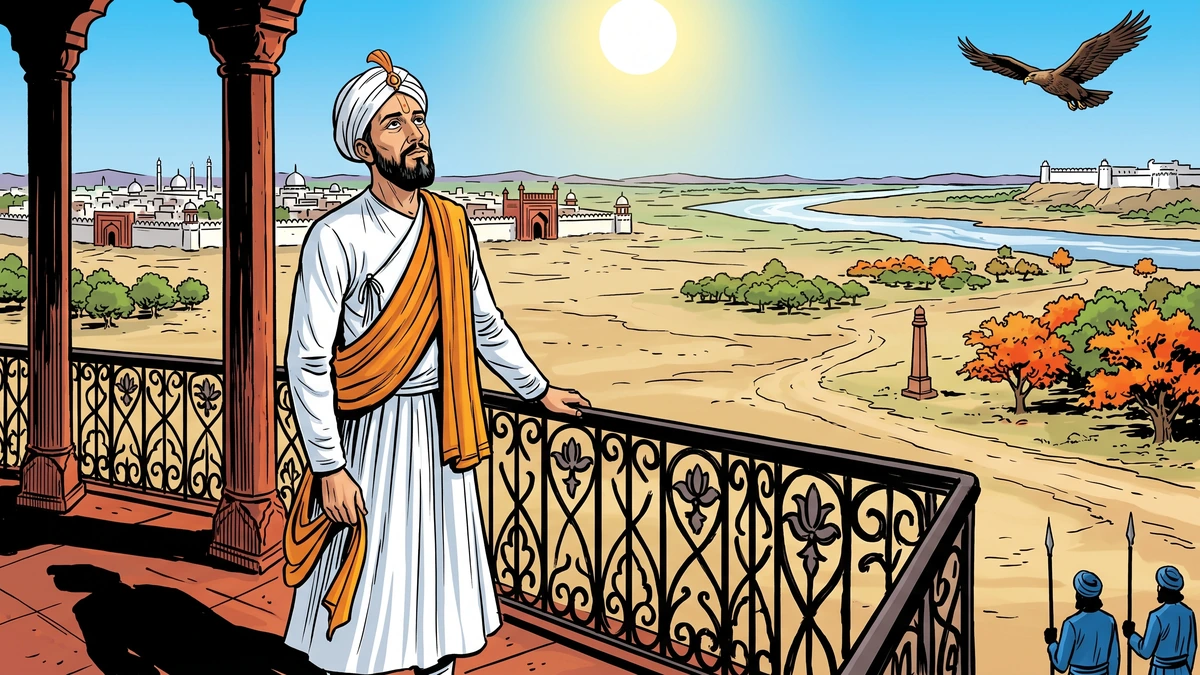
The guards hesitated; they had seen earlier accusers punished simply for speaking against this favourite. But Dhairya-Śīla, calm as river-stone, spared them: “I go with you gladly. It is for the master to command and for me to obey.” He walked to the tower under the high midday sun, head up, and let himself be left on the platform — open to the air, no roof, only the iron railing running round the edge and, far below, the ant-line of the road back to the city. The tale gives no measurement, but the height is the kind a Mughal watch-tower attained: forty to sixty cubits, a fall that admits no second thought.
Buddhi-Matī’s Errand and the Six Things She Bought
When the vizier did not come home that night, Buddhi-Matī wrapped her veil close and went out into the lanes. She did not cry; she listened. The Allahabad streets at dusk were full of the talk that always follows public cruelty — clusters of betel-stained mouths around the lamp-shops, sweepers leaning on their brooms, water-carriers with goatskin mussaks gossiping at the well-head — and from them she pieced the truth together. She made herself wait. Only at midnight, when the streets had emptied and the watchmen had withdrawn into their guard-rooms, did she slip out beyond the city wall, across the dust-flats, to the foot of the tower. In the starlight she could just see the form of her husband leaning over the iron railing.
“Is my dear lord still alive?” she whispered upward. “And is there anything I can do to help him?“
Dhairya-Śīla’s voice came down quiet and exact. He gave her, in a single breath, a list that reads — at first hearing — like the inventory of a magician: first, a beetle; second, sixty yards of the finest silken thread, as thin as a spider’s web; third, sixty yards of cotton thread, as thin as could be got but very strong; fourth, sixty yards of good stout twine; fifth, sixty yards of rope strong enough to carry his weight; and last, but not least, one drop of the purest bees’ honey. He would not tell her why. “I have no strength to waste in explanations,” he said. “Go home in peace, sleep well, and dream of me.”
Buddhi-Matī obeyed without a single question more. The next morning she walked through the bazaars of Allahabad — the silk-merchants near the Jhāwī ghāṭ, where the river-going women in indigo and saffron came to choose Banārasī silk woven on Mughal pattern; the cotton-yarn stalls under the awnings where the kapās from the Doab fields was spun on hand-takli spindles; the rope-makers’ courtyard where coir and san-hemp were twisted on long walking-frames — and bought silk so fine it had to be lifted in a pinch of fingers, cotton thread thin but tough, twine of triple ply, and a coil of best Doab rope. From a forest-honey-seller squatting beside a brass paṭalā tray of comb she bought a pinch of pure honey wrapped in a leaf-cup. And the beetle — that took longest. She walked among the henna and tulsi pots in her own back garden, looking for the right one. In the end she chose a strong-bodied, brilliantly-coloured fellow whose iridescent green-and-gold elytra caught the sun like beaten copper, and whom she had often seen sip honey from spilled drops on the verandah floor. He would do.
The Climb of the Beetle
At midnight she returned. The Allahabad sky over the Sangam was thick with stars, the river glittered in a thin silver line eastward, and the tower stood up against the south wind like a black exclamation. “All is still well with me,” Dhairya-Śīla called down softly from the platform. “I have slept well, feeling confident that my dear one would bring all that is needed for my safety. But I dread the heat of another day; we must lose no time. Now attend most carefully to all I bid you do, and remember not to speak loud, or the sentries within hearing will take alarm and drive you away.”
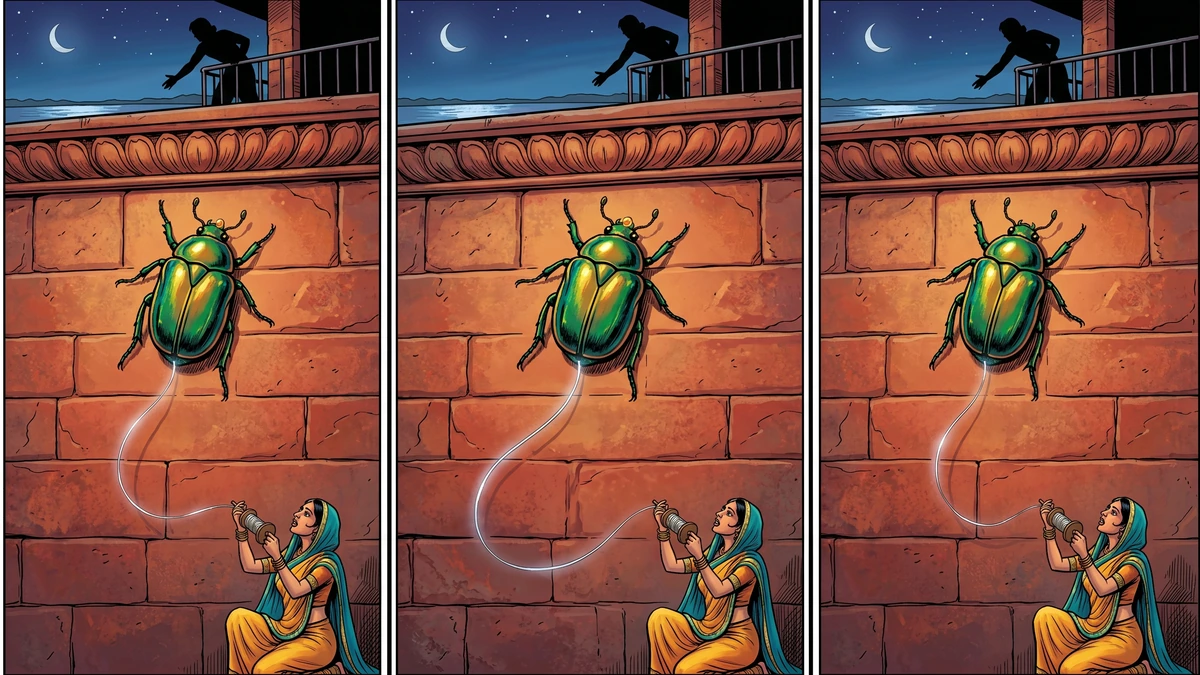
His instructions were a small marvel of practical engineering: “First, tie the end of the silken thread round the middle of the beetle, leaving all its legs quite free. Then rub the drop of honey on its nose, and put the little creature on the wall, with its nose turned upwards towards me. It will smell the honey, but will not guess that it carries it itself, and it will crawl upwards in the hope of getting to the hive from which that honey came. Keep the rest of the silk firmly held, and gradually unwind it as the beetle climbs up. Mind you do not let it slip — for my very life depends on that slight link with you.”
So Buddhi-Matī, with a hand that trembled but never let go, knotted the gossamer silk around the beetle’s middle, daubed honey on the iridescent forehead with the tip of her little finger, and set the creature against the cool sandstone of the tower’s wall, head pointing skyward. The beetle paused — antennae quivering — and then, drawn by the warm gold scent floating just beyond reach, began to climb.
It crawled steadily, a small dark gleam against the moon-pale stone, the hair-thin silk paying out behind it like the secret breath of a spider. Below, the wife’s hands shook — she was holding her husband’s life in a thread half the weight of an eyelash — but the silk did not catch, did not tangle, did not snap. The beetle climbed because beetles do not surrender. It did not know it carried anything; it knew only that the honey was always above and never quite reached. Somewhere over the height of two stories, then three, then four, the small messenger of life mounted the masonry, and at last came over the iron railing and onto the open platform where the vizier stood waiting.
Dhairya-Śīla took the beetle very gently in his palm, untied the silk from its body, and laid the small creature folded into a soft pleat of his turban. Then, drawing the silk up — slowly, slowly, never letting it tighten enough to break — he brought into his fingers the end of the cotton thread that Buddhi-Matī had knotted onto the silk’s other end. He wound the silk carefully and put it, too, into his turban — “It had done its duty well, and he would not throw it away.” The cotton he drew up next, hand over hand; then the twine; then, at last, the rope. He fastened one end of the rope to the iron railing and slid down the long sandstone face into the warm night air, into the arms of his trembling wife.
The Lie, the Eagle, and the Imperfect Triumph
What happens next is the moral cunning of the tale — its refusal of an easy ending. The husband and wife do not keep their secret out of pride; they keep it out of practical sense, because Sūrya Pratāp would not have forgiven a clever escape. They first kneel on the dust at the foot of the tower in the small hours and offer thanks to parameśvara — the great God who put the device into Dhairya-Śīla’s mind. They take the beetle back to its garden, find for it the food it loves, and lay it tenderly down where its old life can resume. Then, in the morning, the vizier walks calmly into the Rājā’s audience hall and tells him a lie.
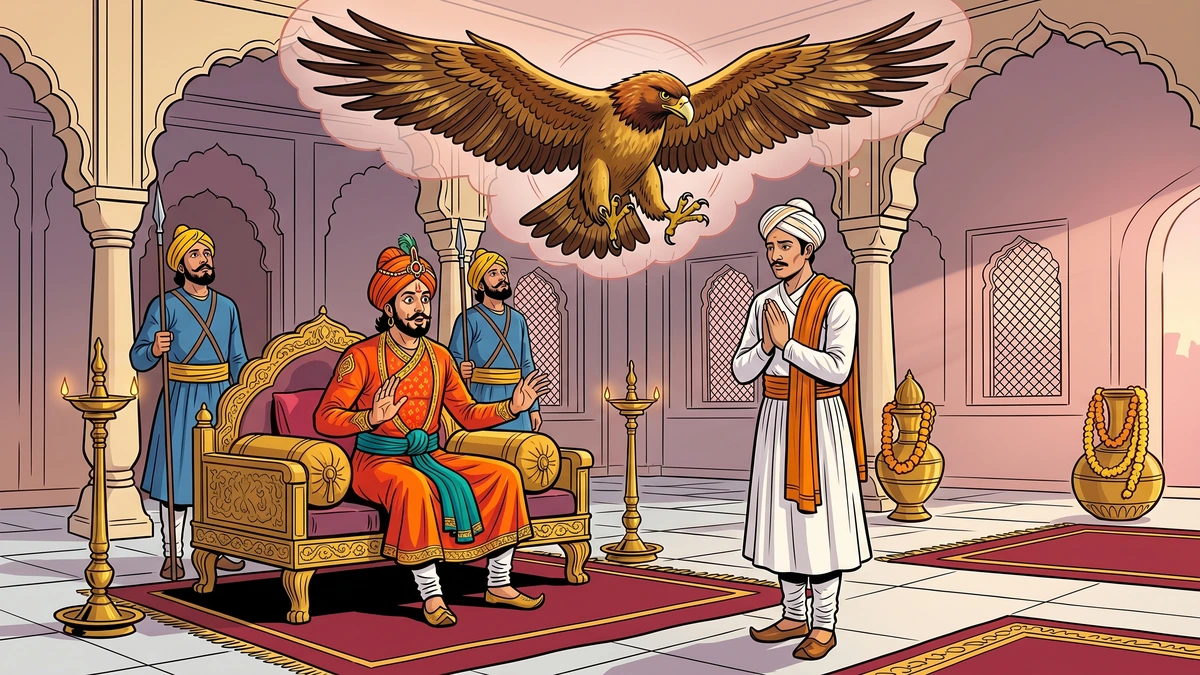
The lie is precise and elegant: “None of your subjects, great and just and glorious ruler, but the God who created us both, making you my master and me your humble servant. It was that God who saved me, knowing that I was indeed guiltless. I had not been long on the tower when help came to me in the form of a great and noble eagle, which appeared above me, hovering with outspread wings, as if about to swoop down and tear me limb from limb. I trembled greatly — but instead of harming me, the bird suddenly lifted me up in its talons and, flying rapidly through the air, landed me upon the balcony of my home and disappeared.” Sūrya Pratāp, hearing the word miracle, asked no further questions. He restored the vizier to office and never again imprisoned him; from that day forward Dhairya-Śīla was effectively the ruler of the kingdom, and at his death his son inherited the office.
But the storyteller does not let the vizier off easily. “He grew richer and richer, but he was never really happy again, remembering the lie he had told to the master to whom he owed so much.” Buddhi-Matī, the Sensible One, never understood the lie. She thought the truth was more wonderful: that a tiny beetle, baited with a drop of honey, had pulled the saving rope up the wall. She kept her promise of silence — but the secret leaked, as such secrets do, after long years, when Dhairya-Śīla was already too powerful to be touched. The tale ends with this small unfinished note of regret, refusing to flatter cleverness. The escape was a triumph; the lie that secured it was a wound the vizier never closed.
Moral and the Sanskrit Sense of Buddhi
The tale’s moral is double, and Hindu literature has carried both halves a long way. The first is the supremacy of buddhi over bala — the small, careful, patient mind over brute power. The wife’s name, Buddhi-Matī, says it plainly: she is the embodied principle that solves what the sword cannot. The Hitopadeśa, in its Mitralābha, puts the same proverb in its bluntest form:
बुद्धिर् यस्य बलं तस्य निर्बुद्धेस् तु कुतो बलम् — buddhir yasya balaṁ tasya nirbuddhes tu kuto balam
(“Whose intelligence is, his strength is; without intelligence, where is strength?”)
The Pañcatantra of Viṣṇu Śarman opens its third book with the same insistence — that armies of monkeys may be defeated by a single owl that has thought a few moves ahead — and the Mahābhārata’s Vidura-nīti (Udyoga-parva 35–40) reminds the king that buddhi ungoverned by patience is empty cunning, and patience without buddhi is sleep. The second half of the tale’s moral is the wound the lie leaves behind: even an escape achieved by ingenuity is shadowed, in Hindu ethics, by the asatya spoken to preserve it. The Manu-smṛti (IV.138) commands, in a famous half-verse: satyaṁ brūyāt priyaṁ brūyāt na brūyāt satyam apriyam — “speak truth, speak what is pleasing; do not speak truth that is unpleasing” — and the Mahābhārata’s Śānti-parva (162) extends this to a whole hierarchy of truth-telling. The vizier survives by violating that hierarchy, and the tale knows it.
Why the Tale Has Lasted
The Beetle and the Silken Thread has been told in Indian schoolrooms and on village charpoys for a hundred years and more because it does what only the strongest folk tales do: it makes the smallest possible thing the agent of liberation. There is no demon, no avatāra, no thunderbolt; there is a wife who buys silk by the yard, a husband who has thought clearly under the sun, and a beetle who climbs because honey is above. It is the geometry of patience — a thread doubled into cotton, doubled into twine, doubled into rope — drawn up the wall by something the size of a thumbnail. The Sanskrit imagination loved this proportion: the Bodhisattva once pulled the world out of fire as a quail (Vaṭṭaka Jātaka 35), once stopped a forest blaze as a hare (Sasa Jātaka 316), once ferried truth out of a tyrant’s tower as a beetle. In every retelling, the lesson is the same — that dhairya (patience) and buddhi (intellect) and the smallest helping creature can together undo what the biggest cruelty has done. Mitra and Bell, in 1919, wrote it down for English-speaking children; the Punjabi grandmothers, the Avadhi nurses, the Allahabad pandits had been telling it long before. It survives because it is true to a child’s first instinct about justice: that the powerful are not always strong, and the small are not always weak, and a single drop of honey, applied with care to the right small head, can outclimb a tower.
Sources: S. M. Mitra (translator) and Mrs. Arthur Bell / N. D’Anvers (adapter), Hindu Tales from the Sanskrit, Macmillan & Co., London, 1919, Tale VI, “The Beetle and the Silken Thread”; project Gutenberg ebook 11310. Aarne–Thompson–Uther index ATU 967, ATU 875; Stith Thompson Motif-Index R211.4, R215, B481.3, K640, H561.6, J1117, P14.15.2. Comparative parallels: Hitopadeśa, Mitralābha (proverb buddhir yasya balaṁ tasya); Pañcatantra III, Kākolūkīyam; Mahābhārata, Vidura-nīti (Udyoga-parva 35–40), Śānti-parva 162; Manu-smṛti IV.138; Tūṭī-Nāmā of Ziyā’ al-Dīn Nakhshabī, c. 1330; Vaṭṭaka Jātaka 35, Sasa Jātaka 316. Setting: Allahabad / Prayāga, Akbar’s fort (1583), Triveṇī Saṅgam, Mughal–Awadh era.
You May Also Like
 Indian Folk Tales
All Ages
Indian Folk Tales
All Ages
The King Who Would See Paradise
The King Who Would See Paradise: Once upon a time there was king who, one day out hunting, came upon a fakeer in a lonely place in the mountains. The fakeer
 Indian Folk Tales
Ages 9-12
Indian Folk Tales
Ages 9-12
Her Childhood
A blue-eyed village girl who lives in books meets a songbird — then an empty nest — and learns that what we love may leave while love itself remains. Full unique literary short.
 Indian Folk Tales
Ages 3-5
Indian Folk Tales
Ages 3-5
Raṇavîrasiṅg
Raṇavîrasiṅg: Once upon a time in the town of Vañjaimânagar there ruled a king, named Śivâchâr, under whom peace and prosperity reigned throughout the land.