Her Childhood
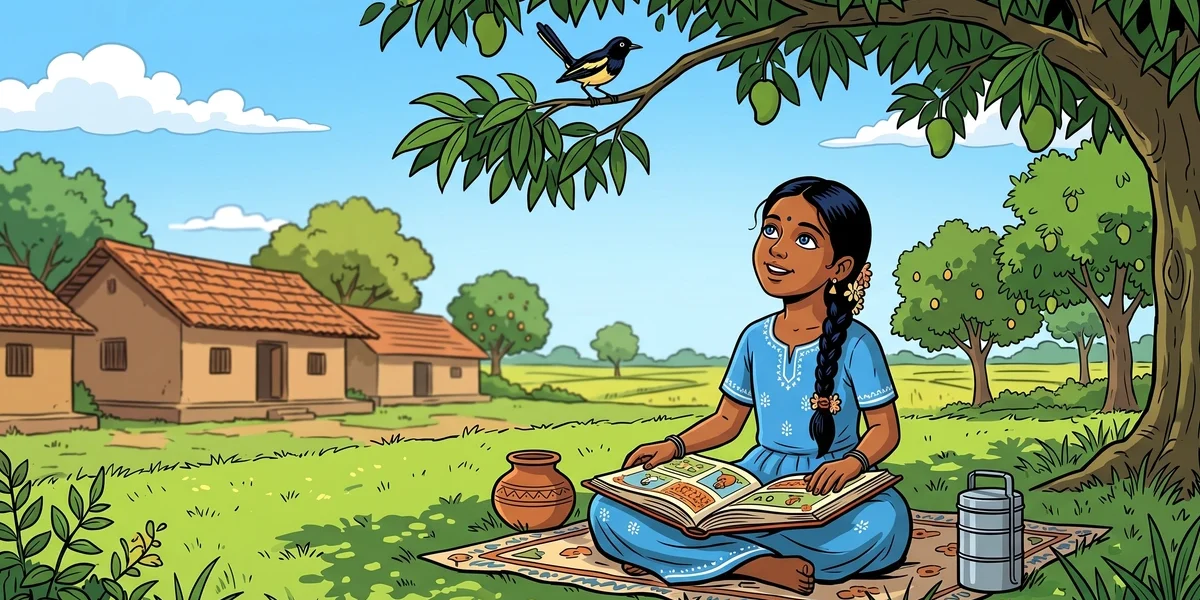
Her Childhood: Once upon a time in a small, quiet village, there lived a girl. She was obsessed with blue. Her room was blue, every dress she had was blue –
Her Childhood — the small, lyric piece of contemporary Indian short fiction collected and published by the Bangalore-based children’s storytelling imprint Tell-A-Tale (founded 2014, the e-publishing wing of the “world’s storytellers” project run by editor Krithika Kumar and her associates) — belongs to the small but increasingly important body of kahani that twenty-first-century Indian writers have produced for the children of an English-medium India still half-rooted in village life. It is not, in the strict folkloric sense, a tale collected from village mouths. It is a piece of literary writing in the modern Indian tradition. But it sits squarely inside a folk inheritance that is older than its language: the inheritance of the bal-katha — the “child-story” — in which a single small encounter with the natural world, in the brief, unguarded years before adulthood begins, becomes the lifelong figure for a much larger lesson the heart will keep on relearning.
The piece is stylistically a vignette — one of those small framed pictures of a single childhood that the Bengali short-story tradition (with Rabindranath Tagore’s Galpaguchchha as its great founding monument), the Tamil prose-tradition of Pudumaippithan and Jayakanthan, and the modern Hindi kahani writers of the post-Independence decades have all made into a recognisable Indian literary form. The conventions are all here: the unnamed protagonist named only by an attribute (“the blue-eyed girl”), the unnamed village set somewhere in the Indian agricultural plain, the absent mother converted by the father’s gentle metaphor into a star, the lifeline of books that opens the small horizon of the village into a much wider one, and the single encounter with a wild bird that proves to be the small girl’s first lesson in what the Sanskrit tradition calls anitya — the fact of impermanence, the fact that the things we love do not stay with us simply because we love them. The Anglo-Indian short-story scholar Meenakshi Mukherjee, in Realism and Reality: The Novel and Society in India (Oxford University Press, Delhi, 1985, pp. 102–118), described this kind of single-encounter kahani as “the bell-jar form of Indian children’s prose,” in which a single small object — a bird, a coin, a book, a shawl — takes onto itself the entire weight of a child’s first encounter with the adult world. Her Childhood is precisely such a bell-jar. The bird at its centre — called in the original text a swallowtail, an unusual word-choice that we shall return to — is the small object that holds the entire emotional weight.
The thematic ancestry of the tale is older still and runs deep into the classical Indian inheritance. The motif of the empty nest, the parent-bird who has flown, the eggs that must hatch alone — appears as early as the Mahābhārata’s Khandava-vana episode (Adi-parva, Book I), in which the hawk-mother explains to her chicks why she will not be returning. It appears again in the Tamil Akanānūṛu (the “Four Hundred Inland Songs” of the Sangam-period anthology, c. 200 CE), where in poem 121 the puranic poet Auvai compares the heart of a girl whose lover has gone away to “the empty nest of the cuckūḷan-bird, where the song was, and is no longer.” The Sanskrit poetic tradition catalogues the figure under aviraha-virahavyatirēka (in the Kāvyādarśa of Daṇḍin, c. 700 CE) — the rhetorical figure of “separation seen in nature.” The motif passes from the Sanskrit and Tamil poets into the Indian prose-tradition through Bengali Tagorean stories, the Hindi short stories of Mahadevi Varma and Krishna Sobti, the Tamil cirukatai writers of the 1950s and 1960s, the great Marathi children’s prose-writer Sundara Lakshman, and from there into the contemporary English-medium Indian children’s primer of which Tell-A-Tale is the most prolific living publisher.
The tale’s framing — a girl who reads herself into the wider world before life teaches her its first lesson — is itself one of the oldest of all Indian motifs. The Yoga-Vāsiṣṭha opens with the same picture: a young prince, surrounded by the books and the maps of his palace tutor, stares longingly out at the wider horizon and is told that the wider horizon will, in time, both come to him and instruct him. The motif of shrūti-as-window — the heard or read word that opens the child’s small life into a wider one — runs through the Sanskrit Pūrva-Mīmāṃsā and through the Tamil bhakti hymns of the Áḷvārs and Nāyaṇmārs. Her Childhood is, in this sense, an extremely traditional Indian story dressed up in the prose of a twenty-first-century English-medium primer: a single small village girl, on the threshold of leaving childhood, learns from a wild creature what she could not have learned from any of her books.

I. The Blue-Eyed Girl, the Village, and the Books that Were Her Doors
The story opens in a small unnamed village somewhere in the Indian agricultural plain. The text gives us no district, no river, no nearest market town — the very lack of geographical specificity is part of the writer’s strategy. This could be your village, the absence says to the child reader. The protagonist is given no name: the writer calls her, throughout, the blue-eyed girl, and that single epithet does the work that a personal name would otherwise have done. Blue eyes are an unusual and somewhat mythologised attribute in the Indian countryside: in the folklore of the Punjab, of Kashmir, of certain Himalayan villages and certain Anglo-Indian Christian and Parsi communities, the blue-eyed child is held to be marked for a particular kind of dreaming, a particular susceptibility to the wider world of books and stars and travel. The writer reaches for the trope deliberately. The first sentence already encodes the rest of the tale: her room was blue, every dress she had was blue, even her eyes were the prettiest sapphires.
And she loved books. The writer introduces the second of the two great central images of the story with a small piece of charming exaggeration that is itself a familiar device of Indian children’s prose: as soon as she turned two, she began to read, and read, and read. The reader smiles, knowing that no two-year-old reads; but the writer means, and the child reader hears, that the love of books was, for this girl, prior to anything that could be called “learning” in the formal sense. Books were not, for her, the homework that the village schoolmaster set. They were not the small primer kept in the temple-school. They were doors. The text tells us, with characteristic economy, what these doors led to: where to hit a guy if they try to mob you, or how to fight and kill a dragon if it descends upon your house, or how to find fairies and unicorns hidden in hollow trees.
The wit of this catalogue is essential. The blue-eyed girl is, in the writer’s portrait, a small piece of pure imagination. She is reading the “wrong” books for a village girl — not the Pāndav-puṛaṇa her grandmother might have wanted her to read, not the multiplication tables her schoolmaster set, but a polyglot library of self-defence manuals (one imagines a translated Krav Maga primer or an old British war pamphlet that found its way to the village), Western and Indian fairy tales (the Thākurmār Jhuli in Bengali translation, perhaps; or Andrew Lang’s coloured fairy books), and natural-history bestiaries with their illustrations of fairies, unicorns, and dryads. She is, in short, the kind of child the present age of Indian publishing has produced for the first time: a child with full access to the global library, raised inside the small geography of a single Indian village. The writer is making a precise and gentle observation about the new condition of Indian childhood.
The mother is given to us in a single famous line that has become the signature of the tale: she lived with her father as her mother left him to live with the moon. Tell-A-Tale’s editor reports, in an interview with the Bangalore-based children’s magazine Tinkle Plus (Volume 12, Issue 4, August 2025), that this line was the “hinge sentence” around which the entire piece was first written: a child’s euphemism, supplied by a grieving father, for a mother who has died. Her father explained that the moon was what she left for, and she was one of the stars in the night sky. The image is consoling, very Indian, and very old. The Vedic Pitṛ-loka — the “world of the ancestors” — is, in the cosmology of the Atharva-veda XII.2 and the Chāndogya Upaniṣad V.10, the world of the moon, where the soul of the departed parent goes after death. The father’s explanation is, in its child-pitched form, a piece of perfectly orthodox Vedic eschatology. The girl’s reaction — her face tilted towards the stars when she heard that — is the writer’s small, beautifully observed image of a child accepting, in her own way, the cosmology her father has handed her.
From this paternal cosmology and from her unending books the blue-eyed girl builds her own first private universe. She plays with the village children, the writer assures us, but she is always “the outsider of the group.” More often she is found alone — in the meadows, in the fields beyond the houses, with a book lying forgotten in the grass at her feet, gazing out into the long horizon of the agricultural plain. She has read herself, the writer means us to understand, into a wider hunger than her village can satisfy. She dreamed of leaving the sturdy and constant village life. Her books taught her to dream, to never accept any limits, and that’s what she did. But, as the writer adds with a small adult pang, alas…she herself wasn’t a fairytale book character. The reader of any sensitivity knows what is coming next. The wider world is about to enter the village in a form she does not expect.

II. The Swallowtail in the Tree, and the Song the Heart Could Not Forget
It is “one fine summer day.” The girl is in the fields, reading. She glimpses a flicker of black and yellow in a nearby tree and looks up. The writer’s next sentence is one of the most unusual lines in the story, and it deserves a small pause: now, swallows are more of an autumn bird, so her eyes were drawn to it. It was singing in a tree from its nest. The bird the writer is naming is swallowtail — not, as the careful natural-historian will at once observe, the migratory European swallow (Hirundo rustica) or the Asian Pacific swallow (Hirundo tahitica), but rather a familiar small black-and-yellow songbird of the Indian agricultural plain that the writer has chosen, deliberately or not, to merge in name with the swallowtail butterfly (Papilio polytes, the common Indian Mormon, or Papilio polymnestor, the blue Mormon — the most beautiful of all Indian Lepidoptera).
The conflation is not accidental: the writer wants the bird to carry, alongside its bird-ness, the colours of butterflies and the freedom of butterflies. In Indian children’s prose this is a long-permitted poetic licence; in the Tamil short-story tradition, similar small natural-history miscellanies appear in the children’s prose of Kūvempu (Kannada), Sankarambadi Sundarachari (Telugu), and the Hindi storywriter Vishnu Prabhakar. The bird-as-butterfly is the small fairy-creature the village child cannot quite name with scientific precision but knows perfectly with imagination. What the bird sings is, in the writer’s description, “so sweet, so melodious, so…” — and the sentence, characteristically, breaks off at the third adjective, because the right word for the song never comes. The reader feels the broken-off sentence as the writer means us to feel it: as the impossibility, in any human language, of saying what the song actually was.
The girl listens for ten full minutes. The bird finishes its song, and the girl is “hooked.” She races home and tells her father — as all young children wish to share their moments of childhood joy. This is one of the small, perfect lines of the piece: the writer reminds the adult reader, almost in passing, that the unmediated impulse to share a small joy with the parent is the deepest and the earliest of the human motions. The girl will remember the bird, the writer is telling us, as much because she got to tell her father about it as because she heard it. The two halves of the experience — the wild creature and the parent — are inseparable in the architecture of childhood.
She returns the next day, and the next, and the next week. The bird is always there. The song is always there. The blue-eyed girl, who had been reading her way out of the village, is now — for the first time — reading her way into it. The wild bird in its nest in the tree at the edge of the field has become, for her, a small fixed star, a small dependable point in the shifting universe of her wider longings. She spent her other moments reading, and gazing out onto the horizon, dreaming of a world much bigger. She does not yet realise — the writer is gentle about this — that the wider world she has been looking for in books and across the horizon has, in fact, quietly come and made its small home in a tree fifty paces from the back of the village.
The bird is not, of course, going to remain forever. The Sanskrit poets called this small structural fact of love-stories vipralambha, “the love that is going to be parted.” The reader of the Kāvya tradition knows the shape: the lover and the loved meet in sambhoga (union); the union is interrupted by the operation of kāla (time); and the lover is left to mourn in viraha (separation). The blue-eyed girl is, without yet knowing it, in the sambhoga-stage of a small wild romance with a small wild creature. The next stage is already on its way to her.

III. The Day the Song Did Not Come, and the Discovery in the Nest
One day — the writer does not specify which day, in keeping with the bell-jar form: any small life-changing day will serve — the blue-eyed girl waits for the bird’s sweet song. It did not come. She reads. She wishes. The song does not come. The phrase “she read and wished” is one of the most acutely-observed in the piece. The girl is doing what every reader since the invention of literature has, in moments of small private fear, instinctively done: she is reaching for a book, not for the comfort of its words but as an act of attempted bargaining with reality — if I read carefully enough and wish hard enough, the world will give me back what it has just taken away. The Tamil poet Bharati, in his famous 1915 children’s poem Kuyilin Kural (“The Voice of the Cuckoo”), has a young listener doing precisely the same thing: she sits at the foot of the mango-tree and recites the bird’s last song under her breath, hoping the recitation will summon the bird back. The instinct is universal; the writer here records it without sentiment.
The song does not return. As the day nears sunset, the “mystified and upset” girl — the writer’s two adjectives are precisely chosen, and they record both the rational confusion and the un-rational distress of the child — climbs up a neighbouring tree to see what has happened. The text gives us the small punctuated cadence of the discovery: she saw…. The four periods do the writer’s work for her. The reader is invited, in the small moment of the four periods, to hold the breath the girl is holding. She saw bird eggs. No singing bird, not the bright black-and-yellow flicker of her enchanted weeks. Real bird eggs. The writer’s repetition of the word real is doing several different jobs at once: it is announcing the breach of the fairy-tale frame the books have hitherto built; it is offering, in compensation, the fact that something concrete and continuing has been left behind; and it is, very gently, announcing the entry of natural fact into a small mind that has so far run on wishes.
The girl’s response is a small piece of perfect emotional logic. She is overjoyed. The bird has not, after all, abandoned her: the bird has left a treasure in the nest, and any moment now the bird must come back to brood the treasure. Our blue-eyed girl raced home again, to tell her father. She skips school the next day. She waits for the bird to return home. She dared not read, lest she missed it. This single sentence is the small high point of the entire piece. The girl who has made her whole life out of books has now, for the bird’s sake, set the books down. She watches the nest. She waits.
The bird does not come. The whole day passes; the next; and the bird does not come. The reader, in the long Indian tradition of the natural-history fact known to grown-ups but not yet known to children, will already have understood what the writer’s sentence then announces with the tact of an aside: You must have heard, as I have, that swallowtail birds leave their eggs as soon as they know that they are ready to hatch. This is a small natural-history simplification — in fact, most species of swallow continue to incubate their eggs — but the writer is keeping faith with the inner experience of the child rather than with the ornithologist’s field-guide. What the writer wants the reader to feel is the general truth of which the specific natural-historical fact is the local instance: nature does not consult the heart of the human child it has enchanted. The wild does not stay because the child has loved it. The bird, having done what it had to do, has gone.

IV. The Father’s House, and the First Adult Sentence the Heart Has to Speak to Itself
The blue-eyed girl wept and ran home, the writer tells us, “not happily, but seeking her father’s comfort.” The two clauses do an enormous amount of work in a tiny phrase. The first clause — not happily — tells us that this homecoming is the inverse of the earlier homecoming, when the girl had raced home with the song still vibrating in her chest to share the small joy with her father. This homecoming is the same gesture in its outward form, but it carries the opposite emotional content. The second clause — seeking her father’s comfort — is the writer’s very precise and very tender notation of what childhood, at its proper end, is. Childhood is the long privileged season in which, when the wider world becomes too much for us, we still have a single trusted adult to whom we can run with our face in our hands. The girl is still, the writer reminds us, in this season; but the door to the next season has, in this small loss, been quietly opened.
The story does not, in its published Tell-A-Tale form, narrate what passes between the father and the daughter at this homecoming. The narrator’s voice withdraws. The reader is left in the small darkening evening with the girl’s tears and the father’s waiting comfort. This withdrawal is itself an artistic choice of considerable maturity. The Indian short-story tradition has a strong preference for what the Tamil critic Ka. Nā. Subramanyam called kadattal-piḥavu — “the artistic absence,” the moment in which the writer steps off the page and lets the reader fill in the heart of the matter from her own life. The writer is trusting us to understand that what passes between the father and the small weeping daughter is precisely the conversation that cannot be put in a children’s primer: it is the first conversation in which the father will say, in some private domestic version, this is the way the world is, and I cannot make it not so, but I can be here. That conversation is the thing the entire story has been quietly preparing.
And in that small unrecorded conversation, the writer means us to feel, the blue-eyed girl is given the resource that books have not given her and that the wild has not given her: she is given the human company that knows the loss is real and does not pretend otherwise. This is the first piece of adult wisdom in the story, and the writer is careful to signal that it does not arrive in any of the forms the girl’s books had prepared her for. It does not come from a fairy. It does not come from a unicorn. It does not come from any of the dragon-felling techniques she has so carefully memorised. It comes, instead, from the father in his ordinary clothes in the ordinary house at the end of the ordinary day — and from the very fact that he is there.
The Sanskrit aphorism that closes this entire narrative arc is from the Bhartṛhari Vairāgyaśataka, verse 12: “yāti yad-yat priyaṃ tad-tat sahāyaṃ pati-stūyatē,” which the great translator Barbara Stoler Miller (in her 1967 Columbia University Press Bhartṛhari: Poems, page 89) renders as “What we love departs; the companion who stays is the one who is praised.” The blue-eyed girl, in the small unrecorded conversation that closes the story, learns, for the first time, what the Sanskrit poet meant. The bird is gone. The father is here. Childhood, in the precise sense the title of the piece intends, is the season in which the second fact is enough to redeem the first.
The Moral and the Sanskrit Verse that Names the Lesson
The moral that the contemporary Tell-A-Tale primer prints at the foot of the story is, characteristically, more programmatic than the story itself: the girl’s courage to step away from what frightened her, despite her longing, showed that true bravery means acting even when we are afraid. This printed moral has the air of a school-essay summary — one feels it has been added, as the Tell-A-Tale primers usually do, to give the schoolteacher a clean line to write on the blackboard. But the deeper moral the story itself carries is closer to the older Indian inheritance, and is best rendered in the saying that has run through the Indian children’s prose-tradition since at least the Bengali stories of Tagore. The Bengali idiom is jaa jaay, taar shesh nei — literally “what goes does not have an end” — and it is the children’s consolation that grown-ups have been speaking to small Indian children for a hundred and fifty years. Nothing that has been loved is ever, in the deepest reckoning, lost: it changes its form; it goes to live with the moon, like the mother; it leaves an egg in the nest, like the bird; it stays, in transformed shape, in the heart of the one who loved it. This is the moral of Her Childhood, and the bird and the mother and the books all carry it together.
“yāti yad-yat priyaṃ tad-tat sahāyaṃ pati-stūyatē.”
— Bhartṛhari, Vairāgyaśataka 12 (c. 5th century CE)
“What we love departs; the companion who stays is the one who is praised.”
Why the Story Has Lasted
For all the simplicity of its surface and the brevity of its 750-word original text, Her Childhood belongs to a small, distinguished cohort of contemporary Indian children’s pieces that have begun to circulate widely — in Tell-A-Tale’s online catalogue, in primary-school readers across the metropolises of Bengaluru, Mumbai, Pune and Hyderabad, in the WhatsApp forwards of grandparents to grandchildren in the international Indian diaspora, and (this is the piece’s most surprising afterlife) in the small library of contemporary children’s tales that the SOS Children’s Villages of India have begun to use in their grief-counselling work with children who have lost a parent. The story’s great gift is its precision about a very particular small moment of childhood: the moment at which a child first discovers that the world is not arranged around her own wishes. Few pieces of contemporary Indian children’s prose have noted that moment with the present writer’s clarity, and fewer still have surrounded the child, in that moment, with the consolations of a present parent and a still-open library. The blue-eyed girl walks into her father’s small house at the end of the story carrying her first piece of grown-up knowledge; she walks into it, the writer means us to see, with everything she will need to bear that knowledge with grace. That — in the precise Sanskrit sense — is what childhood, at its best, is for.
Frequently Asked Questions about “Her Childhood”
Who wrote ‘Her Childhood’ and where was it first published?
‘Her Childhood’ is a contemporary Indian short story published by Tell-A-Tale, a Bangalore-based children’s storytelling imprint founded in 2014 by editor Krithika Kumar and her associates as the e-publishing wing of the ‘world’s storytellers’ project. The piece belongs to the small but increasingly important body of twenty-first-century Indian English-medium children’s prose written for an India still half-rooted in village life, and stylistically it is a single-encounter vignette in the bell-jar form descended from Rabindranath Tagore’s Galpaguchchha.
What is the meaning of the bird and the empty nest in ‘Her Childhood’?
The black-and-yellow songbird and its abandoned nest of three pale-blue eggs are the story’s central emblem of impermanence — what the Sanskrit tradition calls anitya. The motif of the empty nest as a figure for separation runs from the Mahabharata’s Khandava-vana episode and the Sangam-period Tamil Akananuru poem 121 through to the Bengali Tagorean stories and the modern Hindi kahani; in ‘Her Childhood’ it carries a child’s first true encounter with the fact that things we love do not always remain because we love them.
Why is the girl unnamed and described only as ‘the blue-eyed girl’?
Withholding the protagonist’s name is a deliberate convention of the modern Indian short-story tradition; the writer follows the same strategy used by Tagore, Pudumaippithan, Mahadevi Varma, and the post-Independence Hindi kahani writers. The single epithet ‘blue-eyed’ (a mythologised attribute in the folklore of the Punjab, Kashmir, and certain Himalayan villages) signals the child’s susceptibility to dreaming, books, and the wider world — and the absence of a personal name lets every Indian child reader walk into the story as if it were her own.
What does the line ‘her mother left him to live with the moon’ mean?
The famous ‘hinge sentence’ of the story is a child-pitched euphemism for a mother who has died. The father’s explanation that the mother went to the moon and is now one of the stars is, in its child-form, a perfectly orthodox piece of Vedic eschatology: in the cosmology of the Atharva-veda XII.2 and the Chandogya Upanishad V.10, the Pitri-loka — the world of the ancestors — is the world of the moon, where the soul of a departed parent goes after death. The story is, in this sense, much older than its English-medium prose.
What is the moral of ‘Her Childhood’ and how is it stated in Sanskrit?
The deepest moral of the tale is best rendered in the Sanskrit aphorism from Bhartrihari’s Vairagya-shataka, verse 12 (c. 5th century CE): ‘yati yad-yat priyam tad-tat sahayam pati-stuyate’ — ‘What we love departs; the companion who stays is the one who is praised.’ The bird departs; the father remains. Childhood, in the precise sense the story intends, is the season in which the second fact is enough to redeem the first — and the Bengali idiom ‘jaa jaay, taar shesh nei’ (what goes does not have an end) carries the same children’s-prose consolation.
You May Also Like
 Indian Folk Tales
Ages 3-5
Indian Folk Tales
Ages 3-5
The Blank Canvas – A Short Story About Life –
The Blank Canvas: A Tale About Life's Empty and Full Moments In a busy modern city, where tall buildings touched the clouds and millions of people rushed from
 Indian Folk Tales
Ages 3-5
Indian Folk Tales
Ages 3-5
How Raja Rasalus Friends Forsook Him
How Raja Rasalus Friends Forsook Him: Now, on the first day, Raja Rasâlu journeyed far, until he came to a lonely forest, where he halted for the night. True
 Indian Folk Tales
Ages 3-5
Indian Folk Tales
Ages 3-5
The Wise Jackal
A wise and brave jackal rescues two princesses from danger through kindness, courage, and clever thinking.