Brahma’s Wife and the Mongoose
Brahma's Wife and the Mongoose: Long ago, there lived a Brahman and his wife who had a pet mongoose. The mongoose was loyal and gentle, and the couple treated
Brahma’s Wife and the Mongoose — properly The Brahmin’s Wife and the Mongoose, a folk-spelling variant where Brāhma stands for Brāhmaṇa, a household priest, not the creator god — is one of the most widely travelled tales the world has ever produced. It is the Indian fountainhead of the international story-type Aarne–Thompson–Uther ATU 178A, “Llewelyn and his Dog,” better known in folklore studies as The Faithful Animal Rashly Killed. Its earliest secure attestation is in the lost Sanskrit Pañcatantra of Viṣṇu Śarman (c. 200 BCE–300 CE), where it appears in Book V, Aparīkṣita-kāraka (“Action Without Examination”), reconstructed by Franklin Edgerton in The Pañchatantra Reconstructed (American Oriental Society, 1924).
From that single Sanskrit beginning the tale walked outward in every direction across two thousand years: into the Pali Jātaka orbit; into the Hitopadeśa of Nārāyaṇa Paṇḍita; into Somadeva’s Kathāsaritsāgara (“Ocean of the Streams of Story,” eleventh century, Kashmir); into Pahlavi as Kārīrak ud Damanak through the physician Burzoy at the court of Khusraw I Anūśirvān (~570 CE); into Arabic in Ibn al-Muqaffa‘s immortal Kalīla wa Dimna (c. 750 CE); into Hebrew via Rabbi Joel (~1250); into Latin as John of Capua’s Directorium humanae vitae (~1270); into the medieval European Seven Sages of Rome cycle and Dolopathos, where the mongoose becomes a faithful greyhound; and from there into the Welsh legend of Gelert and Llywelyn the Great at Beddgelert and the cult of the dog-saint Guinefort recorded by the Dominican Stephen of Bourbon (c. 1250). The Sanskrit philologist Murray B. Emeneau (1940) called this migration “one of the best authenticated cases of such diffusions of folk-tales.”
It is, in other words, a story about hasty judgement that survived three thousand miles, a dozen languages, and twenty centuries by being indistinguishable from heartbreak. Stith Thompson catalogues its essential motif as B331.2 — Llewelyn and his dog: faithful animal rashly killed — with cross-references to K2151 (the bloody mouth as false witness), N342.3 (rash slayer kills helper), and J2161 (foolish accusation). The Pañcatantra Book V in which it sits is the book of warnings against rashness; its frame-tale concerns four Brahmin youths who fail through hurry, and the inset stories — the barber who imitates jewellers, the merchant who killed his guest, the snake-killing weasel — are arranged so that this one strikes hardest of all, because the loss is not gold or honour but love.
I. The Childless House and the Forest Gift
In the village of Pratishṭhānapura, on a curve of the river Vāhinī under the white temples of Śiva, there lived a Brahmin named Devasharmā with his wife, Yājñasenī. Their house had a small courtyard of beaten earth, a brass kalaśa water-pot at the door, a tulasī plant tended every morning, and a roof of palm-fronds that whispered when the monsoon came. They were poor but they were learned; the husband chanted the morning sandhyā and the wife knew the Lalitā-sahaśranāma by heart. For years they had only one trouble, and it was the kind that has no remedy in any śāstra: their cradle stood empty.
Then, in the autumn of their middle years, a son was born. Yājñasenī called him Kumāra — simply “the boy” — because no other name seemed real after so much waiting. She fed him with a finger dipped in honey and gold, as the tradition prescribes; her husband distributed sweets to the entire street; the temple priests were given a cow. The wooden cradle which had stood blank for a decade now creaked all night under a small sleeping weight, and the sound was the music of the house.
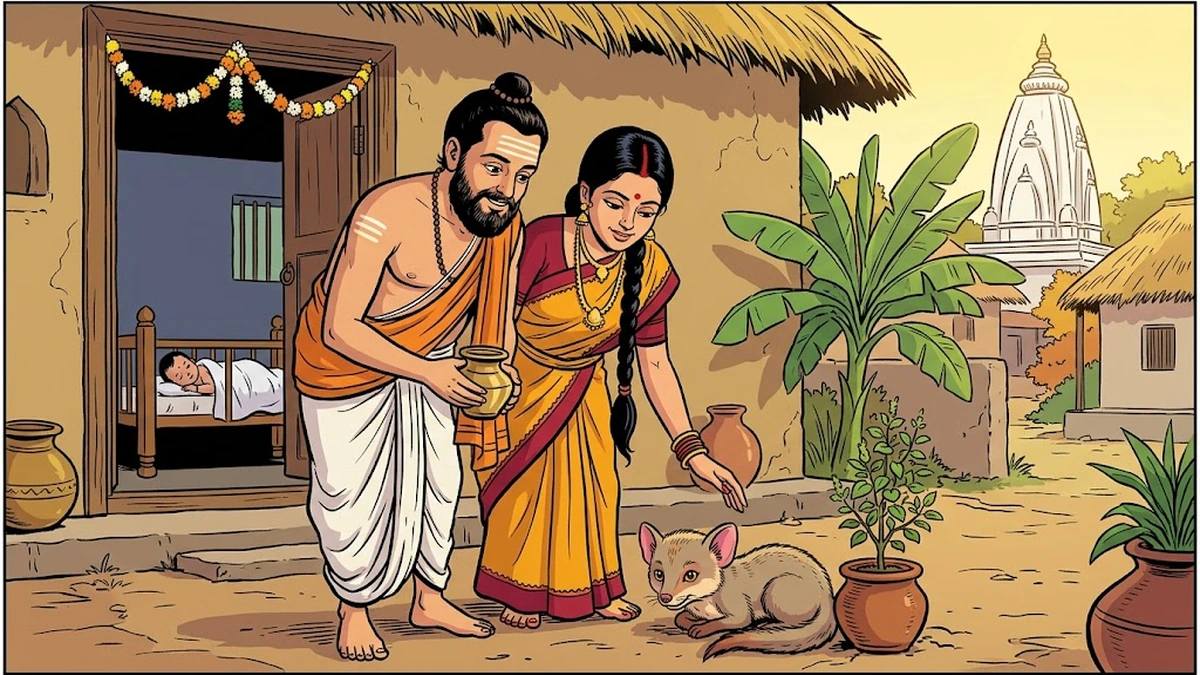
One morning the wife came back from the well and found, curled against the tulasī pot in her courtyard, a young nakula — a grey-and-cinnamon Indian mongoose, Herpestes edwardsii, no bigger than a folded shawl, with a sharp pink nose and amber eyes and the pointed ear-tufts of an animal that has not yet learned fear. Its mother, she guessed, had been killed in the cane-fields. The little creature looked at her without flinching, as if it had decided. Devasharmā said, when he came home, “A nakula in the house is auspicious. The sāstā says it is the great enemy of serpents. Let him stay; he will be the brother of our son.”
And so two children grew together that year in the priest’s house. The mongoose followed Kumāra everywhere on his rolled mat. When the baby cried, the nakula squeaked. When the baby slept, the nakula slept curled at the foot of the cradle with one paw against the wooden rim, like a hand on a shoulder. Yājñasenī sometimes spoke to it as if it understood, and was never sure that it did not.
II. The Errand and the Empty House
One bright morning of the month of Kārttika, when the marigolds were heavy along every doorway and the river was running clear after the last rains, a messenger came from the temple. The chief priest had taken to his bed; Devasharmā was needed to lead the noon pūjā at the Śiva shrine across the water. He went without his wife — the ritual required only one Brahmin — and Yājñasenī remained behind to nurse the child and prepare the household offerings.
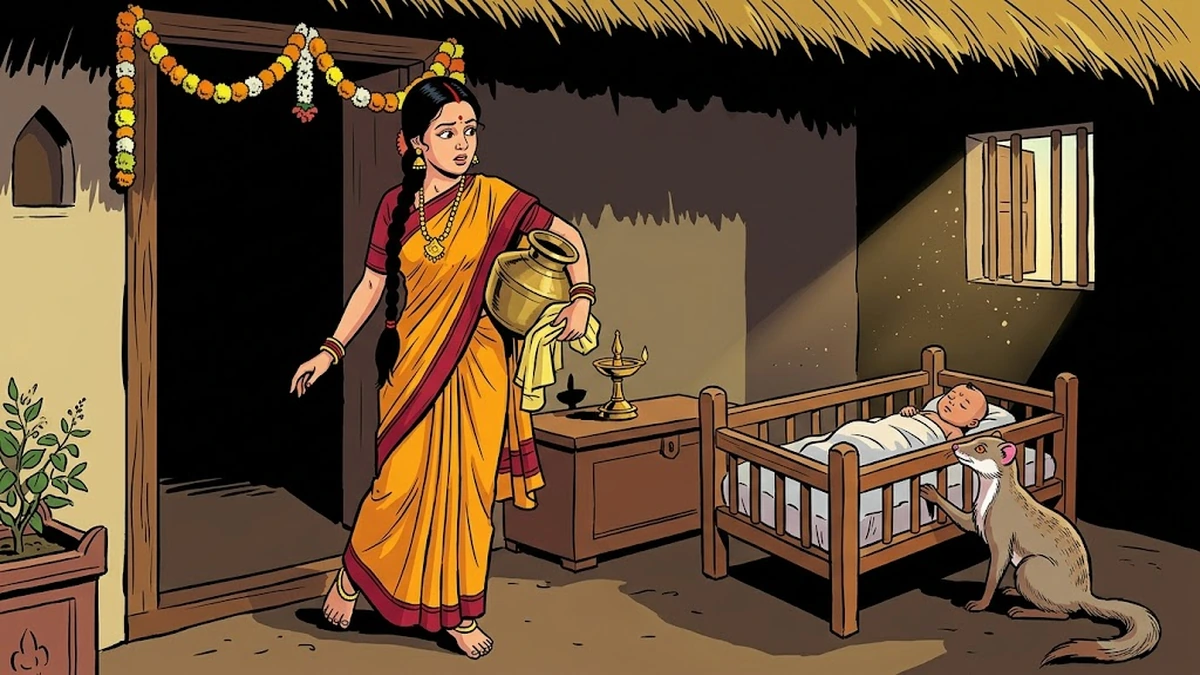
By mid-morning the house was hot. The brass water-pot at the threshold had been emptied to wash the morning rice. Yājñasenī needed water for the noon ritual, and the well was a long furlong down the lane, past the banyan and the cremation-ground. She tied a yellow cotton head-cloth, lifted the empty kalaśa on her hip, and stepped to the cradle. The baby was asleep, breathing the slow sweet breath of the very young. The mongoose was alert at the cradle’s foot, head up, eyes following her.
“Watch over him until I return,” she said. She had said it a hundred times before, and it had never until that moment frightened her. But on this morning some unease moved through her like a sudden draught of cold from an opened door, so that even after she had stepped into the lane she stopped twice to look back. The house gave nothing back. She told herself she was a foolish mother and walked on.
The lane was empty. She drew water from the well slowly, talking to the carpenter’s wife about the price of red lentils, and walked back through the same midday haze, with the kalaśa on her hip and the wet smell of the river in the cloth of her sari. She was perhaps fifteen minutes gone in all. Fifteen minutes can be a small time, the books say; it can also be enough time for a black king cobra, kāla-sarpa, to slide through a crack in a south-facing wall.
III. The Battle on the Earth Floor
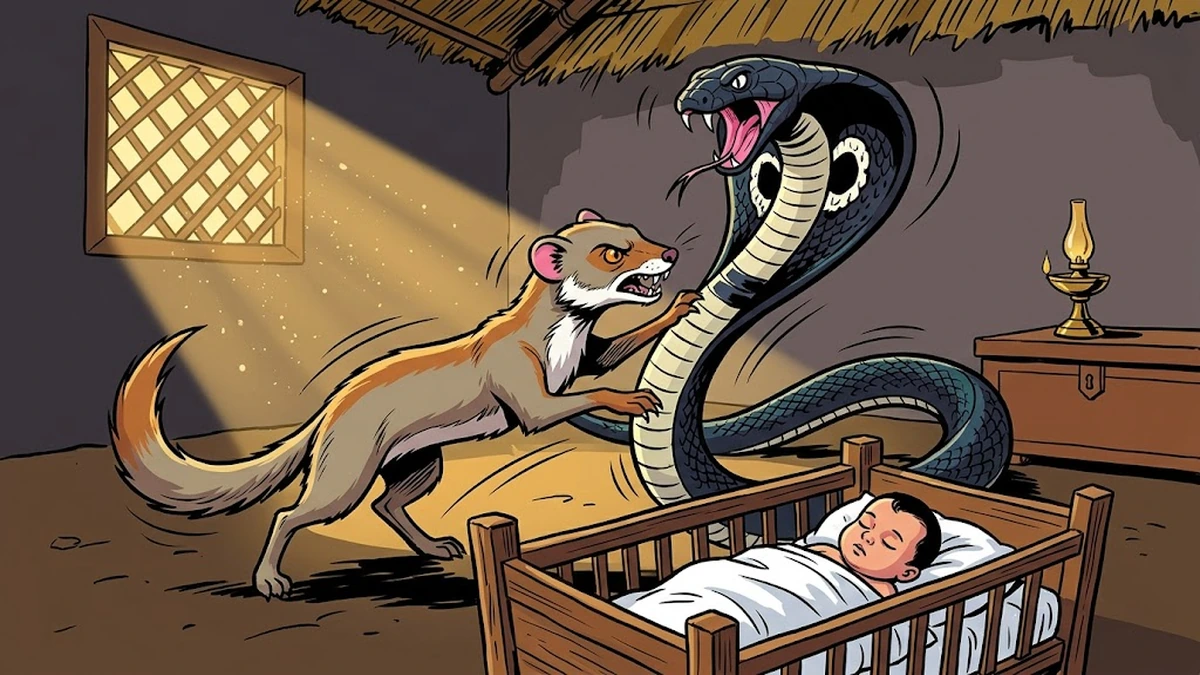
What happened in the empty house is told by the Pañcatantra in twelve unhurried Sanskrit lines, and the description has not been improved on in two thousand years. A great black serpent, full-grown, with a hood marked by the white spectacles of nāga-iconography, came in by the back wall where the wood had cracked in the heat. It tasted the air with a flicked black tongue. It found the cradle.
The mongoose saw it before it saw the mongoose. There is no sound on this earth quite like the small startled hiss of a nakula meeting its hereditary enemy at close range; it is older than language. The little animal launched himself across the room without a thought for his size. The cobra reared. They collided in mid-air over the cradle — flame-orange fur against ink-black scale — and fell together to the earth floor in a knot of striking and twisting that lasted, perhaps, four minutes.
The cobra struck three times. Each time the mongoose, by a swiftness that physiology has still not entirely explained, was elsewhere; and on the fourth pass he had the great snake by the back of the head. He did not let go. They rolled across the threshing-room. The cobra coiled around him in a noose that would have crushed any creature less furred and less furious; the mongoose tightened his bite and shook. The end came suddenly, as such endings do. The serpent went limp. The mongoose dragged him in three pieces to the corner by the door, the way a child arranges trophies, and sat panting beside the broken body with blood on his muzzle and his small paws and the white tuft of his chest. Above him the baby slept on, undisturbed by any of it; serpents kill in silence and nakulas kill in silence and only fools ever kill loudly.
Then the mongoose heard the sound of a brass pot at the threshold and a woman’s sandalled foot on the courtyard stone, and he ran out, joyful in the way that small loyal creatures are joyful, to meet her at the door.
IV. The Mistake That Could Not Be Undone
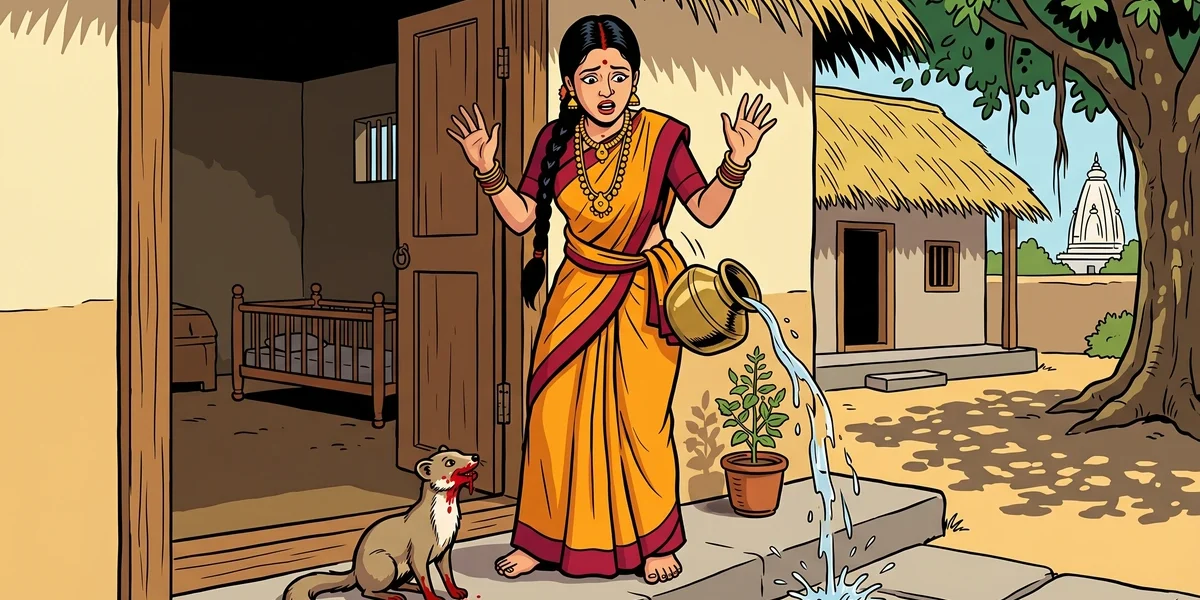
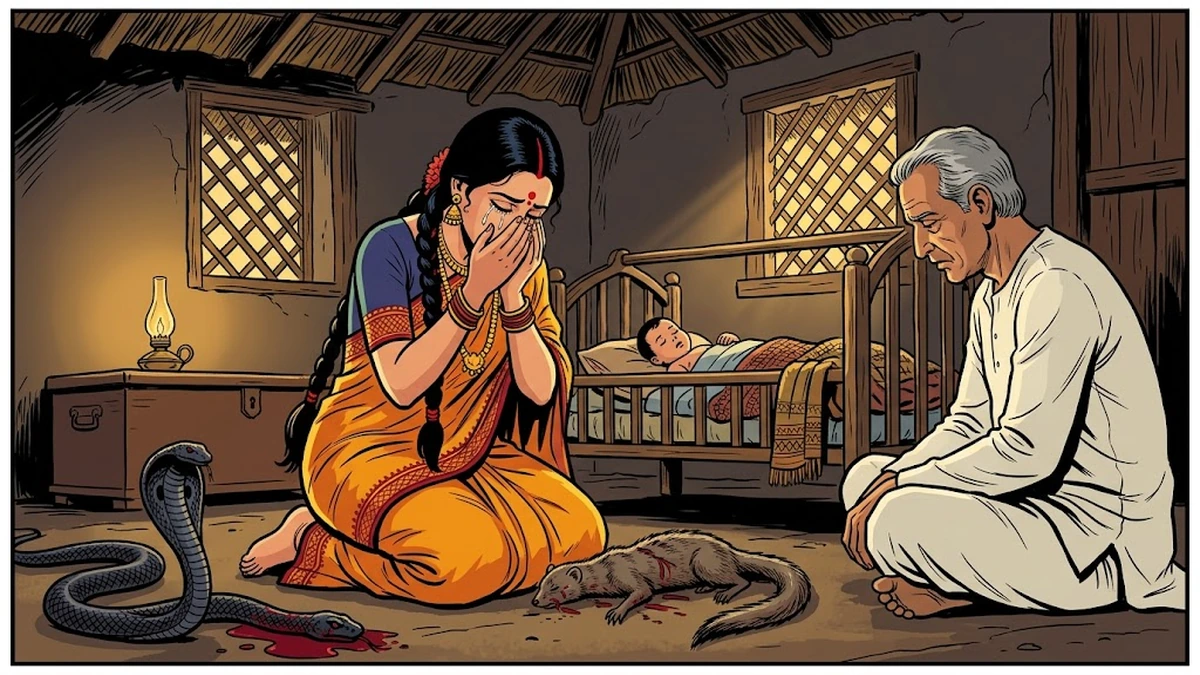
Yājñasenī saw him in the doorway. She saw the bright wet red on his mouth, the red on his small paws, the red darkening the white tuft of his throat; she saw nothing else in the world. The brass pot fell from her hip and broke on the stone with the sound of a deep bell. She did not scream. She did not weep. She walked past the broken pot and the broken water and into the house, and she did not lift her eyes to the cradle because she could not yet bear it; and on the floor she found the polished stone mūsala — the heavy household pestle with which a thousand spice-pastes had been ground — and she came back to the door where the small loyal creature was still standing in the sun with his eyes raised, and she struck him once, and he fell, and she struck him again, although he was already dead.
Then she went into the dark of the house and saw the cradle. The cradle stood whole and the baby slept whole; and across the corner of the threshing-room lay the broken body of a great black cobra in three pieces; and she understood. She understood it all at once, the way the worst understandings come, in a single hot wave like a stove-door opened. The brass pot was broken. The pestle was bloody. The mongoose was dead. The baby was alive. And she had killed, with her own hand, in the heat of one of those four-minute interludes that decide a life, the small grey-and-cinnamon brother of her son, the only one who had stood between the cradle and the snake.
She sat down on the threshing-floor and she wept the kind of weeping for which the Sanskrit poets reserved the word vilāpa. She was still weeping when Devasharmā came home from the temple at dusk; she was still weeping when the village headman came; she was still weeping when they buried the nakula at the foot of the tulasī plant in the courtyard, in a little grave the size of a folded shawl, with a heap of marigolds and one small clay lamp that she would re-light for the rest of her life.
V. Moral — Examine, Then Act
The whole purpose of the Pañcatantra’s fifth book is to teach the reader, by repetition and by accumulating heartbreak, the discipline of parīkṣā — examination, weighing, the deliberate pause before the irrevocable. This story is its bitterest example because the loss is irrecoverable, and because the agent of the loss is not a villain but a loving mother. Folly in the Pañcatantra is not stupidity; it is hurry. The Sanskrit verse that closes the tale in nearly all recensions is one of the shortest and best-known epigrams in classical Indian wisdom literature:
अपरीक्ष्य न कर्तव्यं कर्तव्यं सुपरीक्षितम् ।
पश्चाद्भवति सन्तापो ब्राह्मण्या नकुले यथा ॥“aparīkṣya na kartavyaṁ, kartavyaṁ suparīkṣitam ।
paścād bhavati santāpo brāhmaṇyā nakule yathā ॥”“Do not act without examining; act only after careful examination. Otherwise repentance follows — as it did for the Brahmin’s wife in the matter of the mongoose.”
The Sanskrit verb is precise: aparīkṣya = “without testing,” from the root parī-ẗkṣ, “to look around, to investigate.” The word that ends the verse, santāpa, is not ordinary regret. It means a heat that does not cool, a burning that lasts. It is the precise emotional vocabulary the wife is left with when the brass pot is broken on her doorstep. The Hitopadeśa repeats the verse almost word-for-word, and the Pañcatantra’s commentator Pūrṇabhadra (1199 CE, Jain recension) glosses it: buddhimān śrotavyam, drṣṭavyam, parīkṣya kartavyam — “the wise person should listen, look, examine, and only then act.”
The deeper Indian teaching nested inside the surface tale is the doctrine that kārya — the action one is about to take — lives, until the moment of execution, in the realm of vivekā, discrimination. Once executed it passes into the realm of karma, fact, and karma cannot be unmade by any later sorrow. The wife’s tragedy is not that she made a mistake; mistakes are forgiven. Her tragedy is that she made an irreversible mistake in a reversible situation, by collapsing four minutes of inquiry into one second of fear. Santāpa, the burning, is the long aftermath of a short hurry.
VI. Why This Tale Has Lasted
The story of the Brahmin’s wife and her mongoose has lasted for two thousand years, and travelled to Wales and to Beddgelert and to the medieval shrine of Saint Guinefort at Sandrans in Dombes — where peasants were still venerating a greyhound’s grave in 1879 — for one reason. It does not warn against an ordinary sin. It warns against the most ordinary good impulse, the rush of a parent to protect a child, miscalibrated by half a second of fear into the wrong target. Almost no other folk-tale in the world has dared to identify rash love as the sharpest weapon in the household.
The Indian original survived in two great surface forms: the cradle-and-cobra of the Pañcatantra, and the bedside-and-wolf of medieval Europe. In Wales, Llywelyn the Great kills his hound Gelert at Beddgelert (the modern shrine was, the historians remind us, a tourist invention of the inn-keeper David Pritchard around 1793, popularised by William Robert Spencer’s 1800 ballad “Beth-Gelert; or, The Grave of the Greyhound”). In thirteenth-century France, Stephen of Bourbon records peasant women bringing sick infants to the grave of Saint Guinefort, the holy greyhound rashly killed by his master. In the Seven Sages of Rome, the dog is called Canis; in the Persian Kārīrak ud Damanak, the mongoose is replaced by a weasel; in the Russian variant the animal is a hawk. The instrument of mistaken death is always whatever lies closest to the heroine’s hand: a pestle in India, a sword in Wales, a stick in France, a stone in the Caucasus.
What the story is really teaching, beneath all those local objects, is one of the oldest disciplines in Indian and world ethics: the second look. The Manusmṛti X.63 says satyam brūyāt priyam brūyāt na brūyāt satyam apriyam — speak truth, speak kindness, do not speak truth that is unkind. The Mahābhārata warns at every turn against kopāt prasaktam karma, “action driven by anger.” The Bhagavad-Gītā II.62–63 charts in five short verses the very chain that destroys Yājñasenī: kāmāt krodho’bhijāyate, krodhād bhavati sammohaḥ — from desire (here, to protect) comes anger; from anger, confusion; from confusion, the loss of memory; from loss of memory, the loss of buddhi, judgement; from the loss of judgement, the man perishes. The wife performs all five verses in the time it takes a brass pot to fall from a hip and break on stone.
For the modern reader the tale is not less useful. We live in households whose children sleep beside our phones. We make mongoose-mistakes daily — we read a message, we see a stain of blood, we strike. The shorthand for the discipline that this story exists to teach is the same now as it was in Sanskrit: parīkṣyā. Examine. Look at the cradle before you raise the pestle. Walk to the bed before you draw the sword. Ask the question whose answer might un-break the brass pot. The mongoose lay buried under the tulasī, and the lamp at his grave was lit every evening for the rest of the wife’s life; but no lamp brings back a mongoose, and no santāpa cools without years.
That is why this small Sanskrit story walked from Pratishṭhānapura to Beddgelert. It walked because every household, in every century, has needed to be taught the same thing in the same way: look first.
Canonical attribution · Sanskrit Pañcatantra, Book V Aparīkṣita-kāraka, attributed to Viṣṇu Śarman, c. 200 BCE–300 CE; reconstructed Sanskrit text Franklin Edgerton, The Pañchatantra Reconstructed, American Oriental Society, 1924; Pūrṇabhadra Jain recension, 1199 CE; Hitopadeśa of Nārāyaṇa Paṇḍita, c. 12th c.; Kathāsaritsāgara of Somadeva, 11th c.; Pahlavi Kārīrak ud Damanak through Burzoy, c. 570 CE; Arabic Kalīla wa Dimna, Ibn al-Muqaffa‘, c. 750 CE; Latin Directorium humanae vitae, John of Capua, c. 1270; medieval Welsh Gelert legend at Beddgelert, attached to Llywelyn the Great by William Robert Spencer’s ballad “Beth-Gelert,” 1800; Saint Guinefort cult recorded by Stephen of Bourbon, c. 1250; Aarne–Thompson–Uther type ATU 178A “Llewelyn and his Dog”; Stith Thompson motifs B331.2, K2151, N342.3, J2161; Murray B. Emeneau (1940). Closing Sanskrit verse: aparīkṣya na kartavyaṁ kartavyaṁ suparīkṣitam — paścād bhavati santāpo brāhmaṇyā nakule yathā (Pañcatantra V, traditional). Reading time: ~12 min.
Frequently Asked Questions
Where does “The Brahmin’s Wife and the Mongoose” first appear in writing?
Its earliest secure attestation is in the lost Sanskrit Pañcatantra of Viṣṇu Śarman (c. 200 BCE–300 CE), Book V Aparīkṣita-kāraka (“Action Without Examination”), reconstructed in modern critical form by Franklin Edgerton in The Pañchatantra Reconstructed (American Oriental Society, 1924). It also occurs in the Hitopadeśa of Nārāyaṇa Paṇḍita and Somadeva’s Kathāsaritsāgara. The Sanskrit philologist Murray B. Emeneau called its westward migration “one of the best authenticated cases of such diffusions of folk-tales.”
Is “Brahma’s Wife” in the title a reference to the creator god Brahmā?
No. Brahma in this tale’s English-language title is a colonial-period folk-spelling of Brāhmaṇa (or Brāhmaṇ), a member of the priestly caste — a household priest with a wife and child — not Brahmā, the four-faced creator god of Hindu cosmology, who has no children in any standard recension. The body of the tale itself uses “Brahmin and his wife” correctly. The mis-spelling crept in through nineteenth-century Anglo-Indian print and stuck to several published versions.
What is the international story-type, and why is it called “Llewelyn and his Dog”?
The international classification is ATU 178A “Llewelyn and his Dog,” a sub-type of ATU 178 “The Faithful Animal Rashly Killed.” The English label comes from the medieval Welsh legend in which Llywelyn the Great kills his hound Gelert at Beddgelert (“Gelert’s Grave”) before realising the dog has saved his infant son from a wolf. Thompson’s motif B331.2 bears the same name. Although the Welsh setting is the most famous in Europe, folklorists agree the tale travelled westward from the Sanskrit Pañcatantra through Pahlavi, Arabic Kalīla wa Dimna, Hebrew, and John of Capua’s Latin Directorium before reaching Wales, where the inn-keeper David Pritchard popularised the local Beddgelert legend in the 1790s.
What is the Sanskrit moral of the tale, and what does it mean?
The closing verse in nearly all recensions is aparīkṣya na kartavyaṁ, kartavyaṁ suparīkṣitam | paścād bhavati santāpo brāhmaṇyā nakule yathā || — “Do not act without examining; act only after careful examination. Otherwise repentance follows — as it did for the Brahmin’s wife in the matter of the mongoose.” The key Sanskrit terms are aparīkṣya (“without examining,” from the root parī-ẗkṣ, “to test, look around”) and santāpa (“a burning that does not cool”). The same teaching appears, in fuller form, in Bhagavad-Gītā II.62–63 — the chain that runs from desire to anger to confusion to the loss of judgement.
What modern lesson can a household actually take from this story?
The discipline the tale teaches has a simple modern shorthand: look first. Before any irreversible action — an angry message, a hasty firing, a parental punishment, a public accusation — walk to the cradle. Verify the situation before swinging the pestle. The wife’s loss is not an act of cruelty; it is a loving impulse misfired by half a second of fear, and the only known antidote in classical Indian ethics is parīkṣā — a deliberate pause for examination. Mongoose-mistakes are made every day in every century; the only difference between disasters and stories is whether someone walked to the cradle before raising the stone.
You May Also Like
 Indian Folk Tales
Ages 6-8
Indian Folk Tales
Ages 6-8
Vikram and the Vampire: The King’s Ultimate Test
Vikram and the Vampire: The King's Ultimate Test: The Night of Impossible Riddles In the ancient kingdom of Ujjain, there ruled a king named Vikramaditya
 Indian Folk Tales
Ages 12+ / YA
Indian Folk Tales
Ages 12+ / YA
Chandralekha and the Eight Robbers | Indian Wit Tale (12+)
Chandralekha, a learned dancing-girl’s daughter, refuses a false bargain and outwits danger with intelligence — classic Indian wit tale.
 Indian Folk Tales
Ages 3-5
Indian Folk Tales
Ages 3-5
The Story of a Kind Hearted Little Girl Named Tara
The Story of a Kind Hearted Little Girl Named Tara: Once there lived a little girl named Tara with her mother in a small hut near the forest. Tara was